On this page
~ぬ makes a formal or literary negative, so 行かぬ means “does not go.” ~ねばならない makes an obligation, so 行かねばならない means “must go.” The shared n sound hides opposite outcomes: the first action does not happen, while the second action is required.
This lesson covers inventory items g-89eb58c1a459, ~ねばならない, and g-8c6b97696884, ~ぬ. JLPT Sensei teaches ~ねばならない and ~ぬ at N2, as does Bunpro. Those are study placements: the JLPT does not publish an exhaustive grammar syllabus.
One ending denies; the other requires
Start by identifying where the construction ends.
| Form | Job | Example | Meaning |
|---|---|---|---|
| ~ぬ | direct negative | 今日は行かぬ | I will not go today |
| ~ねばならない | obligation | 今日は行かねばならない | I must go today |
| ~ねばならぬ | more literary obligation | 今日は行かねばならぬ | I must go today |
In 行かぬ, ぬ closes the negative predicate. In 行かねばならない, ねば is only the first half: “if [I] do not go.” The following ならない, “it will not do,” turns that condition into a requirement. Kotobank's dictionary entry for ねばならぬ traces the same negative-condition logic and treats ねばならぬ as equivalent to ねばならない.
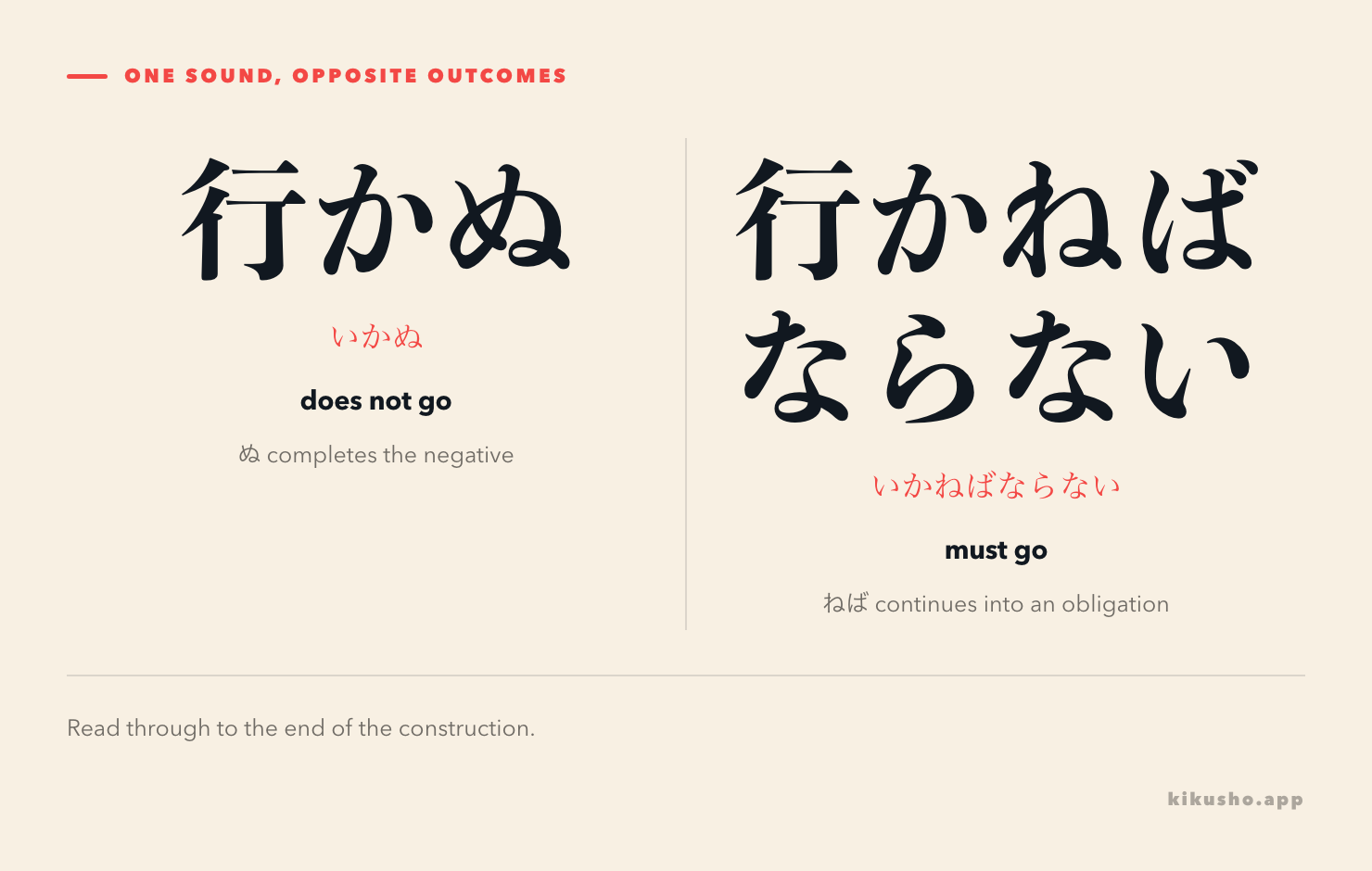
The quickest reading test is structural. If the sentence continues from ねば into ならない, ならぬ, or another negative judgement, expect obligation. If ぬ itself completes the predicate or modifies a noun, read a direct negative.
Build both forms from the plain negative
Use the verb's ない-form as the dependable starting point. For ~ぬ, replace final ない with ぬ. For ~ねばならない, replace it with ねばならない.
| Dictionary form | Plain negative | ~ぬ | ~ねばならない |
|---|---|---|---|
| 書く(かく) | 書かない | 書かぬ | 書かねばならない |
| 読む(よむ) | 読まない | 読まぬ | 読まねばならない |
| 食べる(たべる) | 食べない | 食べぬ | 食べねばならない |
| する | しない | せぬ | せねばならない |
| 来る(くる) | 来ない(こない) | 来ぬ(こぬ) | 来ねばならない(こねばならない) |
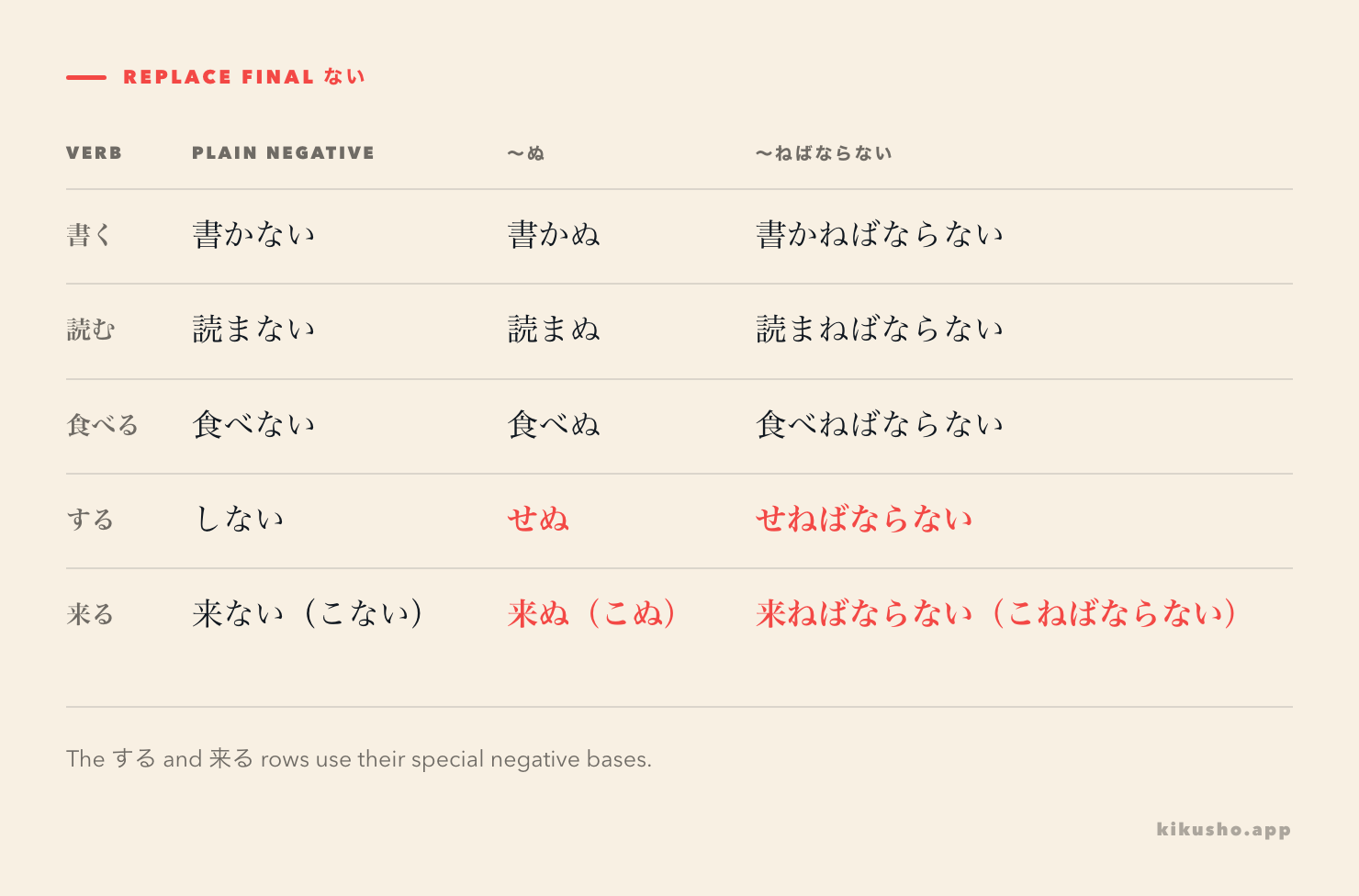
The two irregular verbs deserve deliberate practice. する uses せ-, giving 確認せぬ and 確認せねばならない. 来る uses the reading こ-, giving 来ぬ(こぬ) and 来ねばならない(こねばならない). Forms such as ×しぬ and ×きねばならない do not follow the required negative base.
This formation is related to older negative ず. Bunpro's ~ねばならない explanation describes ねば as the conditional form of that negative auxiliary, and its ~ぬ entry connects ぬ to the same classical system. You do not need historical conjugation tables to use the modern patterns: the plain-negative replacement rule produces the forms reliably.
~ぬ marks a negative in a literary register
In modern standard Japanese, ~ない is the ordinary conversational negative. ~ぬ remains useful because it appears in literature, formal prose, emphatic statements and established combinations.
彼は何も語らぬ。
かれは なにも かたらぬ。
He says nothing.
思わぬ結果になった。
おもわぬ けっかに なった。
It produced an unexpected result.
それは私の知らぬ話だ。
それは わたしの しらぬ はなしだ。
That is a story I do not know.
The second and third examples show ~ぬ directly before a noun. 思わぬ結果 corresponds to 思わない結果, though the fixed 思わぬ phrasing is much more idiomatic for “unexpected.” 知らぬ話 has the same grammar as the conversational 知らない話, but carries a more literary voice.
Kotobank's entry for the negative auxiliary ぬ notes that modern standard Japanese ordinarily uses ない, while ぬ survives especially in literary and fixed usage. A National Institute for Japanese Language and Linguistics study of negative forms likewise distinguishes the less conversational distribution of ぬ and records its frequent noun-modifying use.
Do not treat every written ぬ as this ending. In 死ぬ, the syllable belongs to the dictionary form of the verb “to die.” Classical Japanese also has a separate perfective ぬ; that historical pattern lies outside this modern N2 contrast. Here the diagnostic is simple: the negative ぬ replaces ない in a form such as 書かない → 書かぬ.
~ねばならない presents a duty
~ねばならない states that an action is necessary. It often suits formal writing, a serious personal resolution, a policy argument or a statement of public responsibility.
明日までに報告書を提出せねばならない。
あしたまでに ほうこくしょを ていしゅつせねばならない。
We must submit the report by tomorrow.
同じ失敗を繰り返さぬよう、原因を調べねばならない。
おなじ しっぱいを くりかえさぬよう、げんいんを しらべねばならない。
We must investigate the cause so that we do not repeat the same mistake.
The second sentence contains both target forms. 繰り返さぬ directly negates “repeat” inside よう, while 調べねばならない requires the investigation. Their different jobs remain visible even in the same sentence.
The more neutral full alternative is ~なければならない: 提出しなければならない. Ordinary conversation often chooses ~ないと or ~なきゃ instead. The obligation comparison derives those spoken routes from the negative verb form. ~ねばならない is grammatical in speech, but it can sound weighty when the situation is a routine chat.
Replacing final ならない with ならぬ creates ~ねばならぬ. The obligation stays the same, while the whole expression becomes stiffer or more literary. Goo's entry for ならぬ treats it as the literary counterpart of ならない and includes せねばならぬ among its examples.
Choose by outcome and setting
Ask two questions in order:
- Does the sentence say the action does not happen, or that the action must happen?
- Does the setting support a marked written or serious register?
For a direct negative in everyday conversation, use ~ない: 今日は行かない. For the same negative in literary narration or a fixed expression, ~ぬ may fit: 今日は行かぬ. For neutral obligation, use ~なければならない; for a weightier obligation, ~ねばならない fits.
| Intended message | Natural choice |
|---|---|
| “I am not going” in a chat | 行かない |
| “He would never go” in literary narration | 彼は行かぬ |
| “I have to go” in a normal conversation | 行かないと/行かなきゃ |
| “We must go” in a serious written statement | 行かねばならない |
This is a register tendency, not a ban. A speaker may deliberately choose 行かぬ for humour, characterization or force, and 行かねばならない can be spoken in a solemn moment. The wording signals a stance as well as grammar.
In Kikusho, save the clause that reveals why the marked register was chosen. A bare 行かぬ card loses that clue. 責任者として、事実を確認せねばならない retains the speaker's formal duty, while 思わぬ結果になった retains a common noun-modifying expression.
Practice: separate the negative from the obligation
Work through Questions 1–7 in sequence. The explanations stay hidden until the disclosure after Question 7 is opened.
Question 1 — grammar choice. Complete the formal statement: 明日までに計画を__。 “We must revise the plan by tomorrow.”
- ア. 見直さぬ
- イ. 見直さねばならない
- ウ. 見直してはならない
- エ. 見直さなくてもいい
Question 2 — grammar choice. Which form correctly means “must confirm” using 確認する?
- ア. 確認しねばならない
- イ. 確認すねばならない
- ウ. 確認せねばならない
- エ. 確認せぬならない
Question 3 — meaning contrast. Match each sentence to its meaning.
A. 今日は会社に行かぬ。
B. 今日は会社に行かねばならない。
- I must go to the office today.
- I will not go to the office today.
Question 4 — register choice. You casually tell a close friend, “I have to leave now.” Which option best matches the setting?
- ア. もう行かぬ。
- イ. もう行かねばならぬ。
- ウ. もう行かなきゃ。
- エ. もう行ってはならない。
Question 5 — text grammar. Complete the noun phrase meaning “a person I do not know”: 私の__人.
- ア. 知らぬ
- イ. 知らねばならない
- ウ. 知るぬ
- エ. 知らずならない
Question 6 — sentence composition. Make two formal forms from 食べない: first “does not eat,” then “must eat.”
Question 7 — connected text. Choose the sentence that best completes this formal policy statement: 事故を二度と起こさぬため、__。
- ア. 手順を見直さぬ
- イ. 手順を見直してもいい
- ウ. 手順を見直せぬ
- エ. 手順を見直さねばならない
Answers and explanations
Answer 1. イ, 見直さねばならない. 見直す → 見直さない → 見直さねばならない expresses the required revision. ア says the revision does not happen; ウ forbids it; エ makes it optional.
Answer 2. ウ, 確認せねばならない. The する exception uses せ-: 確認する → 確認しない → 確認せねばならない. The other choices mix the dictionary form, ordinary negative stem and obligation ending incorrectly.
Answer 3. A–2; B–1. 行かぬ is a completed formal negative, “will not go.” 行かねばならない continues through the negative condition into a judgement of necessity, “must go.”
Answer 4. ウ, もう行かなきゃ. The short なきゃ route is natural between friends. イ communicates obligation but sounds deliberately weighty; ア means “I will not go,” and エ means going is forbidden.
Answer 5. ア, 知らぬ. 知らぬ人 is a literary or formal equivalent of 知らない人. ぬ replaces ない and can modify the following noun directly.
Answer 6. 食べぬ/食べねばならない. Remove final ない from 食べない. Add ぬ for the direct negative and ねばならない for the obligation.
Answer 7. エ, 手順を見直さねばならない. The purpose clause says “so that we do not cause another accident,” and the policy then requires reviewing the procedure. ア would merely deny that review; イ makes it optional; ウ says it cannot be reviewed.
Where the N2 label becomes uncertain
JLPT Sensei and Bunpro place both constructions at N2, matching the two assigned inventory rows. The modern forms also rest on older grammar and can appear in material introduced at different stages, especially fixed ~ぬ expressions. Treat N2 as a practical study placement, not an official promise about a particular test item.
OpenAI Codex checked this lesson's negative bases, irregular verbs, readings, translations and seven answer keys against the listed sources. The reviewer was an AI agent; the page does not claim a human language review.
Common questions
What is the difference between ~ぬ and ~ねばならない?
~ぬ is a formal or literary negative: 行かぬ means “does not go.” ~ねばならない expresses obligation: 行かねばならない means “must go.” The ねば clause means “if one does not,” and ならない supplies “it will not do.”
How do する and 来る change before ~ぬ and ~ねばならない?
する becomes せぬ and せねばならない. 来る becomes 来ぬ and 来ねばならない, with 来 read こ in all four forms: こぬ and こねばならない.
Are ~ぬ and ~ねばならない used in modern Japanese?
Yes, but their register is marked. ~ぬ appears in literary narration, formal prose and fixed phrases such as 思わぬ結果. ~ねばならない sounds serious or formal; conversation usually prefers なければならない, ないと or なきゃ.
Are ~ぬ and ~ねばならない officially assigned to JLPT N2?
JLPT Sensei and Bunpro teach both at N2, matching this curriculum. The JLPT does not publish an exhaustive grammar list, so N2 is a study estimate rather than an official item-by-item assignment.