On this page
に応えて says that an action responds to a request, expectation or support; に向かって says that an action points, moves or is directed toward a target. The first noun supplies a reason to respond, while the second supplies a direction.
One audience can make the contrast visible:
観客の声援に応えて、選手は手を振った。
かんきゃくの せいえんに こたえて、せんしゅは てを ふった。
Responding to the crowd's cheers, the athlete waved.
選手は観客に向かって手を振った。
せんしゅは かんきゃくに むかって てを ふった。
The athlete waved toward the crowd.
The same wave can satisfy both descriptions. 声援 explains why the athlete responds; 観客 identifies where the wave is directed.
Ask whether the noun is a cue or a target
Use one test before choosing the ending:
| Question | Choose | Relationship |
|---|---|---|
| Did N call for a fitting response? | N + に応えて | request, hope, expectation, demand or support → response |
| Is the action directed toward N? | N + に向かって | actor or action → destination, audience, object or direction |
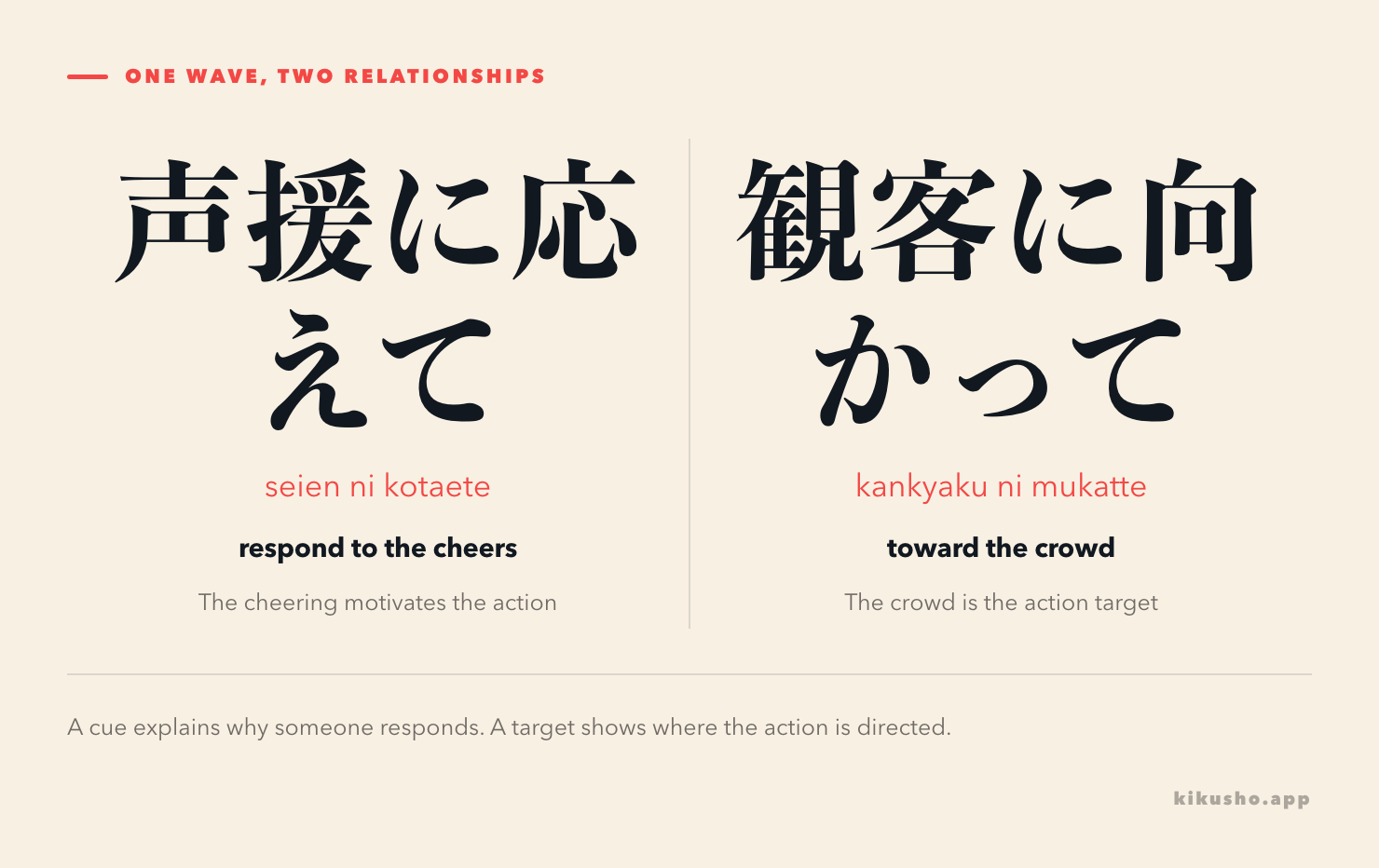
The English word “to” can hide the difference. “Respond to the crowd's support” and “wave to the crowd” do not give the noun the same role in Japanese.
に応えて follows a call for a response
に応えて(にこたえて, ni kotaete) attaches to a noun such as 期待 (expectation), 要望 (request), 希望 (wish), 要求 (demand), 声援 (cheering) or リクエスト. The following action attempts to satisfy, honour or respond to it.
利用者の要望に応えて、開館時間を延長した。
りようしゃの ようぼうに こたえて、かいかんじかんを えんちょうした。
In response to users' requests, the opening hours were extended.
家族の期待に応えて、彼女は最後まで走り切った。
かぞくの きたいに こたえて、かのじょは さいごまで はしりきった。
Meeting her family's expectations, she finished the race.
The response need not be a spoken reply. Extending hours and finishing a race are actions that answer the pressure or hope expressed by the first noun.
Bunpro's N2 reference confirms N + に応えて and notes that the noun often names a request, wish or expectation. 毎日のんびり日本語教師 independently places the form at N2 and teaches the same response relationship.
Do not confuse the kanji:
- 質問に答える: answer a question by supplying an answer.
- 期待に応える: respond to or live up to an expectation.
In kana, both verbs are こたえる. The surrounding noun tells you which relation and kanji are intended.
に向かって gives an action a direction
に向かって(にむかって, ni mukatte) also attaches to a noun, but that noun is the destination, orientation or target of the following action.
駅に向かって歩いている。
えきに むかって あるいている。
I am walking toward the station.
先生に向かって失礼なことを言ってはいけない。
せんせいに むかって しつれいな ことを いってはいけない。
You must not say something rude to the teacher.
カメラに向かって笑ってください。
カメラに むかって わらってください。
Please smile toward the camera.
The target can be a place, person or object. It can also be abstract:
新しい目標に向かって、一歩ずつ進んでいる。
あたらしい もくひょうに むかって、いっぽずつ すすんでいる。
We are moving step by step toward a new goal.
Bunpro's に向かって reference describes physical facing and movement toward a stationary target, as well as abstract destinations. JLPT Sensei likewise places it at N2 and includes speech and gestures aimed toward people or cameras.
Both attach to nouns, but their noun families differ
The shared surface shape makes the patterns look interchangeable. Their natural collocations expose the difference.
| に応えて: cue for a response | に向かって: target or direction |
|---|---|
| 期待に応えて | 駅に向かって |
| 要望に応えて | 観客に向かって |
| 希望に応えて | カメラに向かって |
| 声援に応えて | 未来に向かって |
| リクエストに応えて | 目標に向かって |
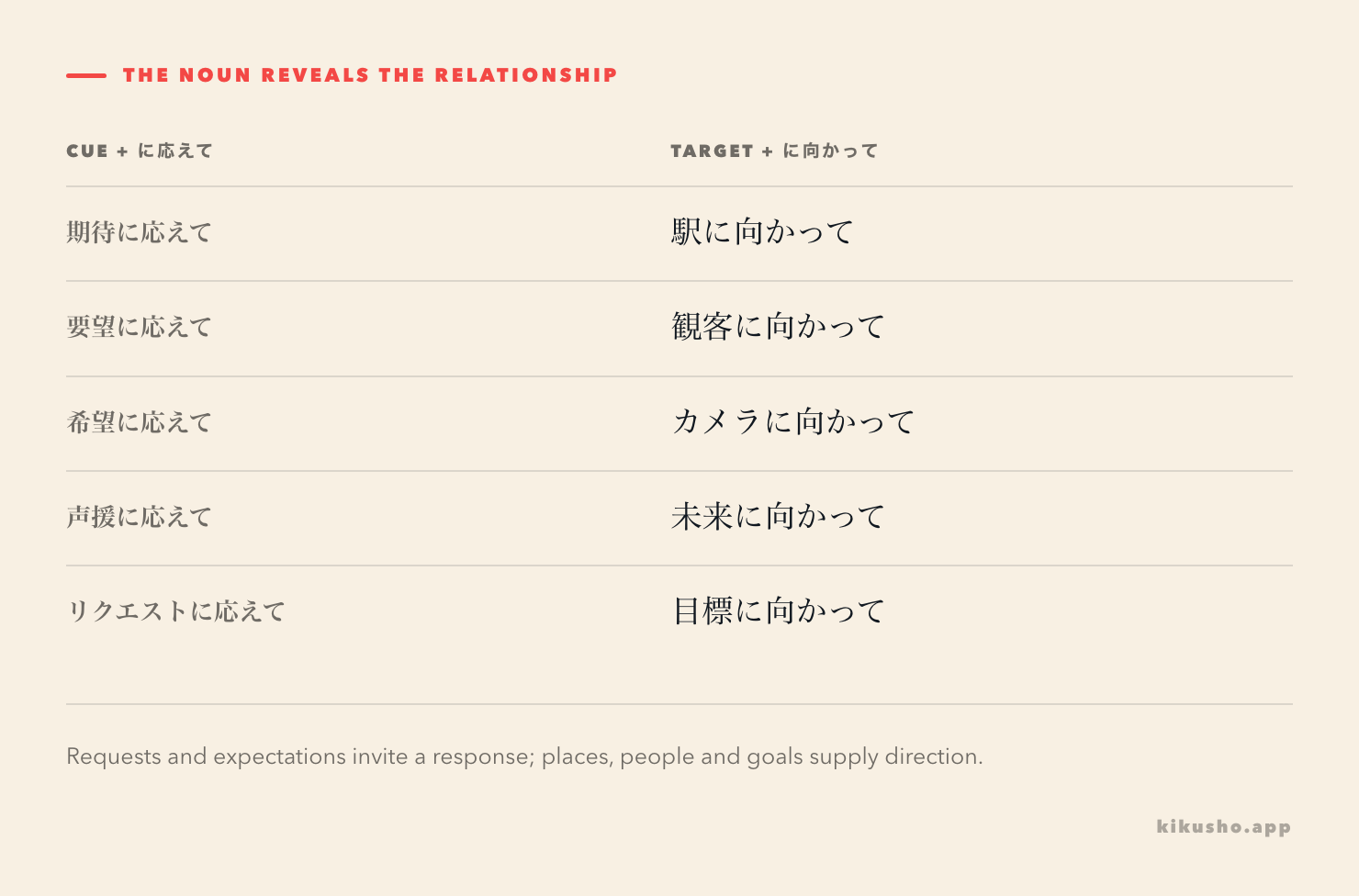
観客に応えて is incomplete or unnatural when the intended cue is the audience's cheering. Name that cue: 観客の声援に応えて. Conversely, 声援に向かって手を振る treats the cheering itself as a physical target and misses the intended audience.
The form changes when it modifies a noun
Clause-linking に応えて is followed by an action:
要望に応えて、案内を追加した。
In response to requests, we added guidance.
Before a noun, use に応える + noun for a general or prospective response, or に応えた + noun for a response presented as realized:
- 期待に応える演技: a performance that meets expectations.
- 期待に応えた演技: a performance that met expectations.
For direction, Nに向かって + action keeps the て-form before the clause:
出口に向かって走った。
They ran toward the exit.
When 向かう directly modifies a noun, it behaves as an ordinary verb: 出口に向かう人 means “a person heading toward the exit.” The N2 pattern matters because に向かって can add direction to another action such as speaking, waving, sitting or throwing.
に応じて and に向けて are close but separate
に応えて reacts to a request or expectation. に応じて adapts an action or outcome to a condition:
利用者の要望に応えて、機能を追加した。
We added a feature in response to user requests.
利用者の人数に応じて、席を増やす。
We increase the seats according to the number of users.
The first noun exerts a call for action. The second supplies a scale that determines the adjustment. The に応じて comparison lesson develops that condition-matching use.
に向かって gives an action a direction or facing. に向けて often highlights deliberate orientation, preparation or design toward a goal:
- 会場に向かって歩く: walk toward the venue.
- 大会に向けて練習する: practise in preparation for the tournament.
The two overlap around goals, but do not reduce them to synonyms. A person can physically head toward a venue with 向かって; a team deliberately organizes preparation for an event with 向けて. The 向け and 向き lesson separates goal-oriented に向けて from audience and suitability suffixes.
Level placement and review cues
JLPT Sensei and Bunpro place both assigned forms at N2; 毎日のんびり日本語教師 and N1et independently agree on N2 for に応えて. Some resources teach に向かって outside a numbered JLPT list or alongside に向けて, which reflects syllabus organization rather than a change in its direction meaning. The JLPT publishes no exhaustive grammar list, so the N2 label remains an editorial study estimate.
For a Kikusho card, preserve the noun on both sides of the contrast. 声援に応えて without the athlete's response hides what was done; 観客に向かって without the wave hides what was directed. A complete pair trains the relationship instead of memorizing two English glosses.
Practice questions
Answer all six questions before revealing the combined explanations.
Question 1
The athlete bows because the crowd has encouraged her. Choose the best phrase.
選手は観客の声援( )、深く頭を下げた。
- A. に向かって
- B. に応えて
- C. に応じて
- D. に比べて
Question 2
The photographer asks the subject to face the lens. Complete the sentence.
カメラ( )、少し右を向いてください。
- A. に応えて
- B. に伴って
- C. に向かって
- D. に限って
Question 3: response sentence
Arrange the four pieces into a sentence and identify the piece at ★.
市民の __ __ ★ __。
- A. 公園を整備した
- B. 要望
- C. に応えて
- D. 市は
Question 4
Select the line that assigns 答える and 応える to their natural noun partners.
- A. 質問に応えて、答えを紙に書いた。
- B. 期待に答えて、優勝した。
- C. 質問に答え、期待にも応えた。
- D. 期待に向かって、質問を答えた。
Question 5
Choose the sentence that means the number of seats is adjusted according to attendance, rather than created in response to a request.
- A. 要望に応えて、席を追加した。
- B. 参加者の人数に応じて、席を用意する。
- C. 参加者に向かって、席を用意する。
- D. 声援に応えて、席を数える。
Question 6
Fill both gaps once each with に応えて and に向かって.
歌手はファンのリクエスト( 甲 )、客席( 乙 )手を振った。
Fix your six responses now; the solutions remain hidden until the block below.
Answers and explanations
Track the noun's role: a cue invites a fitting response, while a target supplies direction.
Answer 1: B. The cheering motivates the bow, so 声援に応えて means “in response to the cheers.” A would direct an action toward the cheering itself. C adapts something according to a condition, and D introduces a comparison standard.
Answer 2: C. The camera is the direction in which the subject should face: カメラに向かって. The camera does not express a request or expectation, accompany a change, or mark an exceptional case.
Answer 3: C at ★. The order is B → C → D → A: 市民の要望に応えて、市は公園を整備した. Citizens' requests call for the city's response, and the park improvement supplies it.
Answer 4: C. 質問に答える supplies an answer to a question, while 期待に応える meets an expectation through action or results. A and B reverse the normal kanji collocations. D combines an unsuitable direction phrase with the wrong transitivity for 答える.
Answer 5: B. 人数に応じて makes attendance the condition that determines the number of seats. A is a valid response to a request, but it expresses the different relationship the question excludes. C and D do not connect the seat allocation to attendance.
Answer 6: 甲 is に応えて and 乙 is に向かって. The fans' request motivates the response; the seating area is the direction of the wave: ファンのリクエストに応えて、客席に向かって手を振った.
Common questions
What is the difference between に応えて and に向かって?
に応えて marks a request, expectation, wish or support that motivates a fitting response. に向かって marks the destination, direction or target toward which movement, speech, attention or another action is directed.
What comes before に応えて and に向かって?
Both patterns attach to a noun. The noun before に応えて is usually an expectation, request, demand, wish or encouragement; the noun before に向かって is a place, person, object, audience or abstract direction.
Is に応えて the same as answering a question?
Usually no. 質問に答える uses 答える for supplying an answer. 応える in 期待に応える means responding to or meeting an expectation through an action or result.