On this page
N + にしたら/にすれば asks you to stand where N stands before judging the situation. The following clause usually describes what that person, group or organization would feel, think or find difficult, often as an inference rather than a quotation.
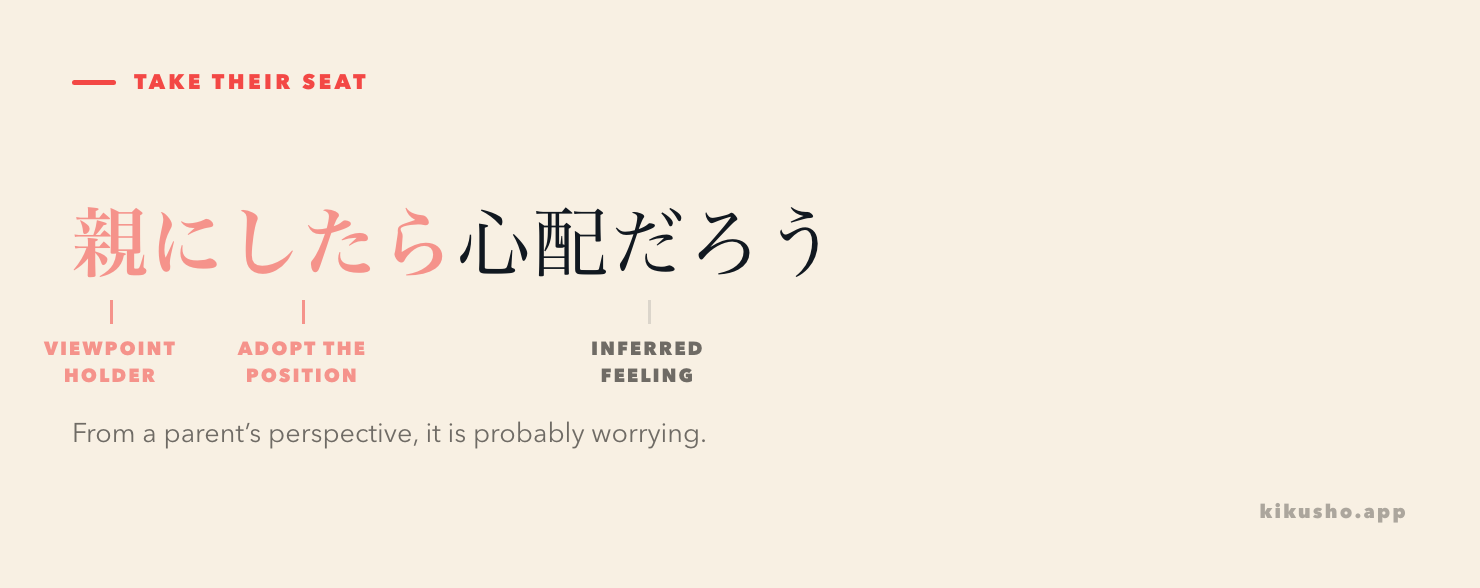
親にしたら、子どもの一人暮らしは心配だろう。
おやにしたら、こどもの ひとりぐらしは しんぱいだろう。
From a parent's perspective, a child living alone is probably worrying.
The speaker is not stating a general definition of parents. They are rebuilding this situation from the parent's side and marking the conclusion with だろう as an inference.
Put the viewpoint holder before the comma
The structure is compact:
| Viewpoint holder | Marker | Inferred experience |
|---|---|---|
| 親 | にしたら | 心配だろう |
| 会社 | にすれば | 十分説明したつもりだ |
| 子ども | にしてみれば | 急な転校はつらい |
| 受け取る側 | にしてみたら | 迷惑かもしれない |
The noun is normally animate or capable of having a position: a person, family, team, company, customer, government, or a side in a transaction. Expressions such as 受け取る側 and 店の立場 work because they name a participant whose circumstances can be imagined.
会社にすれば、必要な情報はすべて公開したつもりなのだろう。
かいしゃにすれば、ひつような じょうほうは すべて こうかいした つもりなのだろう。
From the company's standpoint, it probably believes it disclosed all the necessary information.
An organization cannot literally speak in one voice here. The grammar treats it as a decision-making party and reconstructs its likely view.
The four forms share one viewpoint move
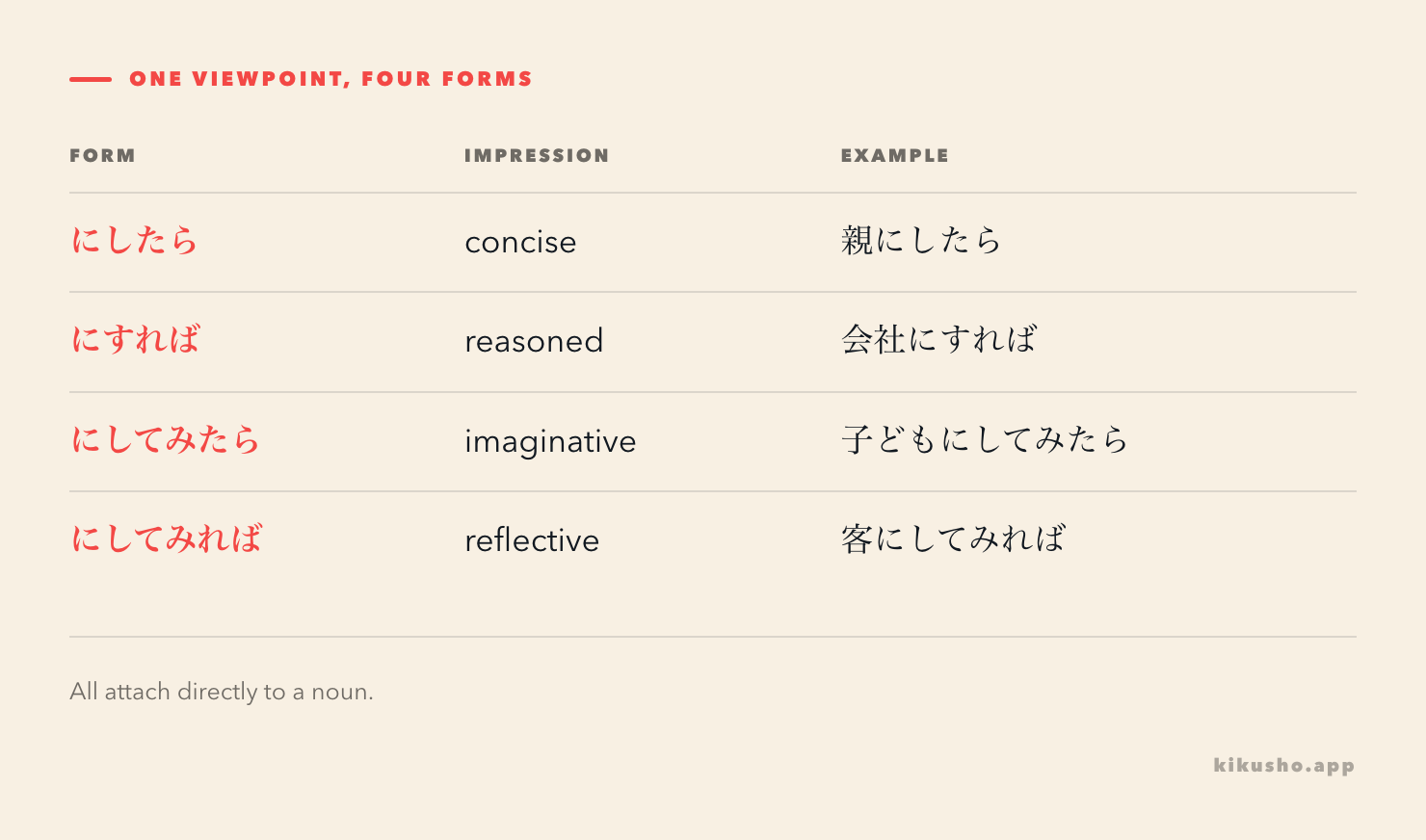
The main variants are にしたら, にすれば, にしてみたら and にしてみれば. All attach directly to a noun.
| Form | Core meaning | Nuance to notice |
|---|---|---|
| N にしたら | from N's position | concise, often conversational or explanatory |
| N にすれば | from N's position | concise, suited to reasoned comparison |
| N にしてみたら | if you put yourself in N's position | the imaginative shift is more visible |
| N にしてみれば | if you put yourself in N's position | reflective, common when explaining hidden feelings |
引っ越す子どもにしてみれば、友達と別れるのが一番つらい。
ひっこす こどもにしてみれば、ともだちと わかれるのが いちばん つらい。
From the moving child's point of view, leaving friends is the hardest part.
The added みる is not a request to try an action. It makes the speaker's mental experiment easier to hear: “put yourself there and look.” In many contexts the four forms can replace one another without changing the central proposition.
日本語NET lists all four as noun-attaching N2 forms meaning to think from another party's position. HICROSS independently describes them as near-synonyms used especially for circumstances and feelings that outsiders may not see.
The next clause usually sounds inferred
This pattern often appears when the viewpoint holder is not directly stating the conclusion. Japanese therefore pairs it naturally with だろう, のだろう, かもしれない, はずだ, or a description of an understandable feeling.
初めて日本で働く人にしたら、この手続きは複雑に感じられるかもしれない。
はじめて にほんで はたらく ひとにしたら、この てつづきは ふくざつに かんじられるかもしれない。
For someone working in Japan for the first time, this procedure may feel complicated.
店側にすれば、予約の確認は当然必要なことなのだろう。
みせがわにすれば、よやくの かくにんは とうぜん ひつような ことなのだろう。
From the shop's side, confirming the reservation is probably an obvious necessity.
The inference can be sympathetic, critical or neutral. The construction itself only chooses the seat from which the situation is viewed. It does not guarantee that the speaker agrees with that view.
部長にすれば厳しく指導しているつもりだろうが、部下は責められていると感じている。
ぶちょうにすれば きびしく しどうしている つもりだろうが、ぶかは せめられていると かんじている。
From the manager's perspective, they probably intend firm guidance, but the employee feels blamed.
The second clause can explicitly challenge the adopted viewpoint. Perspective taking is an analytical move, not endorsement.
Do not parse it as an ordinary たら or ば condition
The surface contains したら and すれば, but the unit begins with N + に. In 親にしたら心配だ, the sentence does not mean “if someone makes [something] into a parent.” It means “taking the parent's position.”
Compare:
- 静かにしたら、赤ちゃんが寝た。 “When I made it quiet, the baby slept.” Here 静かにする is an ordinary verb phrase followed by たら.
- 親にしたら、静かすぎる家も心配だ。 “From a parent's perspective, a house that is too quiet can also be worrying.” Here 親にしたら is the viewpoint frame.
The noun and the following content expose the difference. A human role followed by feelings or judgment strongly favors the viewpoint construction. A result produced by changing something favors ordinary N/な-adjective + にする.
にとって evaluates; にしたら imagines
Both can be translated as “for N,” but they organize the sentence differently.
私にとって、この町は大切な場所だ。
わたしにとって、この まちは たいせつな ばしょだ。
For me, this town is an important place.
祖母にしたら、私が町を離れるのは寂しいことだろう。
そぼにしたら、わたしが まちを はなれるのは さびしい ことだろう。
From my grandmother's perspective, my leaving town is probably sad.
にとって sets the standard for an evaluation, importance or meaning. にしたら/にすれば foregrounds the act of adopting another party's circumstances and often supports an inference about that party. The dedicated にとって and として lesson separates evaluation from role; the present pattern adds the imaginative viewpoint shift.
からすると/からすれば can also mark a viewpoint, but it has a wider range. It can reason from evidence or a criterion, as in このデータからすると. にしたら/にすれば normally wants a participant whose side can be occupied. The から言うと, から見ると and からすると comparison covers those evidence and standpoint readings.
Choose a viewpoint the speaker can plausibly reconstruct
The pattern becomes weak when N is an object with no metaphorical position. この机にしたら便利だ cannot naturally mean “from this desk's perspective, it is convenient.” If the intended idea is usefulness for a person, name that person: 学生にしたら、この机は便利だ.
It can occasionally appear with the speaker, as in 私にしたら, but the construction often earns its place by crossing into someone else's circumstances. If you are simply giving your own opinion, 私にとって or 私は may say it more directly.
Kikusho cards work best here when the viewpoint holder and inference remain together. Save 親にしたら、子どもの一人暮らしは心配だろう, not the marker alone. The full sentence reminds you that the grammar asks whose seat you occupy and why the ending sounds inferred.
Practice: whose side explains the sentence?
Question 1 · viewpoint holder
Complete: 海外へ引っ越す学生( )、友達との別れが一番つらいだろう。
- A. にしたら
- B. によって
- C. にしたがって
- D. にしたらばかり
Question 2 · attachment
Which phrase correctly establishes the company's viewpoint?
- A. 会社をにすれば
- B. 会社にすれば
- C. 会社ですれば
- D. 会社のにすれば
Question 3 · inference
Which ending fits the viewpoint frame most naturally?
親にしてみれば、子どもから連絡がないのは( )。
- A. 心配なのだろう
- B. 心配にしたら
- C. 心配をすれば
- D. 心配だったら親
Question 4 · ordinary conditional
Which sentence uses したら as an ordinary condition or sequence, rather than as the viewpoint pattern?
- A. 客にしたら、その説明では足りないだろう。
- B. 子どもにしたら、転校は大きな変化だ。
- C. 部屋を静かにしたら、赤ちゃんが眠った。
- D. 会社にしたら、十分対応したつもりだろう。
Question 5 · にとって or にしたら
Choose the sentence that most clearly imagines another person's hidden feeling.
- A. 私にとって音楽は大切だ。
- B. この道具は初心者にとって便利だ。
- C. 祖父にしたら、孫が帰らない正月は寂しいだろう。
- D. 教師として学生を支える。
Question 6 · build the viewpoint
Compose: “From the customer's perspective, waiting another week may be difficult.” Use 客, にすれば, もう一週間待つ, 難しい, and かもしれない.
The explanation panel stays closed until you choose to open it.
Answers and explanations
Explanation for question 1
A. にしたら. The student is the person whose circumstances explain the likely sadness. The noun attaches directly to the marker.
Answer 2
B. 会社にすれば. The viewpoint holder takes に directly. を, で and の do not build this pattern.
Answer 3
A. 心配なのだろう. The speaker adopts the parent's position and infers the likely feeling. The other options break either the syntax or the viewpoint relation.
Answer 4
C. 部屋を静かにしたら、赤ちゃんが眠った. Here 静かにする means “make quiet,” and したら links that completed change to the baby's sleep. The other three sentences use a person or organization plus にしたら to establish a viewpoint.
Answer 5
C. 祖父にしたら、孫が帰らない正月は寂しいだろう. The speaker crosses into the grandfather's circumstances and marks the feeling as an inference. A and B give evaluations with にとって; D states a role with として.
Answer 6
One natural answer is 客にすれば、もう一週間待つのは難しいかもしれない。 The customer is the viewpoint holder, and かもしれない marks the speaker's cautious inference.
Viewpoint grammar carries an ethical limit
This form lets a speaker represent someone who may not be present. That is useful precisely because it is an inference, and the sentence should sound like one. Endings such as だろう and かもしれない keep the boundary visible: you have taken another seat for a moment, not claimed direct access to another person's mind.
Common questions
What do にしたら and にすれば mean?
After a noun naming a person, group or organization, they mean from that party's position. The following clause usually infers that party's feelings, judgment or circumstances.
Are にしたら and にすれば ordinary conditionals?
They contain conditional forms of する, but in this pattern noun plus にしたら or にすれば establishes a viewpoint. It does not mean if someone does the noun.
What is the difference between にしたら and にしてみれば?
Their core viewpoint meaning overlaps. にしてみれば makes the imaginative move into the other party's position especially explicit; にしたら and にすれば are shorter and common in the same careful register.