On this page
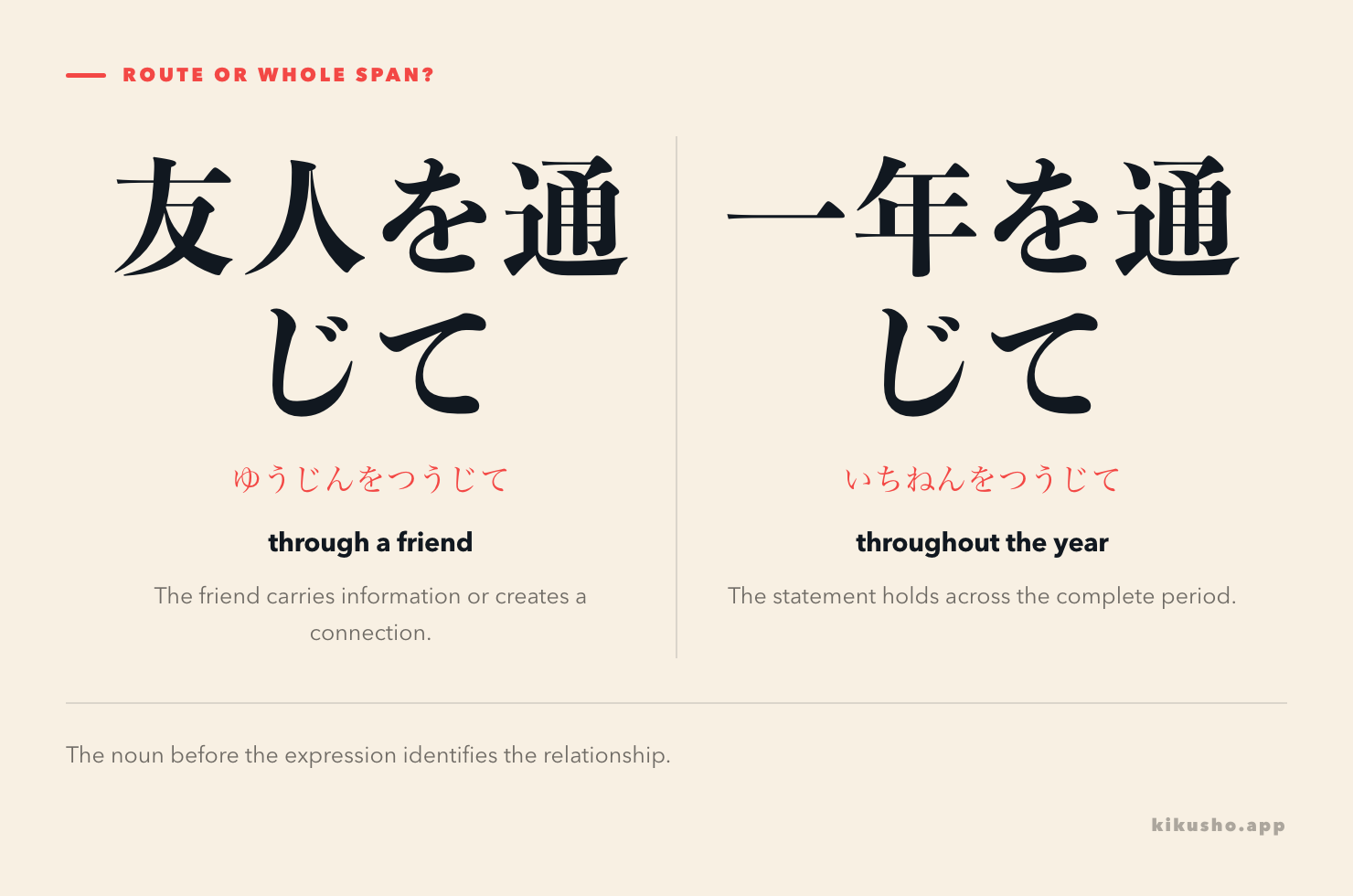
Attach を通じて or を通して to a noun when that noun is either the route through which something happens or the complete span across which it continues. A friend, a news service or an experience can be a route; a year, a season or a lifetime can be a span.
友人を通じて、その会社の仕事を知りました。
ゆうじんを つうじて、その かいしゃの しごとを しりました。
I learned about the company's work through a friend.
この地域は一年を通じて暖かいです。
この ちいきは いちねんを つうじて あたたかいです。
This region is warm throughout the year.
The spelling of the expression does not decide the meaning. The noun before it does most of that work.
First decide whether the noun is a route or a span
Both forms attach directly to a noun:
| Role of the noun | Pattern | Natural nouns | Meaning |
|---|---|---|---|
| intermediary or medium | Nを通じて / Nを通して | 友人, インターネット, 経験, 活動 | through, via, by means of |
| complete period | Nを通じて / Nを通して | 一年, 四季, 夏, 生涯 | throughout the whole span |
For the first meaning, something stands between you and the result. It may be a person who passes information, a channel that carries it, or an activity through which you learn.
SNSを通じて、海外の友達と交流しています。
えすえぬえすを つうじて、かいがいの ともだちと こうりゅうしています。
I interact with friends overseas through social media.
研修を通して、接客の基本を学びました。
けんしゅうを とおして、せっきゃくの きほんを まなびました。
I learned the basics of customer service through the training.
For the second meaning, the noun names a period viewed from beginning to end. The following predicate usually describes a continuing state, a repeated event or an activity sustained across that period.
夏を通して、この図書館は午後八時まで開いています。
なつを とおして、この としょかんは ごご はちじまで あいています。
Throughout the summer, this library is open until 8 p.m.
彼は生涯を通じて、子どもの教育に力を尽くしました。
かれは しょうがいを つうじて、こどもの きょういくに ちからを つくしました。
Throughout his life, he devoted himself to children's education.
JapaneseNET's medium-and-means reference confirms N + を通して/を通じて with people, things and activities as intermediaries. Its separate duration reference gives the complete-period meaning and places both uses at N3.
A channel is more than a direct tool marked by で
The particle で can mark the immediate instrument or setting of an action. を通じて and を通して make the noun a route, intermediary or experience that connects you to a later result.
テレビでニュースを見ました。
てれびで ニュースを みました。
I watched the news on television.
テレビを通じて、世界の出来事を知りました。
てれびを つうじて、せかいの できごとを しりました。
Through television, I learned about events around the world.
The first sentence names where or by what medium the watching happened. The second treats television as the channel through which knowledge reached the speaker. English may use “through” for both, but Japanese chooses according to the relationship being presented.
With a person, the intermediary is especially visible:
代理人を通して、契約の条件を伝えました。
だいりにんを とおして、けいやくの じょうけんを つたえました。
I communicated the contract terms through an agent.
The agent stands between the two parties. A direct conversation would instead be 相手に直接伝えました.
The predicates 知る, 学ぶ, 聞く, 伝える, 交流する and 知り合う occur readily because each one can name a result reached by a route. That is a useful collocation tendency, not a closed verb list.
The two forms overlap, but their viewpoints differ
In many sentences, switching を通じて and を通して leaves the basic claim intact. Do not memorize them as opposites. Their difference is usually one of viewpoint and register.
| Form | Tendency | A setting where it fits easily |
|---|---|---|
| Nを通じて | more written or report-like; presents a connection or channel | information reaching people through an institution or medium |
| Nを通して | often more active or concrete; presents deliberate mediation or experience | learning through a project, speaking through a representative |
The Japan Forum's answer by professor Rikuto Kano says that the two are interchangeable in many contexts. It identifies を通じて as more characteristic of written reports and を通して as particularly natural with active mediation or volitional actions. Treat those as preferences, not grammar gates.
大学を通じて、調査結果が発表されました。
だいがくを つうじて、ちょうさ けっかが はっぴょうされました。
The survey results were announced through the university.
大学での活動を通して、多くの人と知り合いました。
だいがくでの かつどうを とおして、おおくの ひとと しりあいました。
Through my university activities, I met many people.
The first has the tone of an institutional information route. The second reflects a person's active experience. Either pair can sometimes be rephrased with the other form; context matters more than a one-word English gloss.
The time use requires a whole interval
The duration meaning works with a period that can be surveyed as one span: 一年, 年間, 夏, 四季 or 生涯. A point such as 三時 does not form an interval by itself.
Compare two ways of mentioning a year:
日本に一年間住みました。
にほんに いちねんかん すみました。
I lived in Japan for one year.
一年を通して、日本語を使う機会がありました。
いちねんを とおして、にほんごを つかう きかいが ありました。
Throughout the year, I had opportunities to use Japanese.
一年間 measures how long the residence lasted. 一年を通して scans the whole year and says that opportunities occurred across it. The second pattern is useful when distribution or continuity across the interval matters.
Tanosuke's teacher reference independently describes both the intermediary and full-span uses. It notes that period nouns form a coherent whole and that the following statement carries a continuing meaning.
This is close to にわたって, but the focus differs. 三日間にわたって会議が行われた measures the extent occupied by the meeting. 三日間を通して議論が続いた looks across the entire period and says the discussion persisted through it. The lesson on から~にかけて and にかけて covers a looser range with endpoints; it does not make the same claim of whole-span continuity.
Before a noun, keep the intended use visible
For an intermediary or means, を通じた and を通した can modify a following noun directly:
| Adverbial form | Noun-modifying form | Example |
|---|---|---|
| SNSを通じて交流する | SNSを通じた交流 | interaction through social media |
| 活動を通して学ぶ | 活動を通した学び | learning through an activity |
国際交流を通じた相互理解が必要です。
こくさい こうりゅうを つうじた そうご りかいが ひつようです。
Mutual understanding through international exchange is necessary.
You will also meet a relative clause such as 友人を通して得た情報, “information obtained through a friend.” Here 得た is the verb modifying 情報; 友人を通して remains adverbial inside that clause.
With the duration meaning, writers often leave the expression before a predicate rather than forcing a compact modifier. 一年を通じて暖かい地域 is transparent: 一年を通じて modifies 暖かい, and the whole clause modifies 地域.
Keep noun + を通して separate from verb-stem + 通す
These two N3 patterns share 通す, but their attachments and claims differ:
この小説を通して、人生について考えました。
この しょうせつを とおして、じんせいについて かんがえました。
Through this novel, I thought about life.
この小説を最後まで読み通しました。
この しょうせつを さいごまで よみとおしました。
I read this novel all the way through.
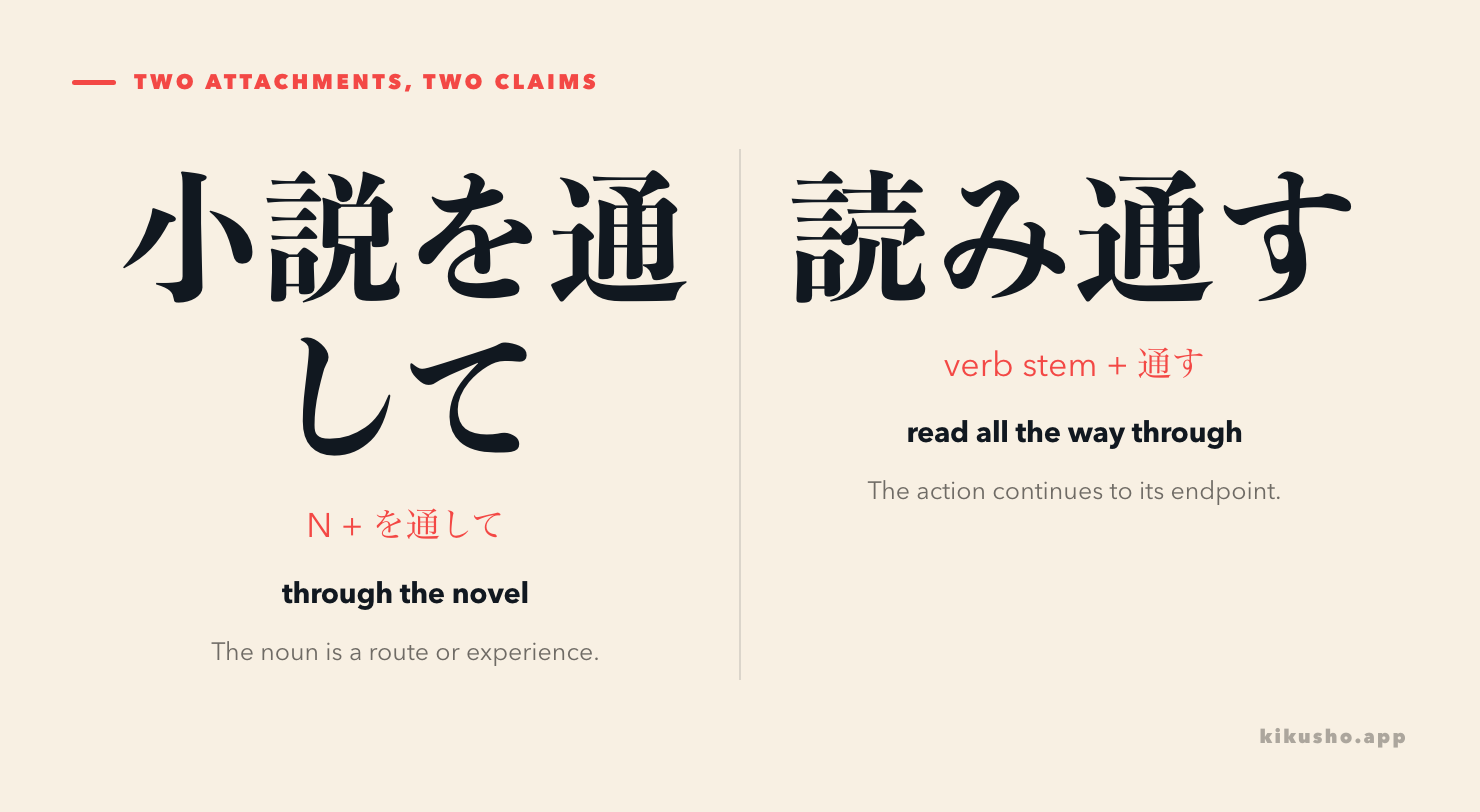
In the first sentence, 小説 is a noun followed by を通して and serves as an experience or route. In the second, 読み + 通す is one compound verb; the action of reading continues to the end. The 込む and 通す lesson teaches that stem-attached pattern and its limited pairings.
Why this lesson sits in the N3 sequence
The assigned reference item and all three inspected teaching sources place these constructions at N3. The agreement is useful for study order, but it does not turn the label into an official exhaustive syllabus. The stable prerequisites are more practical: noun attachment, the particles を and で, and the difference between an intermediary and a duration.
For a Kikusho card, keep the noun and the result together. A card containing only を通して = through cannot tell whether it came from 研修を通して学ぶ, 一年を通して続く or the unrelated compound 読み通す. One full sentence preserves the decision you need to make later.
Practice
Complete the entire set before checking the explanations.
Question 1 — identify the noun's role
What role does 友人 have in 友人を通じて、その店を知りました?
- ア. A period lasting from beginning to end
- イ. An intermediary through whom the information arrived
- ウ. A direct tool used to build the shop
- エ. The destination of movement
Question 2 — choose the complete span
Complete: この町では、一年( )花を見ることができます。 The flowers appear in different seasons across the whole year.
- ア. を通じて
- イ. で通じて
- ウ. に通して
- エ. が通じて
Question 3 — choose the direct instrument
Complete the ordinary statement “I wrote my name with a pen”: ペン( )名前を書きました。
- ア. を通じて
- イ. を通して
- ウ. で
- エ. にわたって
Question 4 — arrange a route sentence
Order these three chunks to say “Through the volunteer activity, I met people from many age groups.”
知り合いました / ボランティア活動を通して / さまざまな年代の人と
Question 5 — distinguish the two 通す patterns
Which sentence says that the novel served as an experience through which the speaker learned about society?
- ア. その小説を最後まで読み通しました。
- イ. その小説を通して、社会について学びました。
- ウ. その小説が一年を通じて売れました。
- エ. その小説で名前を書きました。
Question 6 — text grammar
Choose the pair that fits both meanings.
私は共通の友人( 甲 )、今の仕事を紹介してもらいました。この仕事では、一年( 乙 )海外の会社と連絡を取ります。
- ア. 甲: を通じて / 乙: を通して
- イ. 甲: で / 乙: に通じて
- ウ. 甲: を通した / 乙: を通じた
- エ. 甲: にわたって / 乙: で
Answers and explanations
Answer 1
イ. An intermediary through whom the information arrived. The speaker reached knowledge of the shop by way of the friend. Nothing in the sentence presents the friend as a time span, a construction tool or a destination.
Answer 2
ア. を通じて. 一年 names the complete period, and the sentence says that the possibility of seeing flowers extends across it. を通して could also express the same full-span meaning, but that option is not present. The other choices attach the particles incorrectly.
Answer 3
ウ. で. A pen is the immediate instrument used to write, so the ordinary sentence is ペンで名前を書きました. The target expressions would present an intermediary, an experience or a whole period, none of which matches this simple tool relation.
Answer 4
ボランティア活動を通して、さまざまな年代の人と知り合いました。 The activity is the experience through which the meetings occurred. 知り合いました supplies the result reached by that route.
Answer 5
イ. その小説を通して、社会について学びました。 小説を通して makes the novel an experience or medium for learning. ア contains the compound 読み通す, which says that the speaker completed the reading. ウ makes an awkward duration claim, and エ misuses a novel as a writing instrument.
Answer 6
ア. 甲: を通じて / 乙: を通して. The common friend is an intermediary who connected the speaker to the job. The year is the complete span across which contact with overseas companies occurs. Either target variant can often replace the other, but the two noun roles remain distinct.
The useful clue sits before the expression. If that noun can carry something from one side to another, read a route. If it can be surveyed from beginning to end, read the whole span.
Common questions
What do を通じて and を通して mean?
After a noun, both can mean through or via an intermediary, or throughout a complete period. The noun and the following predicate show which meaning is intended.
What is the difference between を通じて and を通して?
They overlap heavily. を通じて is especially comfortable in written or formal reporting, while を通して often fits a deliberate action, personal experience or active intermediary. This is a tendency rather than a rigid rule.
How are を通じて and を通して formed?
Attach either expression directly to a noun: Nを通じて or Nを通して. For a means or intermediary modifying another noun, Nを通じたN and Nを通したN are also used.
Are を通じて and を通して N3 grammar?
JLPT Sensei, JapaneseNET and Tanosuke all place these uses at N3. The level remains a study-guide estimate because the JLPT does not publish a complete official grammar-item list.