On this page
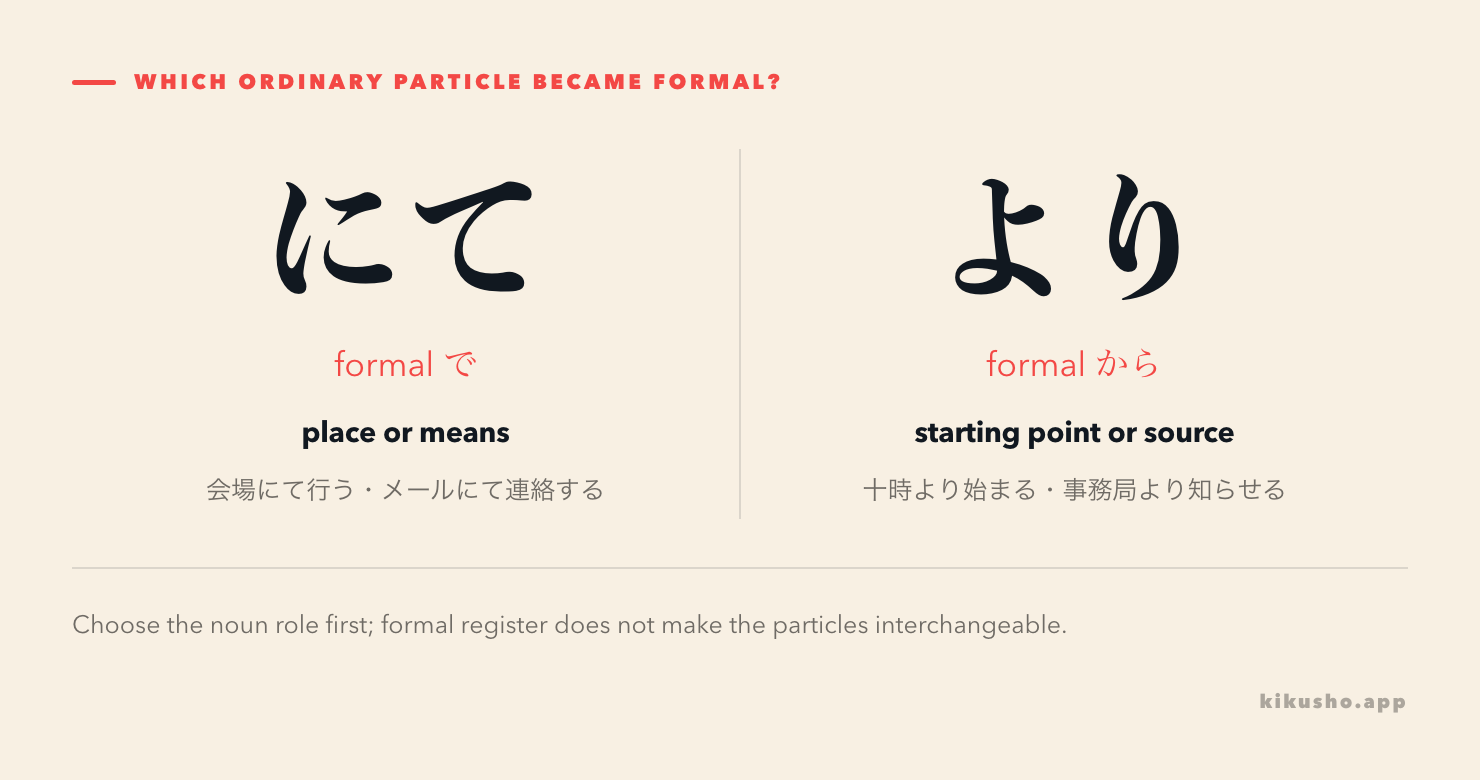
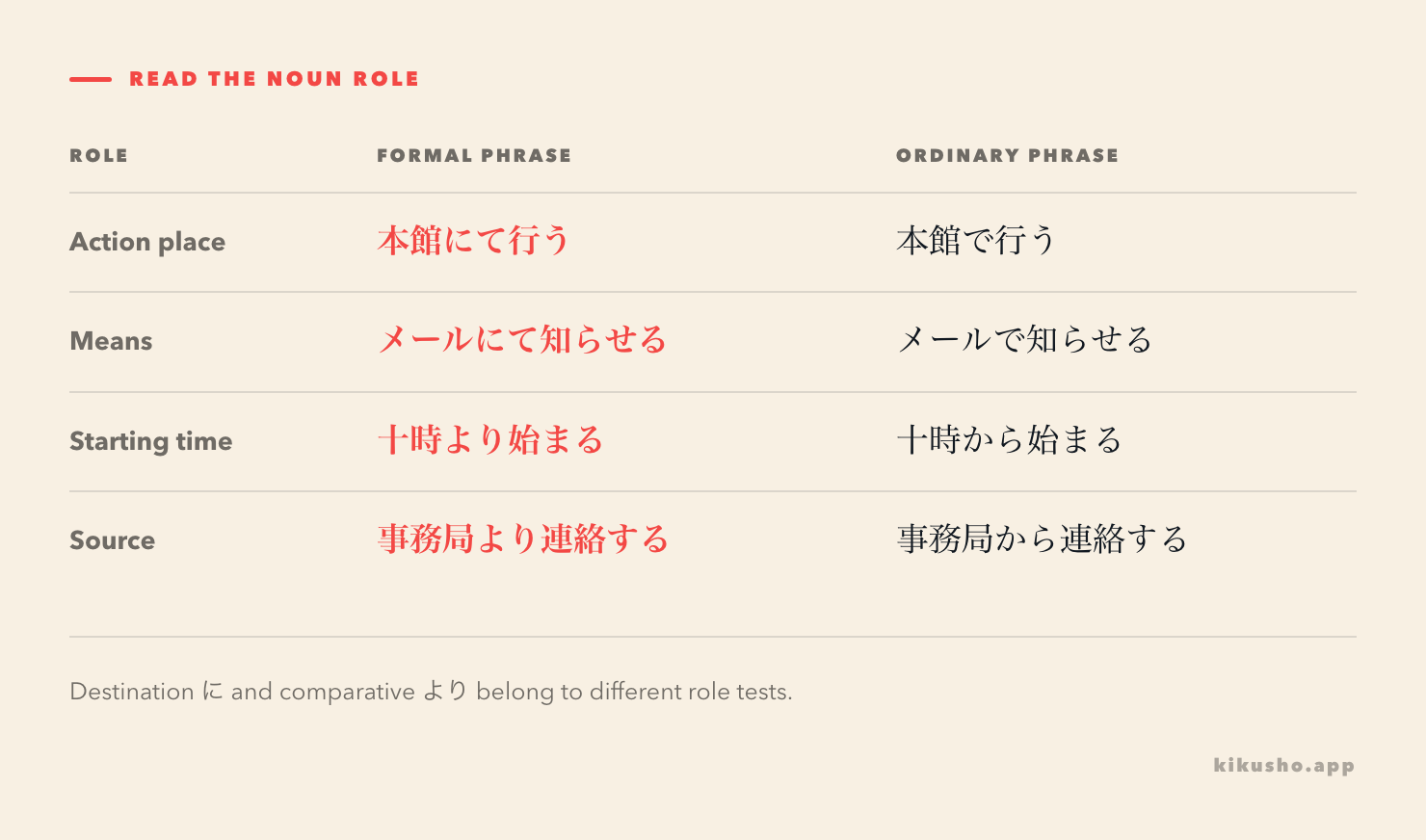
にて and より both appear in formal notices, but they do different jobs. にて is the formal counterpart of action-place or means で; starting-point より is the formal counterpart of から, marking where, when or from whom something begins or comes.
Ask which ordinary particle the notice has formalised
A single notice can show the distinction clearly:
式典は本館にて午前十時より行います。
しきてんは ほんかんにて ごぜんじゅうじより おこないます。
The ceremony will be held in the main building from 10 a.m.
Two noun phrases come before the event:
- 本館にて gives the place where the ceremony occurs. In ordinary speech, 本館で would carry that role.
- 午前十時より gives the starting time. In ordinary speech, 午前十時から would carry that role.
The particles are not interchangeable simply because both sound formal. 本館より行います would make the main building a source or starting point, not the venue. 午前十時にて行います may occur in very formal writing, but it does not teach the ordinary starting-point contrast that the notice above makes transparent.
にて marks an action's setting or means
The core form is noun + にて. It can mark the setting in which an action takes place:
受付は二階にて行います。
うけつけは にかいにて おこないます。
Registration will take place on the second floor.
The verb 行う, read おこなう, describes carrying out the registration. 二階 is therefore the setting of an event. Replace the formal particle with ordinary で and the relationship remains: 受付は二階で行います.
It can also mark a means or channel:
結果はメールにてお知らせします。
けっかは メールにて おしらせします。
We will notify you of the result by email.
Email is the channel used to deliver the notice. Everyday Japanese normally uses メールで. The expression does not say that the result physically exists inside an email; it tells us how the communication will be carried out.
Bunpro's にて reference identifies the form as noun + にて, labels it formal and documents place and means uses. Kotobank's dictionary entry separately records place or time and means, method or material among the particle's functions.
Do not replace every に with にて
The spelling begins with に, but the modern function taught here aligns with で. Compare three roles:
| Intended role | Ordinary particle | Formal sentence |
|---|---|---|
| place of an action | 会場で | 会場にて開催します |
| means of contact | メールで | メールにてご連絡します |
| destination | 会場に | 会場に到着します |
会場に到着します means “arrive at the venue.” The venue is a destination, so replacing に with にて would not merely raise the register. Likewise, 資料は机の上にあります uses に for existence. The N5 lesson on に, で and へ supplies the underlying role test that still matters in formal prose.
For a formal context that can modify a following noun, compare において and における. 大会にて発表する links the setting to the predicate. 大会における発表 can directly modify 発表 as “the presentation at the conference.” にて is not a universal substitute for that pair.
より marks a formal origin or starting point
In this lesson, the form is noun + より, where the noun supplies a place, time or source. It resembles から, but its formal tone suits signs, schedules, business messages and ceremonial language.
入場は午前九時より開始します。
にゅうじょうは ごぜんくじより かいしします。
Admission begins at 9 a.m.
Nine o'clock is the point from which admission starts. In conversation, 午前九時から is the natural default.
ここより先は関係者以外立入禁止です。
ここより さきは かんけいしゃいがい たちいりきんしです。
Beyond this point, entry is prohibited to everyone except authorised personnel.
The sign treats ここ as a spatial boundary. Tofugu's account of starting-point より documents spatial, temporal and source uses and contrasts formal より with ordinary から. The National Diet Library's reference record on より and から cites Japanese usage dictionaries that likewise describe より as the older, harder expression for a temporal or spatial origin.
A person or organisation can also be a source:
事務局より参加者の皆様へお知らせします。
じむきょくより さんかしゃの みなさまへ おしらせします。
The secretariat has an announcement for all participants.
Here the message comes from 事務局. The formal wording fits an institutional announcement. In an ordinary account of receiving a message, 事務局から連絡が来た is more natural.
Separate starting-point より from comparison より
The visible particle is the same, so read the surrounding predicate.
会議は三時より始まります。
かいぎは さんじより はじまります。
The meeting starts at three.
The verb 始まる requires a starting point. There is no second time being judged as better, earlier or later.
電車はバスより速いです。
でんしゃは バスより はやいです。
The train is faster than the bus.
速い compares speed, so バス is the comparison standard. Replacing this より with から would destroy the intended meaning. The dedicated lesson on より, ほうが and いちばん develops that comparison system.
Use a quick predicate test:
- If an event starts, departs, continues or comes from the marked noun, read より as formal “from.”
- If the sentence judges one thing as larger, faster, preferable or more, read より as a comparison standard.
Context can omit part of a comparison, so this is a reading test rather than a claim that one following word mechanically decides every case. A timetable, sign or sender line strongly supports the origin reading.
Keep the whole notice at a compatible register
Formal particles do not force every predicate into one fixed honorific form. Still, a notice usually sounds coherent when the rest of the sentence matches its setting:
説明会はオンラインにて午後六時より開催いたします。
せつめいかいは オンラインにて ごごろくじより かいさいいたします。
The information session will be held online from 6 p.m.
オンラインにて names the medium or setting; 午後六時より names the starting time; 開催いたします provides a formal predicate. In a message between friends, オンラインで六時からやろう expresses the same practical details without the announcement register.
The fixed closing これにて終了します, “This concludes…,” also belongs to formal announcements. Learn it as a complete phrase, but do not use it as evidence that にて and より share the same grammatical role.
When turning a notice into Kikusho cards, preserve the noun and predicate on both sides of the particle. 本館にて行う retains an action setting, while 十時より始まる retains a start. A card containing only “にて = at” or “より = from” hides the role decision that the sentence actually tests.
The curriculum sources place both assigned uses at N2 without a recorded level disagreement. That label is a study placement supported by teaching references; the JLPT does not publish a complete official grammar syllabus. The prerequisite is the ordinary role system of で, に, から and comparison より.
Practice
Work through all six notices before opening the answer panel.
Question 1: choose the formal venue particle
面接は本社( )行います。
Which particle presents headquarters as the formal place of the interview?
A. より
B. から
C. にて
D. へ
Question 2: choose the formal starting time
受付は午前八時( )開始します。
A. より
B. にて
C. まで
D. へ
Question 3: distinguish destination from action place
参加者は九時に会場( )到着してください。
A. にて
B. に
C. より
D. で
Question 4: read より from the predicate
この列車は普通列車より速いです。
What role does より have?
A. It marks the station from which the train departs.
B. It marks the time at which the train starts.
C. It marks the means used to travel.
D. It marks 普通列車 as the standard of comparison.
Question 5: assign both roles in one notice
講演会は市民会館にて午後二時より開催します。
Which analysis is correct?
A. Both particles mark the same starting point.
B. 市民会館 is a destination, and 午後二時 is a means.
C. にて marks the venue; より marks the starting time.
D. にて marks a comparison; より marks the venue.
Question 6: choose a natural formal channel
申込結果は( )お知らせいたします。
Complete the notice with the formal phrase meaning “by email.” Write the channel noun and particle together.
Answers and explanations
1 — C. にて. 本社 is the setting where the interview is carried out. Formal にて fills the role that ordinary で would fill: 本社で行います.
2 — A. より. 午前八時 is the point from which registration begins. Formal より corresponds to ordinary から in this schedule.
3 — B. に. 到着する takes a destination. にて matches action-place or means で in the uses taught here; it does not replace destination に merely to make the instruction formal.
4 — D. 速い evaluates relative speed, so 普通列車 is the comparison standard. Nothing in the sentence describes an origin or starting time.
5 — C. 市民会館にて supplies the place of 開催する, while 午後二時より supplies its temporal starting point. One formal sentence can therefore contain both particles with separate jobs.
6 — メールにて. Email is the channel used for the notification, corresponding to ordinary メールで. The noun and particle must stay together to show how the notice will be delivered.
Common questions
What is the difference between にて and より?
にて is a formal counterpart of で and marks where or by what means an action occurs. Starting-point より is a formal counterpart of から and marks where, when or from whom something begins or comes.
Is にて a formal version of に?
For the uses taught here, it is closer to で. It marks an action location or means, as in 会場にて行う and メールにて連絡する. It does not generally replace destination or existence に.
Does より always mean than?
No. より can mark a comparison standard, but it can also mean from. A time, place or source followed by an action beginning or arriving points to the starting-point use taught in this lesson.
Can にて and より appear in the same sentence?
Yes. 式典は本館にて午前十時より行います assigns different roles: 本館にて is the venue of the event, while 午前十時より is its starting time.