On this page
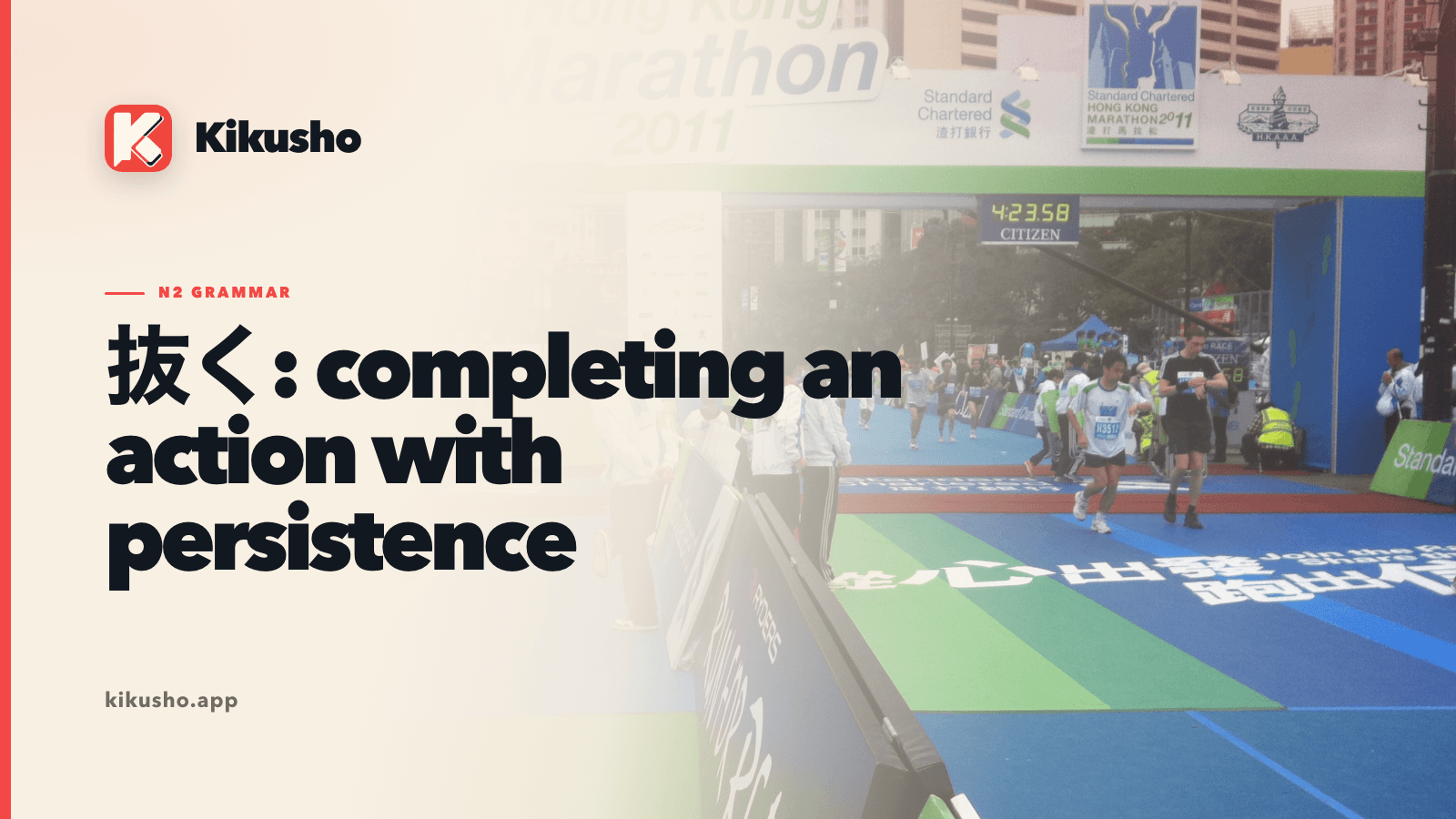
Attach 抜く(ぬく)to a verb's ます-stem when an action is carried fully through, often despite difficulty or resistance. 最後までやり抜いた means “I saw it through to the end”: the endpoint matters, but so does the persistence needed to reach it.
Build the compound from the ます-stem
Remove ます and attach 抜く directly. Do not insert て or a particle between the two verbs.
| Dictionary form | ます-form | Stem | Compound | Plain past |
|---|---|---|---|---|
| やる | やります | やり | やり抜く | やり抜いた |
| 考える | 考えます | 考え | 考え抜く | 考え抜いた |
| 守る | 守ります | 守り | 守り抜く | 守り抜いた |
| 耐える | 耐えます | 耐え | 耐え抜く | 耐え抜いた |
| 頑張る | 頑張ります | 頑張り | 頑張り抜く | 頑張り抜いた |
The last verb controls the conjugation. 抜く is a godan verb, so the compound gives やり抜きます, やり抜いた, やり抜かない, やり抜ける and やり抜こう. The first stem stays fixed.
The form is productive only within limits. The attachment rule tells you how an established compound is built; it does not guarantee that every verb plus 抜く will sound natural. やり抜く, 戦い抜く, 守り抜く, 耐え抜く, 生き抜く and 考え抜く are dependable combinations. An ordinary action with no meaningful resistance may call for a different completion verb.
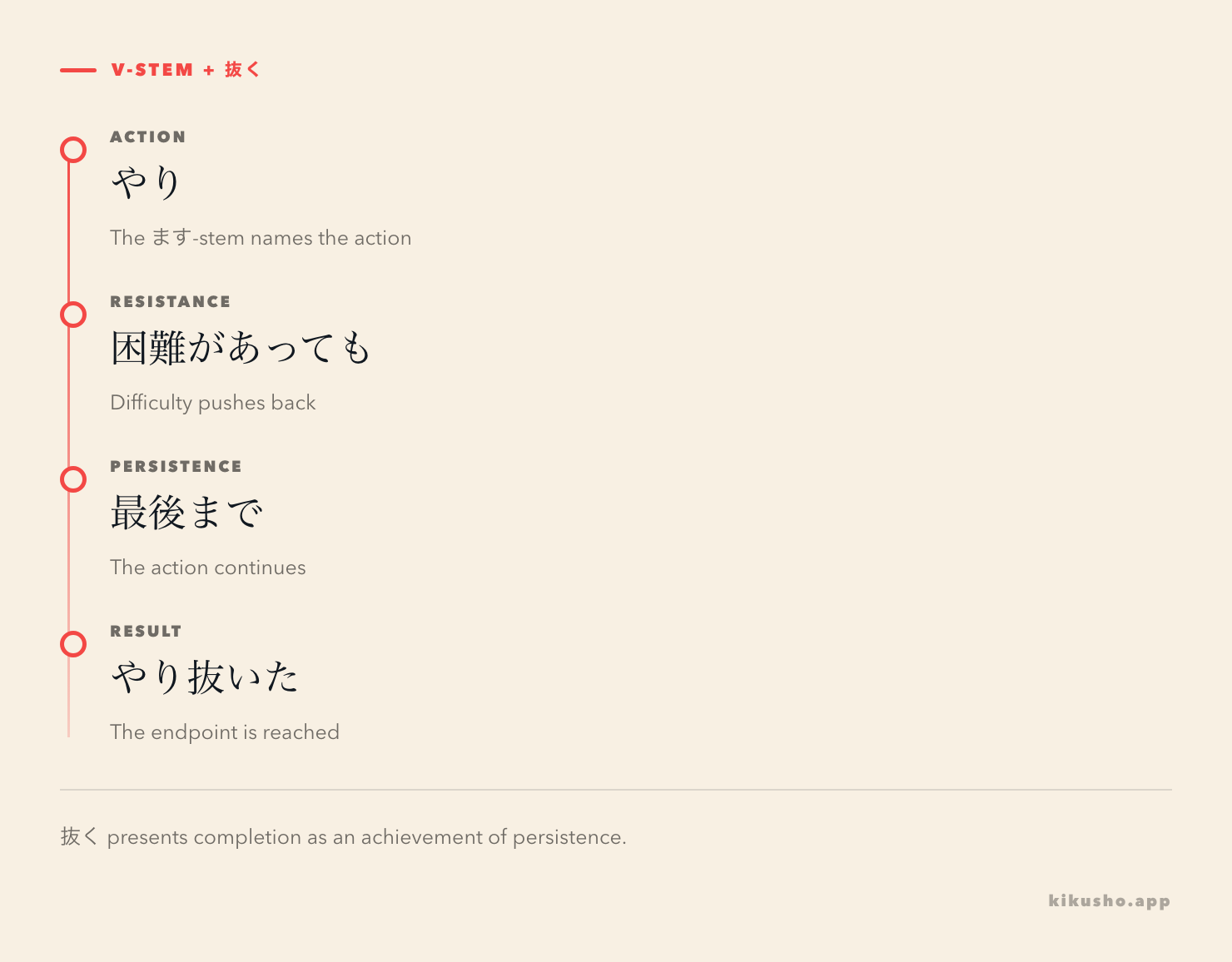
抜く adds persistence or thoroughness
The central image is not merely that an action stopped at its natural endpoint. The subject persists, overcomes resistance or takes the action to an extreme degree.
困難があっても、この計画を最後までやり抜きます。
こんなんが あっても、この けいかくを さいごまで やりぬきます。
Even if there are difficulties, I will see this plan through to the end.
選手たちは最後まで戦い抜いた。
せんしゅたちは さいごまで たたかいぬいた。
The players fought on to the very end.
多くの圧力があっても、彼女は秘密を守り抜いた。
おおくの あつりょくが あっても、かのじょは ひみつを まもりぬいた。
Despite considerable pressure, she kept the secret.
Words such as 困難, 苦しくても, なんとか and 最後まで often make the resistance and endpoint explicit. They are useful clues, but they are not required. この仕事をやり抜く自信がある already presents the work as a commitment that must be carried through.
The compound can also mean doing something exhaustively rather than moving through a neatly bounded task:
三日間考え抜いた末、提案を断ることにした。
みっかかん かんがえぬいた すえ、ていあんを ことわる ことに した。
After thinking it through thoroughly for three days, I decided to reject the proposal.
厳しい冬を耐え抜いて、春を迎えた。
きびしい ふゆを たえぬいて、はるを むかえた。
We endured the harsh winter and reached spring.
With 考え抜く, the relevant limit is depth and thoroughness: the person has considered the matter as far as they can. With 耐え抜く, the subject remains through the whole ordeal. The English wording changes, but both reach a limit under pressure.
JLPT Sensei lists ます-stem + 抜く at N2 and illustrates it with やり抜く, 走り抜く and 守り抜く. Tanosuke's Japanese-teacher explanation independently identifies the two central readings as continuing to the end and doing something thoroughly, with difficulty frequently present. A Nagoya University corpus study of V-抜く further separates completion against resistance from the continuous-span focus of V-通す. These are teaching and research classifications; the JLPT does not publish an exhaustive grammar-item syllabus.
Compare 抜く, 切る, 通す and 終わる
Four stem-attached verbs can all point toward an endpoint. Choose the one that describes what the speaker evaluates.
| Form | Main focus | Natural example | What it highlights |
|---|---|---|---|
| V-stem + 抜く | perseverance or thorough effort | 困難な仕事をやり抜く | reaching the limit despite resistance |
| V-stem + 切る | complete consumption or completion | 一人で全部食べ切る | nothing relevant remains |
| V-stem + 通す | the same action or stance across a span | 最後まで黙り通す | uninterrupted or consistent continuation |
| V-stem + 終わる | neutral completion of a bounded action | 本を読み終わる | the action reaches its ordinary end |
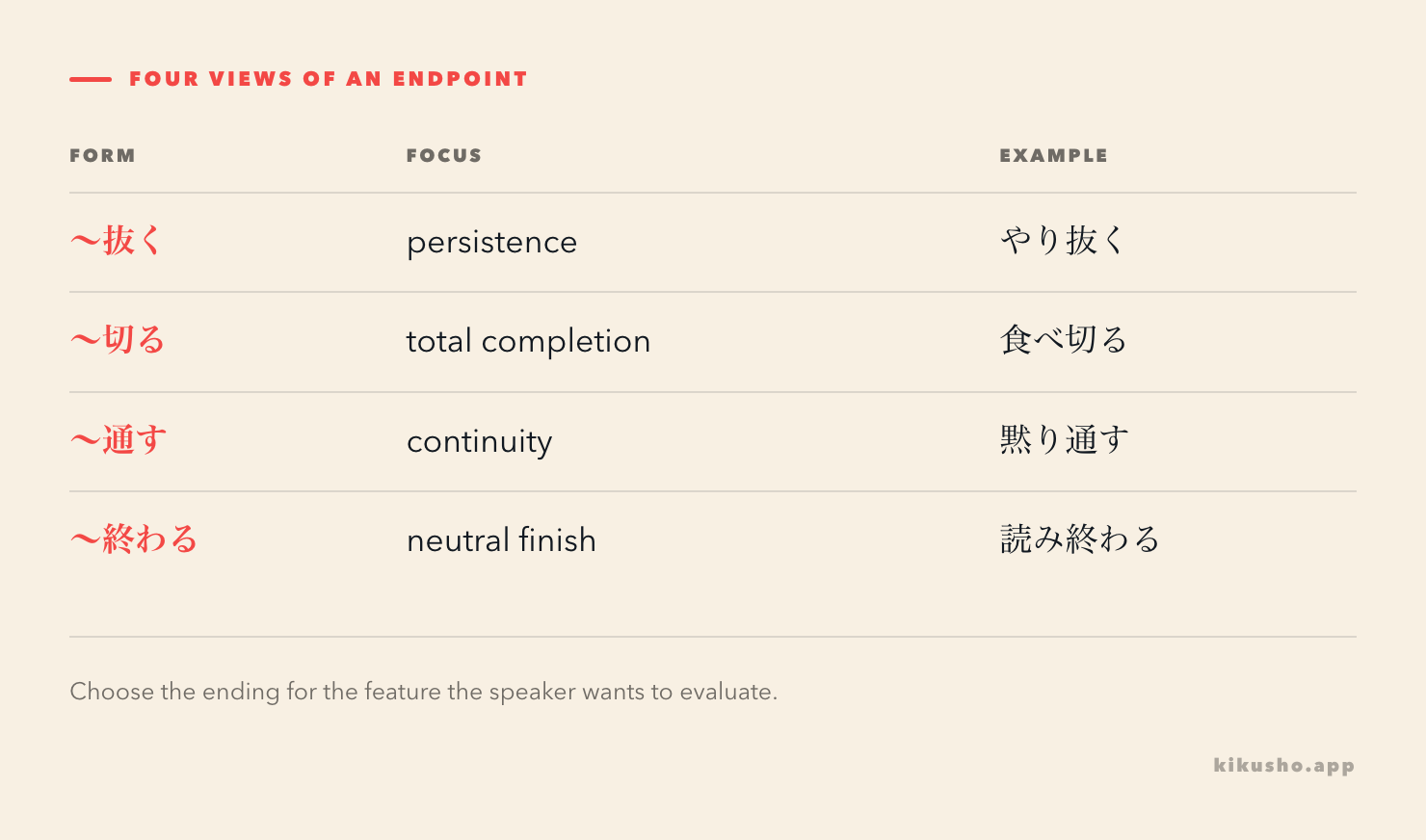
抜く versus 切る
Both can present full completion, but 切る readily measures totality. ラーメンを全部食べ切った means every relevant portion was eaten. The meal can be large, yet 食べ切る does not require a story of perseverance. 抜く makes the effort or resistance part of how the action is viewed.
Compare 難しい仕事をやり切った and 難しい仕事をやり抜いた. Both say the job was completed. やり切った emphasizes that the entire job was done; やり抜いた invites the listener to notice the resolve that carried the subject past difficulties. The lesson on かける, 切る and 切れない develops the total-completion contrast.
抜く versus 通す
通す draws attention to continuity across the whole interval. 面接の間、彼は黙り通した says he maintained silence throughout the interview. 抜く instead presents an action as brought to its limit through effort: 苦しい試合を戦い抜いた.
Some contexts allow either viewpoint. マラソンを走り通した profiles the running as continuing through the entire course; マラソンを走り抜いた profiles the effort of getting all the way through it. This does not make the endings interchangeable in every compound. Learn the established pairing and ask which viewpoint the sentence needs. The 込む and 通す lesson covers the continuous-span reading in detail.
抜く versus 終わる
終わる is the neutral phase marker. 本を読み終わった simply places the reading at its endpoint. It does not tell us that the book was difficult or that the reader persevered. The action-phase lesson shows how 終わる fits beside 始める, 出す and 続ける.
When the only intended fact is “finished,” use 終わる. When totality matters, consider 切る. Choose 抜く only when persistence, resistance or exhaustive effort belongs in the message.
Learn the whole compound, not only the seam
Some words ending in 抜く have established lexical meanings that cannot be calculated as “persist until the end.” 歯を抜く means “pull a tooth,” with 抜く as an independent verb. 前の車を追い抜く means “overtake the car ahead.” うそを見抜く means “see through a lie.” 大会を勝ち抜く describes surviving or winning through successive rounds.
These meanings connect historically and conceptually with extraction, passage or crossing a boundary, but a learner should store the whole word. Seeing a ます-stem before 抜く is evidence of compound structure, not proof of the N2 persistence reading.
The same caution applies to new combinations. 野菜を炒め抜く is mechanically buildable but is not the ordinary way to say “finish stir-frying the vegetables.” 野菜を炒め終わる neutrally marks completion. If every piece has been thoroughly cooked, Japanese may choose a more specific result description instead.
In Kikusho, capture the complete compound with the pressure or endpoint that licenses it. A card containing only 抜く invites the unrelated meaning “pull out.” 困難があっても計画をやり抜く preserves the obstacle, the object and the full verb. 三日間考え抜いた末、決めた preserves the duration and the decision that resulted. Those cues let offline review recover the distinction instead of rehearsing one vague translation.
Practice: answer all six before opening the block
Question 1 — attachment. Turn 守ります into the plain past compound meaning “protected it through to the end.”
Question 2 — choose the endpoint. Complete the ordinary meal sentence: 量は多かったが、一人で全部__。
- 食べ抜いた
- 食べ切った
- 食べ通した
- 食べ込んだ
Question 3 — choose the viewpoint. Complete: 何度反対されても、彼女は自分の意見を最後まで__。 The point is maintaining the same position throughout.
- 言い通した
- 言い終わった
- 言いかけた
- 言い出した
Question 4 — text grammar. Read: 大会まで毎日練習し続けた。決勝戦では、苦しくても最後まで戦い抜いた。 Which compound measures continuation across the training period, and which evaluates perseverance in the final?
Question 5 — lexical boundary. Does 前の車を追い抜いた mean that the driver “persisted in chasing,” or that the driver overtook the car?
Question 6 — sentence composition. Use 困難, 計画, 最後まで and やり抜く to say, “Despite difficulties, we saw the plan through to the end.”
Answers and explanations
Answer 1. 守り抜いた (まもりぬいた). Start with the stem 守り, join 抜く, and put that final element in its ~た form, 抜いた.
Answer 2: 2, 食べ切った. 全部 asks whether the whole quantity was consumed, so 切る supplies total completion. The sentence does not frame eating as a sustained commitment that calls for 抜く.
Answer 3: 1, 言い通した. The prompt explicitly asks about maintaining one position despite repeated opposition. 通す presents that stance as unchanged across the whole interval.
Answer 4. 練習し続けた measures continuation across the days before the competition. 戦い抜いた presents reaching the end of the difficult final as an achievement of resolve. The first sentence supplies duration; the second supplies resistance and a completed endpoint.
Answer 5. It means the driver overtook the car. 追い抜く is an established compound with its own lexical meaning, so the general persistence explanation does not replace the meaning of the complete word.
Answer 6. A model answer is 困難があっても、私たちはその計画を最後までやり抜いた。 困難があっても supplies the resistance, 最後まで marks the endpoint, and やり抜いた presents the completion as an achievement of persistence.
Common questions
What does ~抜く mean after a Japanese verb stem?
It presents an action as carried through fully, often despite difficulty, resistance or sustained effort. やり抜く means to see something through, while 考え抜く means to think something through thoroughly.
How do you attach ~抜く to a verb?
Attach 抜く directly to the ます-stem: やります becomes やり抜く, 考えます becomes 考え抜く, and 耐えます becomes 耐え抜く. The final 抜く conjugates as a godan verb.
What is the difference between ~抜く and ~切る?
Both can reach a complete endpoint, but 抜く highlights perseverance or thorough effort through difficulty. 切る emphasizes complete consumption or completion, as in 食べ切る, without requiring that persistence reading.
Can ~抜く attach freely to every verb?
No. It favors established compounds and actions worth carrying through or doing thoroughly. Learn combinations such as やり抜く, 守り抜く and 考え抜く as complete units rather than generating them from the attachment rule alone.