On this page
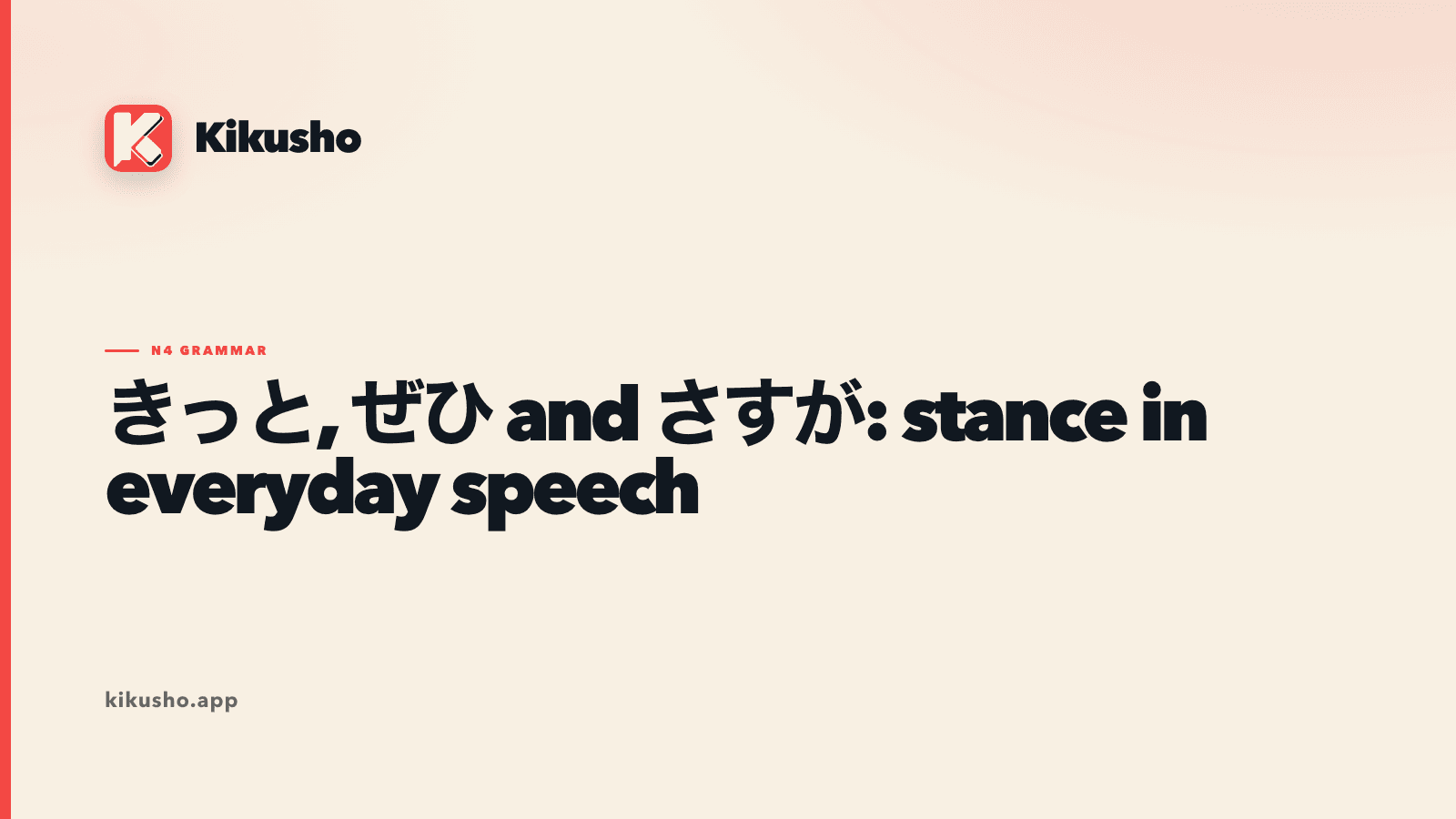
きっと shows strong belief about an outcome, ぜひ shows a strong wish for an action, and さすが reacts when reality fits an expectation or reputation. They can all sound emphatic, but they point the emphasis at three different things: belief, desire and evaluation.
Picture one friend before a concert. きっと成功するよ predicts success with confidence. ぜひ来てください strongly encourages someone to attend. After the performance, さすがですね says the excellent result fits what the speaker already expected.
Find what the speaker is committed to
The three words do not share a grammatical slot that you can fill by translation. Start with the speaker's conversational move.
| Word | Core stance | Typical environment | Short meaning |
|---|---|---|---|
| きっと | confident belief | prediction, inference, reassurance | surely; I'm sure |
| ぜひ | strong desire for an action | request, invitation, intention with たい | by all means; please do |
| さすが | result measured against expectation | reaction, evaluation, acknowledged limit | as expected; even for |
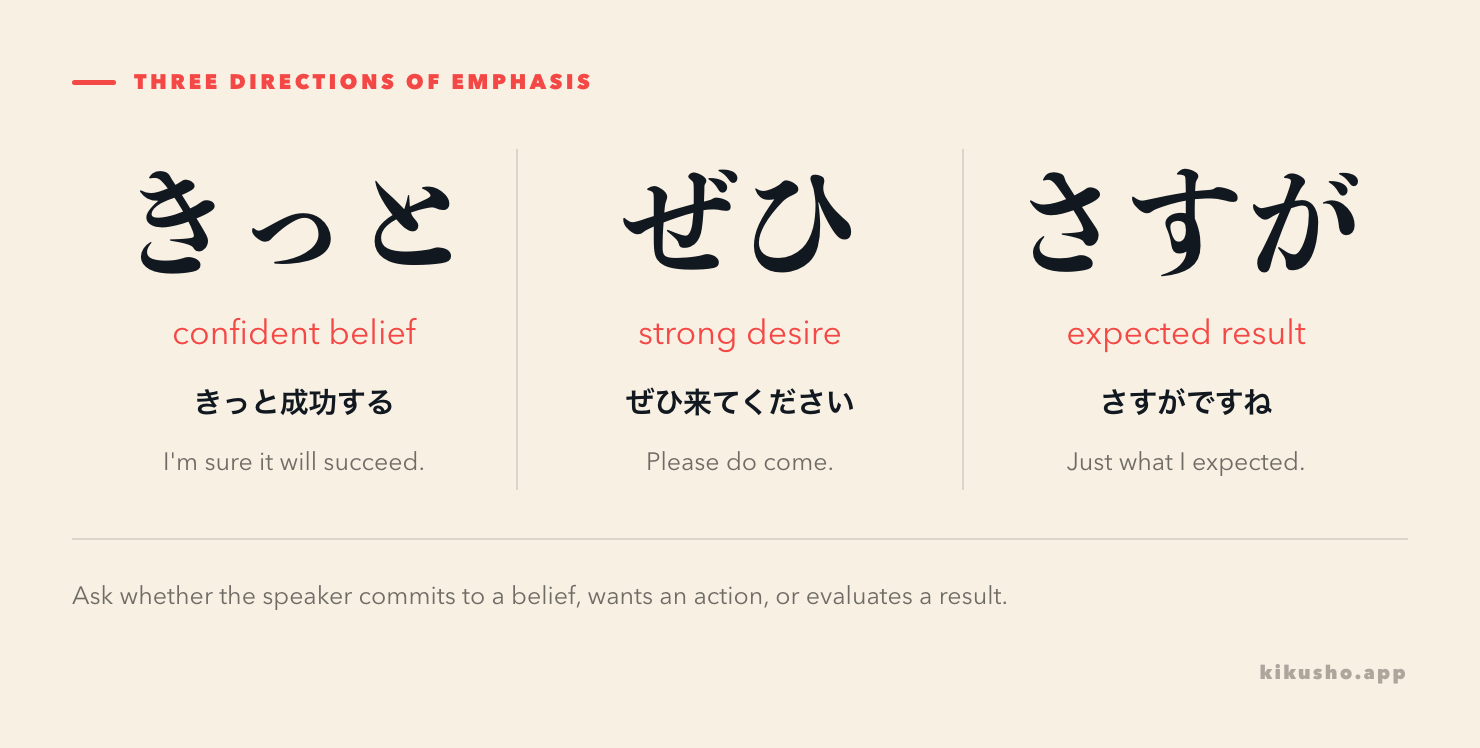
The English words “certainly” and “definitely” can blur the first two. “You will certainly come” expresses belief and points toward きっと. “Please definitely come” urges an action and points toward ぜひ. さすが does neither: it looks at a person, fact or result through a prior expectation.
きっと commits the speaker to a belief
Use きっと when the speaker strongly expects a statement to be true:
明日はきっと晴れます。
あしたは きっと はれます。
I'm sure it will be sunny tomorrow.
このプレゼントなら、きっと喜びます。
このプレゼントなら、きっと よろこびます。
With this present, I'm sure they will be pleased.
The event is not yet established as fact. きっと adds the speaker's confidence, which may come from evidence, trust or hope. It can occur with a plain or polite statement and with inferential endings such as でしょう.
The full comparison of たぶん, おそらく and きっと places that confidence beside weaker estimates. This lesson keeps only the part needed for the stance contrast: きっと primarily strengthens a belief about what will happen or what is true.
Daijisen's entry for きっと also records an emphatic use with commands and requests. In 今度はきっと来てね, the word can reinforce the expected action. Context and the sentence ending matter: きっと supplies confident insistence, while ぜひ more directly presents the action as strongly wanted.
ぜひ puts force behind a desired action
Use ぜひ when you strongly want yourself or another person to do something. It commonly appears with ~たい, requests and invitations:
ぜひ京都へ行きたいです。
ぜひ きょうとへ いきたいです。
I definitely want to go to Kyoto.
ぜひ遊びに来てください。
ぜひ あそびに きてください。
Please do come and visit.
A:今度、一緒に行きませんか。
B:ぜひ。
A: Would you like to go together next time?
B: I'd be delighted.
In the short answer, the invitation supplies the missing action. B is not predicting that the trip will happen; B is accepting it enthusiastically.
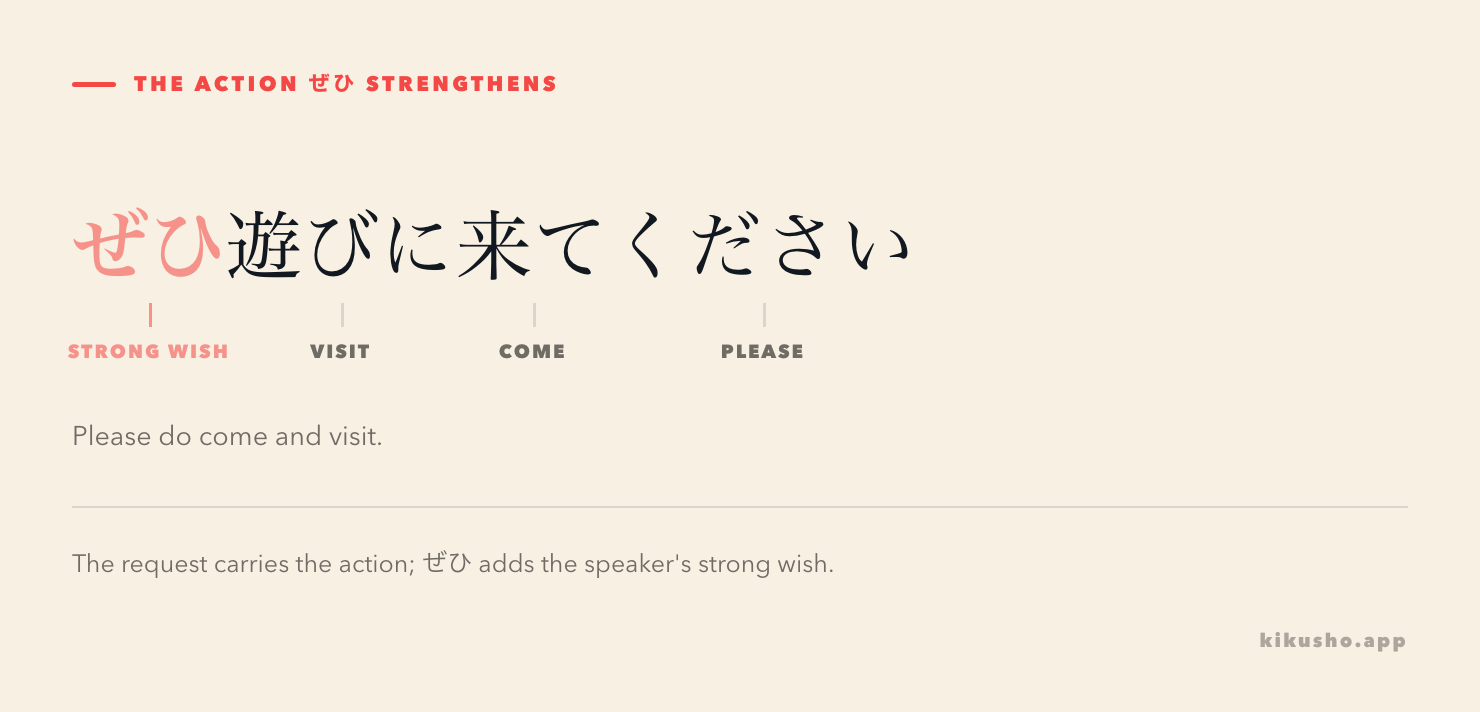
Daijisen's ぜひ entry separates the adverb's strong determination from its use in a heartfelt request. The same entry also records 是非 as a noun meaning right and wrong, as in 是非を問う. That noun use is separate from the kana adverb learners meet in ぜひ来てください.
The lesson on ~ましょう and ~ませんか supplies the invitation shapes. Adding ぜひ makes the speaker's enthusiasm or urging explicit; it does not change how the verb is conjugated.
If a message contains only ぜひ!, save the preceding invitation with it in Kikusho. The missing action is part of the meaning. A card that keeps both turns will test the enthusiastic acceptance rather than an isolated dictionary gloss.
さすが compares the result with an expectation
Use bare さすが when a result confirms someone's ability or reputation:
A:田中さん、一人で全部直しました。
B:さすがですね。
A: Tanaka fixed everything alone.
B: That's just what I would expect. Impressive.
B is praising Tanaka, but the praise contains a comparison: Tanaka has lived up to an existing expectation. If there was no prior basis for the reaction, すごいですね simply says “That's amazing” more directly.
Tofugu's detailed guide to さすが describes this meeting of expectation and result. It also shows why “as expected” is only a starting translation. The word can acknowledge an impressive result, an inevitable consequence or a limit that finally defeats even a capable person.
Bare さすが, さすがに and さすがの divide the work
The surrounding form changes what さすが connects to:
| Shape | Main job | Example |
|---|---|---|
| さすが(だ/です/ですね) | standalone evaluation or praise | 一人でできたんですか。さすがですね。 |
| さすがに + predicate | marks an unsurprising result or understandable limit | 一週間働き続けると、さすがに疲れます。 |
| さすがの + noun + も | even someone or something of that standing | さすがの田中さんも分かりませんでした。 |
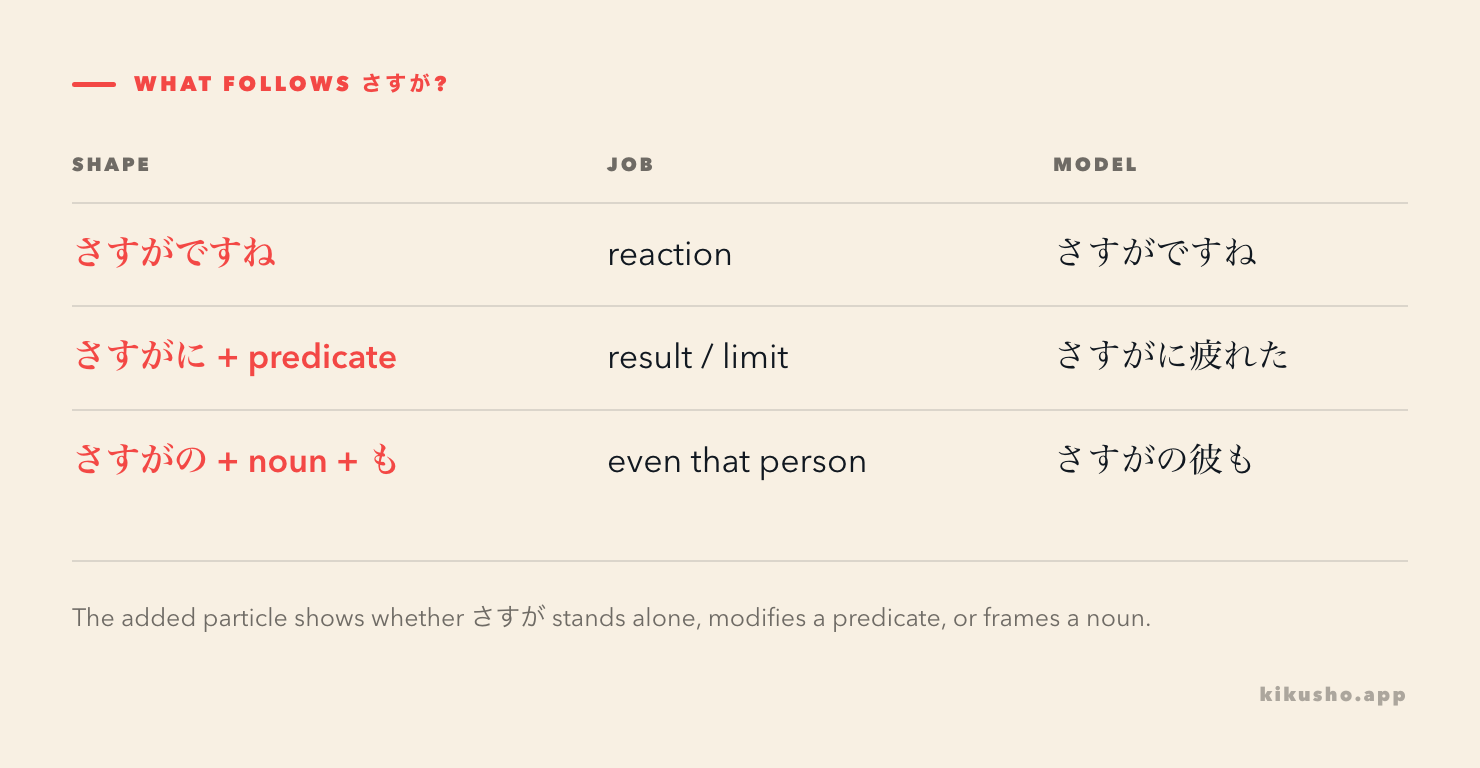
Consider the non-praise use:
一週間も休まずに働くと、さすがに疲れます。
いっしゅうかんも やすまずに はたらくと、さすがに つかれます。
If you work for an entire week without a break, naturally you get tired.
The tiredness fits an expectation created by the extreme condition. Nobody is being complimented. さすがに can therefore be closer to “understandably,” “naturally” or “even I have to admit” than to praise.
The form is not automatically negative. このホテルのサービスは、さすがに丁寧です can acknowledge that the hotel's service is as attentive as its reputation led you to expect. に makes さすが work adverbially; the surrounding evaluation supplies the positive or negative direction.
Now put の before a noun:
さすがの田中さんも、この問題は解けませんでした。
さすがの たなかさんも、この もんだいは とけませんでした。
Even Tanaka, capable as he is, could not solve this problem.
The sentence first acknowledges Tanaka's usual ability, then says the present case exceeded it. Daijisen records both the expectation-confirming use and the さすがの…も pattern that recognizes someone or something's value before presenting an exception.
One event can move through all three stances
Suppose Emi is giving a presentation tomorrow:
- 恵美さんなら、きっとうまくできます。 You predict confidently that Emi will do well.
- ぜひ聞きに来てください。 You strongly encourage someone to attend.
- Afterward, さすが恵美さんですね。 You judge the successful result as fitting Emi's ability.
The time line helps, but it is not the rule. You can say さすが about a fact you just learned, and ぜひ about your own future intention. The reliable distinction is what the speaker contributes: a belief, a wanted action or an evaluation against expectation.
Do not treat the words as politeness levels. All three can appear in polite sentences. ぜひ来てください may sound warm or insistent depending on the relationship and tone; さすがですね may sound sincere, teasing or sarcastic in context. The adverb does not decide the whole register by itself.
N4 is a study placement, especially for さすが
JLPT Sensei places きっと, ぜひ and さすが at N4. Bunpro places さすが at N2, reflecting the wider range of its uses. The JLPT publishes no exhaustive official grammar list, so the level is an editorial estimate.
For N4 production, learn the central contrast and the three visible さすが shapes. Recognizing irony, historical uses and every collocation belongs to a later layer.
Practice: identify the direction of emphasis
Answer all seven questions before consulting the explanations.
Question 1
A friend is nervous about tomorrow's interview. Choose the word that expresses your confident belief.
あなたなら、__大丈夫ですよ。
- ぜひ
- きっと
- さすがの
- さすがに
Question 2
Choose the natural word for an enthusiastic request.
東京に来たら、__連絡してください。
- ぜひ
- きっと
- さすが
- たぶん
Question 3
Your skilled teacher solves a difficult problem immediately. Choose the natural reaction.
- きっとです。
- ぜひですね。
- さすがですね。
- さすがのです。
Question 4
Write a polite sentence meaning “I definitely want to visit Kyoto.” Use ぜひ, 京都へ, 行きたいです.
Question 5
Complete the sentence with the correct form of さすが.
一週間も休まずに働いたので、__疲れました。
Question 6
Explain why さすがの山田さんも答えられませんでした is not simple praise.
Question 7
Read the exchange and choose the best description of the three bold words.
A:発表はきっと成功しますよ。ぜひ見に来てください。
B:(発表の後)すばらしかったです。さすがですね。
- All three words predict the future with the same confidence.
- きっと marks belief, ぜひ strengthens a desired action, and さすが evaluates a result against expectation.
- きっと is a request, ぜひ praises a result, and さすが marks uncertainty.
- All three words make the exchange grammatically polite.
Answers and explanations
1
2. きっと. あなたなら、きっと大丈夫ですよ reassures the friend by expressing strong belief that things will be all right. ぜひ would require a wanted action, while the two さすが forms evaluate something against an expectation.
2
1. ぜひ. ぜひ連絡してください strongly encourages the listener to contact the speaker. きっと would add confident insistence in some contexts, but ぜひ directly matches the enthusiastic request specified here. たぶん weakens certainty, and bare さすが evaluates rather than requests.
3
3. さすがですね. The teacher's successful result matches an existing expectation based on skill. The other choices give きっと and ぜひ copular endings they do not take here or put の before no following noun.
4
ぜひ京都へ行きたいです。 ぜひ strengthens the speaker's wish, and ~たい expresses the desired action. Read it as ぜひきょうとへいきたいです.
5
さすがに. 一週間も休まずに働いたので、さすがに疲れました presents the tiredness as an understandable result after an extreme condition. This is not a compliment.
6
The sentence acknowledges Yamada's usual ability, then says this problem exceeded even that ability. The pattern さすがの + noun + も creates a concession: “even Yamada, capable as he is.” The negative result is the point.
7
2. きっと marks belief, ぜひ strengthens a desired action, and さすが evaluates a result against expectation. The first sentence predicts success, the second invites attendance, and the final reaction confirms the speaker's view of the performance.
Let the omitted action expose ぜひ
The shortest line in this lesson may be the most useful one: ぜひ。 It works only because an invitation has already supplied the action. That omission gives you a practical reading test. If you can recover something the speaker strongly wants done, ぜひ fits; if you recover a confident proposition, look for きっと; if you recover a prior reputation or expectation, look for さすが.
Common questions
What is the difference between きっと and ぜひ?
きっと expresses strong belief about what is true or will happen. ぜひ expresses a strong wish for an action, so it commonly appears with requests, invitations and forms such as たい.
What does さすが mean in Japanese?
さすが signals that a result fits an existing expectation or reputation. As a standalone reaction it often praises someone, while さすがに can also mark an understandable limit or unsurprising result.
Can ぜひ answer an invitation by itself?
Yes. In response to an invitation, ぜひ can mean “I'd be delighted” or “by all means.” The omitted action is understood from the invitation.
Is さすが N4 or N2?
Learner references disagree: JLPT Sensei places it at N4, while Bunpro places さすが at N2. The JLPT does not publish an exhaustive official grammar list.