On this page
Verb-stem + かける leaves an action before its endpoint; verb-stem + 切る carries it completely through; verb-stem + 切れない says the endpoint cannot be reached. The three share one attachment seam, but they make opposite claims about completion.
Ask what happened at the endpoint
Compare one book and three possible states:
この本はまだ読みかけです。
この ほんは まだ よみかけです。
This book is still only partly read.
昨日、この本を読み切りました。
きのう、この ほんを よみきりました。
Yesterday, I read this book all the way through.
長すぎて、今週中には読み切れません。
ながすぎて、こんしゅうちゅうには よみきれません。
It is too long for me to finish this week.
The first sentence stops inside the process. The second reaches the end. The third looks toward the same endpoint but presents it as beyond the speaker's ability or circumstances.
| Form | Endpoint claim | Useful English cue |
|---|---|---|
| V-stem + かける / かけ | the action has started or nearly happened, but is incomplete | partly, started to, almost |
| V-stem + 切る | the action reaches its full limit | finish completely, use up, all the way |
| V-stem + 切れない | the full limit cannot be reached | cannot finish, too much to complete |
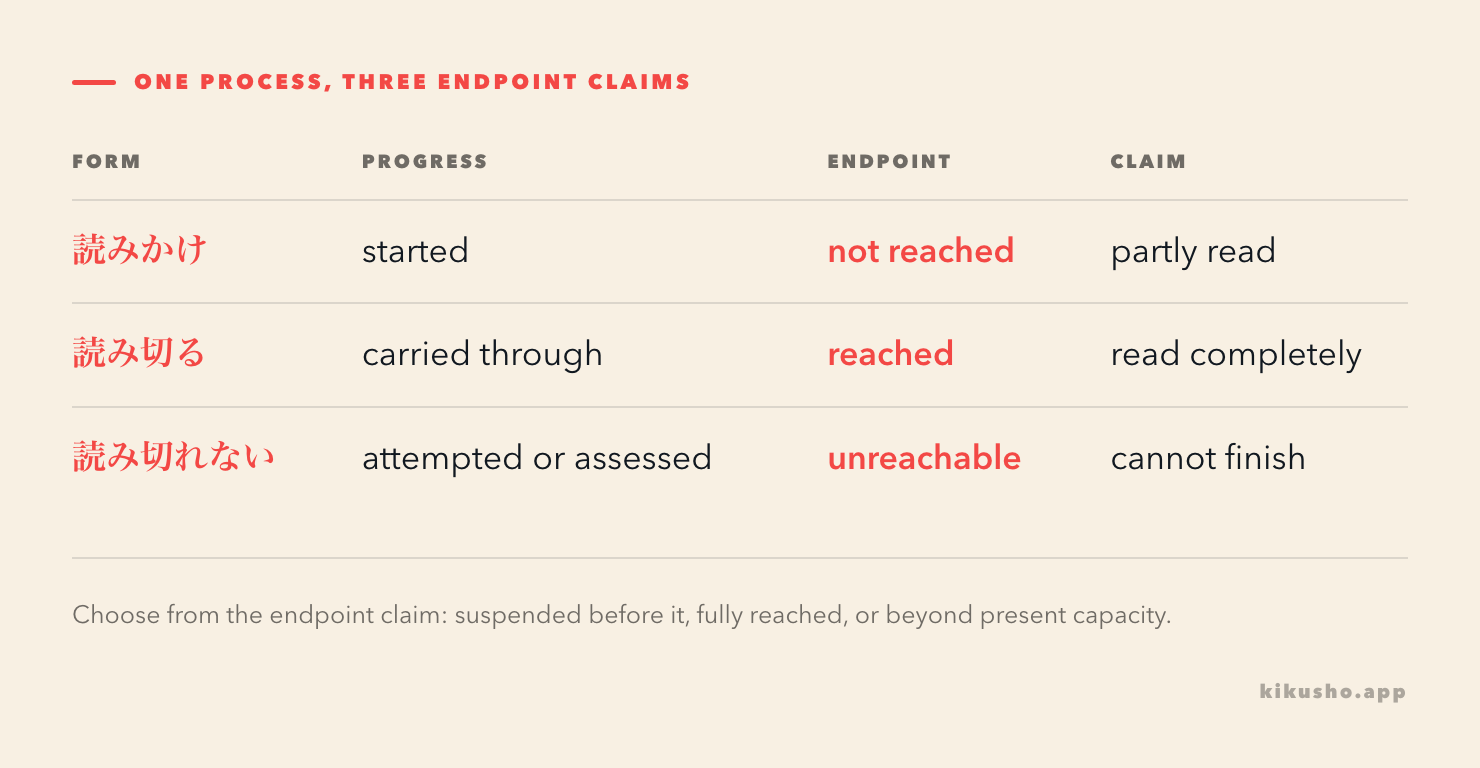
This is more precise than treating all three as general words for “finish.” かける needs incompletion. 切る adds totality. 切れない is potential and negative: the speaker cannot achieve that totality.
Build all three from the ます-stem
Remove ます and attach the second element directly. There is no て or particle between them.
| Dictionary form | ます-form | Stem | Incomplete | Complete | Cannot complete |
|---|---|---|---|---|---|
| 読む | 読みます | 読み | 読みかける | 読み切る | 読み切れない |
| 食べる | 食べます | 食べ | 食べかける | 食べ切る | 食べ切れない |
| 書く | 書きます | 書き | 書きかける | 書き切る | 書き切れない |
| する | します | し | しかける | し切る | し切れない |
Once the compound is built, the final verb carries the grammar of the whole predicate: 読みかけた, 読み切らなかった, 読み切れます. The stem 読み stays fixed.
The seam is the same one used by 始める, 出す, 続ける and 終わる. At N3, the decision becomes narrower: whether an already relevant endpoint remains open, is fully reached, or is unreachable.
かける freezes the action before completion
With an action that takes time, かける presents something begun and unfinished.
テーブルに食べかけのパンがあります。
テーブルに たべかけの パンが あります。
There is a partly eaten piece of bread on the table.
メールを書きかけて、電話に出ました。
メールを かきかけて、でんわに でました。
I stopped partway through writing the email and answered the phone.
The form behaves in several useful ways:
- V-stem + かける continues as a verb: 言いかけてやめた, started to say it and stopped.
- V-stem + かけの + noun modifies a noun: 読みかけの本, a partly read book.
- V-stem + かけだ/です describes a state: 宿題はまだやりかけです, the homework is still unfinished.
With a momentary change, there may be no sensible halfway state. Then かける means “on the verge of”: 危うく階段から落ちかけた, “I nearly fell down the stairs.” The fall did not reach its endpoint. With 食べる or 書く, by contrast, a partial process is easy to see.
Do not replace this with 始める automatically. 本を読み始めた reports that reading began. 読みかけの本 describes a book whose reading has not been completed, often with an interruption or a visible remainder. Beginning is part of the logic, but the unfinished state is what かけ foregrounds.
切る reaches the action's full limit
Use V-stem + 切る when the object, distance, task or commitment is carried through to its relevant limit.
冷蔵庫の野菜を全部使い切りました。
れいぞうこの やさいを ぜんぶ つかいきりました。
I used up all the vegetables in the refrigerator.
最後まで十キロを走り切った。
さいごまで じゅっキロを はしりきった。
I ran the full ten kilometres to the finish.
全部 and 最後まで make the limit visible, but 切る already contributes complete execution. The first sentence leaves no relevant vegetables unused. The second covers the whole distance.
The limit can be a degree rather than a countable object:
一日歩いて、すっかり疲れ切っています。
いちにち あるいて、すっかり つかれきって います。
After walking all day, I am completely exhausted.
彼の説明を信じ切ることはできません。
かれの せつめいを しんじきる ことは できません。
I cannot trust his explanation completely.
Here 切る intensifies the state or commitment toward a full degree. It does not mean physical cutting.
読み終わる and 読み切る can both describe finishing a book. 終わる neutrally marks the endpoint; 切る draws attention to completing the whole amount or carrying the action through. Completion 上げる more often points to a resulting finished product, as in 書き上げる. The lesson on completion 上げる develops that separate contrast.
切れない is inability, not a simple refusal
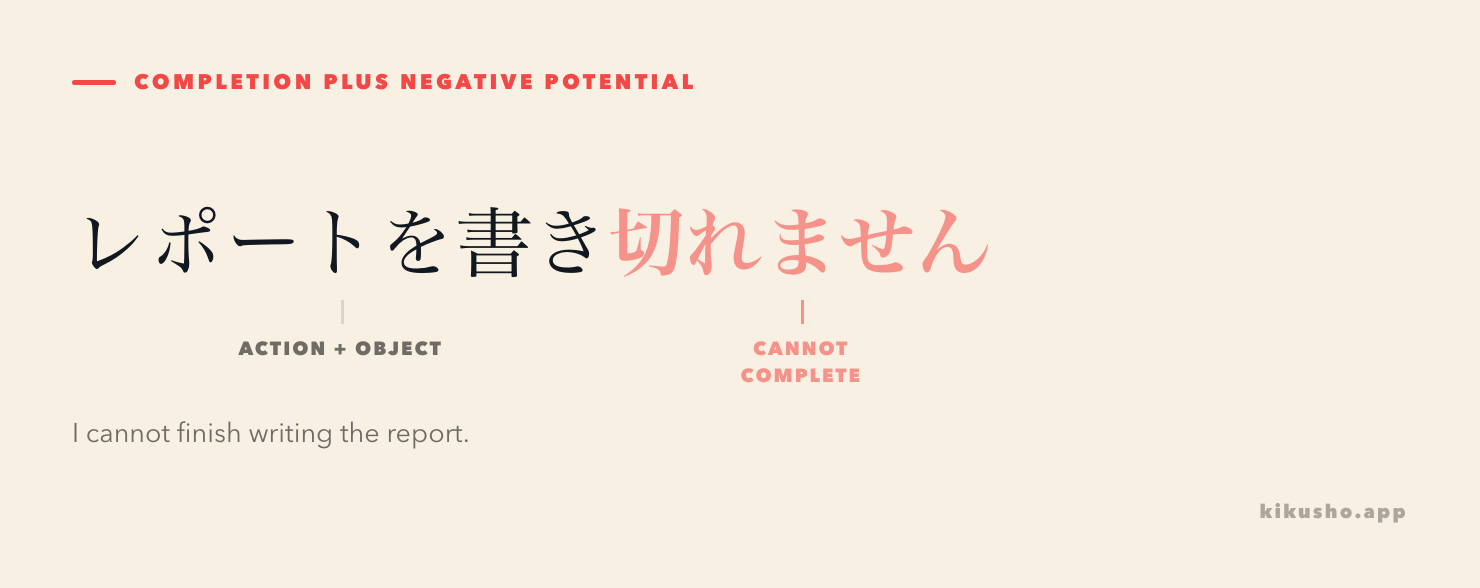
切れない is the negative potential form of 切る. It says the total action is beyond capacity, time, quantity or control.
量が多くて、一人では食べ切れません。
りょうが おおくて、ひとりでは たべきれません。
There is too much for one person to finish.
星が多すぎて、数え切れない。
ほしが おおすぎて、かぞえきれない。
There are too many stars to count.
The first sentence has more food than the eater can manage. The second has more instances than counting can exhaust. V-stem + 切れないほど often turns this limit into a degree expression: 数え切れないほどの星, “more stars than can be counted.”
Compare potential failure with a plain negative:
| Sentence | What the negative says |
|---|---|
| この量は食べ切れない。 | I cannot finish this amount. |
| 今日は全部食べ切らない。 | I will not eat all of it today. |
切らない negates the action and can express a decision or prediction. 切れない says completion is not possible. In polite speech, that pair becomes 食べ切りません versus 食べ切れません.
Some established expressions extend the same limit logic. 待ち切れない means someone cannot wait any longer; the waiting capacity has been exhausted. 抑え切れない means something cannot be fully held back or controlled. The obstacle need not be a physical pile, but the sentence still presents a limit the subject cannot contain.
Read established compounds as whole words
Seeing familiar endings helps, but it does not license a mechanical analysis of every spelling.
出かける means “go out,” not “start leaving and stop.” 話しかける commonly means “address or speak to someone,” not merely “begin speaking incompletely.” 横切る(よこぎる) means “cross,” and the second element is voiced in the complete word. The lesson on lexical compounds shows why the whole word, reading and particle must take priority over a guessed suffix meaning.
The spelling also varies. Productive completion may appear as 読み切る or 読みきる. Kana does not change the construction. Context decides whether 切る is the independent verb “cut,” a productive completion element, or part of an established lexical compound.
JLPT Sensei's かける, 切る and 切れない pages place all three at N3 and give the common stem attachments. Bunpro independently classifies かけ, 切る and 切れない at N3, while distinguishing partial or imminent action, thorough completion and negative potential. The sources agree on placement here. The official JLPT FAQ still matters: N3 is a study-list estimate because the current test publishes no exhaustive grammar specification.
When you save a sentence in Kikusho, keep the quantity or interruption that makes the endpoint visible. 量が多くて、一人では食べ切れない gives a future review a reason for the negative potential. A card reduced to 切れない = cannot loses both the completion target and the evidence that it was unreachable.
Practice: find the endpoint before choosing
Question 1 — grammar choice. The cake has been started but part remains: 冷蔵庫に__のケーキがあります。
① 食べ切った
② 食べかけ
③ 食べ切れない
④ 食べ終わる
Question 2 — grammar choice. You completed every page of a long novel: 長い小説を三日で__。
① 読みかけた
② 読み切った
③ 読み切れなかった
④ 読み出した
Question 3 — sentence composition. Use 一人では, この量, and 食べ切れない to say, “One person cannot finish this amount.”
Question 4 — contrast. Explain the difference between 今日は全部食べ切らない and 今日は全部食べ切れない.
Question 5 — lexical boundary. Why does 友達に話しかけた normally mean “I spoke to my friend” rather than “I began speaking and left the action unfinished”?
Question 6 — text grammar. Read: レポートを書きかけたところで停電になった。翌朝、最後まで書き切った。 What state was the report in at the power cut, and what changed the next morning?
Question 7 — dialogue analysis. A reader asks whether the remaining pages fit into today:
A: この本、今日中に読めそう?
B: まだ百ページあるから、今日は読み切れないと思う。
Which claim does B make?
River. B refuses to read any more today.
Mountain. B has not started the book.
Harbour. B does not expect to reach the book's endpoint today because too much remains.
Forest. B has already finished the final hundred pages.
Answers and explanations
Answer 1: ②, 食べかけ. 食べかけのケーキ describes a cake whose eating was started but not completed. 食べ切った would say it was all consumed, leaving no cake to find.
Answer 2: ②, 読み切った. The prompt says every page was completed. 読み切った carries the reading through to its full limit; かけた leaves it incomplete, and 切れなかった denies the ability to finish.
Answer 3: 一人ではこの量を食べ切れない。 The stem 食べ combines with 切れない. 一人では sets the capacity condition, この量を is the amount, and the compound says that amount cannot be finished.
Answer 4: 食べ切らない is a plain negative: the speaker will not eat everything, which can be a choice. 食べ切れない is negative potential: the speaker cannot eat everything, because the endpoint exceeds their capacity or circumstances.
Answer 5: 話しかける is an established lexical compound meaning to address or speak to someone, commonly with a person marked by に. Recognizing 話し and かける helps with its shape, but the complete word and its construction determine the meaning.
Answer 6: At the power cut, 書きかけた says the report had been started and remained unfinished. The next morning, 書き切った says the writer carried it all the way to completion.
Answer 7: Harbour. まだ百ページある supplies the obstacle, and 読み切れない is negative potential. B predicts that the remaining amount prevents complete reading today; the sentence does not say B refuses to continue.
Common questions
What is the difference between かける and 切る after a verb stem?
Verb-stem かける presents an action as begun or on the verge of happening without reaching completion. Verb-stem 切る presents the action as carried completely through, often until nothing relevant remains.
Is 切れない simply the negative of 切る?
It is the negative potential form: 食べ切れない means “cannot finish eating it.” A plain negative such as 食べ切らない means the person does not or will not eat it all, which describes a choice or prediction rather than inability.
How do かける, 切る and 切れない attach to a verb?
Attach them directly to the ます-stem: 読みかける, 読み切る and 読み切れない. The final element carries tense, politeness and negation while 読み remains fixed.
Does every verb ending in かける or 切る use this grammar?
No. Established compounds can have their own meanings. 出かける means “go out,” 話しかける means “address or speak to,” and 横切る means “cross.” Learn those as complete words instead of forcing the productive grammar onto them.