On this page
幸いなことに (saiwai na koto ni) means “fortunately”, “luckily” or “thankfully”. Put it before a clause to mark the event you are about to report as a fortunate outcome: 幸いなことに、けが人はいなかった means “Fortunately, nobody was injured.”
The phrase gives the speaker's evaluation; it does not by itself explain why the good result happened. That distinction separates it from a causal expression such as おかげで.
幸いなことに evaluates the outcome before stating it
The basic shape is:
幸いなことに、fortunate outcome
幸いなことに、電車には間に合った。
さいわいなことに、でんしゃにはまにあった。
Fortunately, I made the train.
The speaker first tells you how to view the news, then reports what happened. The train was not necessarily the product of anyone's help. The fortunate point may simply be that a feared problem did not occur.
台風が近づいていたが、幸いなことに、飛行機は予定どおり出発した。
たいふうがちかづいていたが、さいわいなことに、ひこうきはよていどおりしゅっぱつした。
A typhoon was approaching, but fortunately the plane departed as scheduled.
The contrast before が creates an expectation of delay. 幸いなことに marks the actual departure as a welcome turn. This pattern is especially useful after mentioning a risk, uncertainty or possible bad result.
Bunpro's account of 幸い and 幸いなことに treats the phrase as a sentence-initial evaluation. JLPT Sensei's N2 lesson likewise gives “fortunately”, “luckily” and “thankfully” as its central meanings.
幸い takes な before ことに
In this expression, 幸い behaves like a な-adjective before こと:
| Form | Typical position | Example |
|---|---|---|
| 幸いなことに | before the event | 幸いなことに、全員無事だった |
| 幸い | before the event, compact | 幸い、全員無事だった |
| 幸いにも | before the event, marked adverbial form | 幸いにも、全員無事だった |
| 幸いだったことに | looking back on what proved fortunate | 幸いだったことに、雨は夜まで降らなかった |
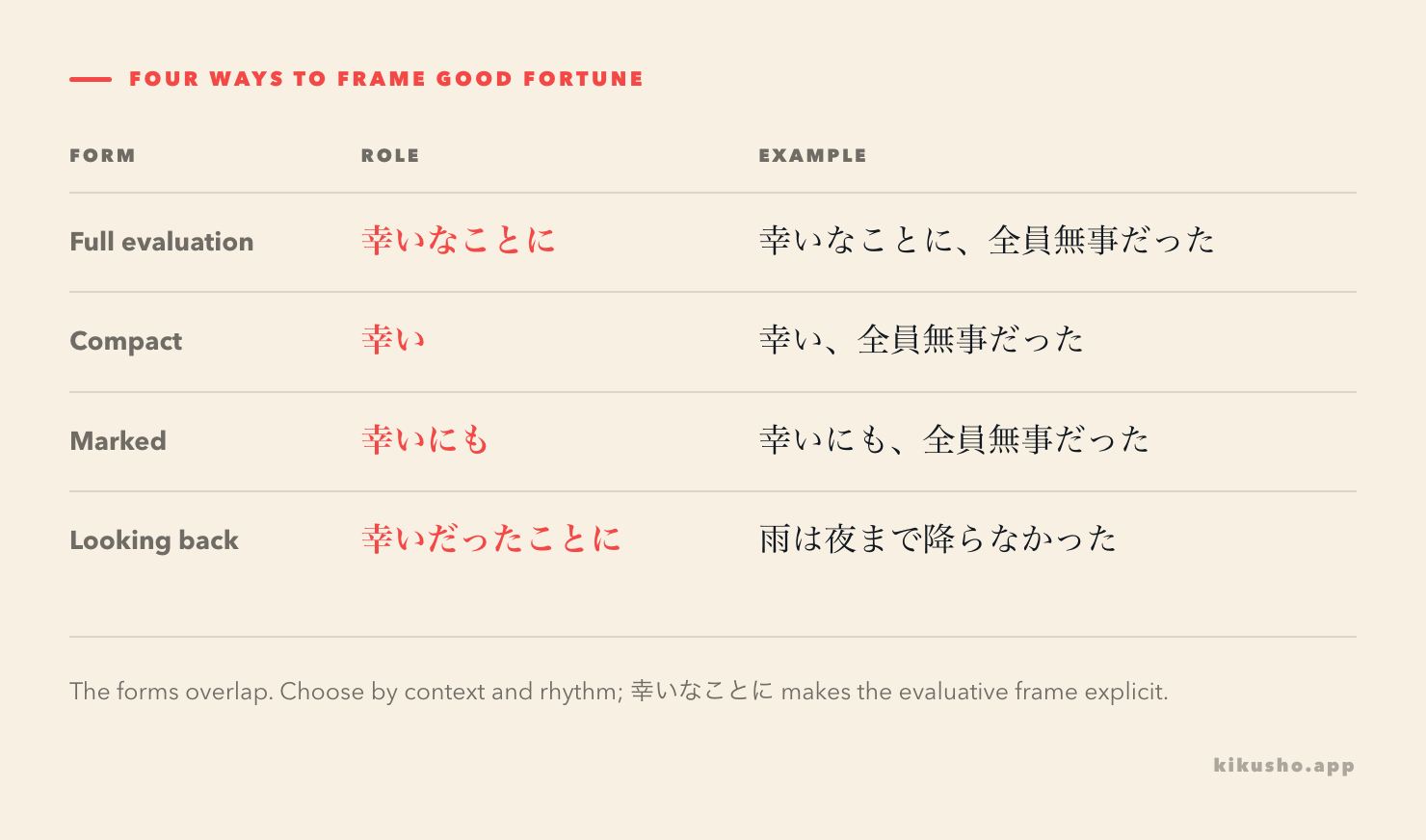
The な is required in the full present form because こと is a noun: 幸いなことに, not 幸いことに. The whole expression belongs to the broader evaluation + ことに pattern. Compare 残念なことに (“regrettably”), ありがたいことに (“thankfully”) and 驚いたことに (“to my surprise”). The lesson on reaction ことに explains the attachment of verbs and both adjective types.
Do not turn the table into a rule that every form is equally natural in every sentence. 幸いなことに is an explicit, neutral way to guide the reader's interpretation. The shorter 幸い is common in concise reports. 幸いにも adds the particle も, which can make the favourable turn more marked.
The following clause states what turned out well
The material after 幸いなことに normally presents an established situation. It is news the speaker can already evaluate, rather than a wish about what might happen.
幸いなことに、検査では異常が見つからなかった。
さいわいなことに、けんさではいじょうがみつからなかった。
Fortunately, the examination found no abnormality.
財布を落としたが、幸いなことに、交番に届いていた。
さいふをおとしたが、さいわいなことに、こうばんにとどいていた。
I lost my wallet, but fortunately it had been handed in at a police box.
A negative predicate can describe the fortunate result: 異常が見つからなかった is good news. A past event can also supply it: 届いていた reports the welcome fact already discovered. Choose the phrase by the outcome's value to the speaker, not by whether the verb is affirmative or negative.
Japanese NET's explanation of evaluative ことに describes the material after this frame as an observed fact or an outcome the speaker treats as settled. That is why 幸いなことに、明日は晴れてほしい is awkward if you only mean “Fortunately, I want tomorrow to be sunny”: wanting does not establish a fortunate outcome. Say what happened, what is true, or what has been reliably determined.
幸い, 幸いにも and 幸いなことに overlap
These three sentences can describe the same result:
幸い、火はすぐに消えた。
幸いにも、火はすぐに消えた。
幸いなことに、火はすぐに消えた。
Fortunately, the fire went out quickly.
The compact 幸い fits a restrained report. 幸いなことに overtly presents the result through the evaluative ことに frame. 幸いにも is also adverbial and can draw more attention to the favourable turn or to the speaker's involvement in judging it.
These are tendencies, not three rigid meanings. A study from Okayama University comparing 幸い and 幸いにも finds substantial overlap while examining differences in how the speaker relates to the event. Context, rhythm and genre still matter. For production, first learn the reliable full form 幸いなことに; then notice which shorter form native texts choose.
おかげで names a cause; 幸いなことに does not
Both expressions can appear near good news, but they perform different jobs:
| Expression | Main job | Question it answers |
|---|---|---|
| 幸いなことに | evaluates the reported outcome | Was this fortunate? |
| おかげで | credits a cause for a welcome result | What helped produce it? |
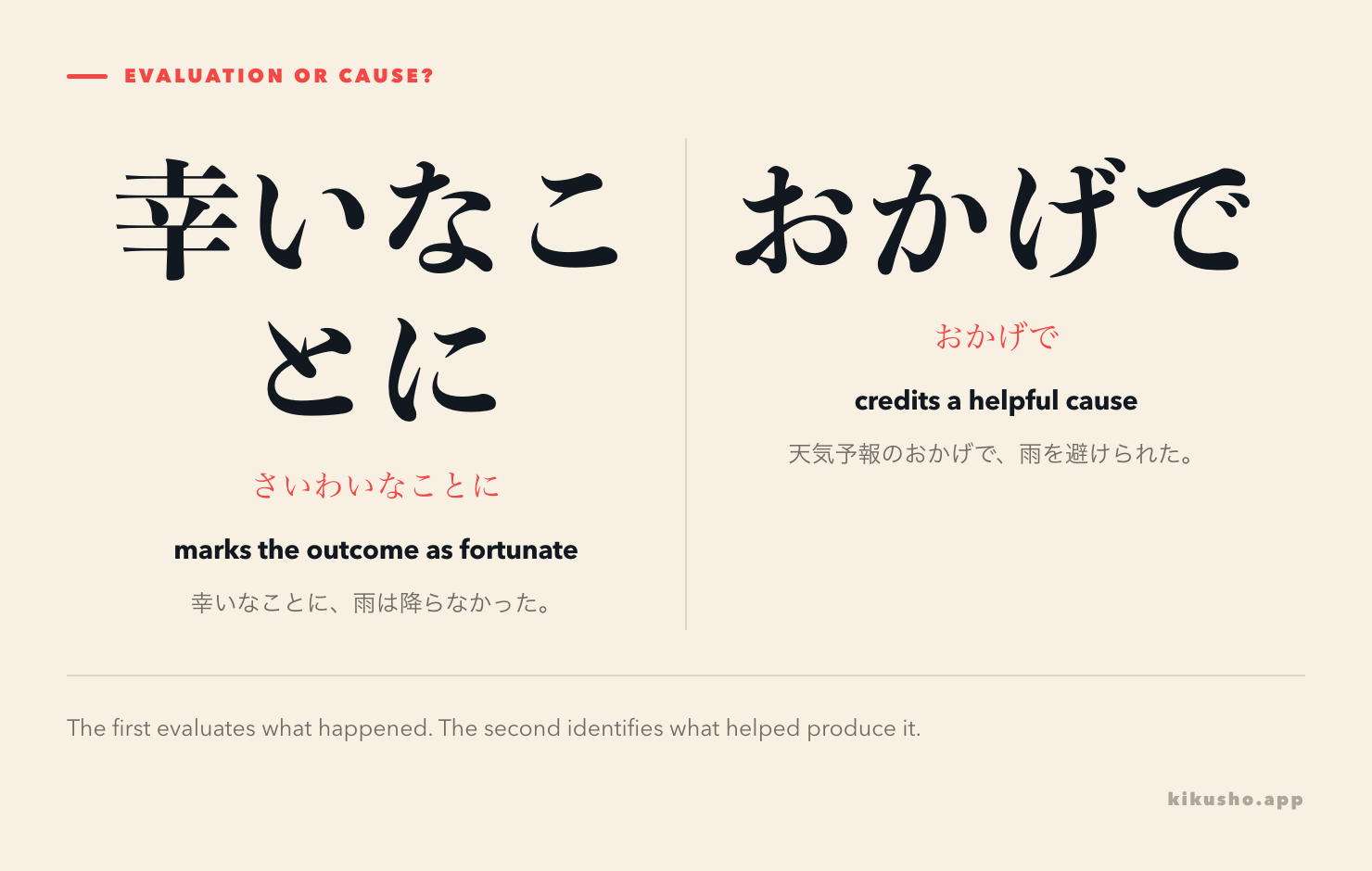
幸いなことに、雨は降らなかった。
Fortunately, it did not rain.
天気予報のおかげで、雨を避けることができた。
Thanks to the weather forecast, we were able to avoid the rain.
The first sentence does not tell us what prevented the rain. It only presents the dry weather as fortunate. The second names the forecast as useful information that enabled the result. The おかげで and せいで comparison develops credit, blame and attachment in detail.
You can use both when each has a clear role:
幸いなことに、近所の人がすぐ知らせてくれたおかげで、大きな被害はなかった。
Fortunately, thanks to a neighbour alerting us immediately, there was no serious damage.
幸いなことに evaluates the lack of serious damage; 知らせてくれたおかげで credits the neighbour's action as its cause.
~ば幸いです is a separate request formula
The same word 幸い appears in polite requests and hopes:
金曜日までにご確認いただければ幸いです。
きんようびまでにごかくにんいただければさいわいです。
I would appreciate it if you could check it by Friday.
This is not a report that a fortunate event occurred. ~ば幸いです places a conditional form before 幸いです and politely presents the requested action as something the speaker would welcome.
Compare the time direction:
- 幸いなことに、ご確認いただけました: fortunately, you were able to check it; the result is reported.
- ご確認いただければ幸いです: I would appreciate it if you could check it; the action is requested or hoped for.
Do not translate both by matching the word “fortunate”. Ask whether the sentence evaluates established news or encourages a future action.
Register and placement
幸いなことに is at home in careful speech, news-like explanation and writing. It can sound heavier than a casual よかった in friendly conversation. After hearing that a friend's lost keys were found, 見つかってよかったね is a natural personal reaction; 幸いなことに、鍵は見つかりました sounds like a composed report.
The phrase usually comes near the beginning of the clause it evaluates and is often followed by a comma in writing. It may follow a scene-setting or contrast clause, as in 事故が起きたが、幸いなことに、けが人はいなかった. Keep it close enough to the result that its scope is clear.
Kikusho's September 2026 inventory, Bunpro and JLPT Sensei place this expression at N2. The level is a study guide rather than an official exhaustive syllabus, because the JLPT does not publish a complete grammar list.
When you save a real example in Kikusho, retain the feared or possible bad outcome as context. A card with only 幸いなことに = fortunately tests a translation; a card that contrasts a delayed flight with one that left on time tests why the evaluation belongs there. Also label ~ば幸いです separately so a polite request is not mistaken for reported good news.
Practice: identify the fortunate evaluation
Work through the six situations, then open the single explanation block to check both form and meaning.
Question 1
The test results showed no serious problem. Choose the correct full expression.
( )、検査では大きな問題が見つからなかった。
A. 幸いことに
B. 幸いなことに
C. 幸いのことに
D. 幸いだことに
Question 2
Which sentence credits the map as the cause of a welcome result?
A. 幸いなことに、地図だった。
B. 地図が幸いなことに、駅に着いた。
C. 地図のおかげで、迷わず駅に着いた。
D. 地図の幸いにも、駅に着いた。
Question 3
Insert only the compact adverbial form 幸い. Do not add ことに.
雨が心配だったが、( )、試合は予定どおり行われた。
Question 4
Turn the following request into a sentence using ~ば幸いです.
Please send your reply by Monday.
月曜日までにご返信________。
Question 5
Is the following sentence reporting a fortunate outcome or making a request? Explain the clue.
資料を読んでいただければ幸いです。
Question 6
Write one sentence meaning “The road was icy, but fortunately nobody was injured.” Use 道が凍っていた, 幸いなことに, and けが人はいなかった.
Answers and explanations
Explanation 1
B, 幸いなことに. 幸い takes な before the noun こと. The following negative predicate is still good news: finding no serious problem is the fortunate outcome.
Explanation 2
C. 地図のおかげで names and credits the map as the helpful cause of reaching the station without getting lost. 幸いなことに could evaluate that whole outcome, but it would not connect the map to it as the cause.
Explanation 3
幸い. The complete sentence is 雨が心配だったが、幸い、試合は予定どおり行われた. The compact sentence adverb evaluates the match going ahead as fortunate.
Explanation 4
月曜日までにご返信いただければ幸いです。 The conditional いただければ presents receiving the reply as something the speaker would appreciate. This is a polite request, not a report of a completed result.
Explanation 5
It makes a request: “I would appreciate it if you would read the material.” The conditional いただければ before 幸いです points to an action the speaker hopes the listener will take. Reported good news would use a form such as 幸いなことに、資料を読んでいただけました.
Explanation 6
One natural answer is 道が凍っていたが、幸いなことに、けが人はいなかった. The first clause establishes the danger, and 幸いなことに frames the absence of injuries as the fortunate outcome.
Common questions
What does 幸いなことに mean?
幸いなことに means “fortunately”, “luckily” or “thankfully”. It appears before a clause and tells the listener that the speaker regards the outcome as fortunate.
What is the difference between 幸いなことに and 幸いにも?
Both can introduce a fortunate outcome, and their uses overlap. 幸いなことに spells out the evaluative ことに frame; 幸いにも is a compact adverbial form and can make the speaker's fortunate evaluation more prominent in context.
How is 幸いなことに different from おかげで?
幸いなことに evaluates the following event as fortunate without naming its cause. おかげで connects a cause to a welcome result and gives that cause credit.
Is ~ば幸いです the same grammar?
No. ~ば幸いです is a polite formula meaning “I would appreciate it if…” or “I hope…”. 幸いなことに is a sentence adverb that reports an outcome the speaker considers fortunate.