On this page
Verb て-form + すみません apologizes for an event; verb て-form + よかった says you are glad the event happened. Compare 遅れてすみません, “I am sorry for being late,” with 早く来てよかったです, “I am glad I came early.”
Both constructions place the event first and the reaction second. The important choice is the speaker's response: apology with すみません, or relief and satisfaction with よかった.
One event, two possible reactions
Start with an ordinary verb て-form, then add the reaction.
| Construction | Speaker's reaction | Example |
|---|---|---|
| verb て-form + すみません | apology for the event | 遅れてすみません。 |
| verb て-form + よかったです | glad the event happened | 間に合ってよかったです。 |
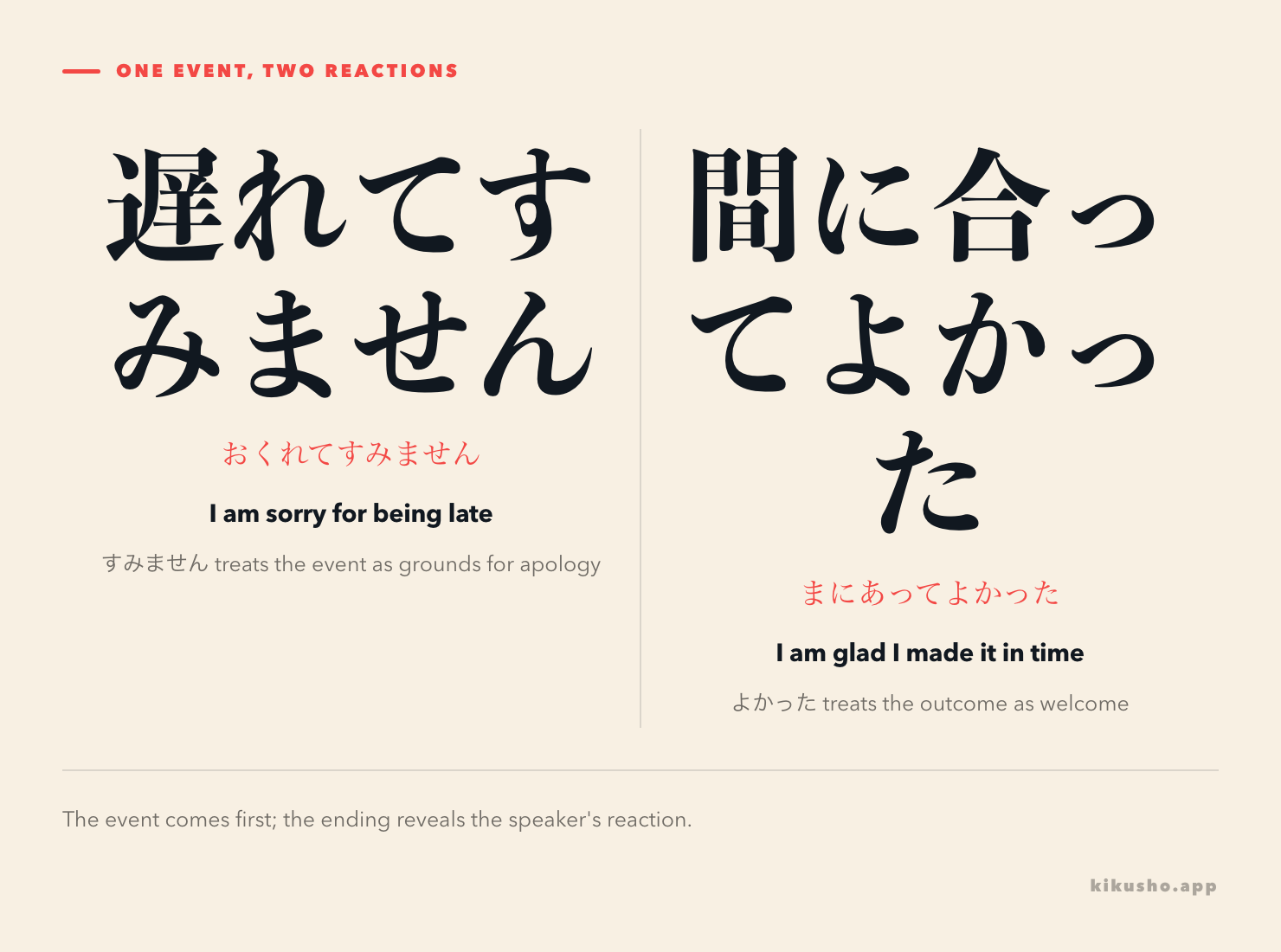
The first part does more than list an earlier action. It supplies the event that causes the reaction, much like the cause-and-result connection in ~て, ~くて and ~で. Here, however, the second part is fixed to an apology or to a judgment that the outcome was good.
Use てすみません to name what you apologize for
~てすみません lets the speaker attach an apology directly to an action, change or inconvenience.
返事が遅くなってすみません。
へんじがおそくなってすみません。
I am sorry my reply was late.
The event is 返事が遅くなった. Its connecting form, 遅くなって, tells the listener what prompted the apology.
お待たせしてすみません。
おまたせしてすみません。
I am sorry for keeping you waiting.
心配をかけてすみません。
しんぱいをかけてすみません。
I am sorry for worrying you.
The action can be deliberate, accidental or simply an unwanted result. The construction does not itself say whether the speaker intended it. It says that the speaker treats that event as grounds for apology.
すみません has other jobs when it stands alone: it can get someone's attention, preface a request or sometimes express thanks for trouble taken. In verb て-form + すみません, the preceding event identifies the apologised-for matter. 来てすみません therefore means “I am sorry for coming,” not “thank you for coming.” To thank the other person for coming, use 来てくれてありがとうございます.
The negative form apologizes for what did not happen
For a negative event, change ない to なくて before the reaction.
| Dictionary form | Negative | Before すみません | Meaning |
|---|---|---|---|
| 連絡する | 連絡しない | 連絡しなくてすみません | sorry for not contacting you |
| 電話に出る | 電話に出られない | 電話に出られなくてすみません | sorry I could not answer the phone |
| 手伝う | 手伝えない | 手伝えなくてすみません | sorry I cannot help |
昨日、電話に出られなくてすみません。
きのう、でんわにでられなくてすみません。
I am sorry I could not answer the phone yesterday.
The apology concerns the negative event 出られなかった. Do not keep ない unchanged before this pattern: ✗出られないてすみません incorrectly stacks the endings.
This negative connection may describe a past failure or a present limitation. Time words and the surrounding message locate the event. 今は手伝えなくてすみません concerns the current situation; 昨日は手伝えなくてすみませんでした looks back at yesterday.
Use てよかった when the outcome brings relief
よかった is the past form of いい, but verb て-form + よかった is best learned as one reaction: “I am glad that …” or “It was good that …”.
早く予約してよかったです。
はやくよやくしてよかったです。
I am glad I booked early.
電車に間に合ってよかった。
でんしゃにまにあってよかった。
I am glad I made the train.
弟が無事に帰ってきてよかった。
おとうとがぶじにかえってきてよかった。
I am glad my younger brother came home safely.
The person who performed the first action need not be the person who feels glad. In the final example, 弟 returned, while the speaker evaluates that return. When no evaluator is stated, the reaction normally belongs to the speaker or to the viewpoint already established in the conversation.
Add です for a polite sentence: よかったです. The plain よかった is common with friends and in inner speech. Because よかった already contains past morphology, ✗よかったでした is not the polite form.
なくてよかった means the negative outcome was welcome
The same negative connecting form works before よかった:
パスポートを忘れなくてよかった。
パスポートをわすれなくてよかった。
I am glad I did not forget my passport.
あの店に行かなくてよかった。
あのみせにいかなくてよかった。
I am glad I did not go to that shop.
The negative belongs to the event, not to the reaction. 行かなくてよかった says that not going was fortunate. It does not mean that the speaker failed to go and regrets it.
Adjectives and nouns can also feed a favorable evaluation through their connecting forms:
ホテルが高くなくてよかったです。
I am glad the hotel was not expensive.
会場が静かでよかったです。
I am glad the venue was quiet.
This flexibility does not make every adjective natural before すみません. ✗静かですみません is unlikely to express a useful apology. Name the action or effect that created the problem: うるさくしてすみません, “I am sorry for making noise.”
Four booking forms separate relief from regret
The most useful comparison changes two choices: whether the booking happened, and whether the speaker welcomes or regrets that outcome.
| Form | What happened? | Reaction |
|---|---|---|
| 予約してよかった | I booked | I am glad I booked |
| 予約しなくてよかった | I did not book | I am glad I did not book |
| 予約すればよかった | I did not book | I wish I had booked |
| 予約しなければよかった | I booked | I wish I had not booked |
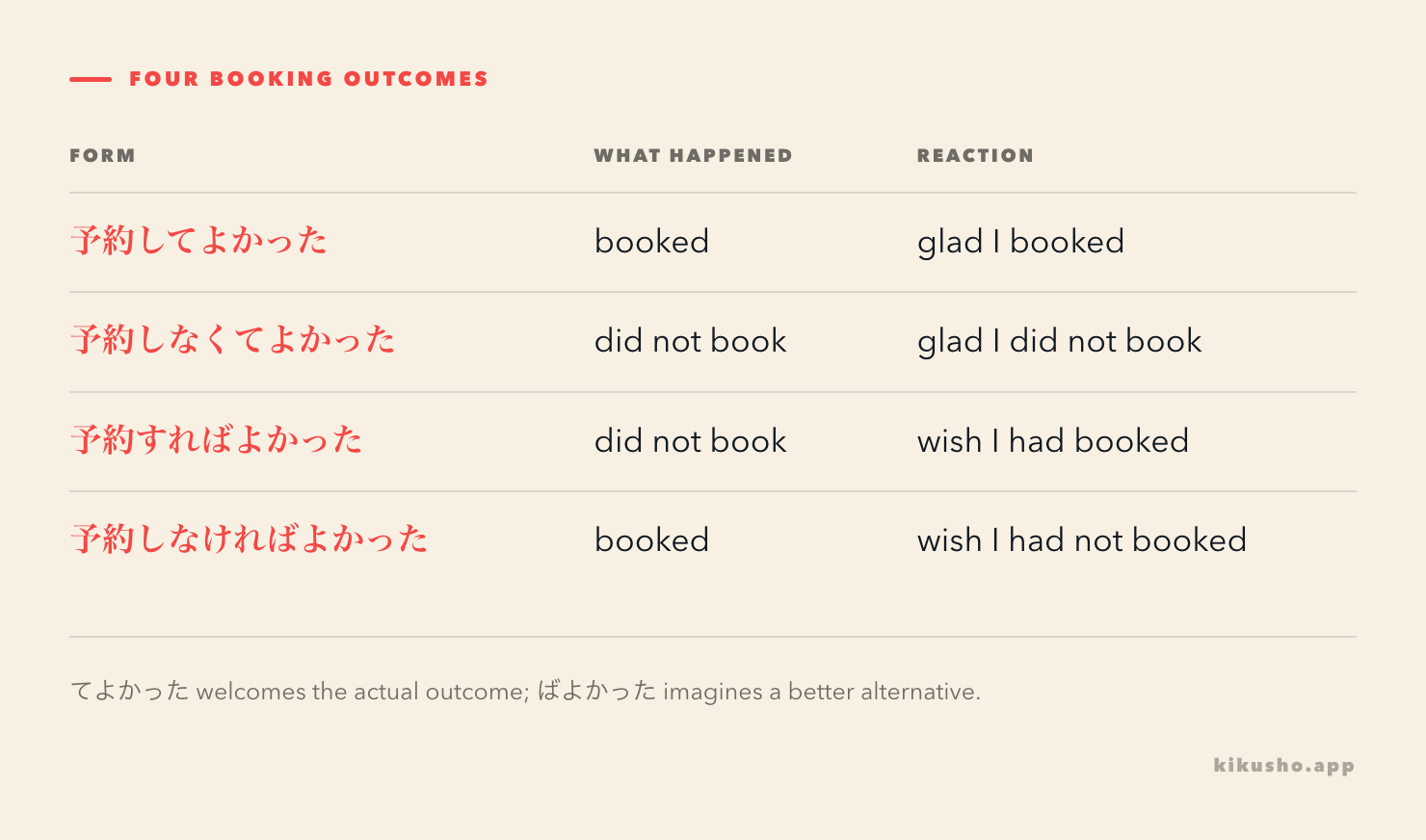
~てよかった evaluates what actually happened as good. ~ばよかった looks toward an unrealised alternative and expresses regret.
ホテルが満室でした。早く予約してよかったです。
The hotel was fully booked. I am glad I reserved early.
ホテルが満室でした。早く予約すればよかったです。
The hotel was fully booked. I wish I had reserved early.
The first speaker has a reservation; the second does not. English “it would have been good” can blur the distinction, so check the actual outcome before choosing the Japanese form.
Match the apology to the relationship
The grammar identifies the event, but the final apology sets the register.
| Situation | Natural choice | Register |
|---|---|---|
| friend | 遅れてごめん。 | casual |
| ordinary polite exchange | 遅れてすみません。 | polite |
| formal message | ご連絡が遅くなり、申し訳ありません。 | formal |
すみませんでした can acknowledge an inconvenience when looking back: 昨日は遅れてすみませんでした, “I am sorry I was late yesterday.” Present すみません can still apologize now for a completed event, so tense is not a mechanical past-versus-present choice. The past form adds retrospective acknowledgement.
For a serious mistake or a formal business apology, grammatical ~てすみません may still sound too light by itself. Use a suitable formal expression, acknowledge the effect and explain the remedy when the situation requires it. The pattern is a language tool, not a complete apology strategy.
Save the event and the reaction together
A card that shows only よかった = was good hides the choice this lesson trains. In Kikusho, save 早く予約してよかった as one sentence, then edit one part at a time. Replacing して with しなくて reverses the event; replacing よかった with すみません changes the speaker's reaction and may require a more plausible event.
Keep context on the back of the card: “The hotel later sold out” makes 予約してよかった memorable. Kikusho lets you edit generated cards, so you can preserve the event that produced the relief instead of reviewing an isolated ending.
Practice
Complete all seven questions before opening the shared answer block.
Question 1. Your reply was late. Choose the natural apology.
- ア. 返事が遅くなってすみません。
- イ. 返事が遅くなってよかったです。
- ウ. 返事が遅くなるてすみません。
- エ. 返事が遅くてよかったすみません。
Question 2. You caught the last train. Complete: 終電に間に合って__。
- ア. すみません
- イ. よかったです
- ウ. ばよかったです
- エ. よくないてす
Question 3. Which sentence correctly apologizes for being unable to answer the phone?
- ア. 電話に出られないてすみません。
- イ. 電話に出られなくてすみません。
- ウ. 電話に出られなくてよかったです。
- エ. 電話に出ればすみません。
Question 4. Put these parts in order to mean “I am glad I booked early.”
- よかったです
- 早く
- 予約して
Question 5. The hotel is full and you did not reserve a room. Which sentence expresses your regret?
- ア. 予約してよかったです。
- イ. 予約しなくてよかったです。
- ウ. 予約すればよかったです。
- エ. 予約しなければよかったです。
Question 6. Which line best fits a formal email about a late reply?
- ア. 返事が遅くてごめん。
- イ. ご連絡が遅くなり、申し訳ありません。
- ウ. 返事が遅くなってよかったです。
- エ. 返事を遅くしてありがとう。
Question 7. Read the hotel scene. Which ending completes its final sentence?
旅行の一週間前にホテルを予約しました。当日、近くのホテルは全部満室でした。早く予約して__。
- ア. すみませんでした
- イ. よかったです
- ウ. すればよかったです
- エ. しなくてよかったです
Answers and explanations
Answer 1. ア. 返事が遅くなってすみません. 遅くなって names the change that prompted the apology. イ expresses gladness about the delay, while ウ and エ combine forms incorrectly.
Answer 2. イ. よかったです. Making the last train is a welcome completed outcome, so 間に合ってよかったです expresses relief. ばよかった would require a conditional form such as 間に合えばよかった and would express regret about not making it.
Answer 3. イ. 電話に出られなくてすみません. The negative potential 出られない changes to 出られなくて before the apology. ウ is grammatical but says the speaker is glad about not answering, which contradicts the prompt.
Answer 4. 早く予約してよかったです. 早く modifies the booking, 予約して supplies the completed event, and よかったです gives the polite reaction.
Answer 5. ウ. 予約すればよかったです. The speaker did not book and now imagines booking as the better alternative. ア says the booking happened and was welcome; イ says not booking was welcome; エ says the booking happened and is now regretted.
Answer 6. イ. ご連絡が遅くなり、申し訳ありません. It uses formal wording suitable for a business message. ア is casual, ウ welcomes the delay, and エ thanks the recipient for an action they did not perform.
Answer 7. イ. よかったです. The speaker did reserve, and the later lack of rooms confirms that the action was fortunate. すればよかった would fit someone who had failed to reserve.
Level evidence and source limits
JLPT Sensei labels てすみません N4 and independently lists てよかった at N4. Bunpro also assigns N4 to てすみません and てよかった, including affirmative and negative attachments.
Tokyo University of Foreign Studies uses 遅れてすみません in an elementary dialogue, supporting the event-plus-apology analysis in connected speech. University of Tokyo Publishing's grammar notes distinguish ~てよかった from regret with ~ばよかった, the contrast used in the booking table.
These publishers agree on the forms taught here; no external level disagreement was found. The official JLPT site describes task types rather than publishing an exhaustive grammar syllabus, so N4 remains a reference-based estimate. Ordinary て-form and negative conjugation are prerequisites.
Codex, an AI agent, checked the attachments, readings, translations, register distinctions and exercise answers against the independent references above and the saved Kikusho inventory. No human language review is claimed.
Common questions
What is the difference between てすみません and てよかった?
Both connect an event to a reaction. Verb て-form + すみません apologizes for the event, while verb て-form + よかった says the speaker is glad it happened.
How do you apologize for not doing something in Japanese?
Change the verb to its negative connecting form and add すみません, as in 連絡しなくてすみません, “I am sorry I did not contact you.”
What is the difference between てよかった and ばよかった?
予約してよかった means “I am glad I booked,” after the action happened. 予約すればよかった means “I wish I had booked,” after the action did not happen.
Can すみませんでした apologize for a completed event?
Yes. すみませんでした looks back and acknowledges an inconvenience, while すみません can apologize at the present moment even when the event itself has already happened.