On this page
せいか (sei ka) means “perhaps because” or “maybe due to”. It connects a suspected cause to an observed result, while か tells the listener that the speaker is not committing to that explanation.
寝不足のせいか、今日は集中できない。
ねぶそくのせいか、きょうはしゅうちゅうできない。
Perhaps because I did not get enough sleep, I cannot concentrate today.
You know that your concentration is poor. You suspect lack of sleep, but you leave room for another cause.
せいか presents a cause as a hypothesis
The sentence has two parts:
suspected cause + せいか、observed result
昨日遅くまで働いたせいか、頭が重い。
きのうおそくまではたらいたせいか、あたまがおもい。
Maybe because I worked late yesterday, my head feels heavy.
The result 頭が重い is available to the speaker now. The preceding clause proposes an explanation for it. English often uses “maybe because”, “perhaps because” or “possibly due to”; none of those translations should be read as a confident diagnosis.
The Japan Foundation's teaching material groups せいか with せいだ and せいで, but assigns it a distinct job: the speaker guesses that the first event or state may be responsible for the bad result that follows. Iku's N2 account likewise describes an uncertain cause and contrasts it with the more definite せいで.
The uncertainty concerns the causal link. 頭が重い can be certain even though 遅くまで働いた is only a possible explanation. Do not weaken both halves into “maybe I worked late and maybe my head feels heavy.”
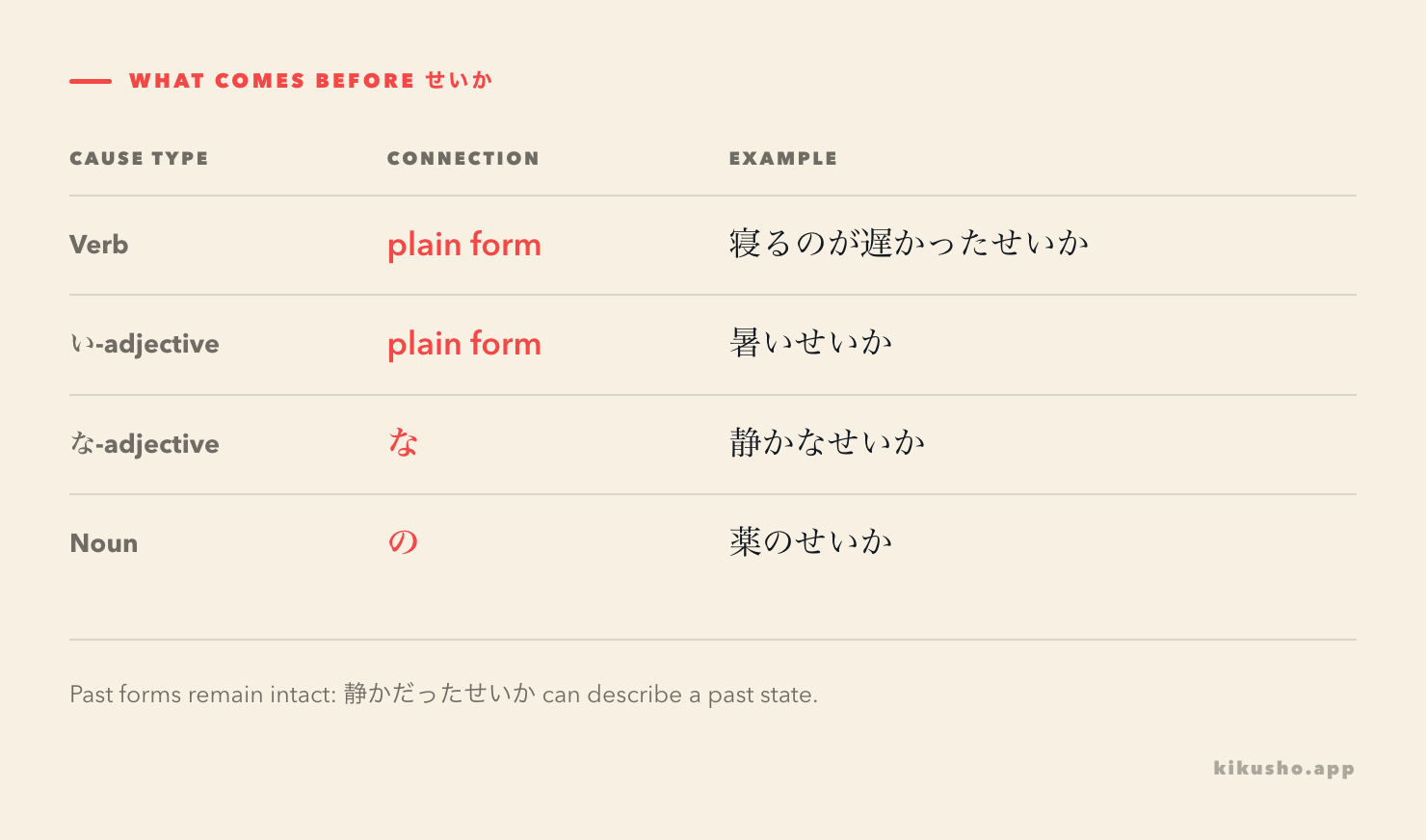
Plain forms attach before せいか
The material before せいか modifies the noun せい. That gives the same attachment pattern as せいで:
| Cause class | Required bridge | Model phrase |
|---|---|---|
| Plain verb clause | none | 寝るのが遅かったせいか |
| Word ending in い | none | 暑いせいか |
| な-adjective | な | 静かなせいか |
| Noun phrase | の | 薬のせいか |
部屋が暑いせいか、よく眠れなかった。
へやがあついせいか、よくねむれなかった。
Perhaps because the room was hot, I did not sleep well.
薬のせいか、朝からずっと眠い。
くすりのせいか、あさからずっとねむい。
Maybe because of the medicine, I have been sleepy since morning.
周りが静かなせいか、時計の音が気になる。
まわりがしずかなせいか、とけいのおとがきになる。
Perhaps because it is quiet around me, the sound of the clock bothers me.
Do not use だ after a present noun or な-adjective: 薬だせいか and 静かだせいか are malformed. Past forms remain intact, so 静かだったせいか is possible when the quiet situation belongs to the past.
The final か reduces commitment
Compare one result with two versions of its cause:
コーヒーを飲んだせいで、眠れなかった。
Because I drank coffee, I could not sleep.
コーヒーを飲んだせいか、眠れなかった。
Perhaps because I drank coffee, I could not sleep.
The first speaker attributes the sleeplessness to coffee. The second suspects coffee but does not rule out stress, noise or another explanation. This small か changes how strongly the speaker stands behind the cause.
It is related to the uncertainty of a question particle, but the sentence as a whole is not a direct question. コーヒーを飲んだせいか? can be asked as a question in the right conversation; コーヒーを飲んだせいか、眠れなかった is a statement whose causal phrase is hedged.
The Japan Foundation's structural account gives plain clause or noun + せいか + result, with nouns taking の and な-adjectives taking な. Its examples consistently treat the cause as the speaker's inference rather than an established fact.
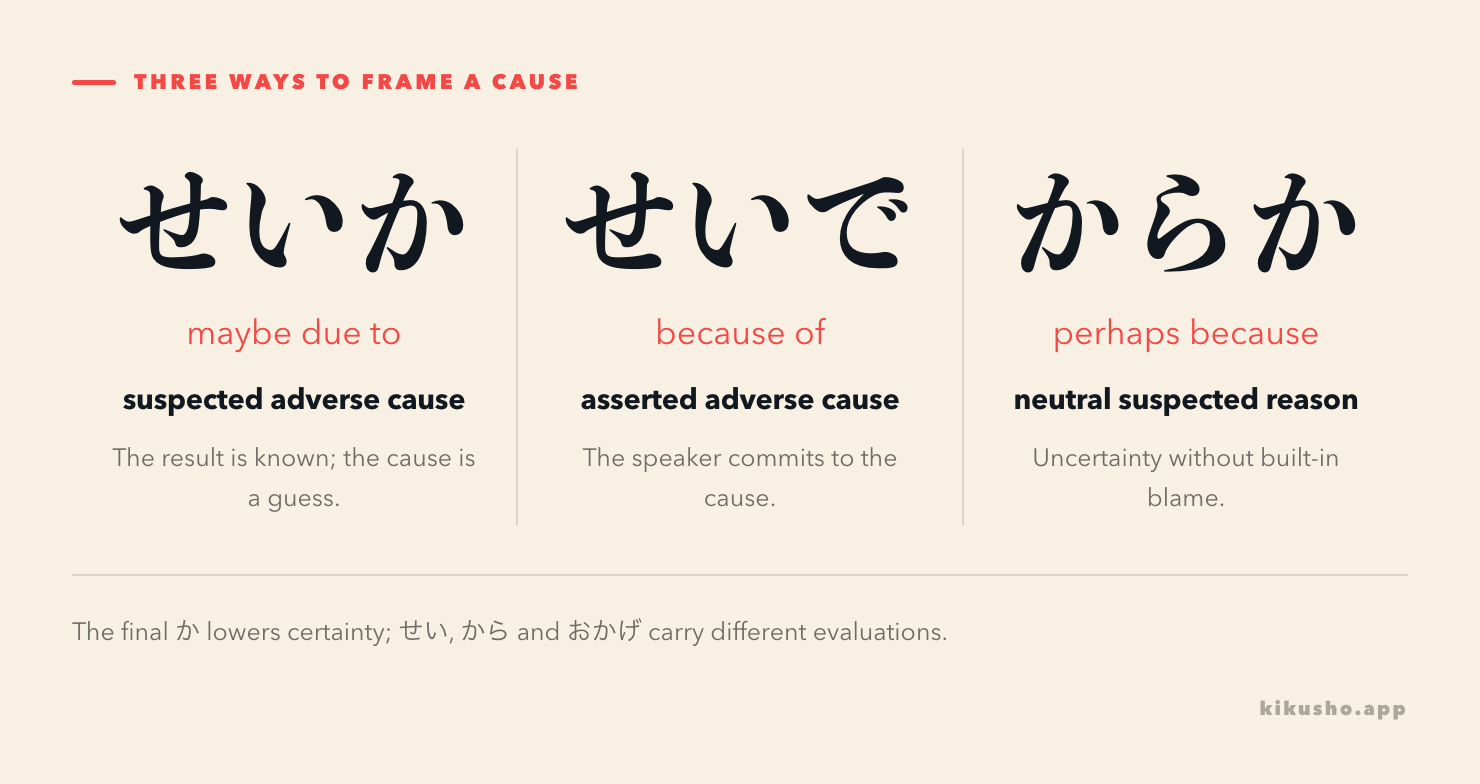
せいか guesses; せいで assigns
Both forms inherit the evaluative force of せい, so they commonly lead to an unwanted result. The practical test is certainty:
| Form | Commitment to the cause | Usual effect |
|---|---|---|
| せいか | tentative | “perhaps because…” |
| せいで | asserted | “because of…” with blame or criticism |
| からか | tentative and more neutral | “perhaps because…” without built-in blame |
緊張したせいか、面接でうまく話せなかった。
Maybe because I was nervous, I could not speak well in the interview.
緊張したせいで、面接でうまく話せなかった。
Because I was nervous, I could not speak well in the interview.
The first sentence sounds like reflection after the event. The second identifies nervousness as the cause. The おかげで and せいで comparison develops the underlying contrast between welcome credit and unwelcome responsibility.
This does not make せいか polite blame. It softens certainty about the cause, not the negative evaluation in せい. あなたのせいか、失敗した still puts the listener near an accusation, even if the speaker claims uncertainty. Use a neutral reason phrase if you do not want that implication.
からか removes the built-in negative judgement
Japanese can also add か to から:
よく寝たからか、今日は集中しやすい。
よくねたからか、きょうはしゅうちゅうしやすい。
Perhaps because I slept well, it is easy to concentrate today.
The Japan Foundation explains からか as a blurred reason: the speaker suggests a cause while admitting that it is not clear. Unlike せい, から does not itself blame that cause. This makes からか useful for neutral and favourable observations.
For a welcome result whose cause receives credit, おかげか is possible:
早く寝たおかげか、今朝は気分がいい。
はやくねたおかげか、けさはきぶんがいい。
Perhaps thanks to going to bed early, I feel good this morning.
Choose among the three by asking two questions. Is the cause certain or only suspected? Does the speaker frame its result as harmful, neutral or beneficial? The particle か answers the first question; せい, から and おかげ answer the second.
A bad result is the norm, not a mechanical ending rule
Introductory references often say that a negative result “must” follow せいか. That is a safe production rule because せい normally expresses an adverse cause. The Japan Foundation's core examples all follow that pattern, from coffee preventing sleep to difficult kanji lowering a test average.
Real usage also contains fixed 気のせいか:
気のせいか、外が少し明るくなったように見える。
きのせいか、そとがすこしあかるくなったようにみえる。
Maybe it is my imagination, but outside seems to have become a little brighter.
Here the following perception is not necessarily bad. 気のせいか means that what you perceive may come from your own mind rather than from a change in the world. A reference from The Japan Forum similarly uses 気のせいか、秋の気配が感じられます, showing that a neutral observation can follow this fixed phrase.
This exception does not make せいか interchangeable with からか. When producing a new sentence, keep せいか for a suspected cause viewed as troublesome. Use からか when the reason is neutral, and おかげか when the possible cause deserves positive credit. That choice communicates the speaker's attitude before the result arrives.
せいか reports an observation rather than a plan
The second clause normally states the evidence that led the speaker to guess the cause: a feeling, change, repeated tendency or completed result.
最近忙しいせいか、曜日を間違えることが増えた。
さいきんいそがしいせいか、ようびをまちがえることがふえた。
Perhaps because I have been busy lately, I have started mixing up the days more often.
Commands and intentions do not fit this relation well. 忙しいせいか、早く帰ろう does not naturally mean “Maybe because I am busy, let us go home early.” The second half announces a decision instead of showing the result from which the cause is inferred. Use 忙しいから、早く帰ろう when the cause supports a proposal.
Because せいか contains the speaker's evaluation and inference, it is more natural in personal explanation than in detached technical reporting. The Japan Foundation notes that the broader せい family is uncommon in objective genres such as academic papers and news reports. Those contexts often prefer a more neutral causal expression such as ため or a precise statement of the evidence.
For a Kikusho card, save the evidence together with its guessed explanation. Isolating 寝不足のせいか = perhaps because of poor sleep removes the result that made this cause plausible. Preserve whether the original speaker was diagnosing their own state, commenting on someone else or using the fixed phrase 気のせいか.
Practice: decide how strongly the cause is claimed
Attempt all six items before revealing the shared explanations.
Question 1
You feel sleepy and suspect, without being certain, that some medicine caused it. Choose the best form.
薬( )、朝から眠い。
- のせいか
- なせいか
- だせいか
- をせいか
Judge the connector as a whole, including the particle between the noun and せい.
Question 2
The speaker firmly blames a train delay for missing the meeting. Which sentence expresses that certainty?
A. 電車が遅れたせいか、会議に間に合わなかった。
B. 電車が遅れたせいで、会議に間に合わなかった。
C. 電車が遅れたおかげか、会議に間に合わなかった。
D. 電車が遅れたからか、会議に間に合おう。
Question 3
Supply the correct attachment after the な-adjective 静か.
周りが( )、小さな音まで聞こえる。
Question 4
Choose the neutral tentative reason for this favourable observation.
よく寝た( )、今日は頭がよく働く。
A. せいで
B. せいか
C. からか
D. せいに
Question 5
Read the two sentences and describe the difference in the speaker's commitment.
- コーヒーを飲んだせいか、眠れなかった。
- コーヒーを飲んだせいで、眠れなかった。
Question 6
Write one sentence meaning “Perhaps because I have been busy lately, I make more mistakes.” Your sentence must contain 最近忙しい, せいか, and ミスが増えた.
The result should remain observed while its explanation stays tentative.
Answers and explanations
Explanation 1
1, のせいか. 薬 is a noun, so it takes の before せい. The sentence reports certain sleepiness while leaving the medicine as a suspected cause.
Explanation 2
B. せいで asserts the delayed train as the cause of the missed meeting and carries an adverse evaluation. A makes the connection tentative. C adds positive credit to a bad result unless used sarcastically. D combines a guessed cause with an intention, so its clause relation does not fit.
Explanation 3
静かなせいか. A present affirmative な-adjective keeps な when it modifies せい: 周りが静かなせいか、小さな音まで聞こえる. The speaker infers that the surrounding quiet may explain the perception.
Explanation 4
C, からか. Sleeping well is offered as an uncertain, neutral reason for better concentration. せい would add an adverse evaluation that conflicts with the ordinary reading of this favourable result. せいに belongs to constructions such as せいにする.
Explanation 5
Sentence 1 treats coffee as a possible explanation for the sleeplessness; another cause remains open. Sentence 2 commits to coffee as the cause and presents its effect negatively. The observed result stays the same while か changes the force of the causal claim.
Explanation 6
One natural answer is 最近忙しいせいか、ミスが増えた. The increase in mistakes is observed, while being busy is offered as a likely but unconfirmed cause.
Common questions
What does せいか mean in Japanese?
せいか means “perhaps because” or “maybe due to”. It places a suspected cause before an observed result while signalling that the speaker is not certain the cause is correct.
What is the difference between せいか and せいで?
せいか offers the cause as a guess, whereas せいで presents it as the cause. Both commonly accompany an unwelcome result because せい carries the speaker's negative evaluation.
How does a noun attach to せいか?
A noun takes の: 寝不足のせいか means “perhaps because of insufficient sleep”. Present な-adjectives take な, while verbs and い-adjectives use their plain forms.
Does せいか always introduce a bad result?
An unwelcome result is the normal teaching pattern, but it is a semantic tendency rather than a mechanical ban. Fixed 気のせいか can introduce a neutral perception. Use からか for a neutral guessed reason and おかげか when a favourable cause deserves credit.