On this page
たまえ (tamae) turns a verb into a command: 読みたまえ means “Read” or “Go ahead and read.” The ending also casts the speaker as someone entitled to direct the listener, so in modern Japanese it often tells you as much about the character as about the action.
まず、この報告書を読みたまえ。
まず、このほうこくしょをよみたまえ。
First, read this report.
This may suit an old-fashioned director speaking to a junior employee in a novel. It would be a striking choice for the junior employee to use toward the director.
たまえ gives a restrained command from above
The core pattern is:
verb ます-stem + たまえ
The speaker directs the listener to perform the action. JLPT Sensei's たまえ reference describes it as an order from someone with higher authority to someone with lower authority. The form can sound less explosive than a bare imperative such as 読め, but that restraint should not be mistaken for equal-footing politeness.
Three facts travel together:
- The sentence is a command, not a suggestion about what might be wise.
- The speaker claims a higher position in the immediate relationship.
- Modern listeners often hear an older, formal or fictional voice.
君の考えを説明したまえ。
きみのかんがえをせつめいしたまえ。
Explain your thinking.
The pronoun 君 reinforces the downward direction here, but it is not required. The ending itself already presents the listener as someone the speaker may instruct.
Remove ます before adding たまえ
Build the form from the same stem that appears before ます:
| Dictionary form | ます-form | Command with たまえ |
|---|---|---|
| 読む, to read | 読みます | 読みたまえ |
| 待つ, to wait | 待ちます | 待ちたまえ |
| 食べる, to eat | 食べます | 食べたまえ |
| 見る, to look | 見ます | 見たまえ |
| する, to do | します | したまえ |
| 来る, to come | 来ます | 来たまえ |
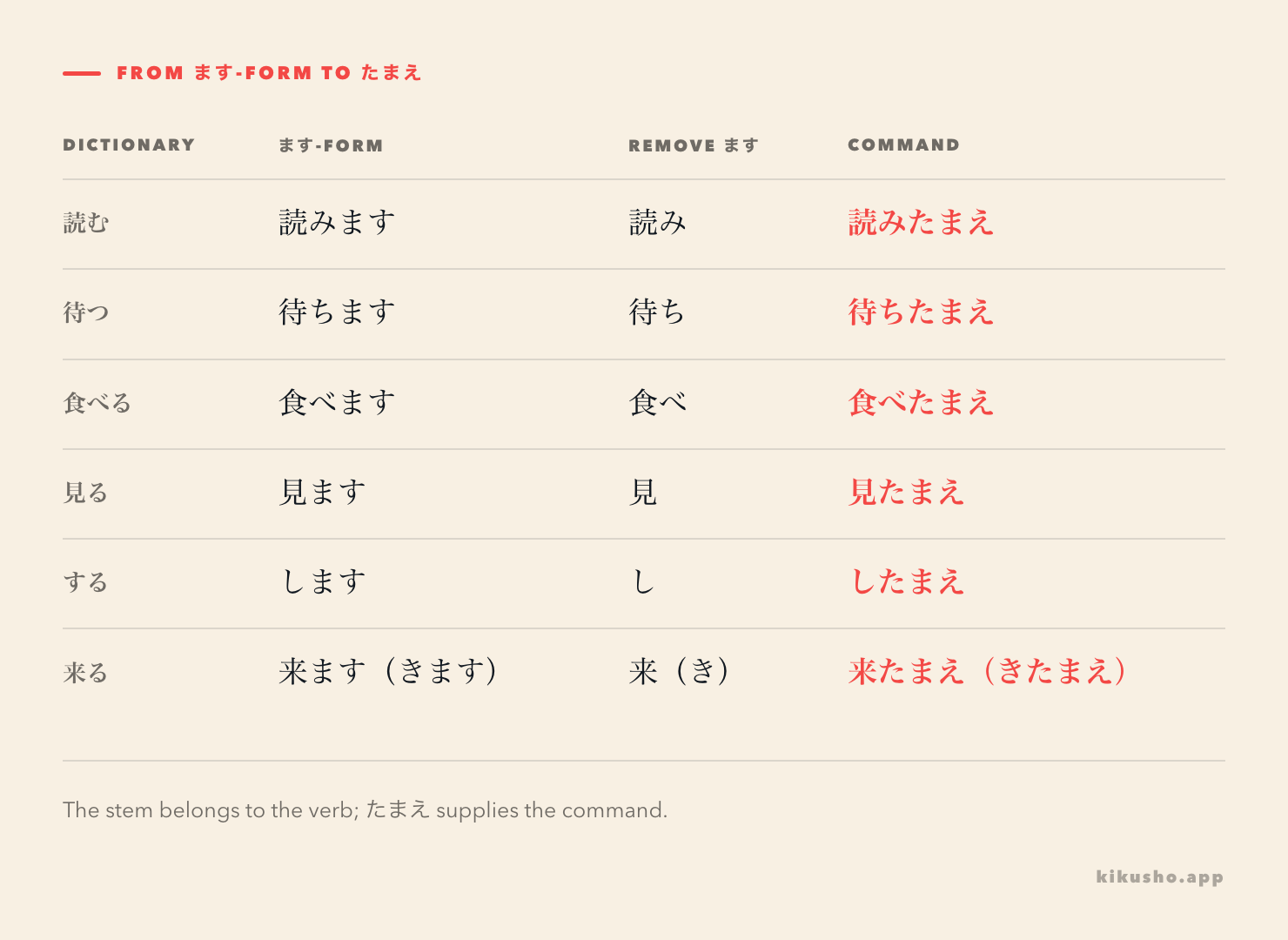
来たまえ is read きたまえ, because its stem comes from 来ます (きます). It is not くるたまえ. Likewise, する becomes したまえ, not するたまえ.
分からないところがあれば、何でも聞きたまえ。
わからないところがあれば、なんでもききたまえ。
If there is anything you do not understand, ask me anything.
The invitation in the content does not erase the hierarchy in the form. A superior can warmly permit questions while still speaking from above.
The direct pattern is affirmative. For an ordinary negative request, choose a form such as 忘れないでください rather than trying to create 忘れないたまえ. Older or stylised language may use longer forms such as Vないでくれたまえ, but that is くれる carrying たまえ, not a negative conjugation of the basic pattern.
A softer surface does not make it polite
English translations such as “please sit” can hide the relationship. Compare four ways to direct the same action:
| Form | Example | What it signals |
|---|---|---|
| Bare imperative | 座れ。 | abrupt, forceful command |
| たまえ | 座りたまえ。 | restrained command from above; old-fashioned colour |
| なさい | 座りなさい。 | authoritative instruction; common with parents or teachers |
| てください | 座ってください。 | politely worded request or instruction |
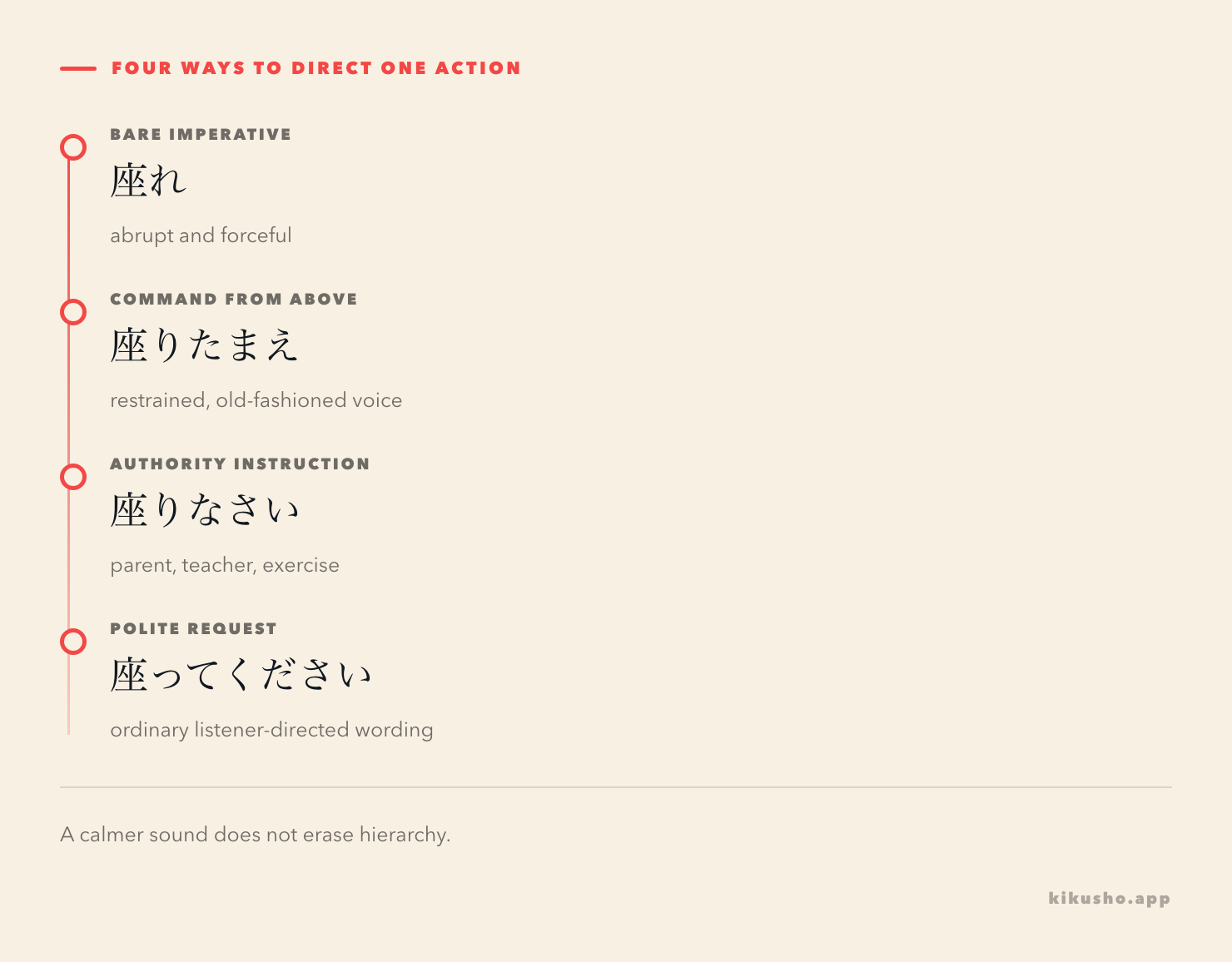
The Japan Foundation's overview of instructions and commands treats a command as an attempt by someone above to make someone below act, and distinguishes that force from a request. たまえ belongs on that command side of the boundary.
Suppose you are showing a customer to a chair. こちらにお座りください or こちらに座ってください fits ordinary service language. こちらに座りたまえ makes you sound as though you have cast the customer as your subordinate or stepped into a dramatic role.
The な and なさい lesson explains why a ます-stem does not automatically make a command polite. That same warning applies here: the stem is a formation rule, not a courtesy marker.
Modern fiction preserves the speaker image
You are more likely to meet たまえ while reading dialogue than to need it at a café or office. A Japan Foundation Seoul article on role language uses わたしに日本語を教えてくれたまえ as speech that makes readers imagine an educated, socially prominent man. It also warns that such character language keeps some distance from ordinary speech.
That is why a line such as 入りたまえ can instantly suggest an older professor, company president, doctor or gentleman in a period-flavoured story. The image is conventional rather than a census of who may pronounce the form. Describing たまえ as male-coded role language is more accurate than claiming that grammar makes it biologically or absolutely male-only.
まあ、入りたまえ。話を聞こう。
まあ、はいりたまえ。はなしをきこう。
Come in. Let me hear what you have to say.
The sentence can sound calm, even welcoming. Yet the speaker still controls admission and the conversation. Tone changes the mood; it does not level the relationship.
Iku's independent account of たまえ likewise associates it with male superiors or older men addressing juniors, calls it gentler than なさい, and notes its old-fashioned, fiction-heavy character. The useful production lesson is conservative: recognise it readily, but choose a more current form unless the status relation and voice are deliberate.
The ending comes from 給う
The modern command ending developed from the auxiliary verb 給う (たまう). Digital Daijisen's entry for 賜え・給え identifies たまえ as its imperative form and records the command toward a friend or social inferior as language descending from Meiji-era student speech.
This history explains two uses that should not be collapsed:
- 読みたまえ is the N2/N3 study pattern: a speaker tells another person to read.
- Literary 恵みを賜え can mean “grant us grace,” a petition directed upward, especially in prayer-like language.
The second use preserves the lexical idea of bestowing something. It does not mean that 座りたまえ is humble or honorific toward the person being ordered to sit. Read the verb before たまえ and the scene around it.
The longer Vてくれたまえ also appears in stylised commands:
この件は誰にも言わないでくれたまえ。
このけんはだれにもいわないでくれたまえ。
Do not tell anyone about this matter.
Grammatically, たまえ directs くれる: roughly, “do me the favour of not telling anyone.” Pragmatically, it still sounds like a higher-status speaker issuing a controlled order.
N2 is a study label, not an official boundary
Kikusho's reference inventory and JLPT Sensei place たまえ at N2. Iku and other teaching sites place it at N3. The disagreement is unsurprising because the JLPT does not publish an exhaustive grammar list.
The level label matters less than the reading skill. You should be able to recover the commanded action from the stem, recognise the downward relationship, and avoid translating the calm surface as neutral politeness. Producing the form is a separate decision, and often the safer modern choice is なさい, てください, or a request shaped for the relationship.
If you capture たまえ from manga, a novel or a drama subtitle in Kikusho, keep the preceding line or the speaker label on the card. The isolated gloss “please do” loses the clue that makes the ending valuable: who believes they may command whom.
Practice: read the command and the relationship
Complete all six questions before opening the explanations.
Question 1
Build the たまえ form of 話す.
A. 話すたまえ
B. 話したまえ
C. 話してたまえ
D. 話せたまえ
Question 2
A company director says to a junior employee:
そこに座りたまえ。
Which interpretation best preserves both action and relationship?
A. “Would you mind sitting there?” between social equals
B. “Do not sit there,” a prohibition
C. “Sit there,” spoken as a restrained command from above
D. “I will sit there,” a statement of intention
Question 3
You need a customer to wait for a moment. Which line belongs in an ordinary service encounter?
A. 少し待ちたまえ。
B. 少し待て。
C. 少し待ちなさい。
D. 少しお待ちください。
Question 4
Complete the sentence with the correct reading and form of 来る:
明日の朝、もう一度( )。
Your answer should mean “Come once more tomorrow morning” in the voice taught in this lesson.
Question 5
Read the exchange:
教授:この資料をよく見たまえ。何か気づかないか。
学生:あ、数字が一つ違います。
What does 見たまえ contribute beyond the action “look”?
Question 6
Rewrite 自分の意見を言います as a direct たまえ command meaning “State your own opinion.” Then explain in one phrase why the result would be risky toward your manager.
Answers and explanations
Explanation 1
B, 話したまえ. Start from 話します, remove ます, and attach たまえ to the stem 話し. A keeps the dictionary form, C keeps て, and D adds たまえ after a bare imperative.
Explanation 2
C. 座りたまえ directs the employee to sit. Its controlled sound can be gentler than 座れ, but the director still claims the standing to command the listener. Nothing in the form makes the action negative or turns it into the speaker's intention.
Explanation 3
D, 少しお待ちください. This is a conventional polite request to a customer. A and C place the speaker above the customer, while B is a blunt imperative.
Explanation 4
来たまえ, read きたまえ. The stem comes from 来ます (きます), so the completed sentence is 明日の朝、もう一度来たまえ. The dictionary reading くる does not survive in this stem.
Explanation 5
It presents the professor as entitled to direct the student and gives the line an older, formal or character-like voice. The professor is not merely describing that the student looks at the material; the utterance requires the student to do so.
Explanation 6
自分の意見を言いたまえ. 言います supplies the stem 言い. Toward your manager, the form is risky because it reverses the expected hierarchy and casts you as the person with authority to issue the command.
Common questions
What does たまえ mean in Japanese?
Verb-stem + たまえ tells the listener to do something. It is a direct command associated with an older or higher-status speaker addressing someone below them, and it often sounds old-fashioned today.
How do you form a command with たまえ?
Take the verb's ます-form, remove ます, and add たまえ: 読みます becomes 読みたまえ, 食べます becomes 食べたまえ, します becomes したまえ, and 来ます becomes 来たまえ, read きたまえ.
Is たまえ polite?
It can sound more restrained than a bare imperative, but it does not show ordinary listener-directed politeness. It assumes the speaker has the standing to direct the listener, so it is unsafe for customers, superiors and most conversations between equals.
What is the difference between たまえ and なさい?
Both can give an instruction from above. なさい remains common for parents, teachers and written exercises, while たまえ strongly evokes an older male superior or a fictional educated gentleman and is uncommon in ordinary modern conversation.