On this page
Your train reaches the last station at 23:48, and the final bus leaves at 23:40. つまり、バスには間に合いません gives the practical conclusion: “So, you will not make the bus.” By contrast, 終点、すなわちこの路線の最後の駅 identifies two descriptions of the same place: “the terminus, that is, the final station on this line.”
Both connectors can be translated as “in other words.” The deciding question is what the second part does. すなわち often places A and B on the two sides of an equals sign in formal language. つまり can do that too, but it also condenses facts into a summary or states the speaker's interpretation.
Test whether B equals A or sums it up
| Connector | Ask this before choosing | Typical job | Register |
|---|---|---|---|
| すなわち | Is B an equivalent name, value or definition of A? | Precise reformulation or identification | Formal, common in expository writing and prepared speech |
| つまり | Does B make the point easier, shorter or explicit? | Reformulation, summary or interpretation | Standard; frequent in speech and writing |
会議は第一月曜日、すなわち十月五日に開かれます。
かいぎは だいいちげつようび、すなわち じゅうがついつかに ひらかれます。
The meeting will be held on the first Monday, that is, October 5.
The date names the same day as 第一月曜日 in the relevant calendar. The second expression makes the reference exact.
会議は午前九時からで、資料は前日までに提出する必要があります。つまり、今夜中に準備を終えなければなりません。
かいぎは ごぜんくじからで、しりょうは ぜんじつまでに ていしゅつする ひつようが あります。つまり、こんやじゅうに じゅんびを おえなければ なりません。
The meeting starts at nine in the morning, and the materials must be submitted by the day before. In other words, I have to finish preparing them tonight.
The last sentence is not another name for the previous two facts. It is the speaker's practical summary of them.
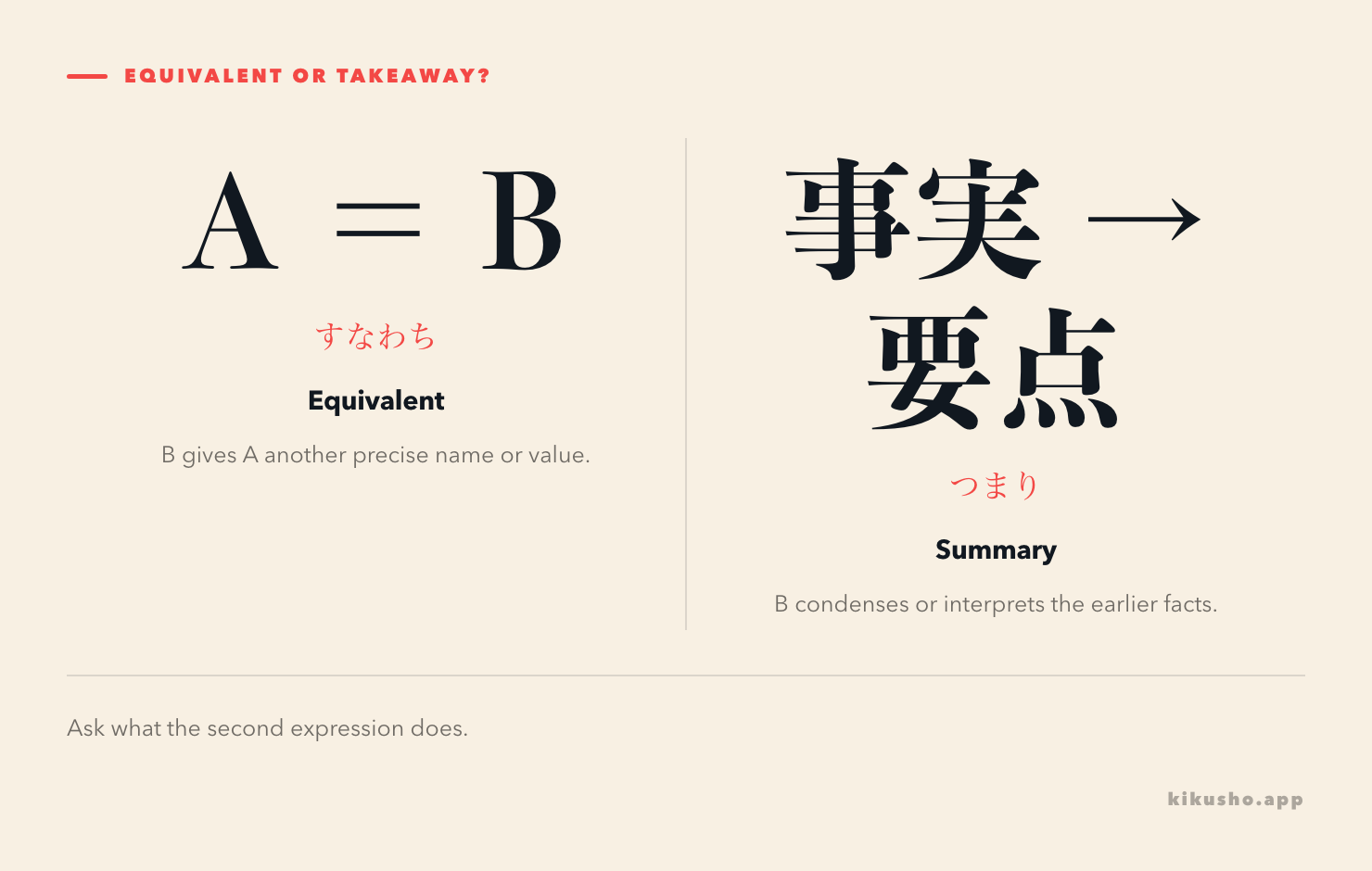
すなわち gives A a formal equivalent
すなわち is a conjunction. It can follow a word, phrase or complete statement and introduce a different expression for the same referent or content.
| Shape | Example | Relationship |
|---|---|---|
| noun A+すなわち+noun B | 二酸化炭素、すなわちCO₂ | Two labels for the same substance |
| quantity A+すなわち+quantity B | 一時間半、すなわち九十分 | Two values for the same duration |
| statement A。すなわち+statement B | 未成年者は申し込めない。すなわち、十八歳未満は対象外だ | B states A in more explicit terms |
この制度の対象は成人、すなわち十八歳以上の人です。
このせいどの たいしょうは せいじん、すなわち じゅうはっさいいじょうの ひとです。
This system is for adults, that is, people aged eighteen or older.
Here the writer fixes what 成人 means within the rule. This exact identity is the centre of the pattern described by the NINJAL discussion of reformulating connectors, which treats すなわち as closer to an objective equivalence and つまり as more open to the speaker's conclusion.
Do not turn an example into a definition:
果物、すなわちりんごを買いました。
Without a context that has already limited 果物 to apples, this says “fruit, that is, apples” as if the whole category and one member were identical. If apples are merely one possible choice, use 例えば to introduce the example instead. The earlier formal-connectors lesson develops this same-equivalence use beside conclusion, restriction and enumeration connectors.
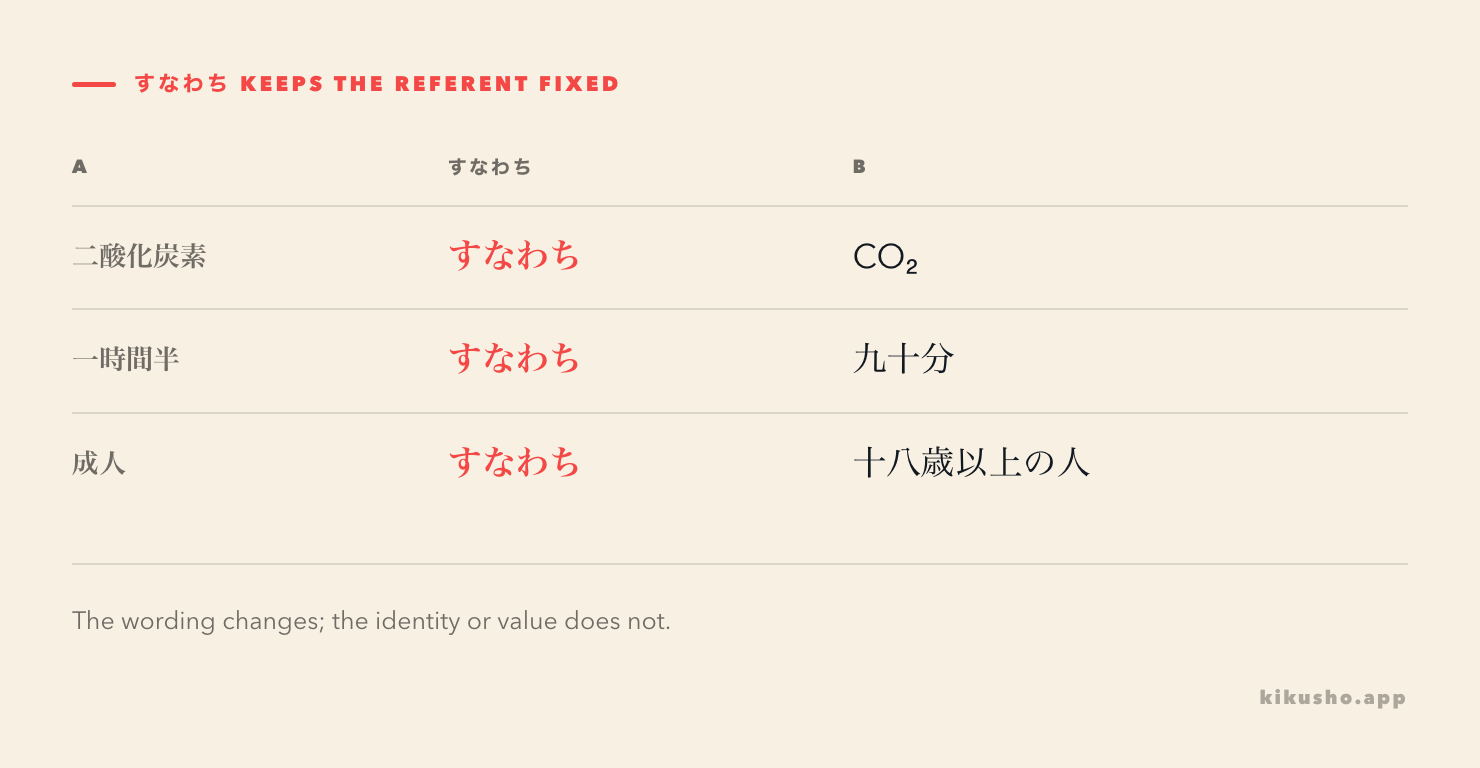
つまり makes the takeaway explicit
つまり can also place an easier expression after a difficult one:
彼は獣医です。つまり、動物の医者です。
かれは じゅういです。つまり、どうぶつの いしゃです。
He is a veterinarian. In other words, he is an animal doctor.
This overlaps with すなわち because the two descriptions identify the same profession. つまり sounds natural in an ordinary explanation; すなわち would make the relation more formal and definitional.
The wider use of つまり is summary. It can collect several details and state the point they lead the speaker to:
田中さんは電話にも出ず、メールにも返信していません。つまり、まだこの知らせを知らない可能性があります。
たなかさんは でんわにも でず、メールにも へんしんしていません。つまり、まだ このしらせを しらない かのうせいが あります。
Tanaka has not answered the phone or replied to the email. In short, there is a possibility that he still does not know the news.
The evidence does not equal the conclusion. The speaker interprets it, and 可能性があります keeps that interpretation appropriately uncertain. Bunpro describes つまり as taking an earlier statement and summarizing it; its comparison likewise marks つまり as common in conversation and すなわち as more formal.
In dialogue, つまり can check another person's intended meaning:
A:今回は参加できません。
B:つまり、来月まで延期したいということですか。
A: I cannot participate this time.
B: So, do you mean that you want to postpone it until next month?
B has made an inference, so the question form asks A to confirm it. ということですか is common after つまり because it makes the proposed interpretation explicit.
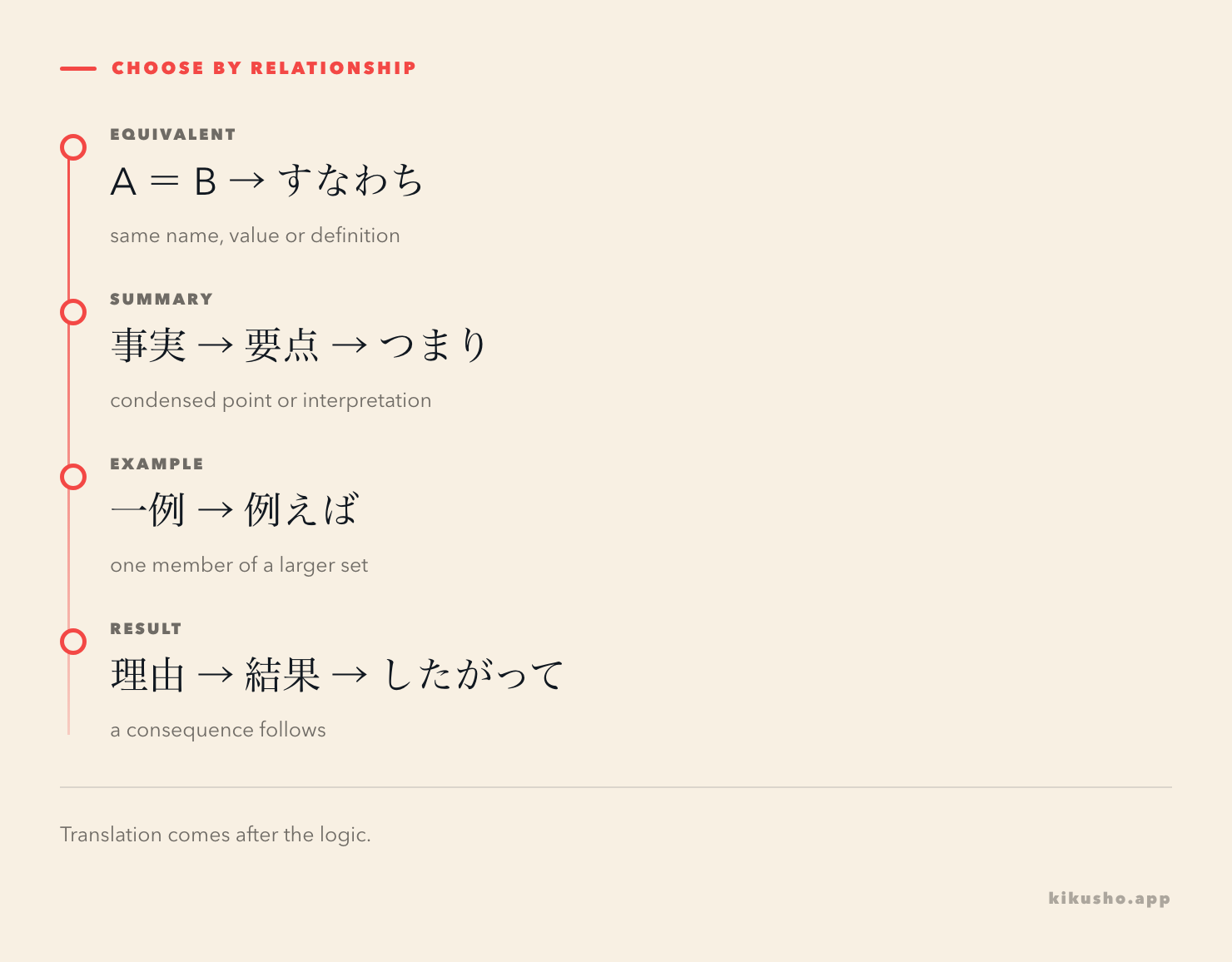
Keep reformulation separate from cause and example
Three neighbouring connectors answer different questions:
| Relationship | Connector | Miniature test |
|---|---|---|
| B is a formal equivalent of A | すなわち | Can you write A = B without changing the claim? |
| B is the condensed point or interpretation | つまり | Does B say what the earlier material amounts to? |
| B is one member illustrating A | 例えば | Is B only one possible case? |
| B follows as a result from A | したがって | Is the writer arguing from a reason to a consequence? |
参加者は全員学生です。したがって、入場料は無料です。
さんかしゃは ぜんいん がくせいです。したがって、にゅうじょうりょうは むりょうです。
All participants are students. Therefore, admission is free.
The free admission is a consequence of a rule, not a second description of “all participants are students.” A loose English “so” can hide the difference. The N4 connector overview is a useful prerequisite when result, addition and contrast still blur together.
Register matters, but it is not a ban
The spelling 即ち exists, yet modern explanatory prose often uses すなわち in hiragana. Changing the script does not make the connector conversational. Its careful, expository tone remains.
Likewise, つまり is not confined to casual speech. Reports and essays use it when the writer wants to condense an argument. The useful register contrast is a tendency, not a wall: すなわち is more formal and definition-like; つまり is the everyday default for “what this amounts to.” JLPT Sensei lists both connectors at N3 and gives “in summary” as part of つまり's range, while its すなわち entry centres “namely” and “in other words.” Those level labels are study estimates; the JLPT publishes no exhaustive grammar list.
If you capture a difficult sentence in Kikusho, keep the clause before the connector on the card. Voice, photo and text captures can preserve that context, and the register note is editable. A card that contains only つまり = in other words removes the exact relationship you need to recognise during reading.
Practice: six questions
Decide each relationship in sequence. The explanations begin only after Question 6.
Question 1: grammar choice.
開館日は四月一日、( )来週の月曜日です。
- A. 例えば
- B. したがって
- C. すなわち
- D. しかし
Question 2: grammar choice.
電車はもうなく、タクシー代も足りない。( )、今夜はここに泊まるしかない。
- A. つまり
- B. すなわち
- C. 例えば
- D. なお
Question 3: relationship.
この機械は再起動が必要です。つまり、いったん電源を切ってから、もう一度入れてください。
What does the sentence after つまり do?
- A. It gives an unrelated exception.
- B. It states in practical terms what restarting requires.
- C. It names one optional machine among many.
- D. It contradicts the first sentence.
Question 4: build the sentence.
Arrange all four parts to make a formal sentence meaning “The deadline is midnight, that is, 12 a.m.”
- すなわち
- 締め切りは深夜零時
- 午前零時です
- 、
Question 5: grammar choice.
A colleague says: 来週は出張で、会議の日には東京にいません。 You want to confirm your interpretation: “So, you mean you cannot attend?”
- A. 例えば、参加できないということですか。
- B. すなわち、参加できないということですか。
- C. つまり、参加できないということですか。
- D. なお、参加できないということですか。
Question 6: text grammar.
本講座は未経験者、( )これまで専門的に学んだことのない方を対象とします。授業は基礎から始まります。( )、事前の知識は必要ありません。
Choose the pair that best fits the passage.
- すなわち/つまり
- つまり/すなわち
- 例えば/ただし
- したがって/例えば
Answers and explanations
Answer 1. C: すなわち. April 1 and next Monday name the same opening day in this context. 例えば would make next Monday only an example, while したがって would present it as a consequence. Read 開館日 as かいかんび.
Answer 2. A: つまり. The lack of trains and money is condensed into the speaker's practical conclusion: staying here is the only option. The conclusion is not an equivalent name for either fact, so formal-equivalence すなわち is a poor fit. 泊まる is とまる.
Answer 3. B. The second sentence explains the action contained in “restart”: switch the power off once and turn it on again. It neither adds an exception nor contradicts the instruction. This is a reformulation, not an optional example.
Answer 4. 2 → 4 → 1 → 3: 締め切りは深夜零時、すなわち午前零時です。 The two time expressions denote the same moment, and すなわち introduces the equivalent formulation. Read 締め切り as しめきり and 深夜零時 as しんやれいじ.
Answer 5. C: つまり、参加できないということですか。 You infer the intended conclusion from the colleague's travel schedule and ask for confirmation. すなわち sounds overly definitional here; 例えば introduces an example, and なお adds a separate note.
Answer 6. 1: すなわち/つまり. The first blank equates 未経験者 with the following explicit description, so すなわち suits the formal definition. The final sentence summarizes what beginner-level teaching means for the reader, so つまり fits the takeaway. Read 未経験者 as みけいけんしゃ and 事前 as じぜん.
Common questions
What is the difference between すなわち and つまり?
すなわち commonly presents B as a formal equivalent or identifying description of A. つまり can also rephrase, but it readily summarizes several facts or adds the speaker's interpretation, and it is common in conversation.
Can すなわち and つまり be used in the same sentence?
They can fit some of the same exact-rephrasing contexts, but using both together for one reformulation is usually redundant. Choose the connector whose scope and register match the passage.
Is すなわち only used in writing?
No. It can occur in formal speeches and careful explanations as well as writing. It normally sounds more formal and deliberate than conversational つまり.
Are すなわち and つまり N3 grammar?
JLPT Sensei and Bunpro place the relevant connector uses at N3. These are study estimates because the JLPT does not publish an exhaustive grammar list.