On this page
At a registration desk, この欄に名前を書いてください means “Please write your name in this field”: ~てください (te kudasai) politely and directly asks the listener to act. The same attachment serves everyday requests and invitations, but a favour that imposes on someone may call for a less direct construction.
“Please do…” is a useful translation. The trap is treating ください as a word you can place anywhere an English sentence allows please. Here it belongs to a specific verb pattern, and that pattern still names the action you want the other person to take.
The form covered here is the affirmative verb て-form + ください request. Bunpro and JLPT Sensei both place it in N5 grammar. The JLPT FAQ explains why it no longer publishes lists of grammar, vocabulary and kanji, so the level is a learning estimate.
Attach ください to the て-form, including で endings
First make the verb's て-form; then append ください. The request ending stays the same whether the connecting form ends in て or で. If you need the full set of sound changes, use the て-form formation lesson.
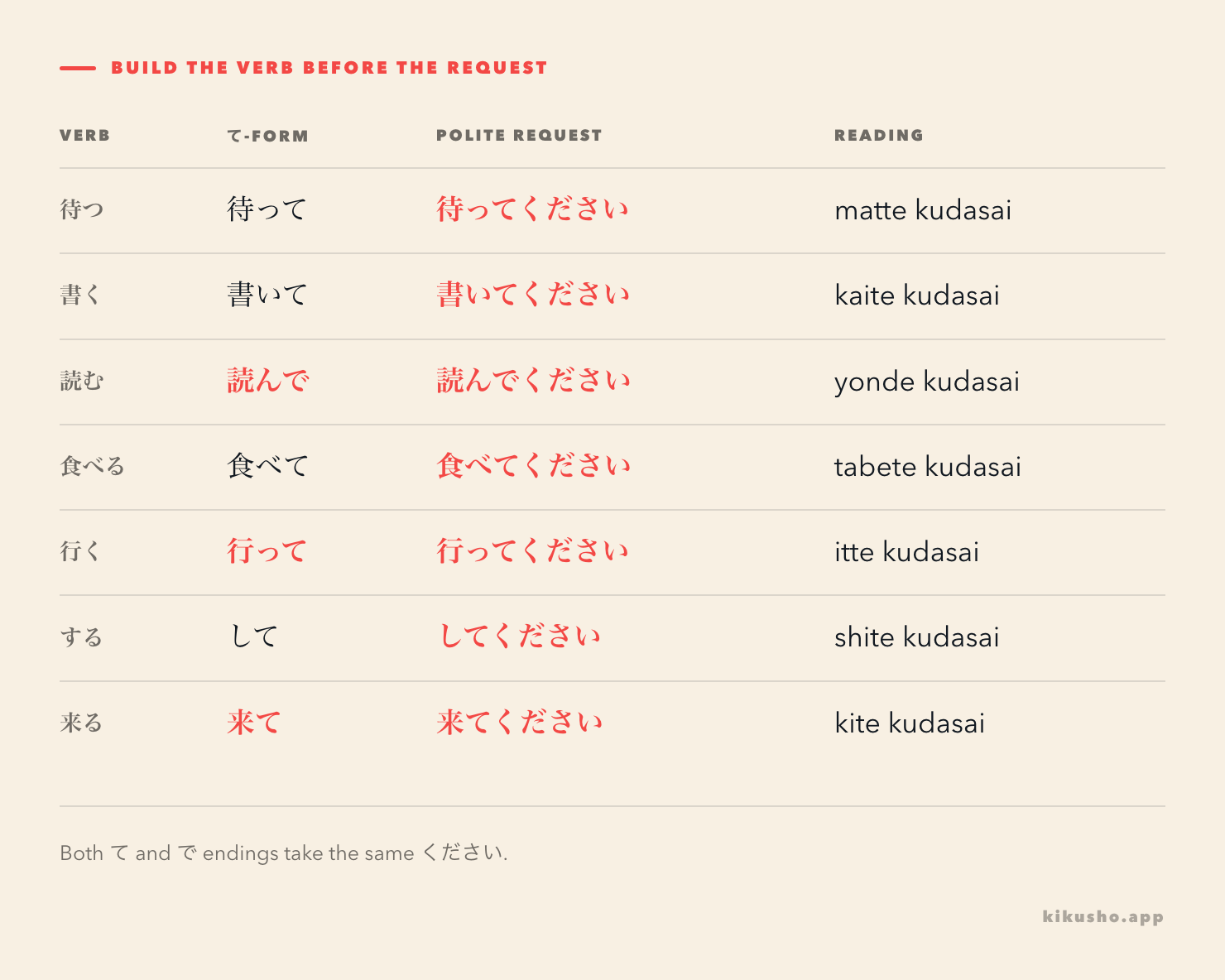
| Verb and reading | て-form | Request and reading | Requested action |
|---|---|---|---|
| 待つ(まつ) | 待って | 待ってください(まってください) | wait |
| 書く(かく) | 書いて | 書いてください(かいてください) | write |
| 読む(よむ) | 読んで | 読んでください(よんでください) | read |
| 食べる(たべる) | 食べて | 食べてください(たべてください) | eat |
| 行く(いく) | 行って | 行ってください(いってください) | go |
| する | して | してください | do |
| 来る(くる) | 来て(きて) | 来てください(きてください) | come |
行ってください keeps the exception 行く → 行って. In 来てください, the kanji 来 is read き, giving kite kudasai. Neither the dictionary reading くる nor the polite ending ます survives in the request. The Japan Foundation's Erin formation notes check the verb groups, the 行く exception and these irregular forms.
The listener performs the requested action
At a class registration desk, a member of staff points to the name field:
この欄に名前を書いてください。
この らんに なまえを かいてください。
Please write your name in this field.
欄(らん) is a field or column. に identifies where the writing goes, 名前を identifies what to write, and 書いてください requests the listener's action. The staff member is giving the instruction; the person holding the form writes.
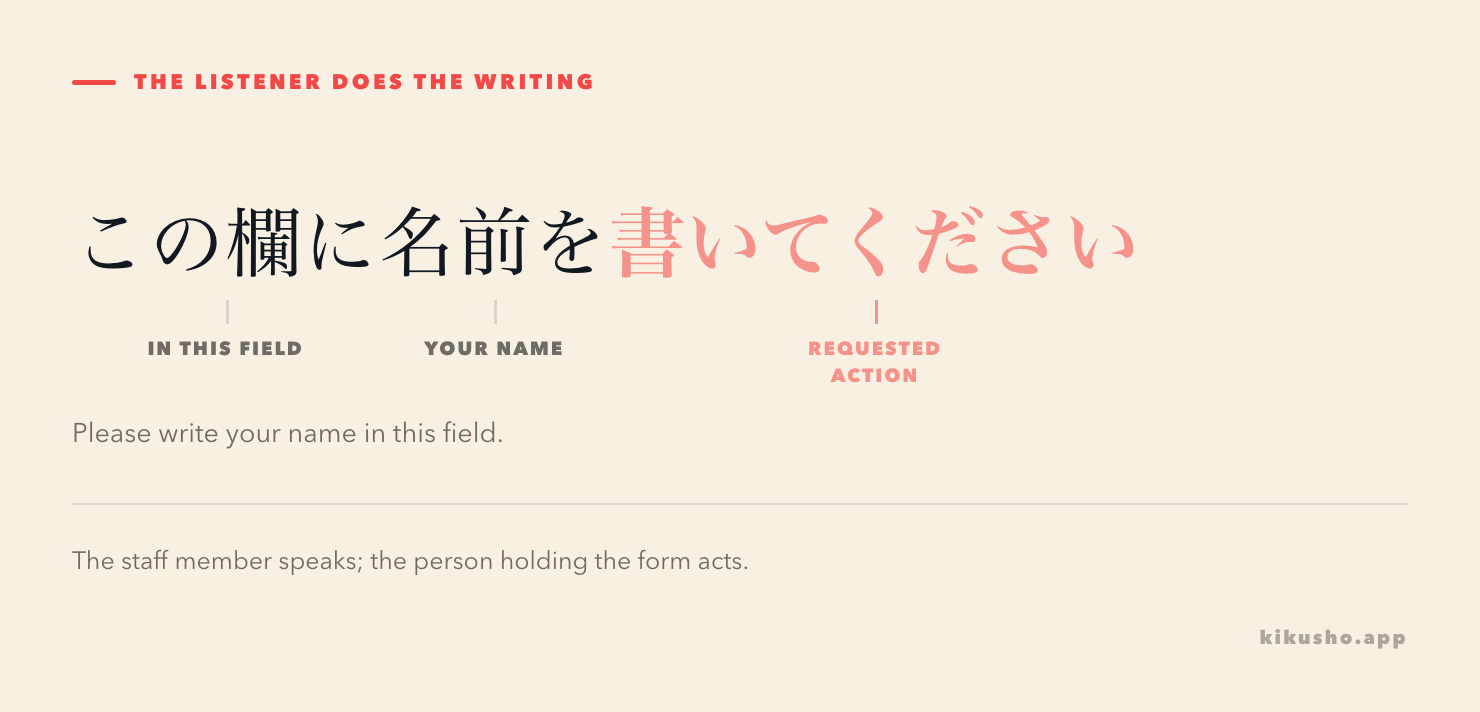
You do not need to put あなたは into every request. The interaction usually identifies the actor. For a group, a topic can narrow who should act: 学生は、こちらに来てください (がくせいは、こちらに きてください) means “Students, please come over here.” Tokyo University of Foreign Studies' explanation describes this use of は as well as ordinary instruction responses.
If you want to offer to write something yourself, 書いてください gives the other person the wrong job. The lesson on ~ましょう, ~ませんか and ~ましょうか explains suggestions and offers.
Instructions, requests and invitations share this attachment
The grammar stays constant while the situation supplies the purpose.
An instruction during an activity:
次の文を読んでください。
つぎの ぶんを よんでください。
Please read the next sentence.
A teacher directs the next step in a reading exercise. The polite wording and the teacher's role can coexist; politeness does not turn the instruction into a question.
A request for practical help:
すみません、このペンを貸してください。
すみません、この ペンを かしてください。
Excuse me, please lend me this pen.
At the registration desk, borrowing a pen is part of getting the form filled in. 貸す(かす) → 貸して(かして) names what the listener should do. It asks for help directly, with すみません acknowledging the approach.
An invitation or encouragement to take what is offered:
どうぞ、このお菓子を食べてください。
どうぞ、この おかしを たべてください。
Please help yourself to these snacks.
The host offers food; the guest decides whether to eat. どうぞ fits this welcoming context. Do not read every てください as an order imposed from above. TUFS distinguishes instructions from requests for help and expressions of consideration, and Erin gives both request and invitation examples. Mango Languages' lesson by Masaru Mito also distinguishes situations where direct requests are expected from those where they can feel demanding.
A polite ending does not remove the burden of a favour
“Never use it with a teacher or boss” is too broad. A classroom clarification and a demand that a busy teacher spend an hour on your private project are different interactions. Likewise, a clerk's usual service task differs from asking that clerk for an unrelated personal favour.
Check what you are asking, whether the request is expected here, and how much choice or effort it involves. A name-field instruction normally needs clarity. A substantial favour may need a question that acknowledges the listener's willingness or availability.
ちょっと (a little / a moment) and すみません can soften how you approach someone. They do not automatically make the underlying request suitably deferential. Tofugu's guide to ください explains the difference between polite directness and asking for a favour.
The more deferential ~ていただけませんか is covered in the N4 lesson on respect, service speech and requests. That lesson also separates お~ください from the ordinary て-form construction. These are further patterns to learn, rather than prefixes or endings you can swap freely into every request.
This page covers affirmative actions. A request to avoid an action needs a negative request construction; the positive chart does not produce it. Nor should you force a verb into an order for an object alone: asking for an item and asking someone to perform an action are separate attachment questions.
With someone close, the request can end at て
In familiar speech, you can omit ください:
| Polite direct request | Familiar request | Meaning |
|---|---|---|
| ここで待ってください(ここで まってください) | ここで待って(ここで まって) | Wait here. |
| これを見てください(これを みてください) | これ、見て(これ、みて) | Look at this. |
The bare form can be friendly, urgent or abrupt according to delivery. It does not preserve the polite register simply because the verb has the same て-form. The Japan Foundation's Erin notes and Bunpro both introduce this familiar request use. Use it where that familiarity already belongs.
Also check whether the sentence continues. In 本を読んで、寝ます (ほんを よんで、ねます), “I read a book and go to bed,” 読んで connects two actions. It is not a request to the listener. The formation lesson's attachment comparison shows why the words after a て-form matter.
The mistake is adding politeness before building the verb
× 書くください keeps the dictionary form. × 書きください uses the ます-stem without the required frame. For this construction, both miss the 書いて attachment. 書きます is a polite statement, not a request meaning “Please write.”
Build 書く → 書いて → 書いてください. For 読む, keep the voiced sound in 読んでください; × 読んてください is not a quieter or more polite variant. Extra politeness cannot repair a malformed verb.
If you photograph a desk instruction in Kikusho, check the generated card before keeping it. Its editable example and register fields let you retain both the requested action and the setting: “staff directing someone through a form” tells you more than an isolated translation of ください. The next encounter may require recognising an instruction before deciding how to answer.
Practice questions
Try all seven questions before scrolling to the answer block. These are original exercises; the three task formats follow the JLPT's grammar task categories, without reproducing an official question.
Question 1. Complete a teacher's request meaning “Please read the next sentence.”
次の文を( )ください。
- ア. 読み
- イ. 読んで
- ウ. 読む
- エ. 読んて
Question 2. Which request means “Please come over here,” with the correct reading?
- ア. こちらに来るください(こちらに くるください)
- イ. こちらに来てください(こちらに くてください)
- ウ. こちらに来ますください(こちらに きますください)
- エ. こちらに来てください(こちらに きてください)
Question 3. You want the person beside you to write their name. Which sentence directly requests that action?
- ア. 名前を書きます。
- イ. 名前を書きました。
- ウ. 名前を書いてください。
- エ. 名前を書くください。
Question 4. Arrange every chunk once to make a request meaning “Please write your name in this field.” There can be more than one natural word order.
名前を / 書いて / この欄に / ください
Question 5. Read the whole exchange and choose the form for the blank.
受付:この欄に名前を( )。ペンはこちらです。
学生:はい、わかりました。
Vocabulary: 受付(うけつけ), reception; 欄(らん), field; 学生(がくせい), student. The receptionist points to the field the student must fill in.
- ア. 書きました
- イ. 書いてください
- ウ. 書いています
- エ. 書くください
Question 6. Which description gives the best register guidance for a request with ~てください?
- ア. Every request is appropriate if you add すみません.
- イ. It can only be used by someone higher in rank.
- ウ. It is always rude when addressed to a teacher.
- エ. It is polite and direct; consider the task, setting, relationship and burden.
Question 7. A host offers you a plate of snacks and says どうぞ、このお菓子を食べてください. What is the sentence doing, and who would eat?
- ア. Reporting that the host ate the snacks.
- イ. Welcoming you to eat the offered snacks.
- ウ. Asking you to cook snacks for the host.
- エ. Offering to eat the snacks on your behalf.
Answers and explanations
Answer 1. イ: 読んで. The full request is 次の文を読んでください. 読む takes 読んで, including voiced で. 読み is the ます-stem, 読む is the dictionary form, and 読んて is an incorrect sound change.
Answer 2. エ: こちらに来てください(こちらに きてください). 来る becomes 来て(きて) before ください. ア and ウ attach ください to the wrong form. イ writes the right kanji but assigns it the wrong reading; this form is きて, not くて.
Answer 3. ウ: 名前を書いてください. The listener writes. ア makes a nonpast statement about writing; イ reports past writing. Context supplies the subject of those statements, and neither directly requests the listener's action. エ is malformed because 書く must become 書いて.
Answer 4. One model is この欄に名前を書いてください (この らんに なまえを かいてください). 名前をこの欄に書いてください also works. The location and object can change order here; 書いてください must remain the attached request at the end. Do not mark the alternate order wrong merely because it differs from the model.
Answer 5. イ: 書いてください. The receptionist directs the student's next action, and はい、わかりました acknowledges the instruction. The exchange means: “Please write your name in this field. The pen is here.” “Yes, understood.” ア reports completed writing; ウ describes ongoing writing. Neither supplies the requested instruction in this exchange. エ uses the dictionary form where the て-form is needed.
Answer 6. エ. The ending is polite while the request remains direct. ア treats a softening phrase as a universal fix. イ excludes ordinary help requests and invitations. ウ turns a contextual concern into a blanket ban; an expected classroom request need not be treated like an imposition on a teacher's private time.
Answer 7. イ. The host welcomes you, the listener, to eat. どうぞ and the offered plate establish the invitation. There is no past statement, cooking request or offer by the host to eat for you. You can respond ありがとうございます (arigatō gozaimasu), “Thank you,” when accepting; an invitation does not oblige you to take the food.
Common questions
How do you attach ください to a Japanese verb?
Use the verb's て-form, including forms ending in で: 書く becomes 書いてください, and 読む becomes 読んでください. Do not attach it directly to the dictionary form or the ます-stem. 来る becomes 来てください, pronounced きてください.
Is ~てください rude?
It is a polite but direct request. It works for clear instructions, ordinary requests and invitations. It can sound demanding when you ask for a substantial favour or extra consideration. The purpose of the request, the relationship and the setting matter; a polite ending does not make every request suitable.
Can you leave out ください?
In a request to someone close to you, a bare て-form such as 待って can mean "Wait." This is familiar speech and can sound abrupt depending on tone. It does not keep the polite register of 待ってください. A て-form inside a longer sentence can instead connect actions.
Is てください N5 grammar?
Bunpro and JLPT Sensei place the basic verb て-form + ください request at N5. That is a study classification, not an official exhaustive JLPT syllabus. More deferential request constructions need separate study; this lesson covers the basic affirmative request.