On this page
A museum notice reads 展示品に触れてはならない: “You must not touch the exhibits.” てはならない marks the action as formally prohibited, with the voice of a rule, institution or serious principle behind it.
The notice does not claim that touching is physically impossible. It says that touching crosses a boundary.
てはならない states a formal prohibition
The core pattern is:
verb て-form + はならない
許可なく、この資料を持ち出してはならない。
きょかなく、このしりょうをもちだしてはならない。
You must not remove this material without permission.
JLPT Sensei's てはならない reference gives the N2 pattern as verb て-form + はならない and translates it with “must not”, “cannot” or “should not”. In this construction, English “cannot” means lack of permission or acceptability, not lack of ability.
Tanosuke's independent teaching note places the form in rules voiced by an organisation or society. That is a useful centre of gravity, though the speaker may also adopt the same rule-like voice for a moral principle:
過去の失敗を忘れてはならない。
かこのしっぱいをわすれてはならない。
We must not forget past failures.
No official regulator is required. The sentence raises remembering into a serious duty and treats forgetting as unacceptable.
The whole て-form comes before は
First build the ordinary て-form or で-form, then add はならない:
| Dictionary form | Linking form | Formal prohibition |
|---|---|---|
| 書く, to write | 書いて | 書いてはならない |
| 使う, to use | 使って | 使ってはならない |
| 読む, to read | 読んで | 読んではならない |
| 泳ぐ, to swim | 泳いで | 泳いではならない |
| 食べる, to eat | 食べて | 食べてはならない |
| する, to do | して | してはならない |
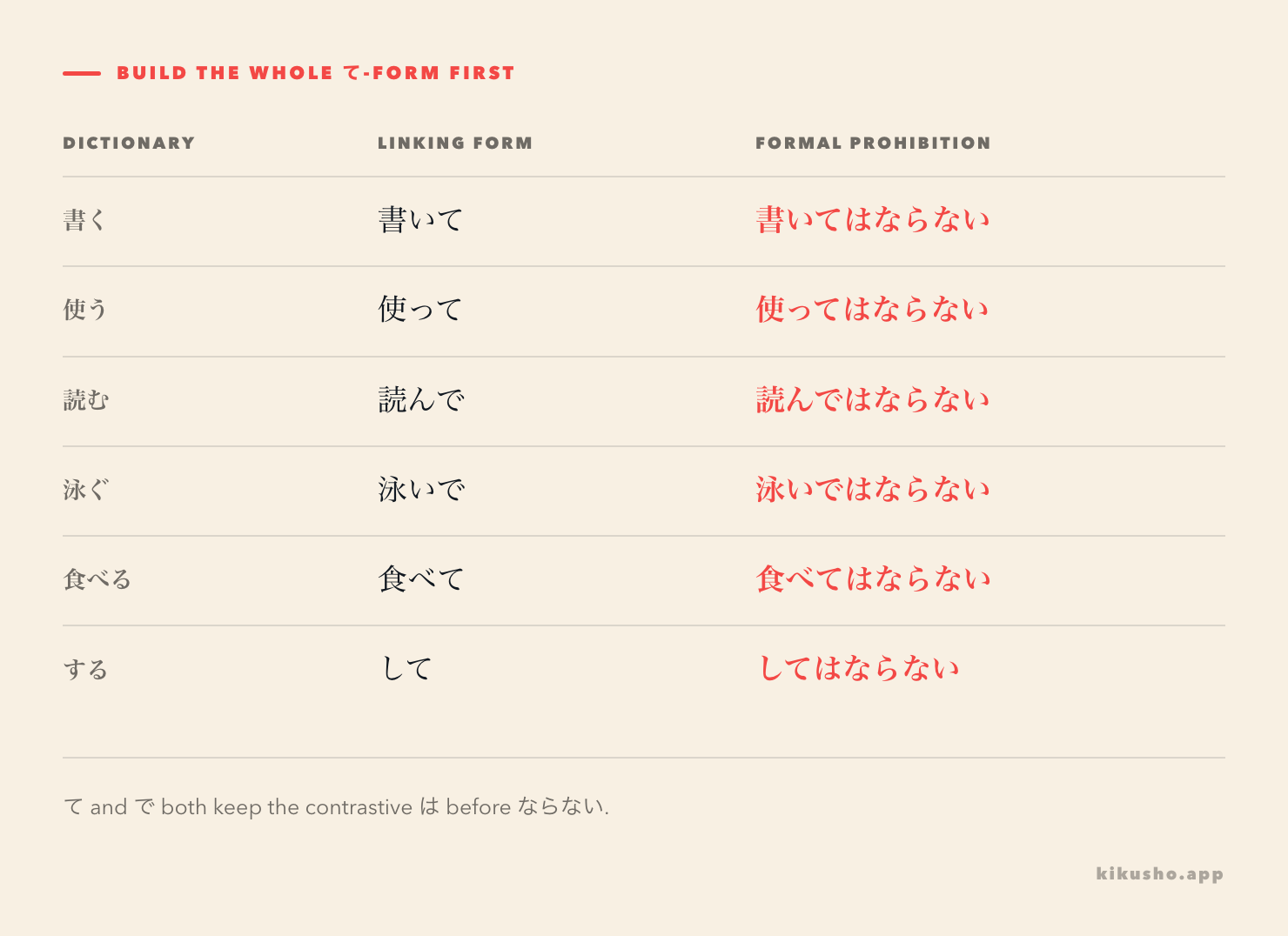
The voiced ending in 読む → 読んで and 泳ぐ → 泳いで stays visible: 読んではならない, 泳いではならない. Do not force every verb into literal て.
この区域では泳いではならない。
このくいきではおよいではならない。
You must not swim in this area.
The first では belongs to この区域では, setting the area under discussion. The second appears inside 泳いではならない. Similar sounds can serve separate grammatical jobs in one sentence.
The polite ending is てはなりません:
試験中に携帯電話を使用してはなりません。
しけんちゅうにけいたいでんわをしようしてはなりません。
Mobile phones must not be used during the exam.
Politeness changes the ending, not the force of the rule. The action remains prohibited.
Formality makes the rule sound external
Compare two prohibitions:
ここで写真を撮ってはいけません。
You must not take photographs here.
ここで写真を撮ってはなりません。
Photographs must not be taken here.
The practical content is nearly the same. てはならない sounds more formal, impersonal and regulation-like. てはいけない is the wider everyday form, usable by a teacher, parent, staff member or person stating a boundary.
Bunpro's comparison of the two endings likewise treats their meanings as equivalent while placing ならない toward the formal, written end. Its examples centre on rules, limits and conduct rather than a casual warning between friends.
| Form | Typical voice | Example setting |
|---|---|---|
| ちゃだめ | conversational, direct | warning a friend or child |
| てはいけない | general prohibition | ordinary rules and instructions |
| てはならない | formal, institutional or moral | regulations, serious declarations, principles |
The permission and prohibition lesson teaches てはいけない and its spoken contractions. Moving to ならない adds register and weight; it does not create a different prohibited action.
Contractions such as ちゃならない can occur in stylised speech, but they pull the phrase in opposite directions: ちゃ is conversational while ならない is formal. When you need an ordinary spoken warning, ちゃいけない or ちゃだめ is the safer productive choice. Keep the full てはならない for the formal register taught here.
The は separates a ban from a strong feeling
One missing particle changes the grammar:
| Form | Core meaning | Example |
|---|---|---|
| Vてはならない | the action is forbidden | 秘密を話してはならない |
| Vてならない / Aくてならない / Aでならない | a feeling or impression is uncontrollably strong | 結果が気になってならない |
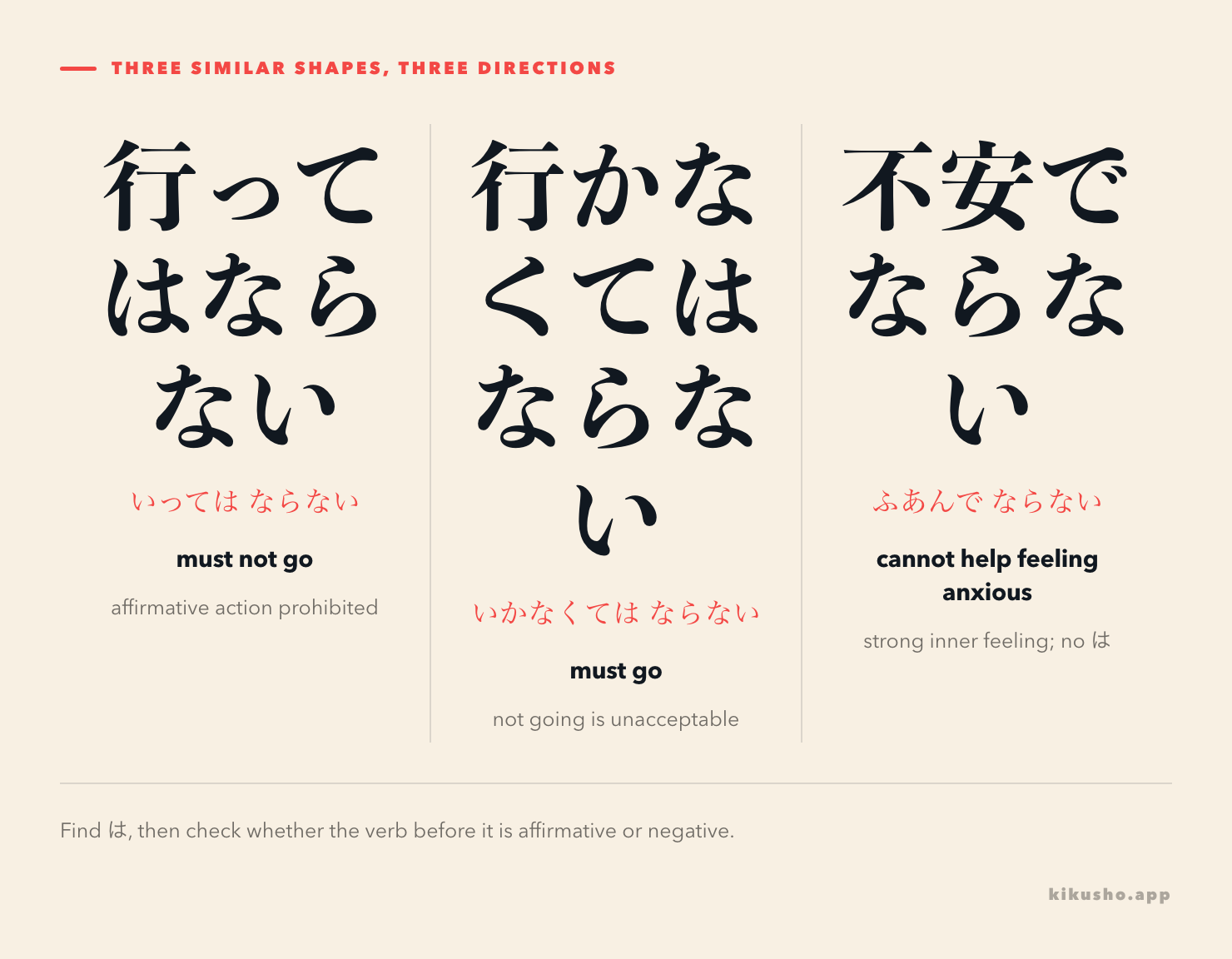
試験の結果が気になってならない。
しけんのけっかがきになってならない。
I cannot stop worrying about the exam result.
This sentence does not prohibit worrying. 気になってならない reports a feeling that arises beyond the speaker's control. Tanosuke explicitly warns that the two patterns look alike but have entirely different meanings. The てならない and ないではいられない lesson develops that emotional construction.
When reading quickly, check for は before interpreting the final ならない. A single visible particle determines whether the sentence is a rule or an inner state.
Affirmative て prohibits; negative なくて obliges
The most dangerous English pair is “must not” versus “must”. Japanese marks the difference before はならない:
行ってはならない。
いってはならない。
You must not go.
行かなくてはならない。
いかなくてはならない。
You must go.
In the first sentence, 行って names the action and rejects it. In the second, 行かなくて names not going and rejects that absence. If not going is unacceptable, going becomes obligatory.
This is composition rather than an arbitrary reversal:
| Material before はならない | What cannot be accepted | Result |
|---|---|---|
| 行って | going | must not go |
| 行かなくて | not going | must go |
The Japanese obligation lesson covers the full family of なければならない, なくてはならない, なきゃ and なくちゃ. Here, the fastest exam check is the polarity of the verb before ては.
A prohibition differs from physical impossibility
English “cannot” covers both rules and ability. Japanese keeps them apart:
関係者以外は、この部屋に入ってはならない。
かんけいしゃいがいは、このへやにはいってはならない。
Anyone other than authorised personnel must not enter this room.
鍵がないので、この部屋に入れない。
かぎがないので、このへやにはいれない。
I cannot enter this room because I do not have a key.
The first sentence sets a rule even if the door is open. The second describes practical inability even if entry would be allowed. Translating both as “cannot enter” conceals the distinction.
The Japan Foundation's guide to instructions, commands and prohibitions treats prohibition as disallowing an action, distinct from merely describing a condition. It also notes that polite wording can still carry strong directive force. Formal てはなりません therefore does not become a request simply because it ends in ません.
When saving a regulation or serious line in Kikusho, keep the entire phrase rather than trimming it to the main verb. A card for 持ち出す, “take out”, misses the institutional force of 持ち出してはならない. Preserve the location, document type or speaker that makes the rule interpretable.
Practice: locate the boundary before translating
Work through the six items first, then open the explanation panel to check the boundary each sentence expresses.
Item 1
Choose the correctly formed prohibition for 読む.
A. 読むてはならない
B. 読みてはならない
C. 読んではならない
D. 読んでならない
Item 2
A notice says:
許可なく、この部屋に入ってはならない。
What does it establish?
A. Entry is physically impossible.
B. Entry without permission is prohibited.
C. The writer cannot stop thinking about entering.
D. Everyone is required to enter.
Item 3
Which sentence means “You must attend tomorrow” rather than “You must not attend tomorrow”?
A. 明日、出席してはならない。
B. 明日、出席しなくてはならない。
C. 明日、出席してはいけない。
D. 明日、出席してならない。
Item 4
Explain the role of は in this pair:
- 秘密を話してはならない。
- その秘密が気になってならない。
Item 5
Rewrite 試験中に辞書を使ってはならない with the polite ending. Do not change the rule itself.
Item 6
Read the policy:
研究データを許可なく持ち出してはなりません。個人の端末に保存してはなりません。必要な場合は、責任者に相談してください。
Which summary is accurate?
A. Researchers may copy the data if they tell the manager afterward.
B. The policy forbids unauthorised removal and storage on personal devices, and directs special cases to the person responsible.
C. The policy says removal is difficult because the devices lack storage.
D. The writer feels unable to stop worrying about the data.
Answers and explanations
Explanation 1
C, 読んではならない. 読む takes the linking form 読んで, followed by はならない. D omits the particle that creates the prohibition; A and B do not supply the correct て-form.
Explanation 2
B. 入ってはならない rejects entering as permitted conduct, and 許可なく narrows the rule to entry without permission. The sentence does not describe a locked door, an inner feeling or a duty to enter.
Explanation 3
B, 出席しなくてはならない. The phrase rejects not attending, so attendance is required. A and C prohibit attendance. D resembles the separate てならない pattern but does not express the requested obligation.
Explanation 4
In sentence 1, は after 話して creates the prohibition: speaking about the secret is unacceptable. Sentence 2 lacks は; 気になってならない reports an uncontrollably strong concern. The similar ending therefore belongs to a different construction.
Explanation 5
試験中に辞書を使ってはなりません. Replace final ならない with なりません. The て-form and は stay intact, so dictionary use remains prohibited.
Explanation 6
B. The first two sentences use polite てはなりません to forbid two actions: taking research data out without permission and saving it on a personal device. The final 相談してください gives the approved route for exceptional needs. Nothing describes physical inability or an involuntary feeling.
Common questions
What does てはならない mean in Japanese?
Verb て-form + はならない means “must not” or “should not”. It frames the action as prohibited by a formal rule, public standard or strong moral principle rather than merely describing an undesirable result.
What is the difference between てはならない and てはいけない?
Both prohibit an action. てはならない is more formal and rule-like, so it is common in regulations, serious statements and moral principles. てはいけない is the broader everyday prohibition taught earlier.
What is the difference between てはならない and なくてはならない?
The affirmative て-form before はならない prohibits the action: 行ってはならない means “must not go”. A negative verb before なくてはならない creates an obligation: 行かなくてはならない means “must go”.
Is てはならない the same as てならない?
No. The は is essential to the prohibition. てならない without は usually expresses an uncontrollably strong feeling or impression, as in 残念でならない, “I cannot help feeling regretful”.