On this page
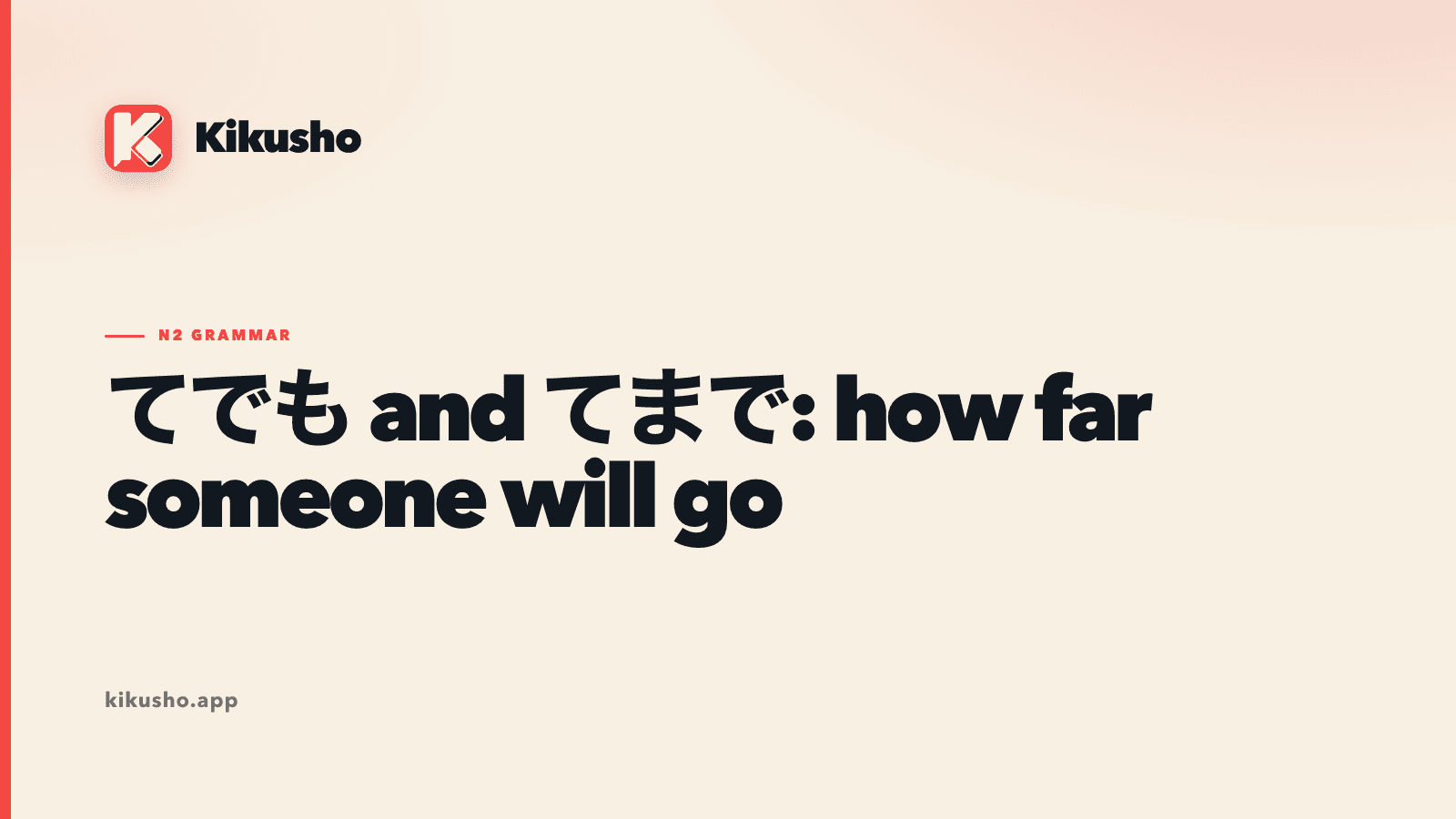
AてでもB says the subject is willing to use the difficult measure A to achieve B: 借金してでも留学したい means “I want to study abroad even if I have to borrow money.” AてまでB puts A at the edge of what seems reasonable: 借金してまで留学したくない means “I do not want to study abroad badly enough to go into debt.”
This lesson covers inventory items g-e0d6efea29d5, ~てでも, and g-3944be979e37, ~てまで. Both forms select an unusual means, but they do not carry the same stance. でも tends to support determination toward a goal; まで presents a boundary that the rest of the sentence accepts, reports or rejects.
The main clause tells you whether the extreme is accepted
Compare the same costly action with two different conclusions.
| Sentence | View of 借金する | Speaker's stance |
|---|---|---|
| 借金してでも留学したい | a cost the subject is willing to bear | determined acceptance |
| 借金してまで留学したくない | a boundary the subject refuses to cross | negative limit |
| 借金してまで留学した | an extreme the speaker reports or evaluates | surprise, criticism or strong resolve |
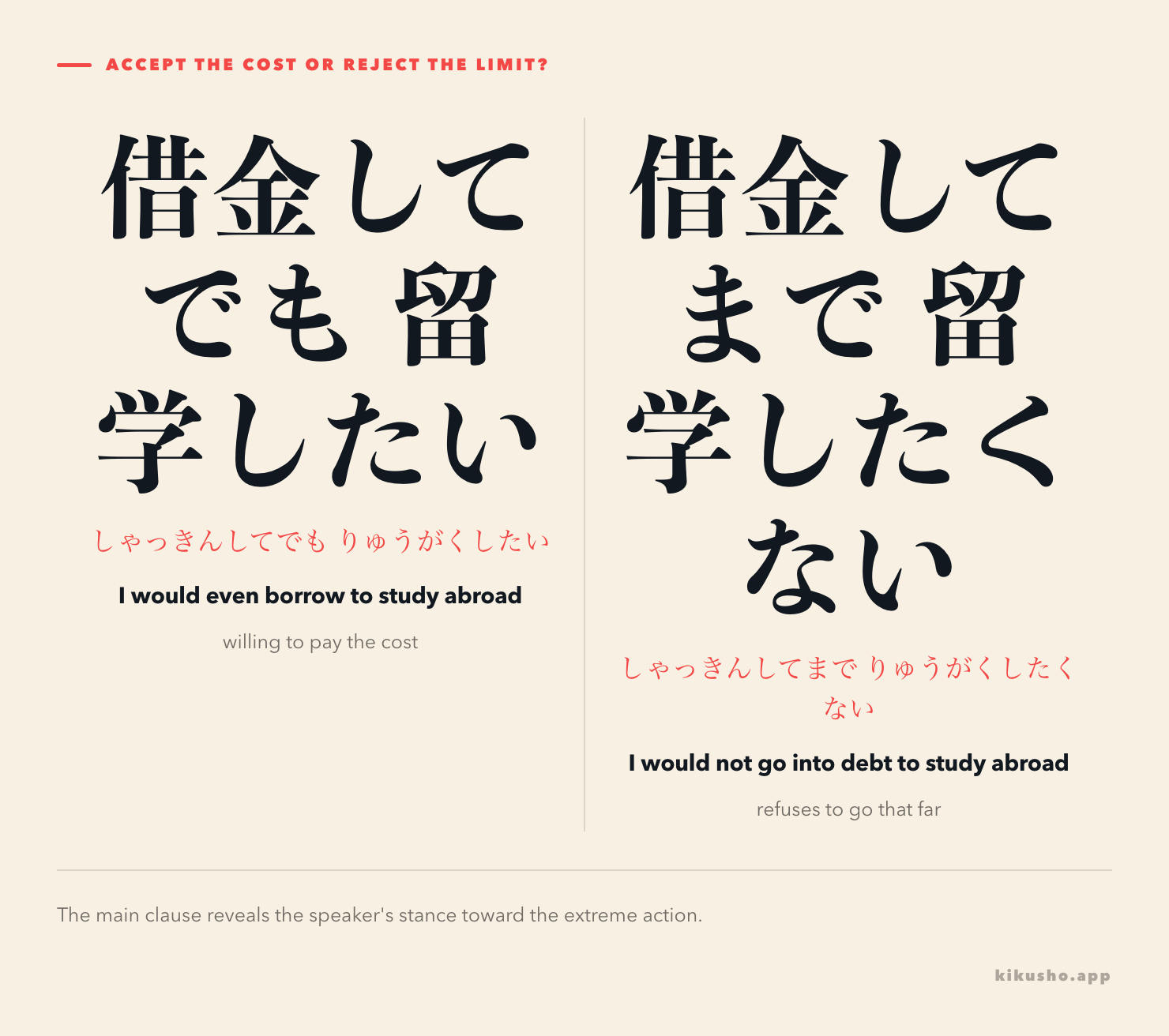
The first clause alone does not finish the message. Read through たい, つもりだ, 必要はない, とは思わない or the final event. That ending shows whether the speaker embraces the difficult means, sets a limit or comments on somebody else's choice.
~てでも accepts a difficult means for the goal
Attach でも to a verb's て-form.
| Dictionary form | て-form | ~てでも |
|---|---|---|
| 借りる | 借りて | 借りてでも |
| 休む | 休んで | 休んででも |
| 徹夜する | 徹夜して | 徹夜してでも |
| 予定を変える | 予定を変えて | 予定を変えてでも |
仕事を休んででも、家族のそばにいたい。
しごとを やすんででも、かぞくの そばに いたい。
I want to stay with my family even if I have to take time off work.
徹夜してでも、明日までに仕上げるつもりだ。
てつやしてでも、あしたまでに しあげる つもりだ。
I intend to finish it by tomorrow even if I have to stay up all night.
遠回りしてでも、安全な道を選ぶべきだ。
とおまわりしてでも、あんぜんな みちを えらぶべきだ。
We should choose the safe route even if it means taking a detour.
The second clause often contains desire, intention, necessity or advice: ~たい, ~つもりだ, ~ようと思う, ~なければならない, ~べきだ. Bunpro's N2 entry explains てでも as a strong-will expression meaning “even if I have to” or “by any means,” and notes its frequent pairing with desire and intention. J-nihongo independently describes an ordinarily avoided measure accepted in order to realize a goal.
The subject need not enjoy A. The point is willingness to pay that cost because B matters more. 予定を変えてでも参加したい does not praise changing plans; it ranks participation above the inconvenience.
~てまで marks the outer edge of acceptable action
Attach まで to the same て-form. The particle's boundary meaning now measures how far the subject goes.
健康を犠牲にしてまで、働く必要はない。
けんこうを ぎせいにしてまで、はたらく ひつようは ない。
There is no need to work to the point of sacrificing your health.
友達にうそをついてまで、秘密を守ろうとは思わない。
ともだちに うそを ついてまで、ひみつを まもろうとは おもわない。
I would not go so far as to lie to a friend to protect the secret.
彼は家族との時間を削ってまで、会社に尽くした。
かれは かぞくとの じかんを けずってまで、かいしゃに つくした。
He devoted himself to the company even to the point of cutting into family time.
Negative evaluations are frequent because まで sets up a natural “not that far” response: 必要はない, 価値はない, ~たくない, ~とは思わない. Japanese Language Education describes the pattern as reaching such an extreme degree and illustrates it with speakers rejecting that degree. Benri Japan likewise notes frequent surprise or criticism and the tendency toward “there is no need to go that far.”
Negative endings are a tendency, not a formation rule. 彼は借金してまで店を守った reports that he actually went as far as borrowing money. Depending on context, it can express admiration, alarm or disapproval. The form supplies the extreme boundary; the surrounding sentence supplies the verdict.
てまで and までして can frame the same extreme
With many noun + する actions, the order can shift.
| ~てまで | ~までして | Meaning |
|---|---|---|
| 借金してまで家を買う | 借金までして家を買う | go so far as borrowing to buy a house |
| 徹夜してまで働く | 徹夜までして働く | go so far as staying up all night to work |
| うそをついてまで隠す | うそまでついて隠す | go so far as lying to hide it |
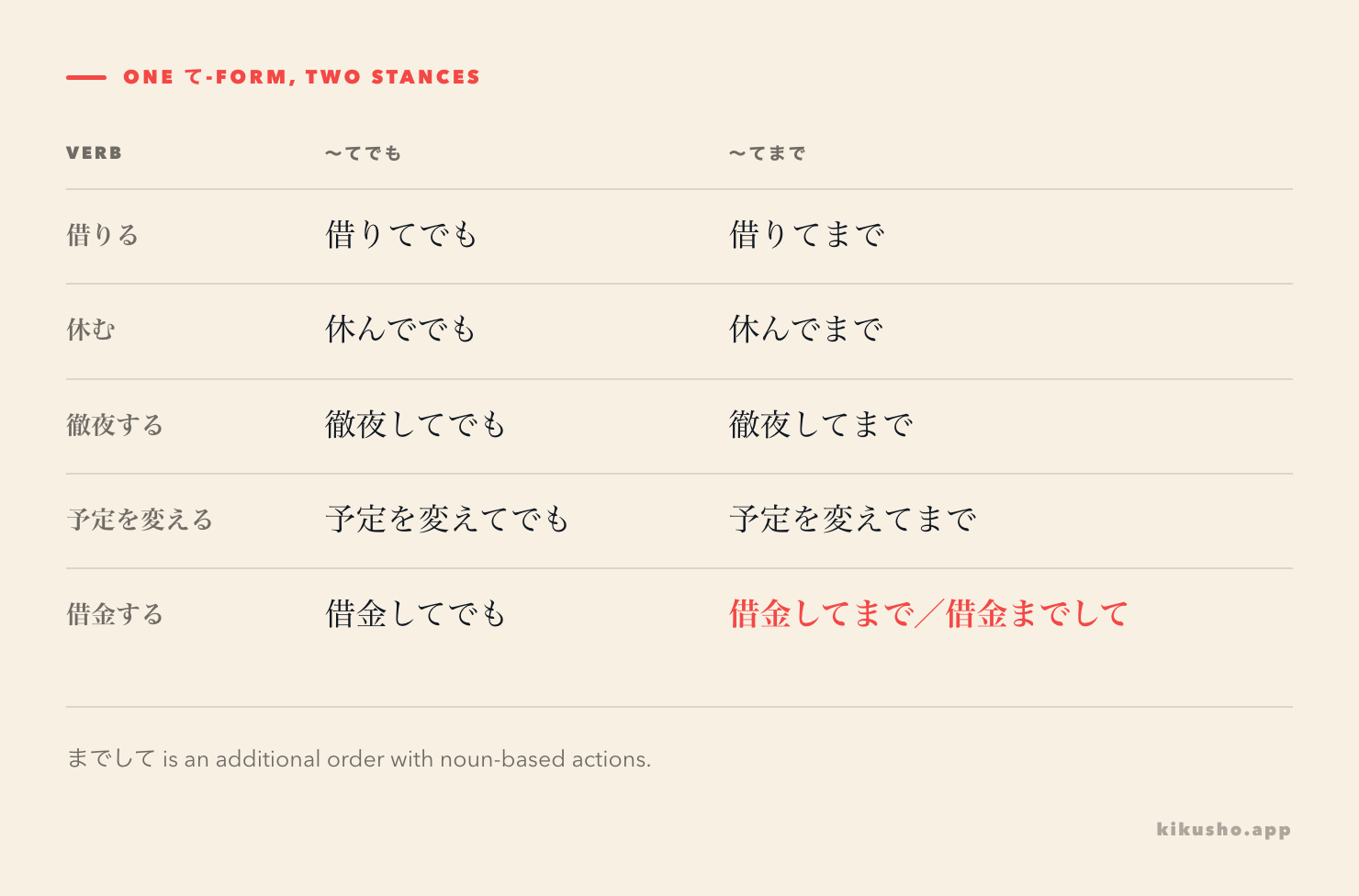
The last pair shows why this is not merely moving characters. うそをつく is a noun plus its light verb, so うそまでついて places まで after the noun while retaining ついて. Japanese with Kanako gives both て-form + まで and noun + までして as N2 patterns for an unusually difficult or undesirable action.
Keep ~てでも separate from ordinary ~ても
雨が降っても行く means “I will go even if it rains.” Rain is a condition the speaker cannot necessarily choose as a means. 雨にぬれてでも行く means “I will go even if I have to get soaked.” Getting soaked is the cost the speaker accepts in order to go.
| Form | Relationship |
|---|---|
| 雨が降っても行く | the result remains despite a condition |
| 雨にぬれてでも行く | the subject accepts a difficult consequence or means |
The concession guide to たとえ~ても and related forms covers the broader “even if” relationship. てでも is narrower: it foregrounds determination strong enough to accept A.
Nor does every emphatic goal need either pattern. どうしても参加したい says “I absolutely want to participate” without naming the price. 予定を変えてでも参加したい names that price. The どうしても and なるべく lesson separates unavoidable insistence from “as much as possible.”
In Kikusho, save the main clause with the extreme action. 借金してでも alone does not say what goal justifies the debt, while 借金してまで alone does not reveal whether the boundary is accepted or rejected. A full pair such as 借金してでも留学したい/借金してまで留学したくない turns the contrast into a reviewable choice.
Practice: read past the extreme action
Work through Questions 1–7, then open the single answer panel.
Question 1 — grammar choice. The speaker is determined to attend: 予定を変えて__、その講演を聞きたい。
- ア. まで
- イ. でも
- ウ. しか
- エ. こそ
Question 2 — grammar choice. The speaker rejects an excessive price: 借金して__、その時計を買いたくない。
- ア. でも
- イ. こそ
- ウ. まで
- エ. ばかり
Question 3 — formation. Which sentence correctly uses 休む with ~てでも?
- ア. 仕事を休みてでも行きたい。
- イ. 仕事を休んでもで行きたい。
- ウ. 仕事を休むてでも行きたい。
- エ. 仕事を休んででも行きたい。
Question 4 — meaning contrast. Match each sentence to its stance.
A. 高いお金を払ってでも手に入れたい。
B. 高いお金を払ってまで手に入れたいとは思わない。
- The speaker refuses to go as far as paying a high price.
- The speaker accepts a high price as the cost of obtaining it.
Question 5 — sentence composition. Say “I will finish it today even if I have to stay up all night,” using 徹夜する, 今日中に仕上げる and ~てでも.
Question 6 — text grammar. Complete the criticism: 体を壊して__働く必要はない。
- ア. こそ
- イ. でも
- ウ. まで
- エ. しか
Question 7 — connected text. Which ending completes the determined goal? その資料は公開されていない。それでも、私は人に頼んででも、__。
- ア. 読みたくない
- イ. 手に入れたい
- ウ. 捨てる必要はない
- エ. 高すぎる
Answers and explanations
Answer 1. イ, でも. 予定を変えてでも聞きたい names changing the schedule as a cost the speaker accepts because hearing the lecture matters more. The desire ending supports the determined reading.
Answer 2. ウ, まで. 借金してまで買いたくない places debt at an unacceptable boundary and rejects crossing it. てでも would normally support willingness to use that means, conflicting with the intended limit.
Answer 3. エ, 仕事を休んででも行きたい. 休む has the て-form 休んで; adding でも gives 休んででも. The other choices attach the particles to non-existent forms.
Answer 4. A–2; B–1. A accepts the high payment as a means to the desired object. B uses まで with とは思わない to deny that the object is worth going that far.
Answer 5. 徹夜してでも、今日中に仕上げる。 徹夜する → 徹夜して takes でも, and the following clause states the determined goal. 今日中に sets the deadline within today.
Answer 6. ウ, まで. 体を壊してまで marks damaging one's health as an excessive boundary, while 必要はない rejects the need to cross it.
Answer 7. イ, 手に入れたい. The unavailable document creates a difficult goal, and 人に頼んででも shows willingness to ask someone for help in order to obtain it. The other endings do not supply the determined goal that the setup requires.
The N2 placement and its limits
JLPT Sensei places both patterns at N2, while Bunpro and J-nihongo independently place てでも there and multiple Japanese-teacher sources teach てまで as N2. These labels align with the inventory but remain publisher estimates because the official JLPT does not publish a form-by-form syllabus.
OpenAI Codex checked the attachments, stance distinctions, readings, translations and seven original answer keys against the listed references. This was an AI language review; no human review is claimed.
Common questions
What is the difference between ~てでも and ~てまで?
AてでもB shows willingness to use A as a difficult or unusual means to achieve B. AてまでB marks A as an extreme point and often questions, criticizes or rejects going that far, though context can also report determined action.
How do you form ~てでも and ~てまで?
Attach でも or まで to a verb's て-form: 借りる → 借りてでも/借りてまで, 徹夜する → 徹夜してでも/徹夜してまで, and 休む → 休んででも/休んでまで.
Why does ~てまで often appear with a negative ending?
The speaker frequently uses it to set a limit: 借金してまで買いたくない means “I do not want it enough to borrow money.” Negative endings are common, but ~てまで can also report that someone actually went to an extreme.
Are ~てでも and ~てまで officially assigned to JLPT N2?
JLPT Sensei lists both at N2, and Bunpro also places ~てでも at N2. The JLPT publishes no exhaustive grammar list, so these are study-guide placements.