On this page
彼はもう無理だというふうに首を振った means that he shook his head in a way that suggested “It is impossible now.” Japanese というふうに packages the preceding statement or arrangement as a manner, impression or pattern for what follows.
The hinge is という. It can quote much more than a single noun, while ふう names a manner or air and に makes that manner modify the next action. Instead of memorizing one English translation, locate the material before というふうに and ask what later verb treats it as a way of acting, thinking, organizing or presenting.
JLPT Sensei and Bunpro both teach というふうに at N2. A 3A Corporation teaching guide analyzes the closely related というように as a way to explain through quoted examples. These references support the two uses developed here: a clause presented as an apparent stance or manner, and an explicit example or arrangement presented as a pattern. The N2 label is study guidance because the JLPT authority does not publish an exhaustive grammar syllabus.
A whole formulation can become the manner
The most useful frame is:
plain statement or arrangement + というふうに + action or judgment
The statement can end in a verb, an い-adjective, a noun predicate or a な-adjective predicate. Complete affirmative noun and な-adjective predicates retain だ because という quotes the complete content.
| Material before というふうに | Complete form | What it supplies |
|---|---|---|
| verb | 参加しないというふうに | “not participating” as the understood stance |
| い-adjective | 難しいというふうに | “difficult” as an assessment |
| noun predicate | 自分が責任者だというふうに | “I am the person responsible” as an air or stance |
| な-adjective predicate | 安全だというふうに | “safe” as an assessment |
| arrangement | 朝は文法、夜は読解というふうに | an explicit organizing pattern |
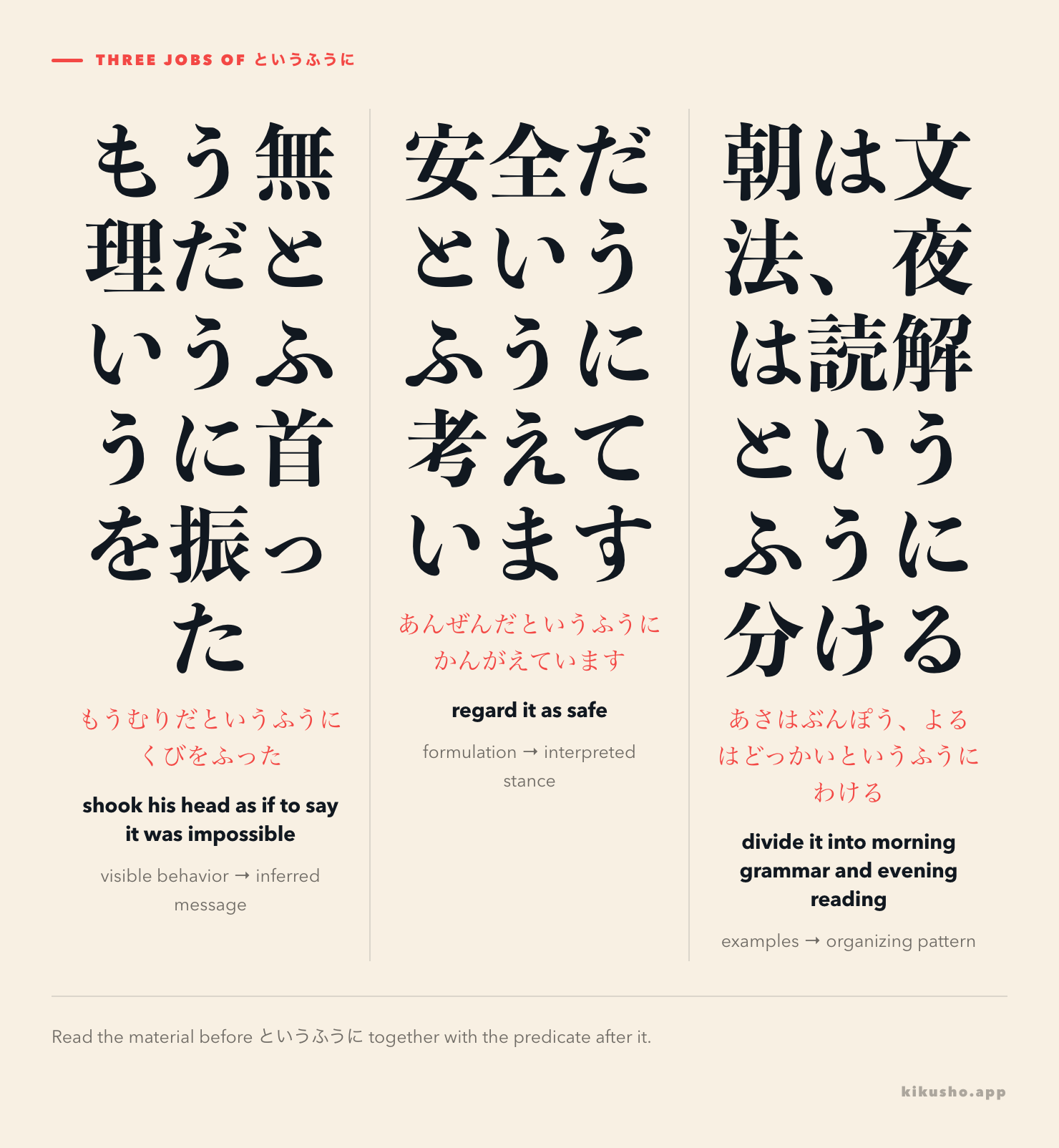
彼はもう無理だというふうに首を振った。
かれは もう むりだというふうに くびを ふった。
He shook his head as if to say that it was impossible now.
No one has to utter もう無理だ. The head movement creates that impression, so “as if to say” works in English.
私は、この方法がいちばん安全だというふうに考えています。
わたしは、この ほうほうが いちばん あんぜんだというふうに かんがえています。
I regard this method as the safest.
Here というふうに考えています frames the speaker's way of viewing the issue. In careful speech it can sound more roundabout than the direct この方法がいちばん安全だと思います. The longer form is useful when the speaker is presenting a position as one interpretation or formulation rather than firing off a bare assertion.
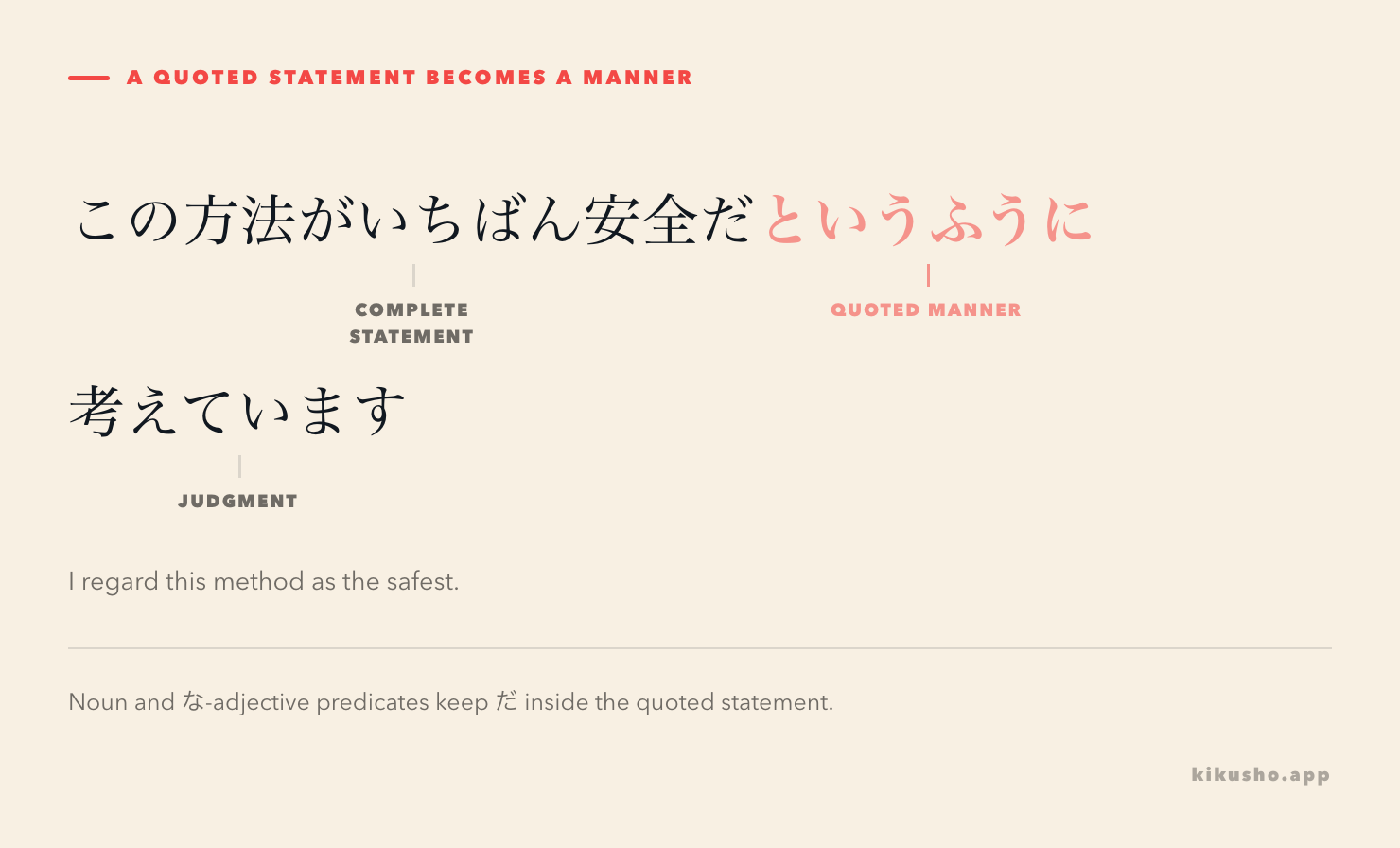
Do not remove だ from the noun-like predicate in 安全だというふうに. Compare 難しいというふうに: 難しい is already a complete い-adjective predicate, so adding だ would be wrong.
The following verb tells you which reading is active
A dictionary gloss cannot decide whether the sentence describes appearance, interpretation or organization. The predicate after というふうに usually reveals the relation.
Behavior can suggest an unspoken message
With 首を振る, 笑う, うなずく or 振る舞う, the quoted content often names the message conveyed by visible behavior.
彼女は心配ないというふうに笑った。
かのじょは しんぱいないというふうに わらった。
She smiled as if to say there was nothing to worry about.
This sentence reports an interpretation of the smile. It does not prove that she felt calm or that she literally spoke.
Thinking and reporting verbs frame a position
With 考える, 見る, 受け取る or 説明する, the construction can present a way of interpreting or formulating information.
担当者は、予定どおり進められるというふうに見ています。
たんとうしゃは、よていどおり すすめられるというふうに みています。
The person in charge sees it as possible to proceed on schedule.
私はその説明を、参加は任意だというふうに受け取りました。
わたしは その せつめいを、さんかは にんいだというふうに うけとりました。
I understood that explanation to mean that participation was optional.
The second example makes the interpretation explicit. Another listener might have understood the explanation differently.
A list can establish an arrangement
When several paired items precede the pattern, というふうに can mean “in this arrangement” or “along these lines.”
朝は文法、夜は読解というふうに、時間帯で勉強内容を分けています。
あさは ぶんぽう、よるは どっかいというふうに、じかんたいで べんきょうないようを わけています。
I divide my study by time of day: grammar in the morning and reading at night.
月曜は田中さん、火曜は私というふうに、交代で担当します。
げつようは たなかさん、かようびは わたしというふうに、こうたいで たんとうします。
We take turns being responsible, with Tanaka on Monday and me on Tuesday.
These are not claims about how something looks. The preceding pairs demonstrate the rule used to organize the schedule. The comma after というふうに is common because the quoted arrangement can be long, but punctuation does not change the grammar.
Do not confuse manner with an actual quotation
The sound という can make every example look like reported speech. Compare the grammatical job of the material after it.
彼は「参加しない」と言った。
かれは「さんかしない」と いった。
He said, “I will not participate.”
彼は参加しないというふうに首を振った。
かれは さんかしないというふうに くびを ふった。
He shook his head in a way that suggested he would not participate.
In the first sentence, 言った is the past verb “said.” In the second, という introduces the content used to characterize the manner, and the actual event is 首を振った. Quotation marks in the first example help show direct speech, but the deeper test is the predicate: did someone say the words, or did some behavior create that impression?
The guide to という names and clauses develops quotation and content attachment. Its noun phrase 店が休みだという知らせ ends at the head noun 知らせ, “a notice that the shop is closed.” In this lesson's 休みだというふうに説明した, the quoted statement instead becomes the manner of 説明した.
Bare ふうに retrieves a manner differently
The shorter ふうに pattern often gets its content from a demonstrative or from a directly described appearance.
こんなふうに線を引いてください。
Draw the line like this.
彼は何も知らないふうに振る舞った。
He acted as if he knew nothing.
こんなふうに points to a shown or present manner. 何も知らないふうに directly describes an outward air. By contrast, 何も知らないというふうに説明した would package “knows nothing” as the way someone explained or characterized the situation. The extra という earns its place when the speaker treats the preceding material as a quotable formulation or an explicit pattern.
The focused lesson on ふうに covers demonstratives, outward air and the contrastive ふうには. Do not expand every こんなふうに into こんなというふうに; こんな already modifies ふう directly.
というふうに and ように do not swap mechanically
Plain ように has many roles: resemblance, following a model, purpose and resulting state. というふうに has a quotative boundary before the manner. That difference blocks simple replacement.
鳥のように飛びたい。
とりのように とびたい。
I want to fly like a bird.
毎日一つ例文を書くというふうに練習しています。
まいにち ひとつ れいぶんを かくというふうに れんしゅうしています。
I practice by following a routine of writing one example sentence every day.
The bird is a comparison model, so 鳥のように is natural. The second sentence states the routine itself and then treats it as the method of practice. The 3A Corporation guide makes the same structural distinction for closely related というように: quoted examples can explain a method or problem, while ordinary comparison ように does not contain that quotation.
For an unreal or vivid resemblance, かのように may fit better: 何も起きなかったかのように話を続けた, “He continued speaking as if nothing had happened.” The かのように lesson explains that stronger as-if frame.
Register and spelling
というふうに belongs to standard Japanese and is common in explanation, careful conversation and prose. In spontaneous speech, a speaker may use っていうふうに:
朝は読む、夜は書くっていうふうに分けています。
I split it up like this: reading in the morning and writing at night.
Use the full というふうに in formal writing and in study examples unless the conversational contraction itself matters. ふう is often written in hiragana in grammatical use. という風に is also seen, as Bunpro's headword and examples show; writing the grammatical noun in hiragana avoids confusing it with lexical compounds such as 和風.
On a Kikusho card, keep both sides of the construction. Saving only というふうに = in such a way hides what is being packaged and which later verb interprets it. A card built from 朝は文法、夜は読解というふうに分ける preserves the arrangement, the connector and the organizing verb.
Practice: locate the quoted formulation and its job
Answer all six prompts before opening the explanations. For each one, identify the material quoted by という and the later predicate that treats it as a manner or pattern.
Question 1 — grammar choice. Which sentence correctly means “She smiled as if to say that there was nothing to worry about”?
- 彼女は心配ないというふうに笑った。
- 彼女は心配ないだというふうに笑った。
- 彼女は心配ないというふうを笑った。
- 彼女は心配ないというふうが笑った。
Question 2 — sentence composition. Combine the content この方法が安全だ with 考えています by using というふうに. Preserve the copula required inside the quoted content.
Question 3 — text grammar. Read the sentence: 月曜は田中さん、火曜は私というふうに、交代で担当します。 What does というふうに do here?
- It reports exact words spoken by Tanaka.
- It gives two assignments as examples of the rotation pattern.
- It compares the speakers to Monday and Tuesday.
- It turns 火曜 into the subject of 担当します.
Question 4 — contrast selection. Choose the natural completion: 先生が実際に「明日は休みです」と発言した。先生は明日は休みだ__。
- というふうに首を振った
- と言った
- というふうだと言ったに
- ふうを言った
Question 5 — error repair. Correct the attachment error in 私はこの町が静かというふうに考えています, keeping the intended meaning “I regard this town as quiet.”
Question 6 — text grammar. In 朝は読む、夜は書くっていうふうに分けています, what does っていうふうに represent, and what register difference does it have from というふうに?
Your diagnostic clue is the predicate after the pattern: it shows whether the quoted material becomes an impression, interpretation or arrangement.
Answers and explanations
Explanation 1. 1. 彼女は心配ないというふうに笑った。 The negative expression 心配ない is already complete and needs no だ. に makes the manner modify 笑った, so を and が do not fit.
Explanation 2. A natural answer is 私はこの方法が安全だというふうに考えています。 安全だ is a complete な-adjective predicate inside the quoted content. というふうに then makes that formulation the speaker's way of regarding the method.
Explanation 3. 2. It gives two assignments as examples of the rotation pattern. The pairs “Tanaka on Monday” and “me on Tuesday” show how the duty is organized. No speech event or comparison is asserted.
Explanation 4. 2. と言った. The context explicitly says that the teacher uttered the words, so the speech-reporting verb is required. というふうに首を振った would describe an indicative gesture and contradict the requested completion with the actual statement.
Explanation 5. 私はこの町が静かだというふうに考えています。 Because 静か is a な-adjective, its complete affirmative plain predicate is 静かだ. The copula remains before quotative という.
Explanation 6. It presents 朝は読む、夜は書く as the arrangement used to divide the work. っていうふうに is a conversational contraction of というふうに; the full form is safer in formal prose.
Common questions
What does というふうに mean in Japanese?
というふうに packages the preceding words as a formulation, manner or illustrative pattern. Depending on context, it can mean “as if to say,” “in such a way,” or “with A here and B there, in that pattern.”
How is というふうに different from ふうに?
Bare ふうに often follows a demonstrative such as こんな or describes an outward air. In というふうに, という can quote a complete statement or an explicit arrangement before ふう turns it into the manner of the next action.
Is というふうに the same as と言った?
No. と言った reports that someone said the quoted words. というふうに describes a manner, impression or pattern; the person need not have spoken the preceding words at all.