On this page
来週は三日間休みです。ということは、五連休になるんですね。 The second speaker has not merely repeated “three days off.” ということは turns that fact into a basis for the new conclusion: “So that means it will be a five-day break.”
The pattern often translates as “so that means,” “if that is the case” or “does that mean…?” Its real job is directional: known information comes first, then a consequence, interpretation or confirmation follows.
JLPT Sensei and Bunpro both place ということは at N2 and show the clause-to-conclusion relation. Japanese dictionary entries collected by Kotobank describe it as introducing the meaning or interpretation of a preceding matter and, adverbially, as “in other words” or “ultimately.” These descriptions overlap, but context tells you whether the speaker simply explains the proposition or infers something new from it. The N2 label is reference-based study guidance; official JLPT materials do not enumerate every grammar form.
Known information becomes the topic for a conclusion
The pieces are ordinary, but their combination has a useful discourse role:
| Part | Job |
|---|---|
| という | packages stated or understood content |
| こと | turns that content into a proposition or “fact” |
| は | makes that proposition the topic for what follows |
A common frame is:
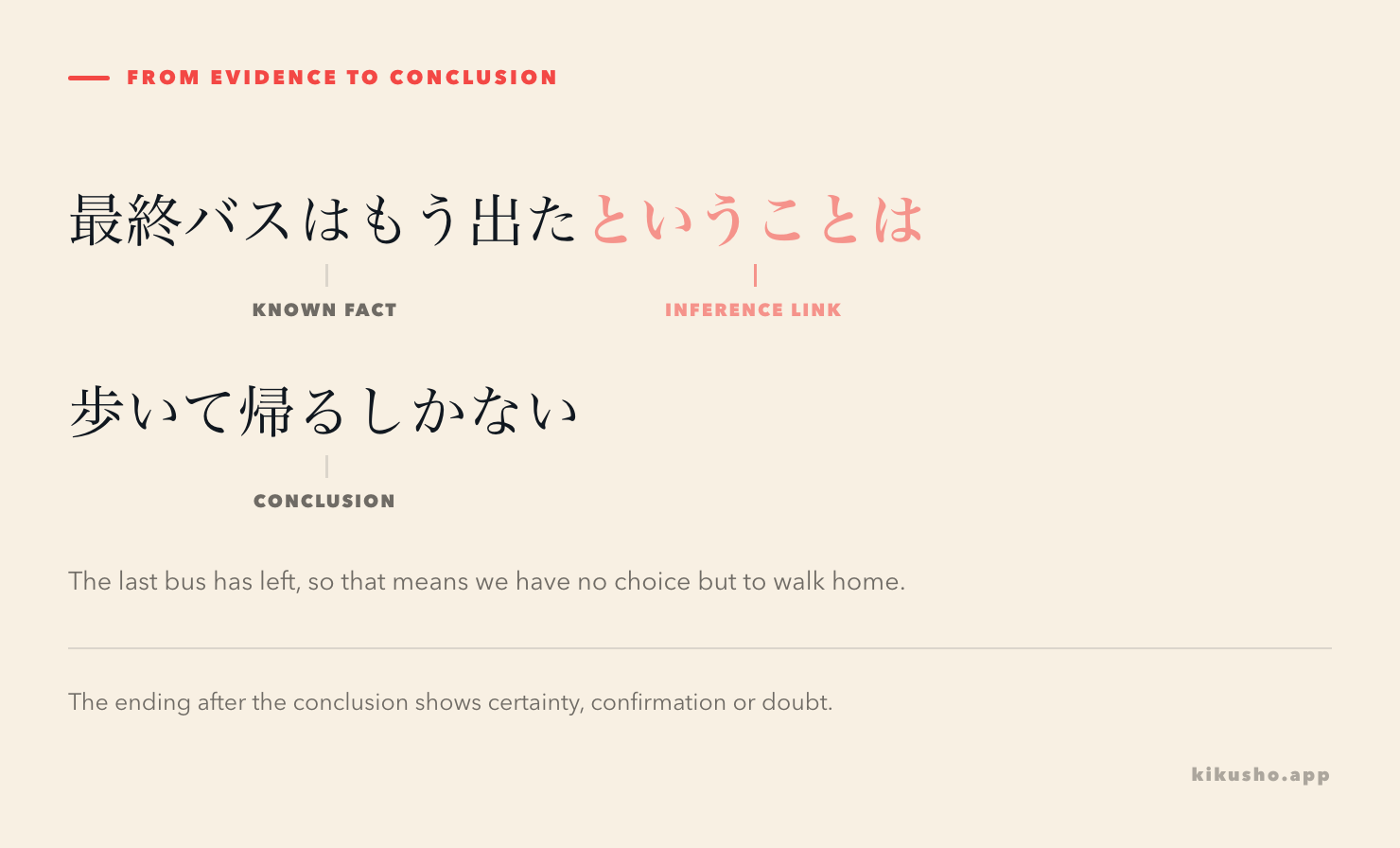
known fact。ということは、conclusion / consequence / confirmation。
田中さんは来週ずっと出張です。ということは、月曜の会議にも出られないんですね。
たなかさんは らいしゅう ずっと しゅっちょうです。ということは、げつようの かいぎにも でられないんですね。
Tanaka will be away on business all next week. So that means he cannot attend Monday's meeting either.
The business trip is given information. Missing the Monday meeting is the listener's conclusion. The ending んですね asks for or signals confirmation.
入口に「本日休業」と書いてある。ということは、中には入れないのだろう。
いりぐちに「ほんじつ きゅうぎょう」と かいてある。ということは、なかには はいれないのだろう。
The entrance says “Closed today.” That probably means we cannot go inside.
Here the evidence is observed rather than spoken. のだろう marks the result as a tentative conclusion reached through reasoning. ということは does not guarantee that the inference is correct; the ending and context show the speaker's confidence.
It can connect two clauses inside one sentence
The same relation can appear without a full stop:
来月から家賃が上がるということは、生活費を見直す必要があるということだ。
らいげつから やちんが あがるということは、せいかつひを みなおす ひつようが あるということだ。
If the rent is going up next month, that means we need to review our living expenses.
The first ということは makes the rent increase the topic from which the consequence follows. The sentence-final ということだ states the resulting interpretation. This paired shape is common, but it is not mandatory.
三割引きということは、一万円の商品なら三千円安くなるんですね。
さんわりびきということは、いちまんえんの しょうひんなら さんぜんえん やすくなるんですね。
A 30 percent discount means that a ¥10,000 item becomes ¥3,000 cheaper, right?
The input can be a noun phrase such as 三割引き, not only a full verb clause. The speaker calculates the consequence and checks it with んですね.
| First part | Typical continuation | Relationship |
|---|---|---|
| observed fact | ~のだろう/~かもしれない | tentative inference |
| another person's statement | ~んですね/~んですか | confirmation |
| numerical or logical premise | ~ということだ | stated consequence |
| plan or condition | action, obligation or result | practical implication |
The conclusion must be recoverable from the premise and context. 雨が降っている。ということは、机が青い。 is grammatically shaped like the pattern, but the two claims have no normal inferential link.
Sentence-initial ということは points back
In conversation, ということは can stand at the beginning of the reply because the content it packages is already available in the previous turn.
A:来月、大阪に引っ越します。
B:ということは、もう東京には住まないんですか。
A: I am moving to Osaka next month.
B: Does that mean you will no longer live in Tokyo?
Speaker B does not repeat 来月、大阪に引っ越す. The expression points back to it and moves directly to the question that follows.
A:最終バスはもう出ました。
B:ということは、歩いて帰るしかないですね。
A: The last bus has already left.
B: So that means we have no choice but to walk home.
In speech, ってことは is a common contraction:
A:明日は店が休みだよ。
B:ってことは、今日中に買わないといけないね。
A: The shop is closed tomorrow.
B: Then we have to buy it today.
Use the full form in formal prose and study examples. Learn the contraction so you can recognize the same inference in conversation.
A proposition topic is not always an inference
The literal combination clause + ということ + は can simply make a proposition the topic.
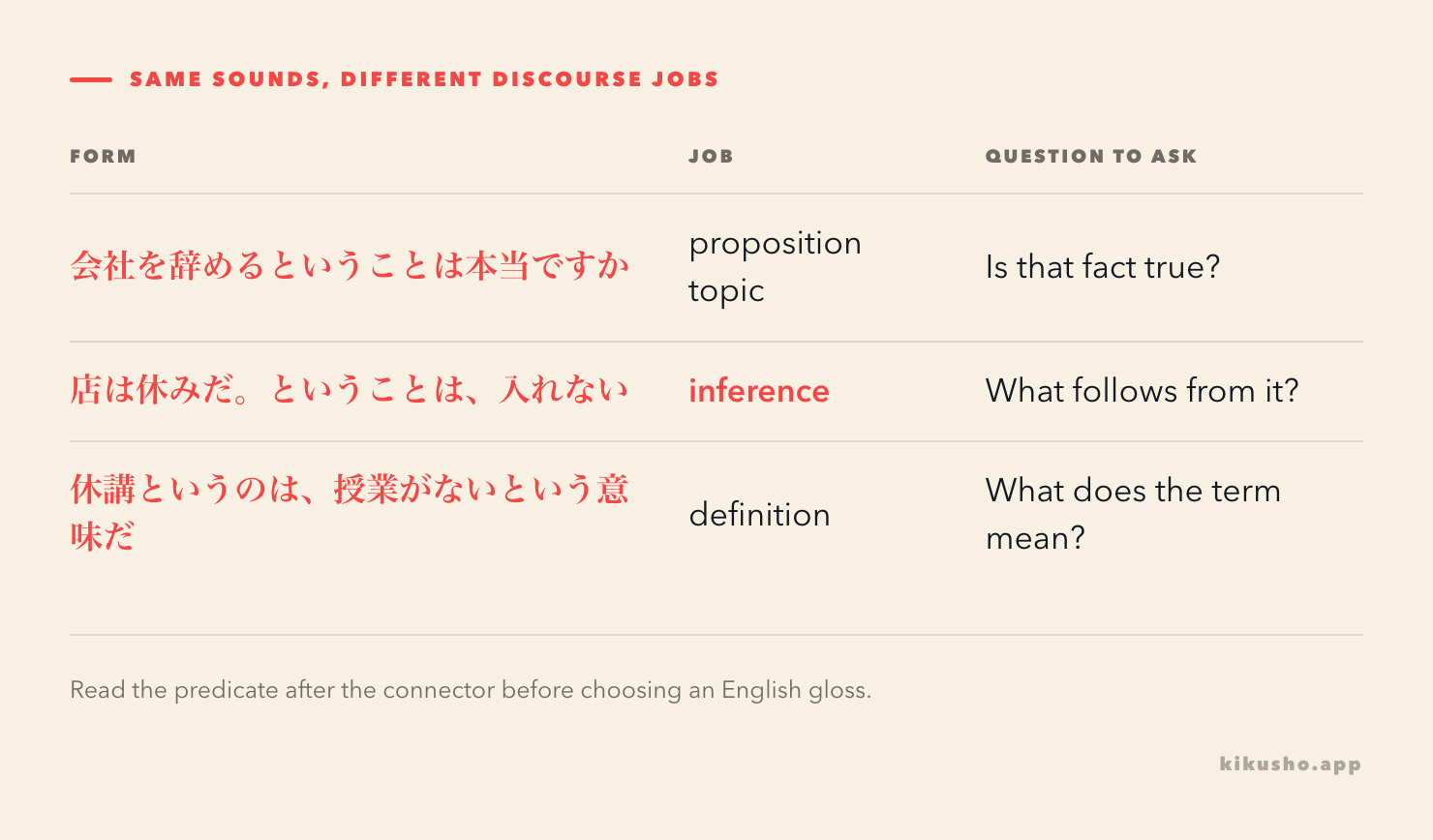
あなたが会社を辞めるということは本当ですか。
あなたが かいしゃを やめるということは ほんとうですか。
Is it true that you are leaving the company?
Here あなたが会社を辞めるということ is the proposition whose truth is questioned. The sentence does not infer a second event from the resignation. This literal topic structure explains how the discourse connector developed, but it should not be forced into “therefore” in every sentence.
A quick test is to look after は. If the continuation draws a consequence such as 出られないんですね, the inference reading is active. If it predicates 本当です, 問題です or another description directly of the proposition, ordinary topicalization may be enough.
The lesson on という and ということ explains how こと packages a clause so it can take a particle. This page adds the discourse step in which topical は launches an inference or confirmation.
ということは, つまり and というのは move differently
All three can appear near an explanation, but they do not ask the reader to perform the same operation.
この試験は辞書を使ってもいい。つまり、持ち込みが認められている。
Dictionaries may be used on this test. In other words, bringing one in is permitted.
つまり reformulates or summarizes the same point. It aims at a clearer equivalent.
この試験は辞書を使ってもいい。ということは、知らない単語をその場で調べられる。
Dictionaries may be used on this test. That means we can look up unfamiliar words on the spot.
ということは adds a consequence enabled by the rule. The conclusion is related to the first fact but is not merely another wording of it. The つまり and すなわち comparison develops summary and exact restatement.
「休講」というのは、授業がないという意味です。
きゅうこうというのは、じゅぎょうが ないという いみです。
休講 means that there is no class.
というのは introduces the item being defined. It can also preface a reason in another sentence pattern. ということは would be unsuitable here unless the speaker were drawing a conclusion from the fact that a class had been canceled. Bunpro makes the same general distinction: というのは favors definition or reason, while ということは favors clarification or conclusion.
The と言えば and というと lesson compares association and topic prompting with inference. Seeing the same という sound is not enough; follow the discourse direction.
Do not merge it with ことはない
A following negative predicate can create a different surface string:
今すぐ決めることはない。
There is no need to decide right now.
This is dictionary-form verb + ことはない, a no-need expression. It contains no quotative という and draws no conclusion. The ことはない and 必要はない lesson covers that form.
Even 注意しすぎるということはない can mean “there is no such thing as being too careful,” where ない denies the proposition. The sequence ということは is present, but its following predicate describes that proposition rather than inferring a consequence. Always read the full sentence.
Choose the ending that matches your certainty
ということは establishes a reasoning link. The ending shows whether you assert, check or soften the result.
- ~ということだ: state the consequence.
- ~んですね: confirm the consequence with shared recognition.
- ~んですか: ask whether your interpretation is right.
- ~のだろう: present a reasoned prediction or inference.
- ~かもしれない: leave the conclusion explicitly uncertain.
連絡がないということは、まだ結果が出ていないのかもしれない。
れんらくが ないということは、まだ けっかが でていないのかもしれない。
The fact that there has been no message may mean that the result is not out yet.
The premise supports the guess, but other explanations remain possible. The construction organizes the reasoning; it does not replace evidence.
When a report presents the result as an impersonal judgment drawn from evidence, the focused と考えられる lesson explains that formal ending and contrasts it with an explicit thinker.
When making a Kikusho card, preserve both the premise and conclusion. A card containing only ということは = that means trains translation, but it does not train the direction of reasoning. Capture a full pair such as 最終バスは出た。ということは、歩くしかない and label the first clause “known fact.”
Practice: follow the inference arrow
Complete all six questions before revealing the explanations. For each prompt, decide whether the speaker is drawing a consequence, confirming an interpretation, restating the same idea or simply making a proposition the topic.
Question 1 — grammar choice. The last train has already left. Choose the continuation that naturally draws a conclusion.
- というのは、「終電」の意味です。
- ということは、タクシーで帰るしかありませんね。
- ということを、駅員です。
- ということはない、タクシーでした。
Question 2 — text grammar. In 三割引きということは、一万円なら三千円安くなるんですね, what relationship does ということは create?
- It names a shop called 三割引き.
- It reports words spoken by the price.
- It turns the discount into the premise for a calculation.
- It denies that the discount exists.
Question 3 — sentence composition. Speaker A says 来週ずっと出張です. Write a response with sentence-initial ということは to confirm that A cannot attend Monday's meeting.
Question 4 — contrast selection. Choose the connector that gives a definition rather than an inference: 「休講」__、授業がないという意味です。
- ということは
- というのは
- ってことは
- ということだろう
Question 5 — interpretation. What does あなたが会社を辞めるということは本当ですか ask?
- Whether the proposition that the listener is leaving the company is true.
- What consequence follows after the listener has already left.
- Why the company itself resigned.
- Whether there is no need to leave the company.
Question 6 — connected text. Read: 店の電気が消えていて、入口にも鍵がかかっている。ということは、今日はもう閉店したのだろう。 Which part is evidence, which part is the inference, and what does のだろう add?
Use the movement from available information to a new interpretation as your final check.
Answers and explanations
Explanation 1. 2. ということは、タクシーで帰るしかありませんね。 The last train's departure is the known fact; having no option except a taxi is the practical consequence. The other choices either define a term or are malformed.
Explanation 2. 3. It turns the discount into the premise for a calculation. A 30 percent discount on ¥10,000 leads to a ¥3,000 reduction. んですね checks that calculated conclusion.
Explanation 3. One natural answer is ということは、月曜の会議にも出られないんですね。 The connector points back to A's business trip. んですね presents B's conclusion for confirmation.
Explanation 4. 2. というのは. The sentence explains the meaning of the term 休講. ということは would normally use an already known cancellation as the premise for some further conclusion.
Explanation 5. 1. Whether the proposition that the listener is leaving the company is true. Here 会社を辞めるということ is the topic of 本当ですか. The surface form does not introduce a separate inferred event.
Explanation 6. The lights being off and the locked entrance are the evidence. 今日はもう閉店した is the conclusion introduced by ということは. のだろう marks it as a reasoned inference rather than a confirmed fact.
Common questions
What does ということは mean in Japanese?
ということは often means “so that means” or “if that is the case.” It takes information already stated or observed and makes it the basis for a conclusion, consequence or confirmation question.
How is ということは different from つまり?
つまり usually summarizes or restates the same point. ということは often moves one step beyond the known fact and draws a consequence or inference from it.
Can ということは begin a sentence?
Yes. At the start of a response, ということは points back to the previous statement and introduces what the listener concludes from it. In conversation, it is often shortened to ってことは.