On this page
とか at the end of a proposition means that the speaker heard the information but is not presenting it as a fully verified fact. Add で when that uncertain report becomes the background reason for what follows: 近くで事故があったとかで、道路が混んでいます means that the road is crowded, reportedly because there was an accident nearby.
This is a hearsay use, separate from the familiar list in 本とか雑誌とか. The shared spelling creates the main reading trap. First decide whether とか follows a complete claim or merely names examples.
JLPT Sensei and JapaneseNET place this pattern at N2 and describe uncertain reported information. Bunpro likewise treats とか as an N2 hearsay marker. Other teaching references assign the form to N3, so the level is best treated as study guidance rather than an official boundary.
Put a complete plain-form report before とか
The content before とか is a proposition: something that could stand as a plain-form statement. Verbs and い-adjectives attach directly. Nouns and な-adjectives keep the plain copula だ.
| Kind of report | Attachment | Example |
|---|---|---|
| verb | plain-form verb + とか | 来月引っ越すとか |
| い-adjective | plain-form い-adjective + とか | 今年は雪が多いとか |
| な-adjective | な-adjective + だとか | 新しい図書館は便利だとか |
| noun | noun + だとか | 明日の会議は休みだとか |
Past and negative forms remain inside the report:
あの店は先月閉店したとか。
あの みせは せんげつ へいてんしたとか。
I heard that shop closed last month.
今年の祭りは駅前では行われないとか。
ことしの まつりは えきまえでは おこなわれないとか。
Apparently this year's festival will not be held in front of the station.
The speaker may know who supplied the information, but the form does not require a named source. 田中さんの話では、新しい支店は六月に開くとか makes the path explicit. A bare 新しい支店は六月に開くとか leaves it to the conversation.
You will also meet んだとか after verbs and い-adjectives, and なんだとか after nouns and な-adjectives:
駅前に新しいホテルができるんだとか。
I hear a new hotel is going to be built near the station.
The explanatory んだ packages the report as background information before とか. Do not confuse this with んだって, another casual hearsay ending. Both relay something heard, but とか more readily marks the content or wording as uncertain, approximate or not fully endorsed.
The uncertainty belongs to the speaker's stance
とか does not prove that the report is false. It shows that the speaker is keeping some distance from it. They may not know whether it is accurate, may not remember the wording precisely, or may prefer not to state the matter too firmly.
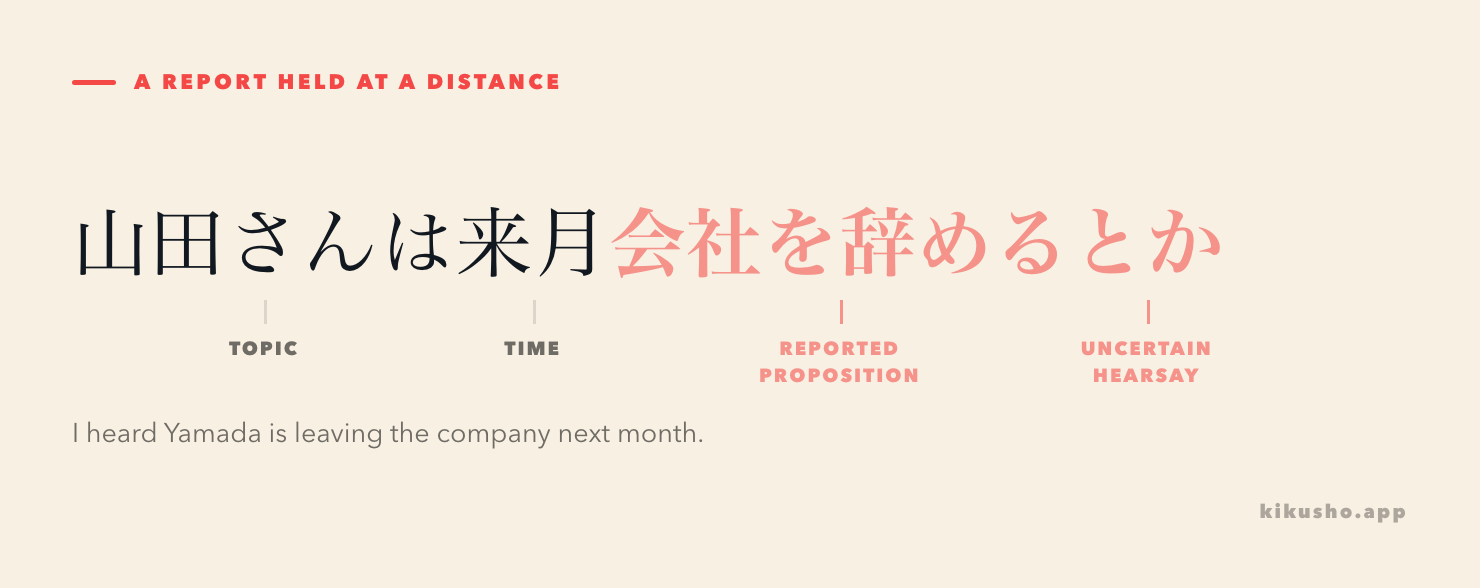
山田さんは来月、会社を辞めるとか。
やまださんは らいげつ、かいしゃを やめるとか。
I heard Yamada is leaving the company next month.
The English “I heard” captures the information path, but the Japanese ending also leaves room for “or so I hear.” That extra distance is why とか suits rumors, secondhand plans and details recalled only approximately.
JapaneseNET describes the form as hearsay used when the speaker wants to avoid a definite assertion. J-nihongo similarly emphasizes that the speaker passes on information without guaranteeing its certainty. Neither description licenses careless claims: if the source and accuracy matter, name the source or verify the information instead of relying on a soft ending.
The pattern can also precede a reporting verb:
来月から新しい制度が始まるとか聞きました。
らいげつから あたらしい せいどが はじまるとか ききました。
I heard something about a new system starting next month.
Here 聞きました states how the speaker received the claim, while とか still makes the remembered content less exact than a straightforward quotation with と.
とかで carries the report into a consequence
When で follows, the report usually supplies a reason or circumstance for the next event. The speaker reports both a cause and its observable consequence without personally guaranteeing the cause.
部長は急な出張が入ったとかで、会議を欠席しました。
ぶちょうは きゅうな しゅっちょうが はいったとかで、かいぎを けっせきしました。
The department head missed the meeting, reportedly because an urgent business trip came up.
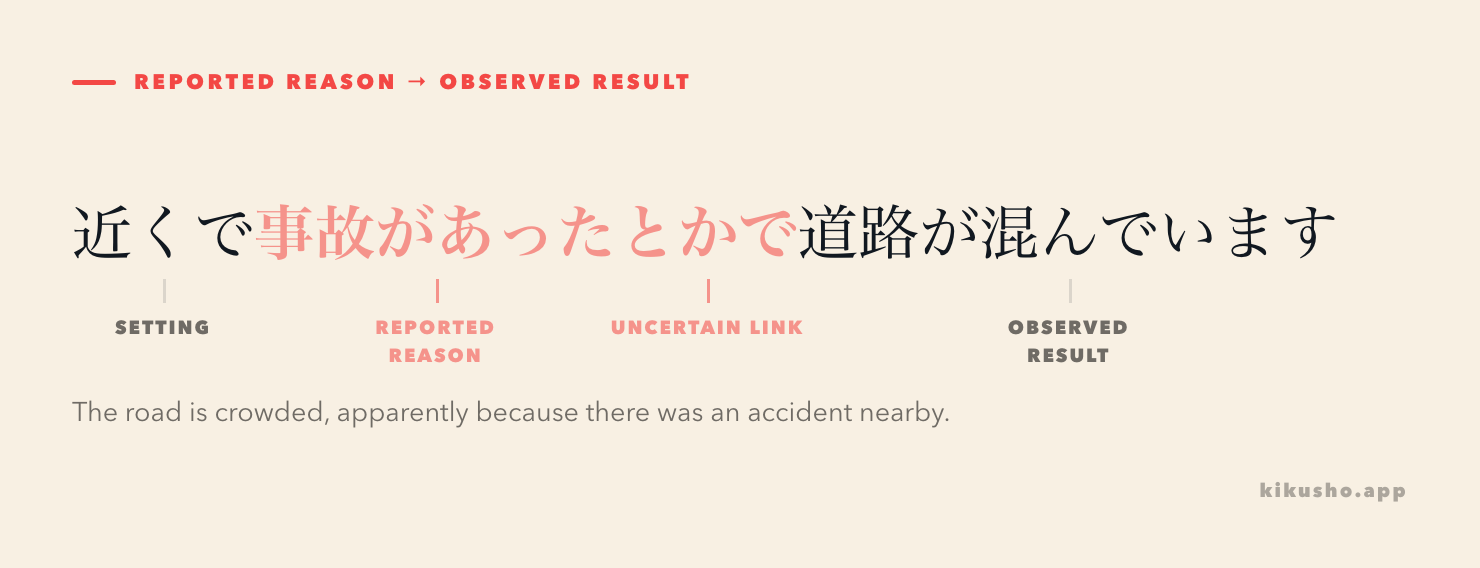
近くで事故があったとかで、道路が混んでいます。
ちかくで じこが あったとかで、どうろが こんでいます。
The road is crowded, apparently because there was an accident nearby.
The first clause is not simply another event in a sequence. It is the reported explanation for the second clause. A useful reading order is:
- identify the reported proposition;
- notice that とか limits commitment to it;
- let で connect that report to the visible result.
The result can be another person's action rather than a physical condition:
佐藤さんは体調がよくないとかで、先に帰りました。
さとうさんは たいちょうが よくないとかで、さきに かえりました。
Sato went home early, reportedly because they were not feeling well.
Avoid using this form when you directly know and assert the reason. If Sato personally told you and you are simply relaying a clear message, 体調がよくないので、先に帰ったそうです may be more neutral. If you witnessed Sato becoming ill, an ordinary reason clause can state what you know without hearsay marking.
A complete claim separates hearsay from a list
Compare the two structures:
週末は映画を見るとか、本を読むとかして過ごします。
I spend weekends doing things like watching films and reading books.
あの映画は来月公開されるとか。
I hear that film will be released next month.
The first sentence contains two example activities, each marked by とか, followed by して過ごします. The second ends after a complete report. A single とか does not automatically mean hearsay, since conversational suggestions such as 映画とかどう? also name an example. Sentence structure settles the reading.
The comparison of とか, なんか, なんて and など teaches the listing and evaluation uses. The key boundary here is that hearsay とか takes a proposition whose truth is at issue. Example-list とか selects a member from a wider set.
| Shape | Likely job | Question to ask |
|---|---|---|
| noun + とか + noun + とか | examples | What larger category do these belong to? |
| plain proposition + とか | uncertain report | Who supplied this claim, and does the speaker endorse it? |
| plain proposition + とかで + result | reported background reason | Is the first claim offered as the reason for the result? |
Choose a hearsay form by information path and register
Several endings translate as “I heard,” but they do not package the information identically.
| Form | Typical effect |
|---|---|
| ~そうだ | relatively neutral relay of information from a source |
| ~とのことだ | formal or businesslike report of a message |
| ~んだって | casual conversational report |
| ~とか | report presented with uncertainty, approximation or limited commitment |
天気予報によると、明日は雪が降るそうです。
According to the forecast, it will snow tomorrow.
発送は金曜日とのことです。
We have been informed that shipment will be on Friday.
発送は金曜日なんだって。
I heard the shipment is on Friday.
発送は金曜日だとか。
The shipment is on Friday, or so I hear.
These are tendencies, not mathematical confidence scores. A skeptical tone can weaken そうだ, and a reliable source can stand behind とか. The construction tells you how the speaker frames the report in this conversation; it does not certify the source.
The っけ and んだって lesson develops casual reported information. For explicit source phrases such as 新聞によると and 担当者によれば, use the によると and によれば guide.
Preserve who said what when you review it
A card containing only とか = I heard loses the feature that distinguishes this form from its neighbors. Save a complete line such as 駅前に新しい店ができるとか and add a note naming the information path: coworker rumor, remembered announcement, or uncertain plan.
Kikusho can draft that card from text or a spoken line. Before saving it, keep the plain-form proposition intact and edit the register note so it records why the speaker avoided a firm assertion. If the sentence uses とかで, include the following result too; the causal link is part of the grammar you need to retrieve.
Practice: trace the report before choosing the ending
Answer all six questions before opening the explanations. Check attachment, the speaker's commitment and whether で connects a reported reason to a result.
Question 1 — grammar choice. Complete the uncertain report: 新しい図書館はとても便利__。
- なとか
- だとか
- でとか
- のとか
Question 2 — reading the structure. Which sentence uses hearsay とか, rather than listing examples?
- 休みの日は映画を見るとか、本を読むとかします。
- 飲み物はお茶とかどうですか。
- あの店は来月閉店するとか。
- 机の上に本とか雑誌があります。
Question 3 — linking reason and result. Complete the sentence: 近くで工事が始まった__、朝から道が混んでいます。
- とかで
- とかを
- とかへ
- とかも
Question 4 — sentence composition. Use 佐藤さんは, 体調がよくないとかで, 先に帰りました to make one sentence that presents an uncertain reported reason.
Question 5 — text grammar. A colleague says: 新しい支店は六月に開くとか。まだ正式な発表はありません。 What stance does とか add?
- The speaker personally guarantees the opening date.
- The date is a command from the speaker.
- The speaker relays the date without fully confirming it.
- June is one example in a list of months.
Question 6 — error diagnosis. Correct 明日の会議は休みなとか聞きました and explain why the original attachment is wrong.
Answers and explanations
Open each explanation only after you have classified the preceding とか by structure.
Explanation 1. 2. だとか. 便利 is a な-adjective, so its plain affirmative proposition ends in だ: 便利だとか. 便利な belongs before a noun, not before this hearsay marker.
Explanation 2. 3. あの店は来月閉店するとか. The complete claim あの店は来月閉店する is relayed as uncertain information. The other sentences use とか to name examples or make a tentative suggestion.
Explanation 3. 1. とかで. 近くで工事が始まった is the reported reason for the observed traffic. The connecting で carries that background into 朝から道が混んでいます.
Explanation 4. 佐藤さんは体調がよくないとかで、先に帰りました。 The い-adjective よくない attaches directly to とか, and で connects the reported condition to Sato's action.
Explanation 5. 3. The speaker relays the date without fully confirming it. The next sentence explicitly says there has been no formal announcement, which supports the limited-commitment hearsay reading.
Explanation 6. Use 明日の会議は休みだとか聞きました. 休み is a noun here, so the plain affirmative proposition needs だ before とか. な would be used when a な-adjective or noun-like modifier directly precedes another noun, which is not the structure here.
Common questions
What does hearsay とか mean in Japanese?
Clause-final とか relays information the speaker heard while withholding full commitment to its accuracy or exact wording. It often feels like “I heard that…” or “apparently…”.
What does the で do in とかで?
The connecting で carries the uncertain report into the following clause, commonly making it the reported background reason for a result or action.
Is hearsay とか the same as example-list とか~とか?
No. Hearsay とか follows a complete plain-form proposition and relays it as uncertain information. Listing とか marks one or more examples inside a larger sentence.
Is とか(で) N2 or N3 grammar?
JLPT Sensei, JapaneseNET, Bunpro and J-nihongo place the hearsay form at N2, while some teaching sites place it at N3. These are study-list estimates because the JLPT does not publish an exhaustive grammar syllabus.