On this page
Use Aとしても、B when you deliberately grant A as a premise but maintain B: 彼の説明が事実だとしても、確認は必要だ, “Even if we assume his explanation is true, verification is still necessary.” The construction is useful when an argument must survive the strongest version of an opposing possibility.
This lesson covers inventory item g-ef253cb3a184, としても. J-nihongo, JLPT Sensei and Bunpro teach this use at N2. This is a publisher estimate: the JLPT does not publish an exhaustive grammar list.
としても grants A without changing B
The speaker does not need to believe A. They temporarily accept it and show that the conclusion in B remains the same.
明日雨が降るとしても、予定は変えない。
あした あめが ふる としても、よていは かえない。
Even if we assume it will rain tomorrow, I will not change the plan.
The forecast is the premise under consideration. The decision survives that premise.
費用が半分になるとしても、不要な機能は追加しない。
ひようが はんぶんに なる としても、ふような きのうは ついかしない。
Even if the cost were cut in half, we would not add an unnecessary feature.
This pattern is common in explanations, negotiations and careful disagreement because the speaker can acknowledge a point before limiting its effect. It does not tell you whether A is likely or unlikely. It tells you that A is being handled as a proposition for the argument.
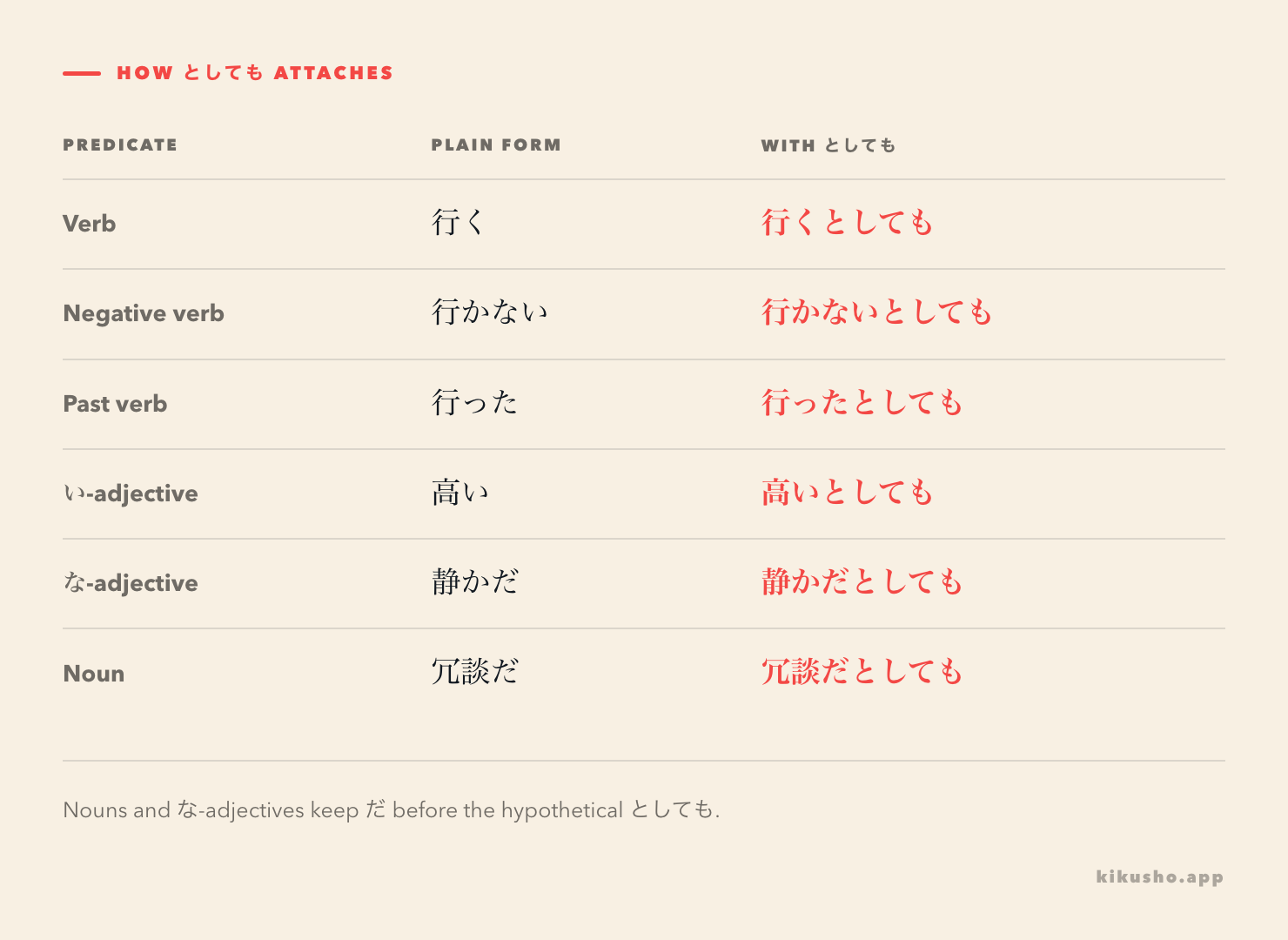
Attach としても to the plain form
Verbs and i-adjectives attach directly. Nouns and na-adjectives normally keep だ.
| Predicate | Form | Example |
|---|---|---|
| verb, non-past | plain + としても | 行くとしても |
| verb, negative | ない + としても | 行かないとしても |
| verb, past | た + としても | 行ったとしても |
| i-adjective | plain + としても | 高いとしても |
| na-adjective | だ + としても | 静かだとしても |
| noun | だ + としても | 冗談だとしても |
会議に参加しないとしても、資料には目を通してください。
かいぎに さんかしない としても、しりょうには めを とおしてください。
Even if you will not attend the meeting, please look through the materials.
部屋が静かだとしても、集中できるとは限らない。
へやが しずかだ としても、しゅうちゅうできるとは かぎらない。
Even if the room is quiet, that does not guarantee that you can concentrate.
冗談だとしても、その言い方はよくない。
じょうだんだ としても、その いいかたは よくない。
Even if it was a joke, that was not a good way to say it.
The tense belongs to the assumed proposition. 行ったとしても grants that the action happened; 行くとしても grants that it will happen or is the option being considered.
Nとしても can be a different construction
The sequence としても is not always this grammar point. After a noun without だ, it often divides as Nとして + も: “also as N.”
彼は医師としても有名だ。
かれは いしとしても ゆうめいだ。
He is also famous as a doctor.
Here 医師として expresses a role, and も adds that role to another one. There is no hypothetical premise.
彼が医師だとしても、この判断は再確認すべきだ。
かれが いしだ としても、この はんだんは さいかくにんすべきだ。
Even if he is a doctor, this judgment should be checked again.
The だ after 医師 and the following unchanged conclusion make the concessive reading clear.
ても states a condition; としても stages an argument
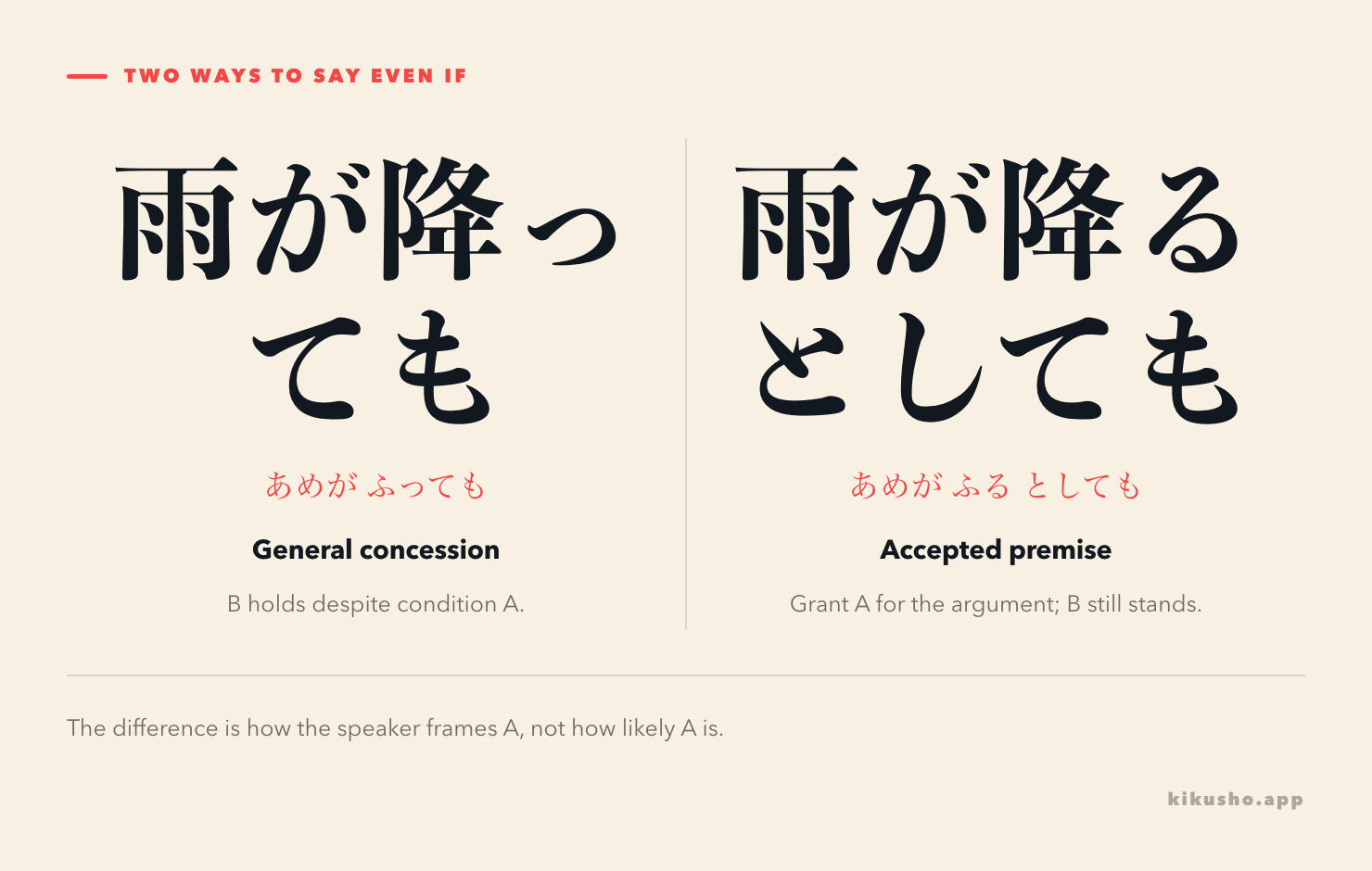
Ordinary ても is the broader way to say that B holds despite condition A.
雨が降っても、試合は行います。
あめが ふっても、しあいは おこないます。
The match will take place even if it rains.
雨が降るとしても、試合は行うという方針は変わりません。
あめが ふる としても、しあいは おこなうという ほうしんは かわりません。
Even assuming that it will rain, the policy of holding the match will not change.
The first is a straightforward concessive condition. The second sounds like an answer to a forecast or objection: “Let us grant that premise; the decision still stands.” This is a difference in framing, so both forms can sometimes describe the same real-world situation.
としたら and とすれば explore the result
としたら and とすれば also introduce an assumption, but the following clause normally explores what would follow from it. としても says that a conclusion holds in spite of it.
来るとしたら、何時ごろですか。
くる としたら、なんじごろですか。
If you were to come, around what time would it be?
来るとしても、今日は会えません。
くる としても、きょうは あえません。
Even if you were to come, I cannot meet you today.
In the first sentence, the assumed visit opens a question about its consequence. In the second, the visit fails to change the speaker's availability.
にしても can concede a case or cover alternatives
にしても overlaps with としても, but it has a wider set of conversational uses. It can concede a case already under discussion, and it can repeat to cover both alternatives.
電車で行くにしても、早めに家を出たほうがいい。
でんしゃで いく にしても、はやめに いえを でたほうが いい。
Even if you go by train, you should leave home early.
行くにしても行かないにしても、今日中に返事をください。
いく にしても いかない にしても、きょうじゅうに へんじを ください。
Whether you go or not, please reply today.
For the full attachment patterns and its contrast with は別として, see the にしても lesson. としても is the clearer choice when the first clause is being installed as a proposition for argument: 事実だとしても means “even granting that it is true.”
The related にせよ and にしろ lesson covers more formal ways to concede a premise or present alternatives. The basic たとえ~ても family is useful when you want to emphasize “no matter how” or “even if” without the explicit premise-setting feel of としても.
Listen for what remains unchanged
Sentences with としても often make B resistant to A. Typical conclusions include a continuing decision, an obligation, a limit or a rejection of an expected consequence.
その情報が正しいとしても、今すぐ公表することはできない。
その じょうほうが ただしい としても、いますぐ こうひょうすることは できない。
Even if that information is correct, we cannot publish it immediately.
一人でできるとしても、念のため誰かに確認してもらおう。
ひとりで できる としても、ねんのため だれかに かくにんしてもらおう。
Even if I can do it alone, I will have someone check it just in case.
When reading, find the proposition before としても, then ask: “What judgment in the second clause survives this assumption?” That relationship matters more than translating the form word by word.
Practice
1. Choose the hypothetical premise
彼の説明が事実__、確認は必要だ。
ア. として
イ. だとしても
ウ. によっても
2. Choose the role reading
Which sentence means “She is also active as a writer”?
ア. 彼女は作家としても活動している。
イ. 彼女が作家だとしても、結論は同じだ。
3. Keep the decision unchanged
明日雨が__、予定は変えない。
ア. 降るとしても
イ. 降るとしたら何時
ウ. 降るとして
4. Choose the assumption that opens a consequence
__、何時ごろ到着しますか。
ア. 来るとしても
イ. 来るとしたら
ウ. 来たとしても会えない
5. Build the concessive sentence
Put all four pieces in order.
ア. 必要だ イ. 事実だとしても ウ. その話が エ. 再確認は
6. Supply the correct attachment
Complete the sentence with 静か and としても.
部屋が__、集中できるとは限らない。
7. Follow the project discussion
担当者:「新しい機能なら、費用を半分にできそうです。」
責任者:「費用が半分に__、利用者が必要としていない機能は追加しません。」
ア. なるとしても
イ. なったとして
ウ. なるとしたらいくら
Answers and explanations
イ. だとしても. Because 事実 is a noun, it takes だ before the concessive としても. The explanation is granted as possibly true while the need to verify it remains.
ア. 作家として + も means “also as a writer.” In イ, 作家だとしても creates the hypothetical premise “even if she is a writer.”
ア. 降るとしても. The forecast is provisionally accepted, but the plan remains unchanged.
イ. 来るとしたら. The assumed visit opens a question about its resulting arrival time. 来るとしても would need a conclusion that holds despite the visit.
ウ → イ → エ → ア: その話が事実だとしても、再確認は必要だ。 “Even if we assume that story is true, another check is necessary.”
静かだとしても. A na-adjective keeps だ before としても: 部屋が静かだとしても、集中できるとは限らない。
ア. なるとしても. The manager grants the proposed cost reduction but maintains the policy against an unnecessary feature.
Common questions
What does としても mean in Japanese grammar?
Aとしても means that the speaker provisionally accepts or assumes A, then says that B still holds. It often translates as “even if we assume A” or “granted that A.”
What is the difference between としても and ても?
Both can express “even if,” but ても presents a general concessive condition. としても more explicitly frames the first clause as a premise accepted for the sake of reasoning before maintaining the second conclusion.
What is the difference between としても and にしても?
としても strongly presents the preceding proposition as a hypothetical premise. にしても can concede a case already under discussion and can also pair alternatives, as in 行くにしても行かないにしても.
Why does だ appear in 冗談だとしても?
Nouns and na-adjectives use だ before the hypothetical としても: 冗談だとしても and 静かだとしても. Without だ, Nとしても is commonly parsed as the role marker として plus additive も, meaning “also as N.”