On this page
Put とみえる after a complete proposition when the evidence lets you infer that the proposition is true. Use とみえて when the sentence continues, often into the observable fact that supports your conclusion.
道が濡れている。昨夜、雨が降ったとみえる。
みちが ぬれている。さくや、あめが ふったと みえる。
The road is wet. It appears that it rained last night.
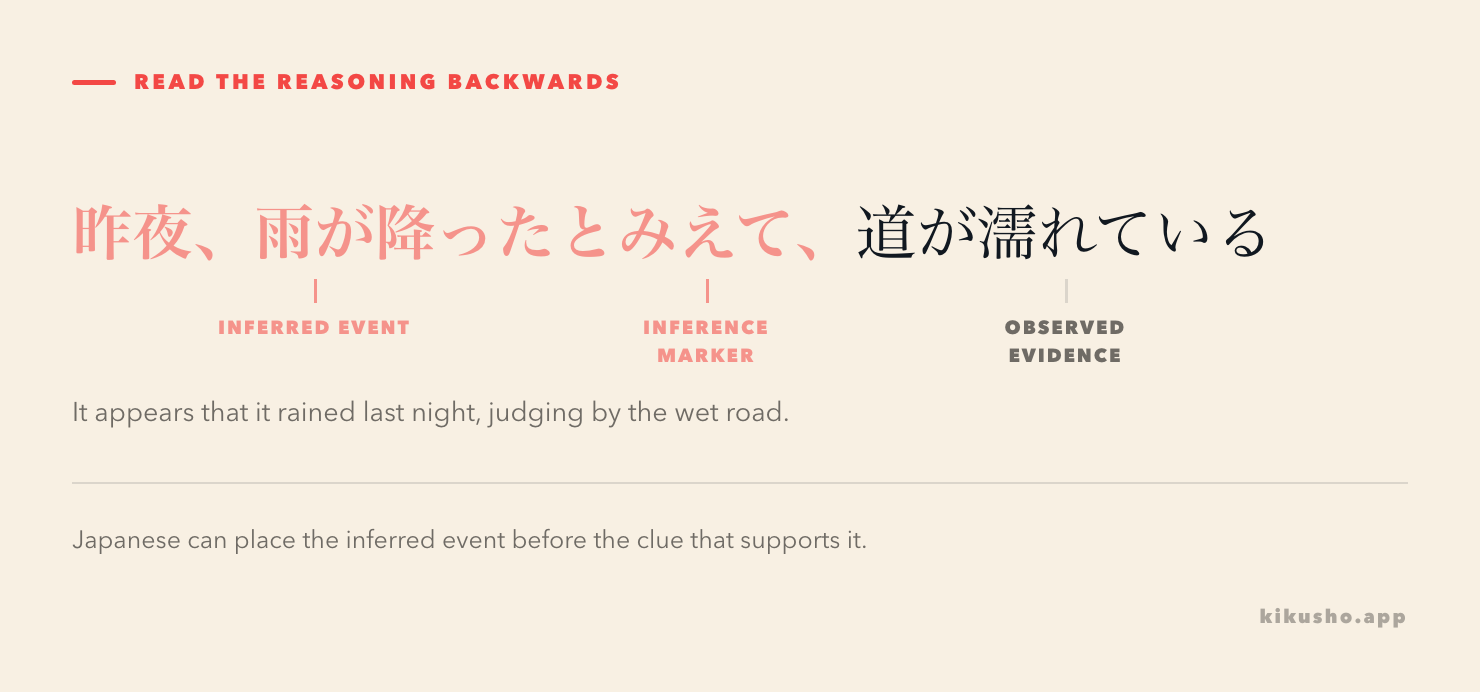
昨夜、雨が降ったとみえて、道が濡れている。
さくや、あめが ふったと みえて、みちが ぬれている。
It appears that it rained last night, judging by the wet road.
In the second sentence, Japanese states the inferred event first and the visible clue second. English often reverses that logic with “judging by” or “because.” This lesson teaches inventory item g-1ad9cb692e75, とみえる/とみえて.
The clause before とみえる is the conclusion
The form packages a proposition with quotation particle と and みえる, “appears.” The proposition is not presented as a directly verified fact. It is what the speaker concludes from something noticed, known or researched.
店の前に長い列ができている。新商品は人気があるとみえる。
みせの まえに ながい れつが できている。しんしょうひんは にんきが あると みえる。
A long line has formed outside the shop. The new product appears to be popular.
The line is observed. 新商品は人気がある is the conclusion. A translation such as “it looks like” can hide this division, so identify the claim before the form and then ask what evidence supports it.
Plain predicates attach directly, while だ may remain after nouns
Use the plain form before とみえる and とみえて. Nouns and な-adjectives often retain the copula だ to make the proposition explicit, though compressed examples without だ also occur.
| Predicate type | Complete proposition | With とみえる | With とみえて |
|---|---|---|---|
| Verb | 雨が降った | 雨が降ったとみえる | 雨が降ったとみえて |
| い-adjective | 忙しい | 忙しいとみえる | 忙しいとみえて |
| な-adjective | 元気だ | 元気だとみえる/元気とみえる | 元気だとみえて/元気とみえて |
| Noun | 留守だ | 留守だとみえる/留守とみえる | 留守だとみえて/留守とみえて |
事務所の電気が消えている。みんな留守だとみえる。
じむしょの でんきが きえている。みんな るすだと みえる。
The office lights are off. Everyone appears to be out.
彼は忙しいとみえて、今週は返事が一度もない。
かれは いそがしいと みえて、こんしゅうは へんじが いちども ない。
He appears to be busy, judging by the fact that he has not replied once this week.
Keeping だ makes the full proposition easy to see: 留守だ + とみえる. JLPT Sensei and N1et teach this attachment, while Bunpro marks だ as optional and N1et's own examples also include a compressed noun such as 苦労人とみえて. Learn the full form first and recognise both in reading.
とみえて connects the inference to its basis
Sentence-final とみえる gives the conclusion room to stand on its own. The evidence may appear in a previous sentence.
まだ会議室の明かりがついている。会議は続いているとみえる。
まだ かいぎしつの あかりが ついている。かいぎは つづいていると みえる。
The meeting-room light is still on. It appears the meeting is continuing.
The connective form とみえて often keeps conclusion and basis in one sentence.
会議は続いているとみえて、部長からまだ連絡がない。
かいぎは つづいていると みえて、ぶちょうから まだ れんらくが ない。
The meeting appears to be continuing, judging by the fact that the director has not contacted us yet.
Do not automatically read this as “the meeting continues, so there is no message.” The second clause is commonly the observed fact from which the first clause was inferred. N1et's Japanese-teacher explanation states this order directly: the first clause is the inferred content, while the following clause gives the grounds for thinking so.
The order is not a logical requirement for every surrounding paragraph. A writer can state the evidence first and finish with とみえる. What stays stable is the role of the marked proposition: Aとみえる presents A as a conclusion.
とみえる reasons; に見える describes an appearance
Both contain 見える, but the particle changes the grammar.
| Form | What precedes it | Speaker's job |
|---|---|---|
| Aとみえる | a complete proposition A | infer that A is true from evidence |
| N/adverbial form+に見える | a label or visible quality | describe how someone or something looks |
| clause+ように見える | a complete situation plus ように | describe the visible impression of that situation |
田中さんは元気に見える。
たなかさんは げんきに みえる。
Tanaka looks healthy.
The speaker describes Tanaka's visible appearance. 元気 becomes adverbial with に.
田中さんは毎日出かけている。元気だとみえる。
たなかさんは まいにち でかけている。げんきだと みえる。
Tanaka goes out every day. Apparently, he is healthy.
The daily outings are evidence for the proposition 元気だ. The judgment is broader than the way Tanaka looks at one moment.
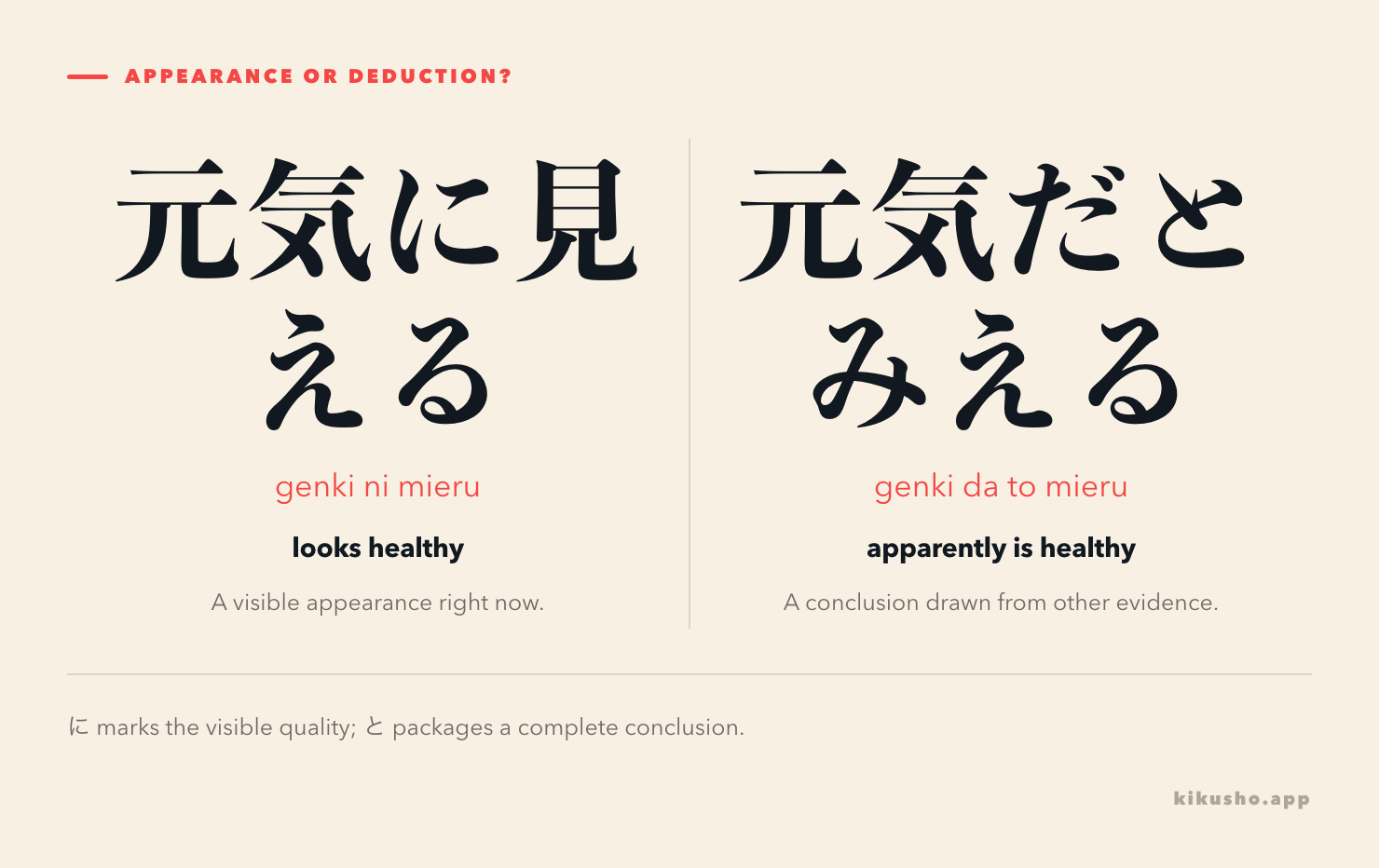
The そうもない and ように見える lesson develops visual interpretation and low-probability events. Here, the essential boundary is that とみえる performs a deduction rather than simply reporting what the eyes resemble.
ようだ is more neutral, while とみえる sounds considered
ようだ can infer a situation from the speaker's senses and is common across speech and writing. とみえる also expresses inference, but it tends to sound more formal, literary or analytical. Its evidence-to-conclusion structure is often more prominent.
道が濡れている。雨が降ったようだ。
The road is wet. It seems to have rained.
道が濡れている。昨夜、雨が降ったとみえる。
The road is wet. One can conclude that it rained last night.
Both can fit the scene. The second sounds like a conclusion drawn after considering the trace. Bunpro's とみえる reference describes it as reasonably confident deduction from a reason or investigation and contrasts it with the broader ようだ.
Appearance そうだ makes a different claim. 雨が降りそうだ predicts rain from the present sky; 雨が降ったとみえる infers a past event from its result. Hearsay そうだ also differs: 雨が降ったそうだ relays a report, while 雨が降ったとみえる belongs to the current speaker's reasoning. The broader evidence and likeness lesson separates those two そう forms from よう, らしい and みたい.
Both spellings occur, and the form suits careful prose
You will meet とみえる/とみえて and と見える/と見えて. JLPT Sensei explicitly accepts both kanji and hiragana spellings. Bunpro notes that the grammar expression is often written in hiragana, which helps separate it visually from the concrete verb “be visible.” Recognition of both spellings matters more than forcing one in every context.
The construction appears naturally in narration, explanation and considered observation. In relaxed conversation, speakers often choose みたい, ようだ or らしい instead. That register difference does not make とみえる obsolete or purely bookish; it explains why you are more likely to meet it while reading an account than while arranging lunch with a friend.
Save the clue with the conclusion
A card containing only とみえる = it seems cannot show why this form was chosen over ようだ, らしい or そうだ. Preserve the evidence and the inferred proposition together.
In Kikusho, a line such as 雨が降ったとみえて、道が濡れている keeps the reversed reasoning order visible. When the card returns in offline review, identify the observed clue first, then recover the conclusion that precedes とみえて. That prompt trains the relationship the grammar carries instead of one crowded English gloss.
Practice: identify the clue and the conclusion
Resolve all six prompts before consulting the explanations.
Question 1 — complete the inference. The office is dark, so you conclude everyone is out: みんな留守__.
- A. に見える
- B. だとみえる
- C. のように見える
- D. そうにない
Question 2 — find the evidence. In 雨が降ったとみえて、道が濡れている, which part states the observable basis for the inference?
- A. 雨が
- B. 降った
- C. とみえて
- D. 道が濡れている
Question 3 — choose the particle. You are describing a person's visible appearance, not making a broader deduction: 田中さんは元気__見える.
- A. と
- B. だと
- C. に
- D. で
Question 4 — order the pieces. Make one natural sentence from 返事がない/忙しいとみえて/彼から今週は.
Question 5 — read the contrast. Which sentence infers a completed past event from a present result?
- A. 空が暗く、雨が降りそうだ。
- B. 天気予報では、雨が降るそうだ。
- C. 道が濡れている。雨が降ったとみえる。
- D. 雨が降るように祈った。
Question 6 — supply the form. Complete the noun proposition with the connective form, retaining だ: 彼は学生__、平日の昼も図書館にいる. The library habit is the clue for the speaker's conclusion.
Answers and explanations
Answer 1. B, だとみえる. だ makes the complete noun proposition みんな留守だ before とみえる. A would describe a visible appearance and requires a different structure. Compressed noun examples can omit だ, but that form is not among the choices.
Answer 2. D, 道が濡れている. The wet road is observed. 雨が降った is the event inferred from it, even though that conclusion comes first in the Japanese sentence.
Answer 3. C, に. 元気に見える describes how Tanaka appears. 元気だとみえる would package “Tanaka is healthy” as a conclusion supported by other evidence.
Answer 4. 彼は忙しいとみえて、今週は彼から返事がない。 The lack of a reply provides the basis for inferring that he is busy. 今週は彼から返事がない is also possible without moving 彼は into the first clause when context supplies whose busyness is meant.
Answer 5. C. A wet road is the current evidence for the inferred past rain. A predicts an event from the sky, B relays a weather report, and D expresses a wish.
Answer 6. 彼は学生だとみえて、平日の昼も図書館にいる. The prompt asks for the full noun proposition 学生だ, then connective とみえて joins it to the observed habit. The sentence means that his weekday library presence leads the speaker to infer that he is a student; compressed prose may also omit だ.
The level disagreement changes study order, not meaning
JLPT Sensei places とみえる/とみえて at N3, as do Nihongo Net and N1et. Bunpro instead places the same logical-inference construction at N4. The inspected pages agree on evidence-based conclusion and plain predicate attachment. Their examples also show that だ is available after nouns and な-adjectives but may be omitted in compressed phrasing.
These labels remain editorial estimates because the JLPT publishes no exhaustive grammar syllabus. Study it with N3 reading if that is where you meet it, while treating plain predicate formation and the broader appearance forms as prerequisites. The durable skill is to locate the evidence and identify which proposition the writer has marked as the conclusion.
Common questions
What does とみえる mean in Japanese?
Plain proposition plus とみえる presents that proposition as a conclusion drawn from evidence: “it appears that” or “one can conclude that.”
What is the difference between とみえる and とみえて?
とみえる can finish the inference. とみえて connects it to another clause, which often states the observable fact that supports the inference.
What is the difference between とみえる and に見える?
とみえる follows a complete proposition and marks a logical inference. に見える describes the visible appearance of a noun or quality, as in 元気に見える.
Is とみえる N3 or N4 grammar?
JLPT Sensei, Nihongo Net and N1et place it at N3, while Bunpro places it at N4. These are editorial study levels because the JLPT publishes no exhaustive list.