On this page
Vるよりほかない says that every workable route except V has been eliminated: 電車が止まったので、歩くよりほかない, “With rail service suspended, walking is the only remaining option.” It belongs to careful speech and writing; ordinary conversation usually reaches for Vるしかない.
This lesson covers inventory item g-d3cb5ca1f80f, よりほかない. JLPT Sensei, Bunpro and Tanosuke place this use at N2. Other publishers group it with N3 expressions such as しかない, so the label is a study order rather than an official boundary; the JLPT publishes no exhaustive grammar list.
よりほかない leaves one action available
The sentence normally gives a constraint first, then names the action that survives it.
予備の鍵がないので、管理会社に連絡するよりほかない。
よびの かぎが ないので、かんりがいしゃに れんらくする より ほかない。
There is no spare key, so there is no choice but to contact the management company.
The speaker may dislike the action, but reluctance is not the grammatical test. The important fact is that no other useful method remains.
記録が残っていない以上、本人の説明を信じるよりほかない。
きろくが のこっていない いじょう、ほんにんの せつめいを しんじる より ほかない。
Since no record remains, there is no alternative but to trust the person's explanation.
Here the limitation concerns available evidence. The pattern sounds like the conclusion of a search through possible courses rather than a spontaneous command.
Attach the pattern to a dictionary-form verb
The productive shape is verb dictionary form + よりほかない.
| Verb | Form | Meaning |
|---|---|---|
| 待つ | 待つよりほかない | no choice but to wait |
| 謝る | 謝るよりほかない | no choice but to apologize |
| やり直す | やり直すよりほかない | no choice but to redo it |
| 受け入れる | 受け入れるよりほかない | no choice but to accept it |
| する | するよりほかない | no choice but to do it |
データを復元できないなら、最初から作り直すよりほかない。
データを ふくげんできないなら、さいしょから つくりなおす より ほかない。
If the data cannot be restored, there is no other course but to recreate it from the beginning.
Do not put a verb stem or て-form before it. 作り直しよりほかない and 作り直してよりほかない do not express this pattern. The remaining course itself stays in dictionary form.
は and に can appear after ほか
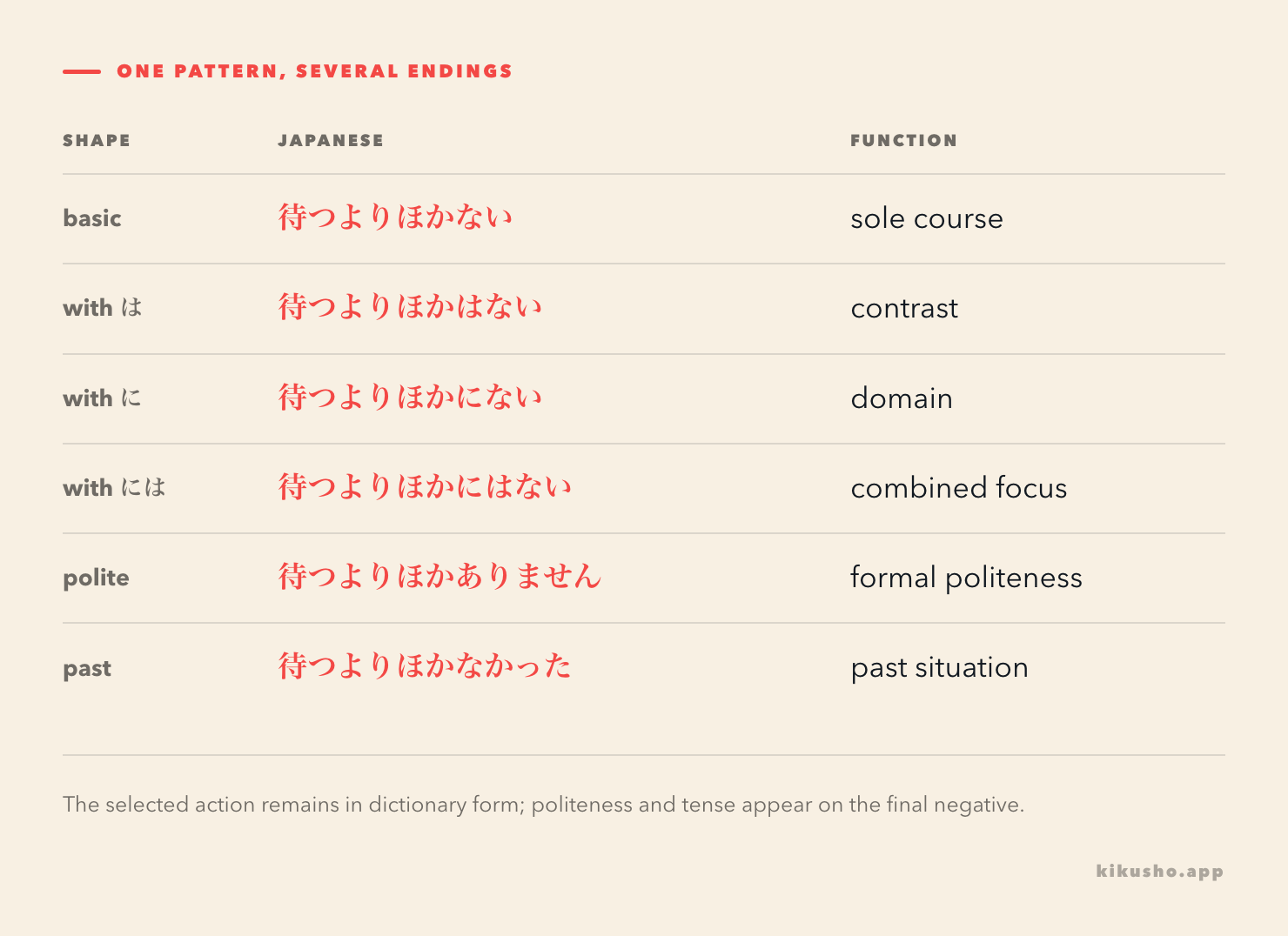
The noun ほか can take particles before ない. These forms share the same basic conclusion.
| Variant | Example | Effect |
|---|---|---|
| よりほかない | 待つよりほかない | neutral form of the pattern |
| よりほかはない | 待つよりほかはない | contrasts the remaining route with all others |
| よりほかにない | 待つよりほかにない | stresses that no alternative exists elsewhere |
| よりほかにはない | 待つよりほかにはない | combines the two emphases |
この条件で合意するには、計画を修正するよりほかはない。
この じょうけんで ごういするには、けいかくを しゅうせいする より ほかはない。
Under these conditions, there is no course other than revising the plan if we are to reach agreement.
原因を確かめる方法は、もう一度実験するよりほかにない。
げんいんを たしかめる ほうほうは、もういちど じっけんする より ほかにない。
The only way to verify the cause is to run the experiment again.
Do not turn the variants into separate translations. The surrounding context supplies most of the force; the particles adjust focus inside the same “no other course” structure.
The ending carries politeness and tense
Because ない closes the expression, it changes for politeness and time.
今は結果を待つよりほかありません。
いまは けっかを まつ より ほかありません。
For now, there is no choice but to wait for the result.
道が閉鎖されていたので、引き返すよりほかなかった。
みちが へいさされていたので、ひきかえす より ほかなかった。
Because the road was closed, there was no choice but to turn back.
よりほかありません is useful in formal explanations. The past よりほかなかった reports the lack of alternatives at an earlier time. The selected verb remains in dictionary form in both.
しかない is the everyday alternative
Vるしかない and Vるよりほかない often describe the same situation. Their main difference is register and how explicitly they frame the alternatives.
終電が出たから、タクシーで帰るしかない。
しゅうでんが でたから、タクシーで かえる しかない。
The last train has left, so I will have to take a taxi home.
公共交通機関が終了したため、タクシーで帰るよりほかない。
こうきょう こうつうきかんが しゅうりょうしたため、タクシーで かえる より ほかない。
As public transportation has ended, there is no alternative but to return by taxi.
The first belongs easily in conversation. The second fits a report, written explanation or deliberately formal statement. しかない can also recommend an attractive option enthusiastically, as in 京都まで来たなら、この庭を見るしかない, “Now that you are in Kyoto, you simply have to see this garden.” よりほかない usually keeps the stricter sense of alternatives having closed.
The しかない and ようがない lesson separates one remaining action from the absence of any method. That distinction still applies here: 連絡するよりほかない requires contacting someone to remain possible.
ざるを得ない foregrounds external compulsion
ざるを得ない also translates as “have no choice but,” but it strongly foregrounds being forced by circumstances, often against the subject's wishes.
規則に違反したため、計画を中止せざるを得ない。
きそくに いはんしたため、けいかくを ちゅうしせざるを えない。
Because it violated the rules, we are compelled to cancel the plan.
他の方法が見つからないので、計画を修正するよりほかない。
ほかの ほうほうが みつからないので、けいかくを しゅうせいする より ほかない。
Since no other method can be found, the only available course is to revise the plan.
Both can carry resignation. The second construction directly maps the alternatives and leaves revision as the sole course. The first presents cancellation as something circumstances compel. The ざるを得ない lesson develops that pressure contrast and its irregular する → せざるを得ない form.
にほかならない answers a different question
Do not confuse よりほかない with にほかならない. Their shared ほか hides different sentence structures.
| Form | Question answered | Example |
|---|---|---|
| Vるよりほかない | What action remains possible? | 待つよりほかない |
| Nにほかならない | What is this, exactly? | 努力の結果にほかならない |
この成功は、チーム全員の努力の結果にほかならない。
この せいこうは、チーム ぜんいんの どりょくの けっかに ほかならない。
This success is nothing other than the result of the whole team's effort.
No action is being selected. The speaker emphatically identifies the success as the result of effort. The に過ぎない and にほかならない comparison explains this limiting-versus-affirming judgment.
Show the closed alternatives when you study it
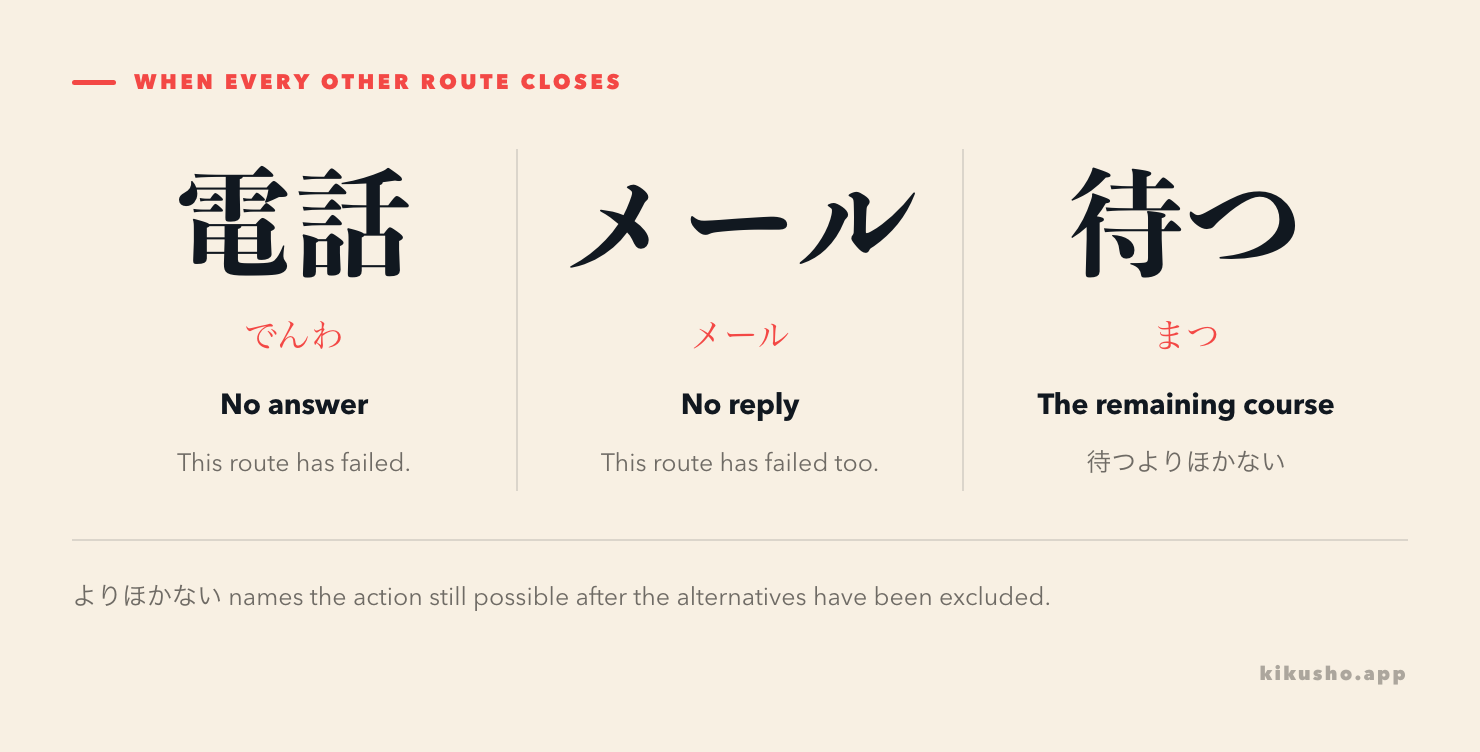
A sentence containing only 待つよりほかない is grammatically complete but gives memory little to work with. Preserve the blocked routes too: 電話もメールも返事がないので、本人が来るのを待つよりほかない. During review, the missing alternatives should make the conclusion feel earned rather than interchangeable with “must.”
Practice
1. Choose the correct attachment
データを復元できないなら、最初から__。
ア. 作り直しよりほかない
イ. 作り直すよりほかない
ウ. 作り直してよりほかない
2. Choose the conversational form
Which sentence most naturally fits a casual chat with a friend?
ア. 終電が出たから、歩いて帰るしかないね。
イ. 終電が出たため、歩いて帰るよりほかありません。
3. Select the identity judgment
この改善は、毎日の練習の結果__。
ア. よりほかない
イ. にほかならない
ウ. しか方法がない
4. Assemble the sole-course sentence
Arrange these four chunks into one sentence.
ア. よりほかない イ. 管理会社に ウ. 連絡する エ. 鍵がないので
5. Place the decision in the past
道が閉鎖されていたので、__。
ア. 引き返すよりほかなかった
イ. 引き返したよりほかない
ウ. 引き返してよりほかだった
6. Preserve a possible action
The bridge is gone and there is no boat. Which sentence correctly says that crossing is currently impossible?
ア. 川を渡るよりほかない。
イ. 川を渡りようがない。
7. Follow the investigation note
記録は削除され、関係者にも連絡がつかない。今は担当者本人の説明を__。
ア. 信じるよりほかない
イ. 信じるにほかならない
ウ. 信じようがないから信じる
First identify whether the sentence leaves one course open, removes every method, or classifies a noun before checking the solutions.
Answers and explanations
イ. 作り直すよりほかない. The remaining action uses the dictionary form. ア uses a verb stem, and ウ uses a て-form.
ア. しかない is the ordinary conversational choice. イ is grammatical, but its formal wording and polite ending sound more like a report or careful statement.
イ. にほかならない. The sentence identifies the improvement as the result of daily practice. It does not select an action from several possible courses.
エ → イ → ウ → ア: 鍵がないので、管理会社に連絡するよりほかない。 The missing key closes other routes, leaving contact with the management company.
ア. 引き返すよりほかなかった. Tense appears on the final ない → なかった while 引き返す remains in dictionary form.
イ. 川を渡りようがない. No bridge or boat means there is currently no method of crossing. ア would incorrectly present crossing as the one action that remains available.
ア. 信じるよりほかない. The missing record and unreachable witnesses leave trusting the person's account as the only available course. イ would require a noun before にほかならない and would make an identity judgment.
Common questions
What does よりほかない mean in Japanese?
Verb dictionary form plus よりほかない means that no workable course remains other than performing that action. It often translates as “there is no choice but to” or “there is no other way than to.”
What is the difference between よりほかない and しかない?
The core meaning is close, but しかない is common and direct in conversation. よりほかない is more formal and explicitly presents the action as the sole course left after other possibilities have been excluded.
Can particles appear inside よりほかない?
Yes. よりほかはない, よりほかにない and よりほかにはない are established variants. The added particles emphasize the domain in which no alternative exists; they do not create a different core meaning.
Is よりほかない the same as にほかならない?
No. Vるよりほかない selects the only available action. Nにほかならない makes an emphatic identity judgment, such as “it is nothing other than N.”