On this page
Verb volitional + ではないか calls on the listener to join the speaker: “let us do it” or “why don't we do it?” In もう一度考えようではないか, the speaker is not merely offering an activity. The line asks an audience to commit to thinking again together.
This lesson covers inventory item g-d6bbd705f6e5, ようではないか. JLPT Sensei, Bunpro, and Japanese teacher Iku Sato place it at N2. The JLPT does not publish a complete grammar syllabus, so N2 is a teaching placement rather than an official promise about a particular test item.
The volitional form turns the ending into an invitation
The material before ではないか decides which construction you have. A plain proposition such as 必要ではないか asks the listener to recognize a claim: “Isn't it necessary?” A volitional verb such as 考えよう changes the job of the whole ending.
この問題を、もう一度みんなで考えようではないか。
この もんだいを、もういちど みんなで かんがえようではないか。
Let us all consider this problem once more.
The volitional 考えよう proposes an action. ではないか presents that proposal as a spirited appeal for agreement. The speaker normally includes themself among the people expected to act, although a public speaker may be addressing a much larger collective.
今こそ、新しい方法を試そうではないか。
いまこそ、あたらしい ほうほうを ためそうではないか。
Now is the time for us to try a new method.
Words such as みんなで, 一緒に, 共に, and 今こそ make the shared or rallying force easy to hear. They are useful clues, but none is required. The volitional form already places a proposed action on the table.
Attach ではないか to the completed volitional form
Build the verb's volitional first, then add ではないか without changing that form.
| Verb class | Dictionary form | Volitional | Complete pattern |
|---|---|---|---|
| godan | 話す | 話そう | 話そうではないか |
| godan | 読む | 読もう | 読もうではないか |
| ichidan | 考える | 考えよう | 考えようではないか |
| irregular | する | しよう | しようではないか |
| irregular | 来る | 来よう | 来ようではないか |
For a godan verb, move the final kana to its o-row and add う: 書く → 書こう, 待つ → 待とう, 選ぶ → 選ぼう. For an ichidan verb, remove る and add よう: 始める → 始めよう. The irregular forms are しよう and 来よう(こよう). The volitional-form lesson covers the conjugation and its other uses in more detail.
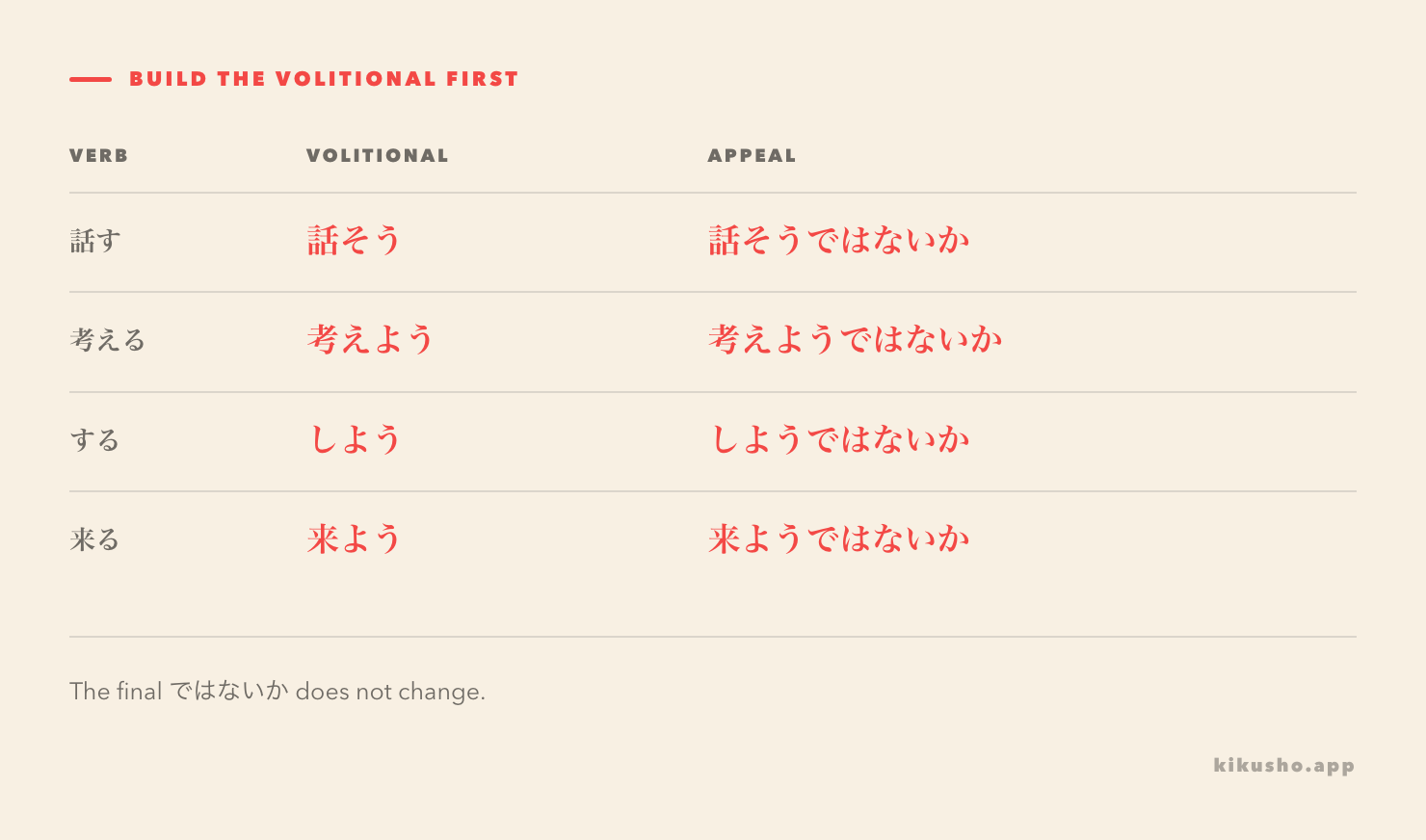
Do not attach the target ending directly to the dictionary form. 考えるではないか can be read as a formal or dramatic confirmation about the proposition “someone thinks,” but it is not the shared invitation. The target is 考えようではないか.
The full form belongs to appeals, speeches, and weighty dialogue
ようではないか sounds larger than an ordinary suggestion. It suits a public appeal, a meeting where someone urges a group toward a decision, persuasive writing, or deliberately dramatic dialogue.
違いを責める前に、共通点を探そうではないか。
ちがいを せめる まえに、きょうつうてんを さがそうではないか。
Before blaming our differences, let us look for common ground.
The speaker commits to a course and invites the audience to share it. That combination can sound encouraging, solemn, combative, or theatrical depending on the verb and setting. The grammar itself does not mean that the speaker is angry.
Nihongo-bu's teaching note describes the form as a formal way to call out to a group and notes that it is not common in ordinary daily life. That limit matters. Saying コーヒーを飲もうではないか to a friend can be playful, but without that deliberate performance it is heavier than the situation needs.
Formality here is not the same thing as deference. ではないか is plain style. A leader can use it to sound elevated while still addressing an audience directly. In a routine exchange with a teacher, customer, or senior colleague, ましょう or another polite invitation is usually safer.
じゃないか lowers the register but keeps the push
では contracts to じゃ in conversation, giving V-volitional + じゃないか. The central invitation remains, while the voice becomes more conversational and sometimes more rough or energetic.
せっかく集まったんだから、最後までやろうじゃないか。
せっかく あつまったんだから、さいごまで やろうじゃないか。
Since we have all made it here, let's see it through to the end.
This can fit teammates, friends, or fictional dialogue where the speaker wants to rally someone. It is still stronger than a neutral やろう. Relationship and delivery matter: a forceful じゃないか may sound presumptuous when the speaker has no standing to press the listener.
You may also encounter ではありませんか or じゃありませんか after the volitional in polite rhetoric. Politeness does not make the line an everyday invitation; it gives the appeal a polite ending while preserving its public, deliberate character.
この機会に、私たちの働き方を見直そうではありませんか。
この きかいに、わたしたちの はたらきかたを みなおそうではありませんか。
Shall we take this opportunity to reconsider how we work?
Use this version when a speaker politely invites an audience into a proposal. In casual life, 見直しましょう would usually sound less staged.
ましょう proposes; ようではないか rallies
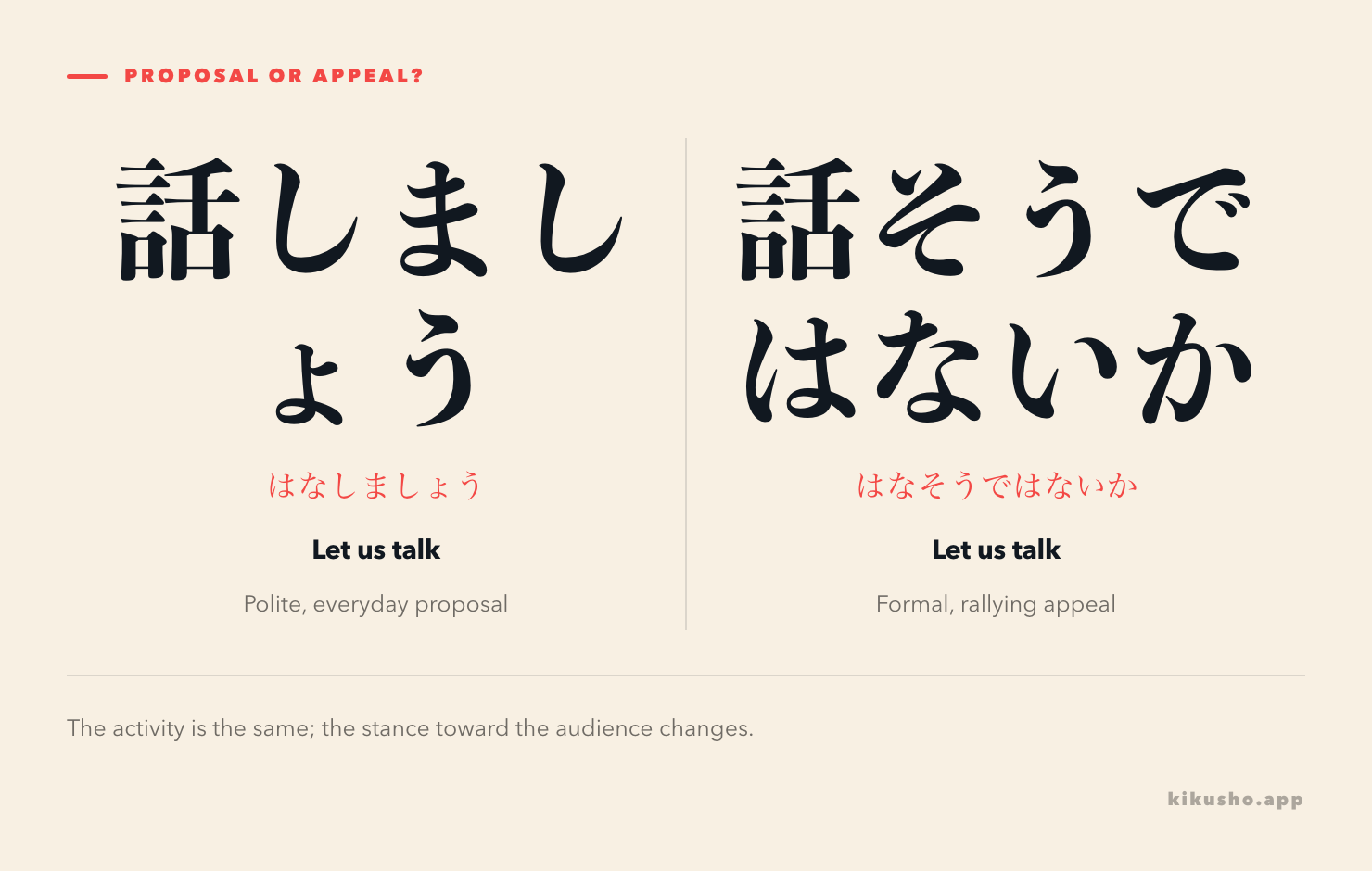
The practical distinction is the amount of rhetorical pressure. 話しましょう makes a polite proposal. 話そうではないか frames talking as the course the group ought to embrace.
| Form | Natural setting | Main effect |
|---|---|---|
| 話そう | familiar conversation or the speaker's own decision | let's talk / I'll talk |
| 話しましょう | polite everyday proposal | shall we talk / let's talk |
| 話そうじゃないか | conversational rally | come on, let's talk |
| 話そうではないか | formal or dramatic appeal | let us talk |
The ましょう and ませんか lesson separates a polite proposal from a polite question. That distinction also helps here: ようではないか is shaped as a question, but it usually does not neutrally ask what the listener prefers. It presses a proposed action forward and asks others to stand behind it.
Choose the lighter form when the decision is small. そろそろ帰りましょう is normal polite conversation at the end of an evening. そろそろ帰ろうではないか sounds like a grand exit, which may be amusing among friends but unusual as an unmarked choice.
Do not confuse the invitation with two similar-looking patterns
The first neighbour is ordinary ではないか / じゃないか after a non-volitional proposition.
この案が一番現実的ではないか。
この あんが いちばん げんじつてきではないか。
Isn't this plan the most realistic?
This seeks recognition of a judgment. It contains no proposed shared action. The dedicated ではないか and じゃないか lesson covers confirmation, reminders, surprise, and challenges.
The second neighbour is ようでは, where よう is a noun meaning a state, manner, or appearance rather than the volitional ending.
同じ失敗を繰り返すようでは、まだ準備不足だ。
おなじ しっぱいを くりかえす ようでは、まだ じゅんびぶそくだ。
If you are still making the same mistake, you are not ready yet.
Here V-dictionary + ようでは sets up a negatively evaluated condition. The verb is 繰り返す, not the volitional 繰り返そう, and no invitation is being made. The ようでは condition lesson explains that separate boundary.
The quickest test is to identify the verb form immediately before では:
- 考えようではないか: volitional 考えよう; a shared-action appeal.
- 必要ではないか: noun or な-adjective predicate; expected agreement.
- 遅れるようでは困る: dictionary verb + nominal ようでは; a problematic condition.
The form can invite resolve without naming every participant
A sentence does not need 私たち to be collective. In a speech, the audience and speaker are already the understood group.
過去を忘れず、次の世代に伝えていこうではないか。
かこを わすれず、つぎの せだいに つたえていこうではないか。
Let us remember the past and continue passing it to the next generation.
The compound volitional 伝えていこう adds continuation into the future. The appeal concerns a sustained shared commitment, which is exactly the kind of idea that suits this construction.
An imperative orders the listener; ようではないか tries to create alignment. That does not make it weak. A speaker can use the apparent invitation to exert social pressure, especially before an audience where disagreement is conspicuous. Translate the action and the stance, not the negative-looking pieces: “let us,” “why don't we,” or “come, let's” may each fit.
Kikusho is most useful here when the surrounding scene survives with the sentence. Capture the line from the speech, meeting, novel, or drama, then keep a short note about who is rallying whom. On review, that context stops ようではないか from collapsing into the ordinary ましょう you would use over coffee.
Practice: choose the invitation that fits the room
Question 1 — grammar choice. Complete the public appeal: 未来のために、今から行動__。
① しようではないか
② するようでは
③ しないではないか
④ してではないか
Question 2 — grammar choice. Two colleagues politely make a routine suggestion to take a short break. Which is the most neutral choice?
① 少し休もうではないか。
② 少し休みましょう。
③ 少し休むようではないか。
④ 少し休め。
Question 3 — sentence composition. Change 考える into a formal shared-action appeal and complete: この問題を、もう一度みんなで__。
Question 4 — grammar choice. Which sentence contains the target volitional invitation?
① この計画は必要ではないか。
② 計画を一緒に見直そうではないか。
③ 計画を見直すようでは遅い。
④ 計画を見直してはいけない。
Question 5 — sentence composition. Make a conversational rally from 最後までやる using じゃないか.
Question 6 — text grammar. A speaker says: 立場の違いを越えて、共に話し合おうではないか。 What makes this more forceful and public than 話し合いましょう?
Question 7 — grammar choice. Which polite form can preserve the rhetorical invitation in a formal address?
- ① 検討しようではありませんか。
- ② 検討するではありませんか。
- ③ 検討しようですか。
- ④ 検討してではありません。
Answers and explanations
Read the room before checking the ending: each explanation tests whether the speaker is proposing, rallying, confirming, or evaluating.
Answer 1: ①, しようではないか. Start with the irregular volitional しよう, then attach ではないか. The sentence calls on the audience to act now. Choice ② begins the separate “if one is in such a state” pattern.
Answer 2: ②, 少し休みましょう. A short workplace break calls for an ordinary polite proposal. Choice ① is grammatical but needlessly grand or theatrical. Choice ③ is not an invitation, and ④ is a direct command.
Answer 3: この問題を、もう一度みんなで考えようではないか。 Remove る from the ichidan verb 考える, add よう, then attach ではないか.
Answer 4: ②, 計画を一緒に見直そうではないか. 見直そう is the volitional and 一緒に confirms the shared action. Choice ① seeks agreement about necessity; ③ evaluates a condition; ④ gives a prohibition.
Answer 5: 最後までやろうじゃないか。 The godan verb やる becomes やろう. Contracting では to じゃ gives the appeal a more conversational voice while retaining its rallying force.
Answer 6: 話し合おう is volitional, 共に explicitly includes the audience, and ではないか asks that audience to align with the proposal. 話し合いましょう proposes the same activity politely, without the same speech-like call to commitment.
Answer 7: ①, 検討しようではありませんか. The volitional 検討しよう remains intact, and ではありませんか supplies a polite rhetorical ending. The other options attach the ending to the wrong verb form or combine incompatible endings.
When you meet the form in reading or listening, identify the volitional before translating the apparent negative question. That single boundary reveals the sentence's real action: the speaker is asking a group to choose a course together.
Common questions
What does ようではないか mean in Japanese?
A verb in the volitional form plus ではないか makes a forceful invitation to act together, often translated as “let us” or “why don't we.” It is especially at home in speeches, appeals, debate, and dramatic dialogue.
How do you form ようではないか?
Put the verb in its volitional form, then add ではないか: 行く becomes 行こうではないか, 食べる becomes 食べようではないか, and する becomes しようではないか.
What is the difference between ようではないか and ましょう?
Both can propose shared action. ましょう is the ordinary polite proposal; ようではないか is plainer, more rhetorical, and more insistent, as though asking the audience to commit to a common course.
Is ようではないか common in everyday conversation?
The full ではないか form is uncommon in casual daily talk and may sound formal, old-fashioned, or theatrical. ようじゃないか is more conversational, while a bare volitional or ましょう is usually more neutral.