On this page
Japanese leaves out spaces because its writing already shows where one word ends and the next begins — not with a gap, but with a change of script. Content words are written in kanji, the grammar that joins them in hiragana, and borrowed words in katakana, so a sentence switches alphabets several times, and every switch falls on a word boundary. The seam an English space marks with emptiness, Japanese marks by changing what the next character looks like.
Which is why the feature that looks like written Japanese's great difficulty — three scripts where English has one — is the thing that makes it readable at all. It is also why a page set entirely in hiragana, which sounds as though it should be the easy version, is slower and more ambiguous to read than the same page full of kanji.
The change of script is the space
An English space carries no meaning of its own; its whole job is to say a word ended here. Japanese does that job differently. Instead of inserting a neutral gap, it changes which script the next word is written in, and three scripts divide the labour by the kind of word they carry.
Kanji carry the content — nouns, and the roots of verbs and adjectives, the words that mean something on their own. Hiragana carry the grammar — particles, verb endings, the small native words that hold a sentence together. Katakana carry what came from outside — loanwords, foreign names, the occasional word set apart for emphasis. Because these three jobs alternate constantly in any real sentence, the scripts alternate with them, and the alternation is the boundary marker.
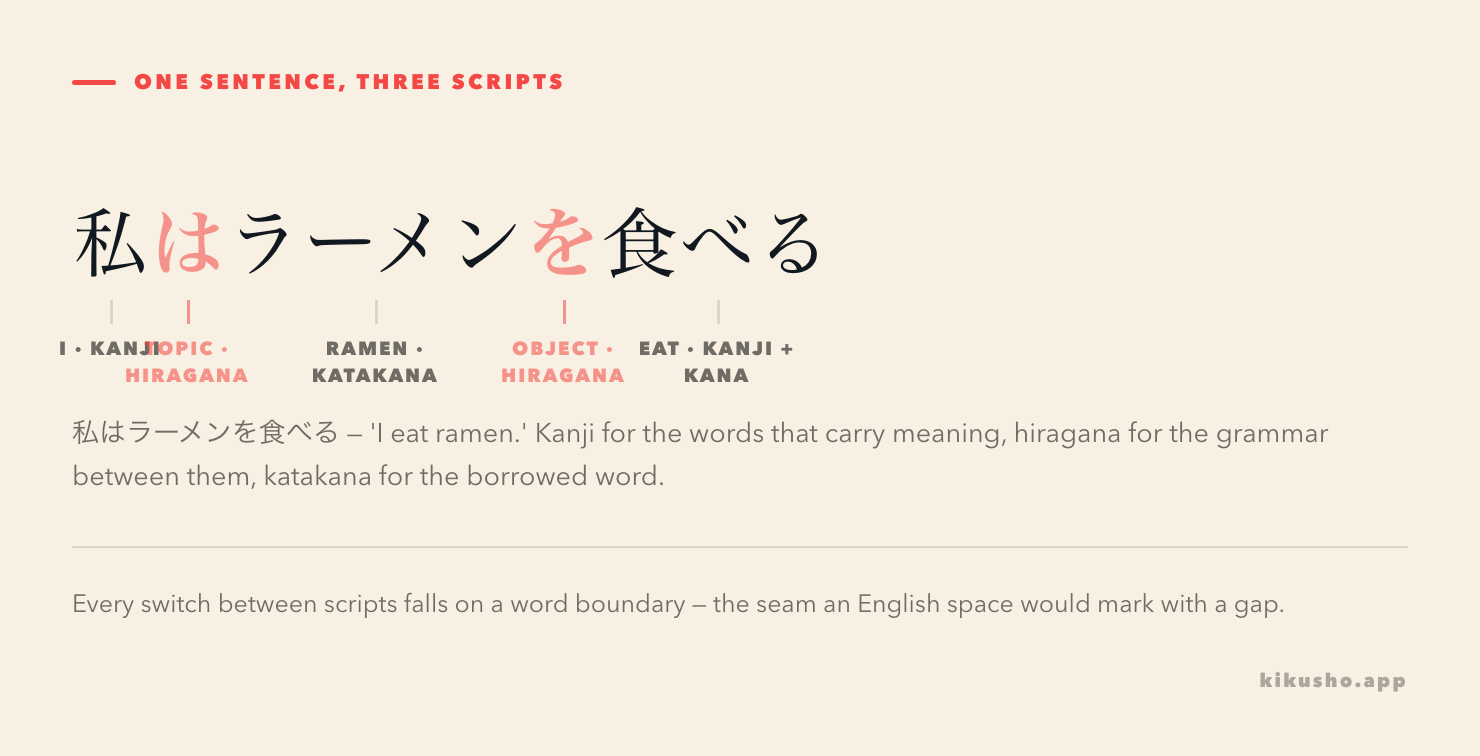
Read across that sentence and you cross four boundaries without a single gap. 私 is a kanji, so it is a word; は is hiragana, so it is grammar hanging off that word; ラーメン jumps to katakana, so it is a borrowed thing; を drops back to hiragana; 食べる is a kanji stem with a hiragana ending. Your eye does not hunt for the edges. The script announces each one before you have finished reading the character.
Which script a word wears tells you what kind of word it is
The switch does more than cut the text into pieces. Because each script has a job, the script a word is written in tells you, before you have read it, roughly what part it plays. A kanji is almost always a content word — the thing the sentence is about. A run of hiragana after it is almost always grammar doing something to that content word. A katakana word is almost always foreign, and often the one piece of a sentence a beginner can decode by sound alone.
This is a real head start. A fluent reader takes in a line the way you take in an English one: not character by character but in chunks, and the chunks come pre-sorted by shape. The kanji stand out as the load-bearing words, dark and dense; the hiragana thin out between them into connective tissue. You are reading the vocabulary and the grammar in two different weights, and your eye has learned to treat them differently.
Kanji settle which word it is, not only where it ends
Spoken Japanese has a great many homophones — words that sound identical and are separated by context and, in speech, by pitch. Writing separates them a second way: it gives each its own kanji. The reading はし is at least three different words, and on the page they are never in doubt.
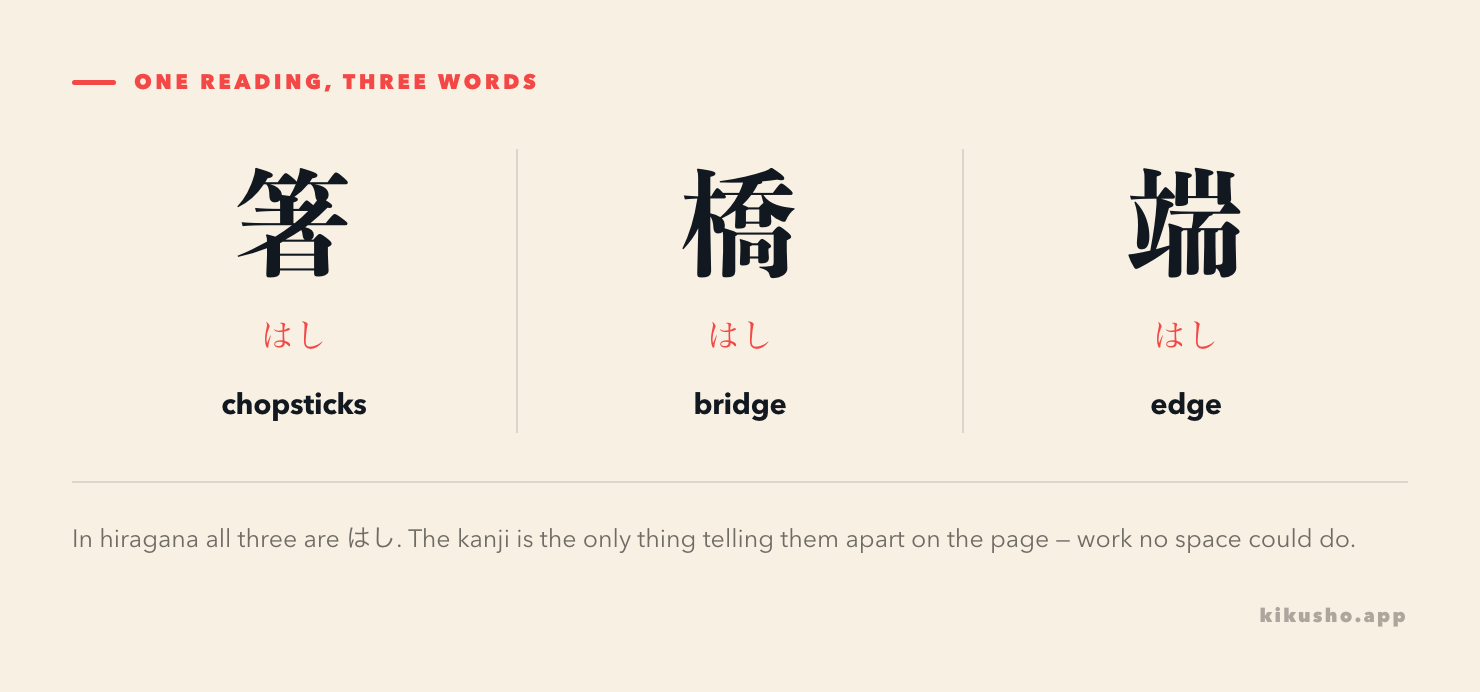
A space could never do this. Put a gap around hashi in a stream of romaji and you still would not know whether someone reached for chopsticks, a bridge or the edge of the table. The kanji does the work the space cannot: it does not just show you where the word ends, it shows you which word it was. This is the same fact seen from the other side as why a single kanji carries several readings — a reading only settles into a meaning once it is attached to a written word.
In speech, pitch and context carry this load, so nobody stops a conversation to wonder which はし you meant. On the page without kanji that support is gone, which is exactly the situation the next section is about.
A page of all hiragana is harder to read, not easier
Beginners often assume the kana-only version of a text — a children's book, an early-textbook passage, a casual message from someone sparing you the kanji — is the gentle one. It reads more slowly and strands you more often, because taking out the kanji removes the boundaries and the disambiguation in the same stroke.
The classic demonstration is a single instruction that splits two ways depending on where you cut it.
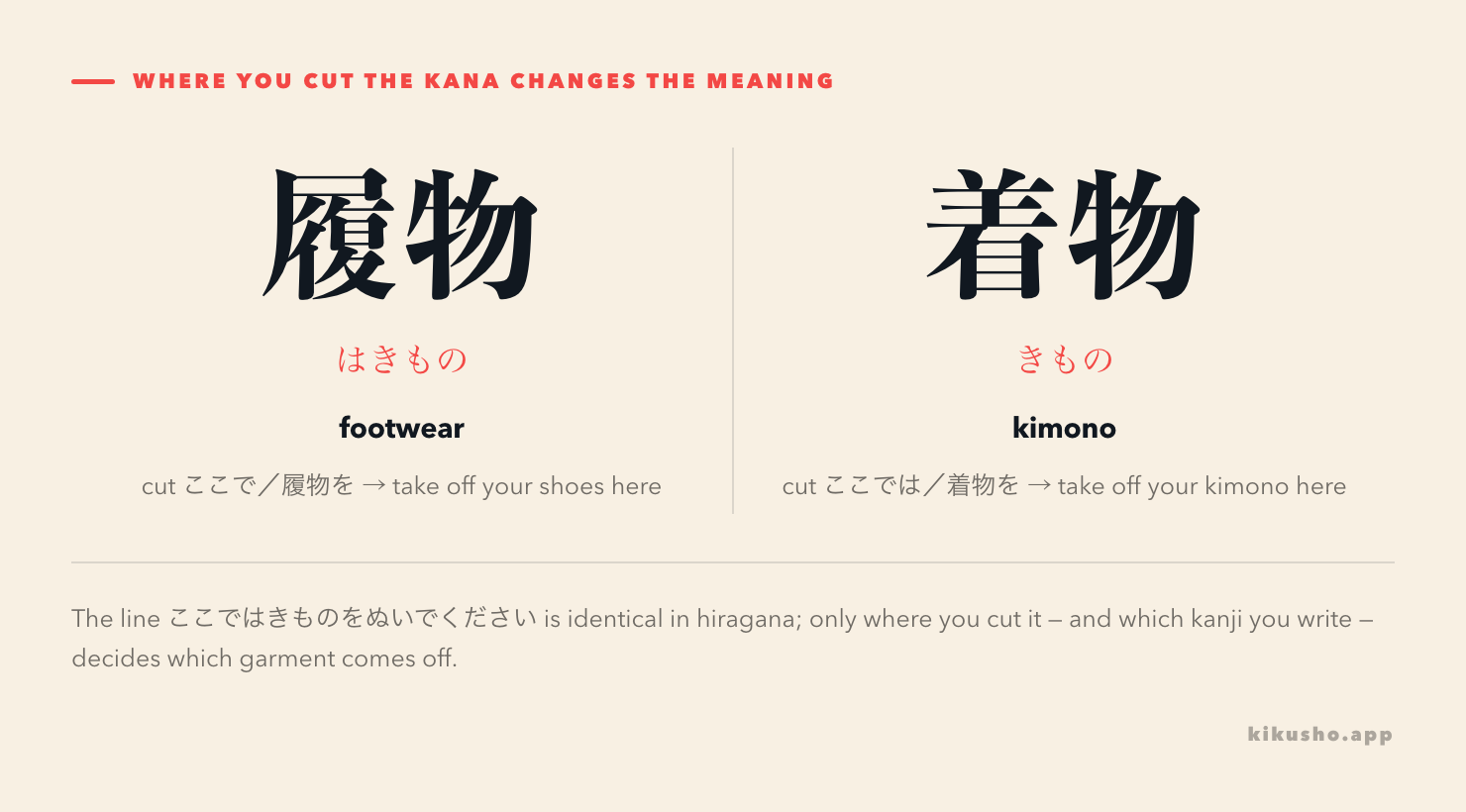
Written ここではきものをぬいでください, the line is genuinely ambiguous. Cut it after ここで and the next word is はきもの, 履物, footwear: take off your shoes here. Cut it after ここでは and the next word is きもの, 着物, a kimono: take off your kimono here. Nothing in the hiragana chooses between them. Write one kanji — 履物 or 着物 — and the ambiguity is gone before it can start, because the kanji is the boundary and the meaning at once.
Most all-hiragana text is not booby-trapped like this, but it is uniformly slower, because every boundary you were getting for free from a script change you now have to find yourself, from the words alone. Stripping out the kanji does not simplify the page. It removes the scaffolding and leaves you to parse the way a listener does, only without the sound to help.
Where the scripts stop helping
The script-switch rule does most of the work, not all of it. Two situations hand the problem back to you.
The first is a run of kanji with no kana between them. A compound noun like 個人情報保護方針 — a privacy policy — is six kanji in a row, and the seams inside it are marked by no script change at all, because it is one script the whole way. You break it into 個人 / 情報 / 保護 / 方針 by knowing those sub-words, not by seeing a boundary. Long official and technical nouns are where this bites, and it is why a wall of unfamiliar kanji can be as hard as a wall of hiragana, for the opposite reason.
The second is a long stretch of hiragana — a passage of pure grammar, or a kana-written word sitting among particles — where there is no kanji to break the run. Here you are back to segmenting by vocabulary alone.
Which points at what a fluent reader is really doing. The scripts are a fast, reliable first pass, but the last step is always lexical: you know where a word ends because you recognise the word. The script transitions just make that recognition quicker by narrowing the field. This is the same lesson as telling apart look-alike kanji by meeting them inside words rather than as bare shapes — segmentation, like disambiguation, is something your vocabulary does, and the writing system only assists.
How to read Japanese without spaces
The practical answer is to stop wishing for spaces and start reading the transitions. When the script changes, a word ended; when you reach a kanji, a content word began; when a tail of hiragana follows, that is its grammar. Very quickly this stops being a rule you apply and becomes the way the page looks, the same way you no longer consciously notice the spaces in this sentence.
But the part that actually improves is your vocabulary in context. The reason a fluent reader glides through an unspaced line is that they meet almost no unfamiliar words, so segmentation is pure recognition. Every new word you learn as a word — with its kanji, its kana tail, the neighbours it usually travels with — is one more place the text will segment itself for you next time. This is why reading real material, where you keep meeting the same words in their written form, does more for your parsing speed than any amount of studying the scripts in the abstract. A menu you can only half-read teaches boundaries faster than a chart of them, because there the words are doing their actual job.
The bottleneck, then, is the same one that stops most learners everywhere: keeping the words you meet. A word you looked up on a sign and did not record is a boundary you will have to work out again the next time you see it. This is the part Kikusho is built to remove. Point the camera at the line, say it, or paste it, and a card comes back with the word, its reading, its meaning, a register note and an example sentence, which you check before it is saved — so the word enters your memory already segmented, kanji and kana tail and all. On a photo of a sign or a menu you can highlight up to five things and get five cards from the one capture, and reviews run on FSRS with no signal needed, because the point is to keep the words you actually walk past, not to sit down and study a wall of them.
None of this is really about spaces. Japanese dropped them because it had already solved, with kanji and kana, the two problems a space only half-solves: where the word ends, and which word it was. Learn to read the scripts as the boundary markers they are, keep the words you meet, and the missing spaces stop being missing at all.
Common questions
Why doesn't Japanese use spaces between words?
Because it does not need them. Content words are written in kanji, grammar in hiragana and loanwords in katakana, so ordinary text switches script several times a sentence and each switch falls on a word boundary. A space would add nothing a change of script is not already showing, so Japanese never adopted one for normal writing.
Is text written only in hiragana harder to read?
Yes — generally slower and more ambiguous than mixed text, not easier. Removing the kanji removes the boundaries the script changes were marking and the kanji that told homophones apart, so you have to segment from the words alone. The line ここではきものをぬいでください can mean "take off your shoes" or "take off your kimono" depending only on where you cut it; a single kanji would settle it.
How do Japanese readers know where one word ends and the next begins?
Mostly from the constant switching between kanji, hiragana and katakana, which puts a visible seam at most boundaries. Where the script does not change — a run of kanji inside a compound, or a long stretch of hiragana — they fall back on recognising the words themselves. Fluent reading is word recognition; the scripts just make it faster.
How can I get better at reading Japanese without spaces?
Read the script transitions as boundaries rather than wishing for gaps, and build your vocabulary in context. The more words you know as written words — with their kanji and their kana endings — the more an unspaced line segments itself. Reading real material and keeping the words you meet does more than studying the scripts in the abstract.