On this page
予約の変更は可能です tells you that a booking change can be made; it says nothing about how likely you are to request one. Japanese words for certainty and uncertainty distinguish feasibility, probability, personal conviction, definite judgments, guesses and forecasts.
This N2 vocabulary set teaches 明らか、可能、見当、予測、確率、断定、確信、推測、見込み、見通し. Some qualify a claim; others strengthen it. Learn the job each word does before treating it as a translation of “probably.”
The study-list levels cross this page's editorial boundary. Our planning snapshot credits Jonathan Waller's Tanos resources: 明らか、可能、見当、予測 are placed at N3, 確率、断定 at N2, and 確信、推測、見込み、見通し at N1. The two imported adaptations share that ancestry, so their agreement is one list-family observation. The JLPT has no exhaustive official vocabulary syllabus. Use the earlier words as foundations and the later words as a preview.
These ten words tell you what kind of claim you are reading
All ten help you read a writer's commitment to a statement, but they answer different questions. Is the writer calling something clear? Reporting a belief? Inferring a cause? Forecasting a future result?
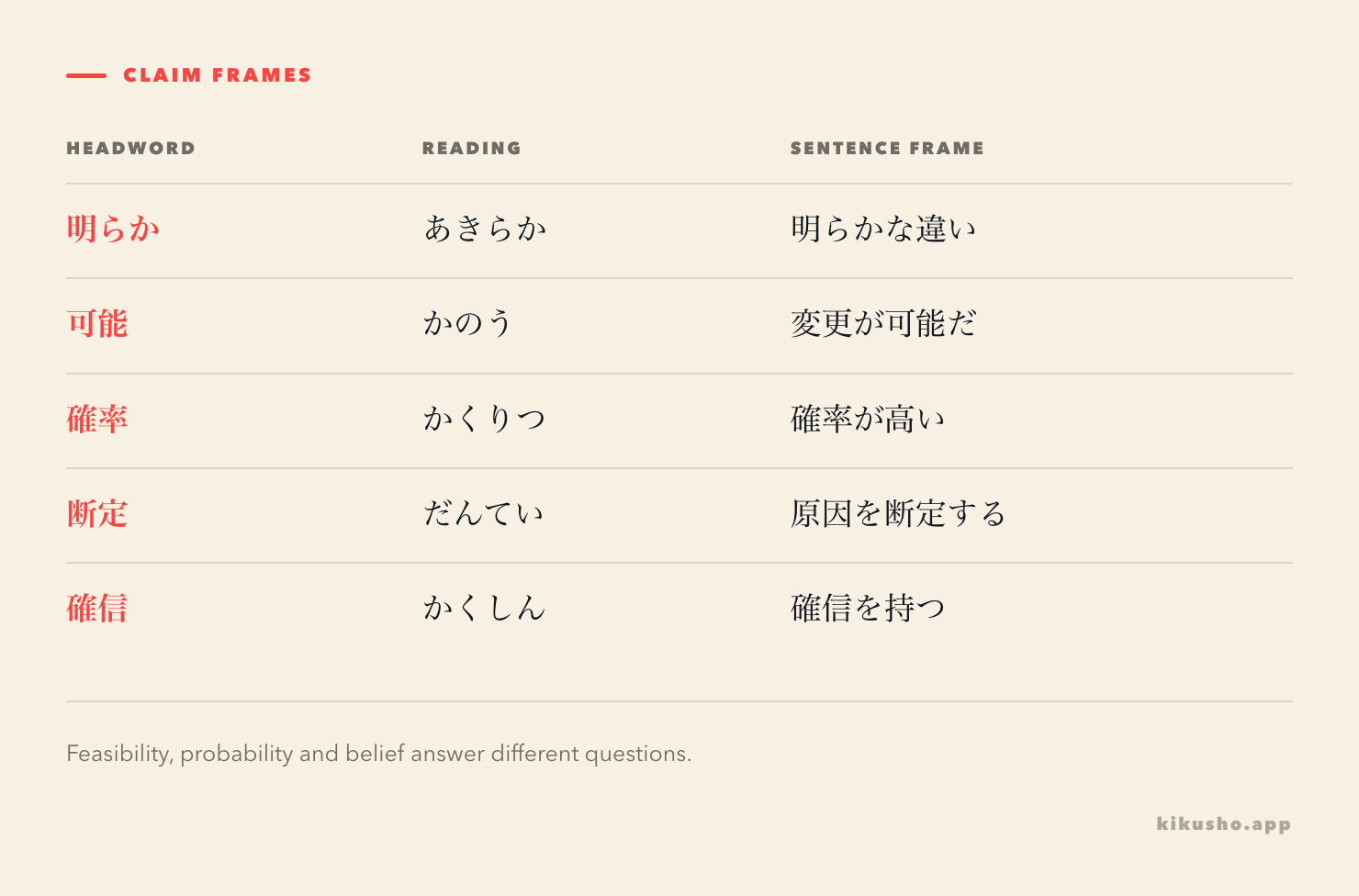
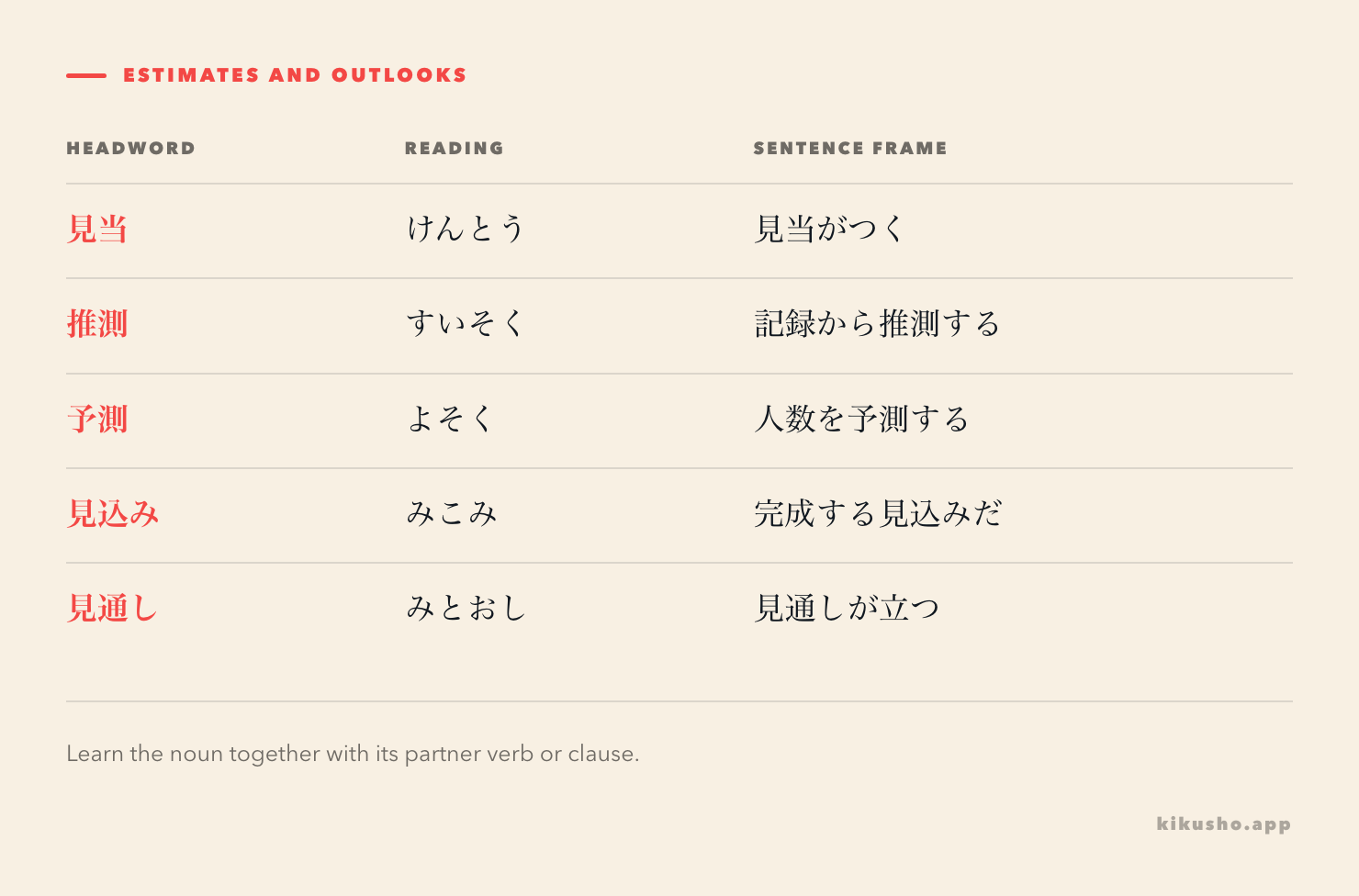
The table gives the senses taught here. Na-adjective means a word that takes な before a noun; suru noun means a noun that can form a verb with する. Other dictionary senses, such as physical visibility for 見通し, need their own context.
| Word and reading | Part of speech in this lesson | Sense | Useful collocation |
|---|---|---|---|
| 明らか(あきらか) | Na-adjective | Clear; evident | 明らかな違い: a clear difference |
| 可能(かのう) | Na-adjective; noun | Possible; feasible | 変更が可能だ: a change is possible |
| 見当(けんとう) | Noun | A rough idea or estimate | 見当をつける: form a rough idea |
| 予測(よそく) | Noun; suru noun | A forecast made in advance | 人数を予測する: forecast the number of people |
| 確率(かくりつ) | Noun | Probability | 確率が高い: the probability is high |
| 断定(だんてい) | Noun; suru noun | A definite judgment or assertion | 原因を断定する: identify the cause definitively |
| 確信(かくしん) | Noun; suru noun | Firm conviction | 確信を持つ: have a firm conviction |
| 推測(すいそく) | Noun; suru noun | An inference or conjecture | 記録から推測する: infer from records |
| 見込み(みこみ) | Noun | An expected outcome; prospects | 完成する見込みだ: completion is expected |
| 見通し(みとおし) | Noun | An outlook on how things will develop | 見通しが立つ: an outlook can be formed |
For sentence-level “probably” and “surely,” compare たぶん, きっと and おそらく. Those adverbs modify a statement. The nouns here often become what a sentence discusses: a forecast can change, and an inference can remain unconfirmed.
Clear evidence, personal conviction and a definite judgment differ
明らか describes something as clear
明らか takes な before a noun and に in expressions such as 明らかにする, to make something clear or clarify it.
二つの案には明らかな違いがあります。
ふたつの あんには あきらかな ちがいが あります。
There is a clear difference between the two proposals.
The sentence presents the difference as evident. It does not merely report how confident someone feels. Shogakukan's Daijisen entry supports this clear, unambiguous sense and the 明らかにする frame.
確信 names a firm belief
Use 確信する for being convinced, or 確信がある/確信を持つ to speak about that conviction as a noun. A proposition can precede と確信している.
この方法で解決できると確信しています。
この ほうほうで かいけつできると かくしんして います。
I am convinced that this method can solve the problem.
The speaker's commitment is strong. Whether the method works still needs to be tested. Daijisen and Heibonsha's 字通 describe conviction without doubt; that is a claim about belief, rather than a certificate of truth.
断定 makes a definite judgment
断定する is more specific than the broad English gloss “decide.” It means settling a judgment firmly. 原因を断定する concerns a cause; 故障だと断定する states the judgment that something is a malfunction.
まだ原因を断定することはできません。
まだ げんいんを だんていする ことは できません。
We cannot yet identify the cause definitively.
Here the qualification comes from まだ…できません, “cannot yet.” The headword 断定 itself names a definite judgment. A sentence containing it may therefore be cautious, even though the action it names is decisive. Daijisen gives the firm-judgment sense and the …と断定する construction.
可能 says something can happen; 確率 discusses its likelihood
可能 works before a noun with な, as in 可能な方法, a feasible method. It also forms a predicate: 変更は可能です, a change is possible.
オンラインでの変更が可能です。
オンラインでの へんこうが かのうです。
Changes can be made online.
This could be a service instruction. It does not predict that a customer will make a change. Daijisen and Nihongo Master's entry support the possible or feasible sense.
確率 is a noun. Use 高い/低い to describe probability, or a number when a source supplies one. A high probability still leaves room for another outcome.
この条件なら、成功する確率は高いと思います。
この じょうけんなら、せいこうする かくりつは たかいと おもいます。
Under these conditions, I think the probability of success is high.
This is an illustrative speaker's assessment, not a measured success rate. Daijisen's 確率 entry defines probability and gives 確率が高い. Notice that と思います qualifies the assessment without changing 確率 into a na-adjective.
見当 gives a rough idea; 推測 draws an inference
見当 is read けんとう. 見当をつける means forming a rough idea or estimate. 見当がつく means you have some idea; 見当がつかない means you cannot work it out.
修理に何日かかるか、見当がつきません。
しゅうりに なんにち かかるか、けんとうが つきません。
I have no idea how many days the repair will take.
The noun names the rough idea. Do not read it as the verb “be found,” even if an imported word list suggests that gloss. Daijisen gives this estimate sense and its つける/つく pairings. The kanji 当 matters: other words pronounced けんとう need a separate lookup.
推測 names an inference from clues. It can be a noun, 私の推測, my conjecture, or a verb, 推測する.
残った記録から、故障の原因を推測しました。
のこった きろくから、こしょうの げんいんを すいそくしました。
We inferred the cause of the malfunction from the remaining records.
The clue is 記録から, from the records. The inference could be sensible and still unconfirmed. Calling it 推測にすぎない, no more than a conjecture, makes that limit explicit; にすぎない supplies the limiting grammar.
Daijisen's 推測 entry describes reasoning from something known. Do not make a rigid rule that 推測 only concerns the past. A future event can also be the object of a conjecture.
予測 forecasts ahead; 見込み and 見通し describe prospects
予測 is a noun or a suru noun. 予測する means forecasting an outcome in advance, and 予測が外れる means the forecast proves wrong.
去年の記録を使って、来週の来場者数を予測します。
きょねんの きろくを つかって、らいしゅうの らいじょうしゃすうを よそくします。
We will use last year's records to forecast next week's visitor numbers.
The temporal focus distinguishes this from the earlier 推測 example about an already existing fault. Both can use records. 予測 does not promise a statistical model, and 推測 does not imply a random guess with no basis. Daijisen supports the in-advance forecast sense.
見込み reports an expected outcome or the prospect that something will happen. A plain nonpast verb can precede it directly: 完成する見込みです. With a noun, use の, as in 完成の見込み.
新しい教室は来月完成する見込みです。
あたらしい きょうしつは らいげつ かんせいする みこみです。
The new classroom is expected to be completed next month.
見込みがある/ない says there is, or is not, such a prospect. The word does not always mean hopeful personal desire; it can report an expected outcome neutrally. Daijisen separates expectations and future possibility from specialised senses in tea utensils and architecture. Those specialised senses are outside this lesson.
見通し is read みとおし, with とお, not とう. Its future-oriented sense is an outlook on how things will develop. 見通しが立つ says that such an outlook becomes clear enough to form; 見通しが立たない says it cannot yet be formed.
再開の見通しはまだ立っていません。
さいかいの みとおしは まだ たって いません。
There is still no clear outlook for reopening.
Daijisen also records physical visibility and insight. Here 再開, reopening, points to the outlook sense.
見込み and 見通し overlap. You can discuss the prospects of reopening with either. The frames above are useful starting points, rather than a rule that one is always more confident or broader than the other. Neither word has an inherent percentage attached to it.
Save the collocation you encounter in a report
Begin with 見当がつかない, 変更が可能だ and 見込みです when they appear in something you read. Then examine stronger judgments with 断定 and 確信. This is a study sequence for this comparison, not a claim about word frequency. Newspaper vocabulary gives neighbouring reporting terms; noticing, doubting and judging compares other verbs for handling information.
For a digital project update, Kikusho's text capture can help you collect the unfamiliar expression. Check the editable card before saving it, and make its example distinguish 見当がつく from 見通しが立つ. That distinction depends on the partner verb as much as on the English gloss. The app supplies capture and review tools, not an official exam vocabulary list.
Practice: six questions before the solutions
These original exercises sample six vocabulary formats used in N2 preparation. They are not official questions. Choose one option for each; the shared answer block follows Question 6.
Question 1
How is the bold probability noun 確率 read aloud?
当選する確率は低いそうです。
- A. かくそつ
- B. かくれつ
- C. かくりょく
- D. かくりつ
Question 2
Which written form belongs in place of the kana word だんてい?
十分な資料がないため、今はだんていできません。
- A. 断定
- B. 段定
- C. 断訂
- D. 暖定
Question 3
Complete the compound used for making an advance forecast.
来月の来場者数を、過去の記録から予( )した。
- A. 信
- B. 率
- C. 測
- D. 当
Question 4
A booking service is explaining whether a change can be made. Choose the word that fits.
予約の変更は( )ですが、希望の日に空きがあるか確認が必要です。
- A. 明らか
- B. 可能
- C. 確率
- D. 見当
Question 5
Choose the closest paraphrase of the sentence.
原因はまだ断定できない。
- A. 原因が何か、はっきり判断することはまだできない。
- B. 原因はすでに明らかになっている。
- C. 原因を考える必要はない。
- D. 原因が何か、調べたくない。
Question 6
Choose the sentence that correctly uses 見込み to report an expected future outcome.
- A. 会議の内容を見込みに説明しました。
- B. その結果を見込みするため、資料を集めました。
- C. 工事の見込みを持って、道を歩きました。
- D. 工事は金曜日に終わる見込みです。
Answers and explanations
Answer 1: D. かくりつ. The headword is 確率(かくりつ), probability. In 当選する確率, it is the probability of being selected or winning the draw; 低い describes that probability as low. The other readings do not belong to 確率.
Answer 2: A. 断定. 断定できません means that a definite judgment cannot be made. The sentence gives insufficient material as the reason. The other options change a kanji and are not the spelling of this headword.
Answer 3: C. 測. 予+測 forms 予測(よそく). The full sentence says the speaker forecast next month's visitor numbers from past records. Combining 予 with 信, 率 or 当 does not form the requested word.
Answer 4: B. 可能. The service says a change is feasible, then qualifies this by requiring a check for availability on the requested day. 明らか would call something clear, rather than say a change can be made. 確率 and 見当 are nouns for probability and a rough idea; neither supplies this feasibility statement.
Answer 5: A. 断定できない denies the ability to make a definite judgment. B says the cause is already clear, which reverses the claim. C removes the need to consider it; D describes unwillingness to investigate. Neither C nor D follows from uncertainty about the cause.
Answer 6: D. 終わる見込みです places a plain nonpast verb before the noun to report expected completion. A uses 見込み as though it were an adverb meaning clearly; it is not. B incorrectly makes 見込みする a suru verb. C gives 工事の見込み no coherent connection to walking down the road. D reports an expectation while leaving room for the completion date to change.
Common questions
Are these ten words all N2 vocabulary?
No. This comparison belongs to the N2 vocabulary section, but the Waller-derived planning lists place 明らか, 可能, 見当 and 予測 at N3; 確率 and 断定 at N2; and 確信, 推測, 見込み and 見通し at N1. These are study-list estimates, not an official exhaustive JLPT syllabus.
What is the difference between 推測 and 予測?
推測 means inferring or conjecturing from what is known. It can concern a past cause, a current situation or a future outcome. 予測 means forecasting an outcome in advance. Both can use evidence; neither word alone guarantees accuracy.
Does 可能 mean that something is likely?
可能 means possible or feasible. For example, 変更が可能です says that a change can be made. It does not tell you its probability. 確率 is the noun for probability, used in phrases such as 確率が高い.
Can 見込み and 見通し both mean an outlook?
Yes, their future-oriented senses overlap. Learn useful frames: 完成する見込みだ reports expected completion, while 見通しが立つ says an outlook can be formed. They do not occupy fixed, different percentages on a certainty scale.