On this page
友人 names a friend, 親戚 a relative, and 同僚 a colleague. This N3 vocabulary set teaches eleven Japanese relationship nouns that distinguish family ties, personal closeness, workplace roles, shared activity and the side someone takes.
The words answer different questions about a person. Some describe intimacy; others describe a position or a role that may coexist with friendship. Choosing one tells your listener which relationship matters in this sentence.
Eleven words for naming the relationship
Every entry below is a noun. 味方 also combines with する to mean supporting someone or taking their side. The linked Shogakukan dictionary entries support the readings and the senses selected here.
| Word | Reading | Sense in this set | Phrase to keep with it |
|---|---|---|---|
| 相手 | あいて | Other participant, partner or opponent | 話し相手: someone to talk to |
| 後輩 | こうはい | Junior or later entrant in a school, workplace or group | 大学の後輩: a university junior |
| 親戚 | しんせき | Relative connected by blood or marriage | 親戚の家: a relative's home |
| 親友 | しんゆう | Particularly close, trusted friend | 長年の親友: a close friend of many years |
| 上司 | じょうし | Boss or workplace superior | 上司に相談する: consult your boss |
| 他人 | たにん | Other person; non-relative or outsider in relevant contexts | 他人の意見: other people's opinions |
| 敵 | てき | Enemy or opposing side in a contest | 敵と戦う: fight an enemy |
| 同僚 | どうりょう | Colleague sharing a workplace, position or role | 職場の同僚: a workplace colleague |
| 仲間 | なかま | Companion or fellow member sharing an activity or affiliation | 趣味の仲間: companions with a shared hobby |
| 味方 | みかた | Ally, supporter or your side | 私の味方: someone on my side |
| 友人 | ゆうじん | Friend | 学生時代の友人: a friend from your student days |
This is the assigned set, not a complete list of ways Japanese names relationships. For particular family roles and the distinction between talking about your own relatives and someone else's, use the earlier family vocabulary lesson.
Ask which kind of connection the word describes
親戚 states a family connection, including marriage. It does not say how often you meet or how affectionate the relationship is:
週末は親戚の家に泊まった。
I stayed at a relative's home over the weekend.
友人 identifies friendship. 親友 adds particular closeness and trust; it does not require that you have only one such friend:
山田さんは学生時代の友人です。
Yamada is a friend from my student days.
美咲は私の親友です。
Misaki is a close friend of mine.
The workplace words describe a different dimension. 上司 points to the person above you in workplace position. 同僚 identifies a colleague. 後輩 can identify someone who entered your school, workplace or club after you:
上司に予定を確認した。
I checked the schedule with my boss.
同僚と昼ご飯を食べた。
I ate lunch with a colleague.
大学の後輩と駅で会った。
I met a university junior at the station.
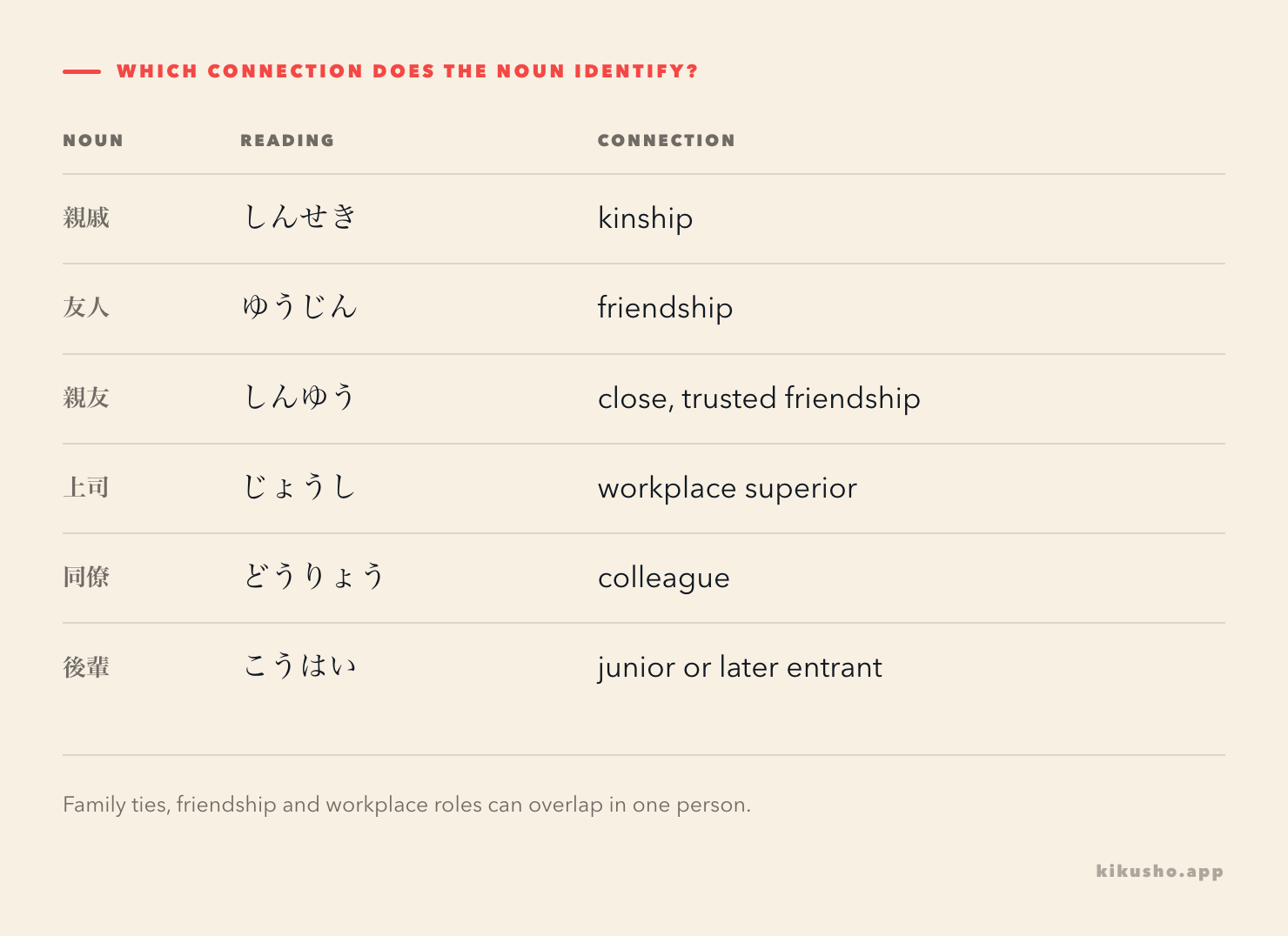
A colleague can also be a friend or a close friend. Changing 同僚 to 親友 changes the connection you emphasise, not necessarily the person. Naming your boss is also separate from deciding how to speak respectfully about their actions; the politeness lesson explains that second decision. When you make a request, 依頼 and 要求 describe what you ask for, while the relationship noun describes the person involved.
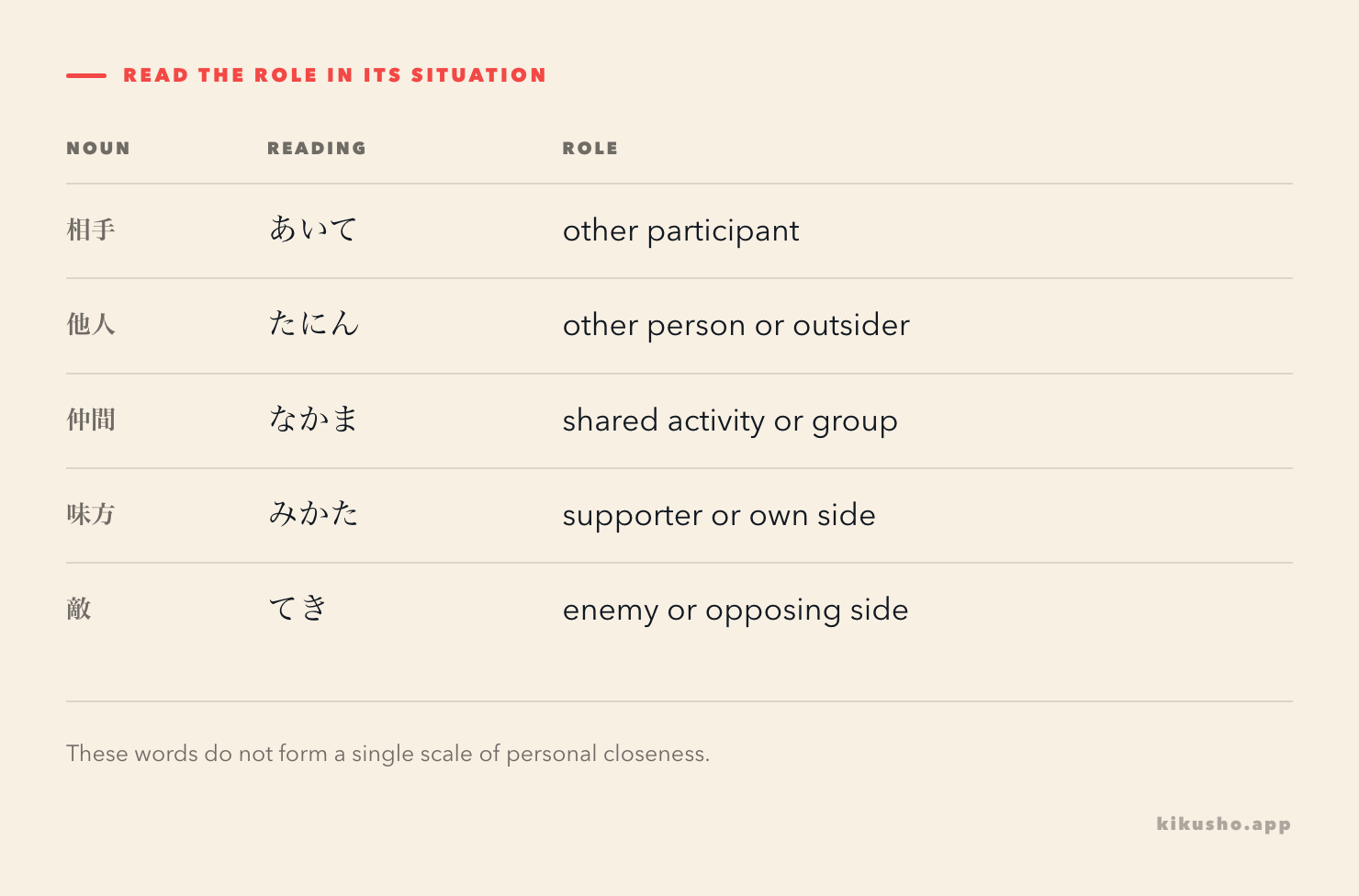
仲間 centres on doing something together or belonging together. 味方 centres on support or being on the same side. 敵 names the opposing side or an enemy:
趣味の仲間と旅行した。
I travelled with companions who share my hobby.
兄は私の味方になってくれた。
My older brother took my side.
物語の主人公は敵と戦う。
The story's protagonist fights an enemy.
仲間 can carry warmth and solidarity, but shared activity does not automatically establish the intimate trust of 親友. A 味方 might support you in a particular disagreement without being your friend. In a sports report, 敵 can refer to the opposition; describing someone as an enemy in a personal disagreement is a stronger claim than simply calling them 相手.
相手, 他人 and 後輩 need their surrounding context
相手 gives you the other participant, not a fixed kind of intimacy. A conversation, negotiation or game can each supply a different 相手:
次の試合の相手は誰ですか。
Who is our opponent in the next match?
Nothing here establishes romance or hostility. JapaneseTest4You's 相手 entry includes the partner and opponent senses; the preceding words tell you which applies.
他人 is broader than “a stranger I have never met”. In 他人の意見, it means other people's opinions. In a family comparison it can mean a non-relative, and in a discussion of who is involved it can mean an outsider or third party. The boundary comes from the situation:
他人の意見も聞きたい。
I want to hear other people's opinions too.
後輩 is not a reliable age label. For the later-entry sense practised here, someone older than you can still be your 後輩 if they joined the same organisation later. Tofugu's workplace guide likewise distinguishes experience from age. The word's broader dictionary senses include experience and standing, so “joined later” is a useful specific use rather than its only possible definition.
The level labels are estimates, with two visible disagreements
The reference inventory places this set in N3 vocabulary. Its two Waller-derived lists are one source family. For 後輩, those lists disagree between N3 and N2; the inspected Japanese Compass N3 people list includes it in N3.
For 上司, the inventory records N3 and N1. Meshclass teaches 上司 at N3. The JapaneseTest4You page is internally inconsistent: its heading says N3, while its explicit level field says N1. That page confirms the reading and boss sense, but cannot supply an unambiguous level estimate.
Keep both words in this lesson. These references guide study order; they do not establish an official exhaustive JLPT syllabus. The noun phrases and basic particles are earlier prerequisites, not additional N3 grammar credited by this set.
Keep the role you encounter in introductions and stories
Introductions often tell you a relationship before they tell you much about the person: 私の同僚, 大学の後輩, 学生時代の友人. Fiction adds shifts in allegiance, where 味方 or 敵 may matter more than family or friendship. An invitation or family gathering can instead put 親戚 beside 友人 without ranking their closeness.
If a line of dialogue says someone became the speaker's 味方, save that support context with the word. After a text capture in Kikusho, check that the draft card reads みかた and describes an ally or supporter. Keep an example about taking someone's side, so a later review asks you to recall the role rather than merely equating every warm relationship word with “friend”.
Practice
Work through the ten prompts and keep your choices. All solutions follow the final prompt.
Question 1
Read the colleague noun 同僚.
A. どうりょう
B. どうろう
C. おなりょう
D. どうりょ
Question 2
Choose the spelling of みかた when it means “ally or supporter”.
A. 見方
B. 味形
C. 味方
D. 見形
Question 3
Which noun explicitly emphasises a particularly close, trusted friendship?
A. 相手
B. 同僚
C. 後輩
D. 親友
Question 4
A colleague introduces the person who holds a higher workplace position than you. Which noun specifically names that superior relationship?
A. 親戚
B. 上司
C. 仲間
D. 他人
Question 5
What does 他人の意見 mean without further context?
A. Other people's opinions.
B. Only the opinions of people you have never met.
C. Your own opinion.
D. Your boss's instructions only.
Question 6
Which noun can neutrally name the other participant in 次の試合の( ), without describing a family tie, friendship or allegiance?
A. 親友
B. 親戚
C. 相手
D. 味方
Question 7
For the later-entry use of 後輩, which description fits?
A. 年上の人は全員、後輩だ。
B. 親戚なら、必ず後輩だ。
C. 同じ年なら、必ず後輩だ。
D. 同じクラブに私より後から入った人だ。
Question 8
Your aunt is visiting. Which noun identifies the family connection itself?
A. 敵
B. 親戚
C. 仲間
D. 味方
Question 9
In 趣味の仲間, what does 仲間 emphasise?
A. Companions connected by a shared activity.
B. People who are necessarily your closest friends.
C. People who are necessarily your relatives.
D. People who necessarily outrank you at work.
Question 10
Pick the particle for “I will take my sister's side”.
私は姉( )味方します。
A. に
B. を
C. で
D. から
Finish your answer list before moving into the solution block.
Answers and explanations
Answer 1. A. 同僚 is どうりょう, with both どう and りょう. The shortened vowels in どうりょ and the reading どうろう do not give this word's standard pronunciation.
Answer 2. C. 味方 is the ally or supporter. 見方 is also read みかた, but means a way of looking at something or a viewpoint. 味形 and 見形 are not the target word's standard spelling.
Answer 3. D. 親友 explicitly describes close, trusted friendship. A 同僚 could also be a 親友, but 同僚 itself names a colleague rather than the degree of trust.
Answer 4. B. 上司 names the workplace superior. 仲間 can describe shared activity and 他人 another person, but neither specifically states that higher position.
Answer 5. A. 他人の意見 means other people's opinions. 他人 does not require that every person be unknown to you, nor does it restrict the phrase to your boss.
Answer 6. C. 相手 supplies the other participant or opponent in the match. 味方 puts someone on your side instead; 親友 and 親戚 specify other connections that the prompt does not establish.
Answer 7. D. Joining the same club after the speaker fits this selected use of 後輩. Age, kinship and sharing a birth year do not by themselves establish it. In this use, an older new member can be the speaker's 後輩.
Answer 8. B. 親戚 identifies a relative. Your aunt might also support you or share your hobby, but those possibilities are different from the family tie the prompt asks you to name.
Answer 9. A. 趣味の仲間 emphasises doing or enjoying an activity together. It establishes neither a family tie nor workplace rank, and does not promise the close trust expressed by 親友.
Answer 10. A. Use 姉に味方します. 味方する takes に for the person or side supported. Compare 姉の味方です, “I am on my sister's side”: the noun construction uses の to connect the supporter with that side.
Common questions
Does 友人 mean a less close friend than 親友?
友人 means friend without specifying an exact degree of closeness. 親友 explicitly describes a particularly close, trusted friend. The same person can be described by either word, depending on what you need to say.
Is 後輩 always someone younger than you?
No. In a school, workplace or club, 後輩 can identify someone who joined later. Age alone does not determine that relationship. The word also has broader senses involving experience or standing.
Can 相手 mean an opponent?
Yes. 相手 can be the other participant in a conversation, partnership or contest. A phrase such as 試合の相手 identifies a match opponent without necessarily calling that person an enemy.