On this page
Verb-stem 上げる(あげる) can bring work to a finished result; verb-stem 合う(あう) makes the action mutual or shared. The useful question is whether the sentence is about what was completed or how the participants acted toward one another.
Three classmates might discuss a poster and then finish writing its text. 話し合う describes their discussion; 書き上げる describes the completed writing. You can need both verbs for the same afternoon without either being a substitute for the other.
The rule follows the claim you want to make
Both constructions start with the ます-stem, the part left after removing ます. They make a compound verb without a connecting particle.
| Construction taught here | Main claim | Established example | Reading |
|---|---|---|---|
| Stem + 上げる | Carry work through to completion | 書き上げる: finish writing | かきあげる |
| Stem + 合う | Do something mutually or in interaction | 話し合う: discuss together | はなしあう |
This is N3 grammar in JLPT Sensei's completion lesson and its 合う lesson. Bunpro also places both patterns at N3. There is a level boundary to acknowledge: Maggie Sensei's independently written 合う lesson is tagged N4. That changes a study sequence, not the attachment or meaning. The JLPT supplies no exhaustive official grammar syllabus.
Know the ます-form before working with these endings. The earlier compound-verb set introduces the stem seam through endings such as 始める and 続ける; this page teaches two different additions to that structure.
Ask what evidence the sentence gives you
For completion, look for a piece of work and a resulting finished version. For mutual action, look for participants exchanging, discussing, helping or competing. A plural subject alone cannot decide the ending: several people can complete something, and several people can perform separate actions without interacting.
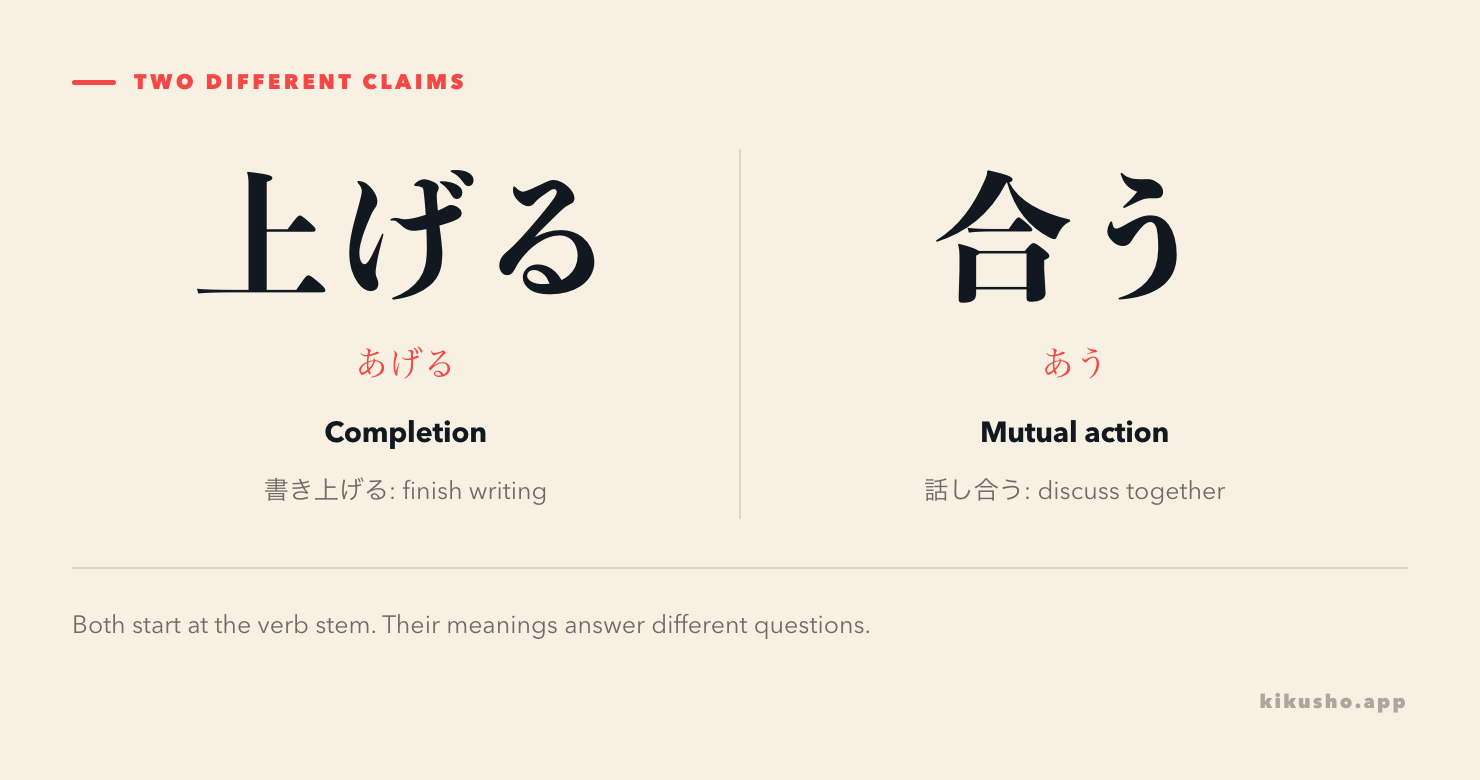
Avoid treating this as a mechanical choice between the same two endings on every verb. The reliable starting vocabulary is 書き上げる and 作り上げる for finished work, then 話し合う and 助け合う for interaction. Recognizing a stem does not license every imaginable combination.
上げる belongs with work brought to a finished result
書き上げる presents a completed piece of writing. 作り上げる(つくりあげる) presents something made or built through to completion. The object takes を in these examples.
昨夜、発表の原稿を書き上げた。
さくや、はっぴょうのげんこうをかきあげた。
Last night, I finished writing the script for my presentation.
三人で展示用の模型を作り上げました。
さんにんでてんじようのもけいをつくりあげました。
The three of us completed the model for the exhibition.
The second sentence has three makers, yet its compound highlights the model's completion. It does not become a 合う sentence just because the work was collaborative.
Bunpro's 上がる・上げる explanation emphasizes a completed effect or product. J-nihongo's completion page independently describes carrying production or work through to completion. Neither gives you a reason to turn every activity translated as “finish” into an 上げる compound. Keep the actual word with its object.
Completion can suggest effort or achievement, especially with やっと, “at last,” but it does not certify perfect quality. A finished script can still contain a mistake. Nor is this ending an expression of regret; for that distinction, compare ~てしまう.
上げる here is an ichidan verb. Once the compound exists, conjugate that final part: 書き上げた, 書き上げない, 書き上げます. 書き remains fixed.
合う belongs with interaction between participants
話し合う is talking a matter over together. 助け合う(たすけあう) is helping one another, rather than a single giver helping a single receiver.
姉と引っ越しの日について話し合った。
あねとひっこしのひについてはなしあった。
I discussed the moving date with my older sister.
この寮では、住人同士が助け合っています。
このりょうでは、じゅうにんどうしがたすけあっています。
In this dormitory, the residents help one another.
と identifies the discussion partner in the first sentence; について introduces the topic. 同士(どうし)means fellow members of a group in the second. You can also emphasize mutuality with お互いに(おたがいに), “one another.” These expressions make the participants easier to recover, but お互いに is not an obligatory attachment rule.
Bunpro's 合う page treats this as reciprocal involvement and explicitly includes competition. 競い合う(きそいあう) means competing with one another: interaction does not have to be a kindness. A group can help one another over a month, too; the ending does not itself demand that every person act at the same instant.
合う is godan, even when the first verb is ichidan. 助ける becomes 助け合う, then 助け合った or 助け合わない. Do not conjugate the whole compound as though its last verb were still 助ける.
| First verb | ます-form | Stem | Compound | Past / polite |
|---|---|---|---|---|
| 書く | 書きます | 書き | 書き上げる | 書き上げた / 書き上げます |
| 作る | 作ります | 作り | 作り上げる | 作り上げた / 作り上げます |
| 話す | 話します | 話し | 話し合う | 話し合った / 話し合います |
| 助ける | 助けます | 助け | 助け合う | 助け合った / 助け合います |
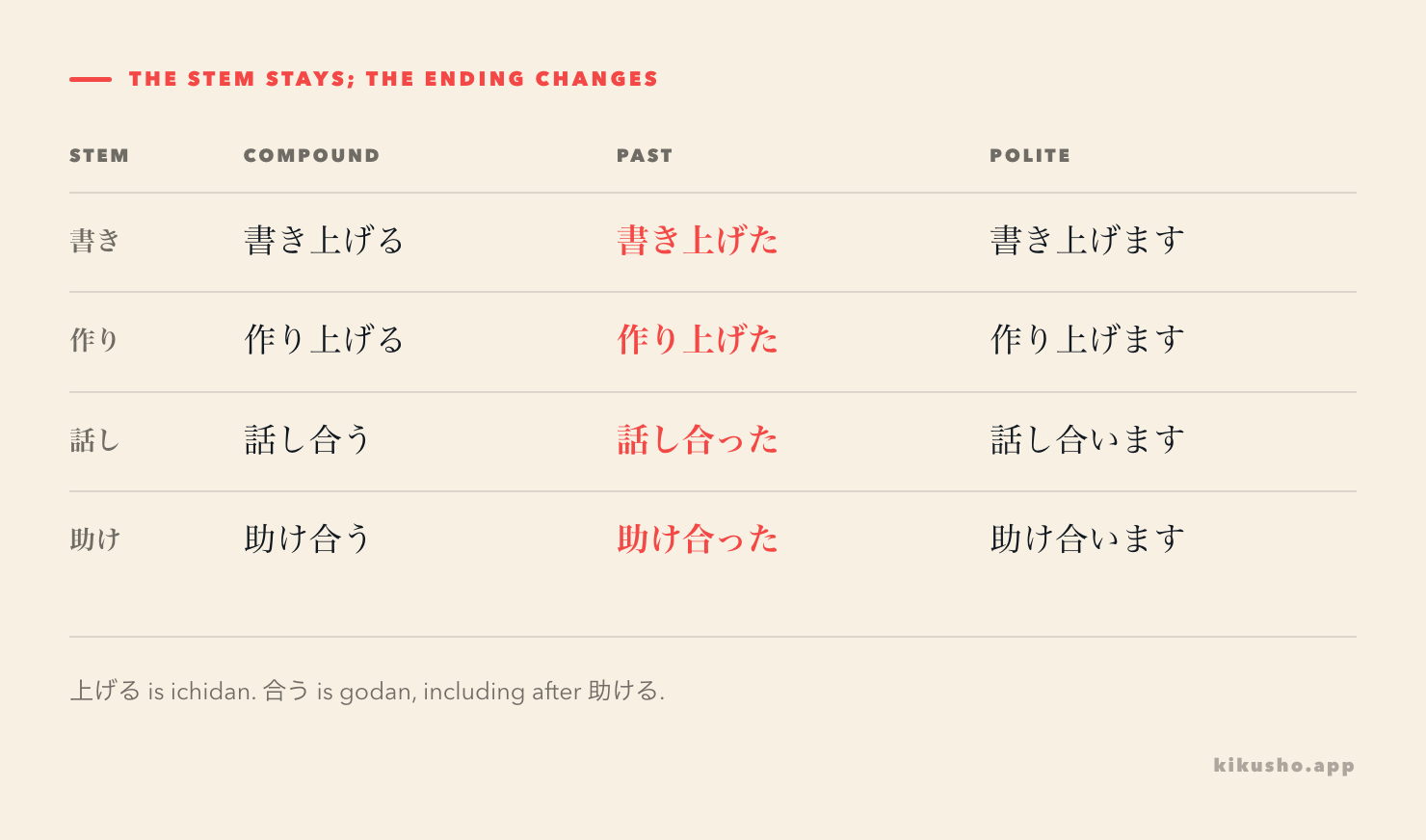
Both patterns can appear in everyday conversation or ordinary written Japanese. Politeness comes from the surrounding sentence and endings such as ます; 合う is not inherently casual, and completion 上げる is not inherently honorific.
The two claims can coexist in one account
予算について話し合ってから、二人で広告を作り上げた。
よさんについてはなしあってから、ふたりでこうこくをつくりあげた。
After discussing the budget, the two of us completed the advertisement.
The first clause tells you how the decision was handled. The second reports a finished product. Discussion alone does not prove that an advertisement was completed; completion alone does not tell you that the makers talked the budget over.
The difference also matters when keeping vocabulary. A message saying 原稿を書き上げた is a useful item to paste into Kikusho with its whole object phrase. In the editable card, preserve the completed-script sense beside the reading. A separate example containing 話し合った will remind you that a shared discussion makes a different claim, even if the two sentences came from one project.
The wrong attachment can change the subject of the lesson
書き上げる and 書いてあげる differ at the seam. The first uses 書き, the stem; the second uses 書いて, the て-form. Kanjipedia's 上げる entry separates completion from the favour construction.
| Sentence | What it reports |
|---|---|
| 案内文を書き上げた。 | I finished writing the notice. |
| 弟のために案内文を書いてあげた。 | I wrote the notice for my younger brother as a favour. |
The favour sentence may describe a completed act, but the あげる construction is marking the benefit, not serving as the completion suffix. For giver and receiver perspectives, use the favour-verb comparison.
Also keep the compound's own meaning. Not every word ending in 上げる expresses completion: 持ち上げる(もちあげる), for example, can mean lifting something, a directional use distinguished in this compound-verb study's abstract. And standalone 合う can mean fitting or matching; that is a different use from adding 合う after a verb stem. A dictionary lookup should include the whole compound, not just its final two or three kana.
Practice
These six tasks use the forms above. Complete the whole set before scrolling to the answer block.
Question 1
The intended message is “I finished writing the meeting record last night.” Select the sentence that expresses completion rather than a favour.
A. 昨夜、会議の記録を書いてあげた。
B. 昨夜、会議の記録を書き合った。
C. 昨夜、会議の記録を書き上げた。
D. 昨夜、会議の記録を書いて合った。
Question 2
The speaker wants residents to help one another, with support moving both ways. Pick the matching continuation.
困ったときは、住人同士で( )。
A. 助け合いましょう
B. 助け上げましょう
C. 助けてあげましょう
D. 助ける合いましょう
Question 3
Build a sentence meaning “I finished writing the presentation script last night.” Place the four numbered pieces between the supplied beginning and ending.
昨夜、[ ][ ][ ][ ]。
- 書き\
- 上げた\
- 発表の\
- 原稿を
Question 4
Reassemble “I discussed the moving date with my older sister.” The sentence begins 姉と and ends 。; each of the following four pieces belongs in the middle.
- 合った\
- 引っ越しの\
- 話し\
- 日について
Question 5
Read the account and select the pair that preserves its intended sequence: discussion first, then a finished advertisement.
二人の意見は違っていた。そこで、予算について(①)。その後、二人で広告を(②)。完成した広告は、店の入口に貼った。
A. ①書き上げた ②話し合った
B. ①話し合った ②作り上げた
C. ①助け合った ②話し合った
D. ①作り上げた ②助け合った
Glosses: 意見(いけん), opinion; 予算(よさん), budget; 広告(こうこく), advertisement; 完成(かんせい), completion; 入口(いりぐち), entrance; 貼る(はる), stick up.
Question 6
Which statement follows from this short passage?
この寮では、住人同士が助け合っている。忙しい人がいると、ほかの住人が買い物を手伝うこともある。
A. Every resident finishes a piece of writing each day.
B. Only one permanent giver is allowed to help others.
C. All assistance must happen at precisely the same moment.
D. The residents support one another; the passage describes an example of that support.
Glosses: 寮(りょう), dormitory; 住人(じゅうにん), resident; 忙しい(いそがしい), busy.
Answers and explanations
Answer 1
C. 昨夜、会議の記録を書き上げた means “Last night, I finished writing the meeting record.” A marks writing as a favour. B attempts a mutual-writing claim and does not express completion. D incorrectly joins a て-form to 合う. The question specifies the desired meaning, so a possible favour context cannot make A an equivalent answer.
Answer 2
A. 困ったときは、住人同士で助け合いましょう means “When there is trouble, let's help one another as fellow residents.” C describes help given as a favour, without the reciprocal claim requested. B does not supply that mutual sense. D retains the dictionary-form ending of 助ける instead of using its stem 助け.
Answer 3
3 → 4 → 1 → 2. 昨夜、発表の原稿を書き上げた: “Last night, I finished writing the presentation script.” 発表の modifies 原稿; 原稿を supplies the object; 書き joins directly to 上げた. Splitting the compound at its stem is the point of the exercise, not permission to move a particle inside it.
Answer 4
2 → 4 → 3 → 1. 姉と引っ越しの日について話し合った: “I discussed the moving date with my older sister.” 引っ越しの日 is the topic, について introduces it, and 話し合った ends with godan 合う's past form 合った. 姉と stays outside that compound as the partner phrase.
Answer 5
B. The pair gives “We discussed the budget. Afterwards, the two of us completed the advertisement.” Different opinions motivate the discussion; 完成した広告 then refers to the completed result. A attaches writing to the budget topic and discussion to an advertisement object. C never reports the required finished advertisement. D exchanges the two jobs and leaves the final reference to completion unsupported by the intended account.
Answer 6
D. 助け合っている describes mutual support among the residents. The shopping sentence shows what one instance can look like, without assigning one person the permanent giver role. A introduces writing absent from the passage. B contradicts the reciprocal construction. C invents a simultaneity requirement. Helping one resident today and receiving help another day can belong to the same ongoing pattern.
Common questions
Does 書き上げる mean writing something for another person?
No. 書き上げる means completing the writing. 書いてあげる uses the て-form and presents the writing as a favour. Someone else may benefit from a finished document, but the stem construction itself does not mark that benefit.
Does 合う always mean cooperation?
No. Verb-stem 合う expresses an action involving the participants mutually. 助け合う means helping each other, while 競い合う means competing with each other. Mutual involvement can be friendly or competitive.
Can 上げる replace every English use of finish?
No. Completion 上げる occurs in established compounds such as 書き上げる and 作り上げる. Learn the compound and its context. Other 上げる compounds can have different meanings, so the ending alone does not guarantee completion.