On this page
Use 頃(ころ/ごろ) for an approximate point or period, おきに for an action repeated after a set gap, and さっき for something that happened a little while ago. The quickest test is to ask whether the sentence looks around a named time, measures the space between repetitions, or points backward from now.
七時ごろ帰ります。
しちじごろ かえります。
I will return around seven.
一日おきに走ります。
いちにちおきに はしります。
I run every other day.
さっき帰りました。
さっき かえりました。
I returned a little while ago.
Start with the three kinds of time
| Form | Question it answers | Time relationship | Example |
|---|---|---|---|
| 頃(ころ/ごろ) | About when? | approximate point or period | 七時ごろ: around seven |
| おきに | At what interval? | repeated gap | 一日おきに: every other day |
| さっき | How recently? | recent past relative to now | さっき電話した: called a little while ago |
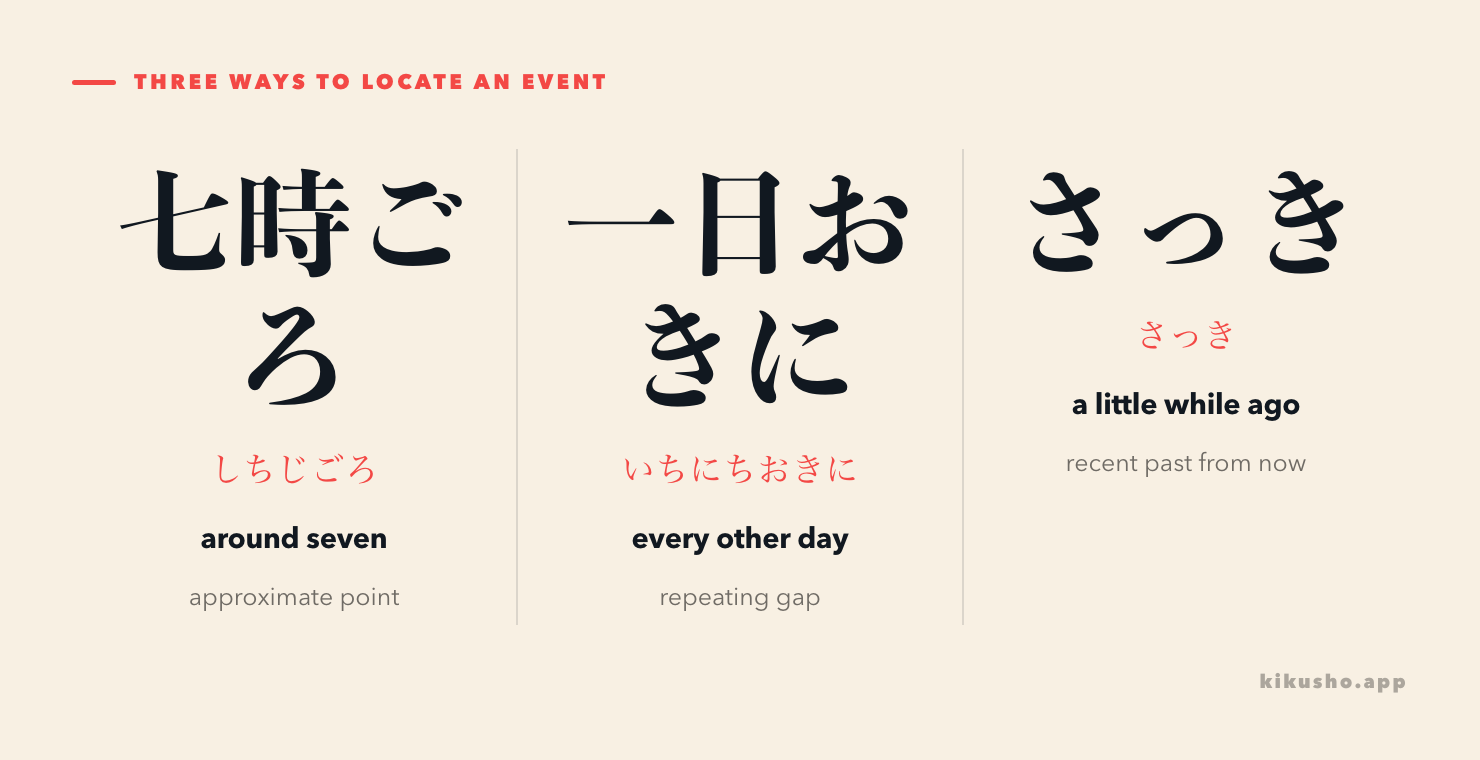
The English word “about” can blur two different ideas. 七時ごろ is about seven o'clock. さっき is about a short time before now, without naming a clock time. An interval is different again: 一時間おきに tells you how much space separates one repetition from the next. At N3, the ぶりに and 中 comparison separates the time since a previous event from a window that contains one.
ごろ follows a named point on the calendar or clock
After a clock time, date, month or other named point, 頃 is usually read ごろ. It softens the boundary from one exact point to a surrounding range.
| Named point | Approximate expression | Meaning |
|---|---|---|
| 七時(しちじ) | 七時ごろ | around seven |
| 三月(さんがつ) | 三月ごろ | around March |
| 何時(なんじ) | 何時ごろ | about what time |
| 1980年(せんきゅうひゃくはちじゅうねん) | 1980年ごろ | around 1980 |
何時ごろ駅に着きますか。
なんじごろ えきに つきますか。
About what time will you arrive at the station?
The particle に is optional after this kind of ごろ phrase. 七時ごろ帰ります and 七時ごろに帰ります both work. The lesson on Japanese time expressions and に explains the underlying exact-time pattern; ごろ adds approximation without forcing に to remain.
The Japan Foundation's teaching notes contrast 七時ごろ with a duration such as 七時間ぐらい. This is a useful division: use ごろ after a point on the clock, but ぐらい after an amount.
| Point in time | Amount or duration |
|---|---|
| 七時ごろ帰ります。 — I will return around seven. | 七時間ぐらい寝ました。 — I slept for about seven hours. |
| 三月ごろ始まります。 — It starts around March. | 三か月ぐらいかかります。 — It takes about three months. |
Do not extend the clock pattern to every time word. Relative expressions such as 今日, 今週 and 今年 already locate themselves from the moment of speaking. The same Japan Foundation notes advise against forms such as 今日ごろ or 今年ごろ for the basic approximate-time use.
ころ names the period when something was true
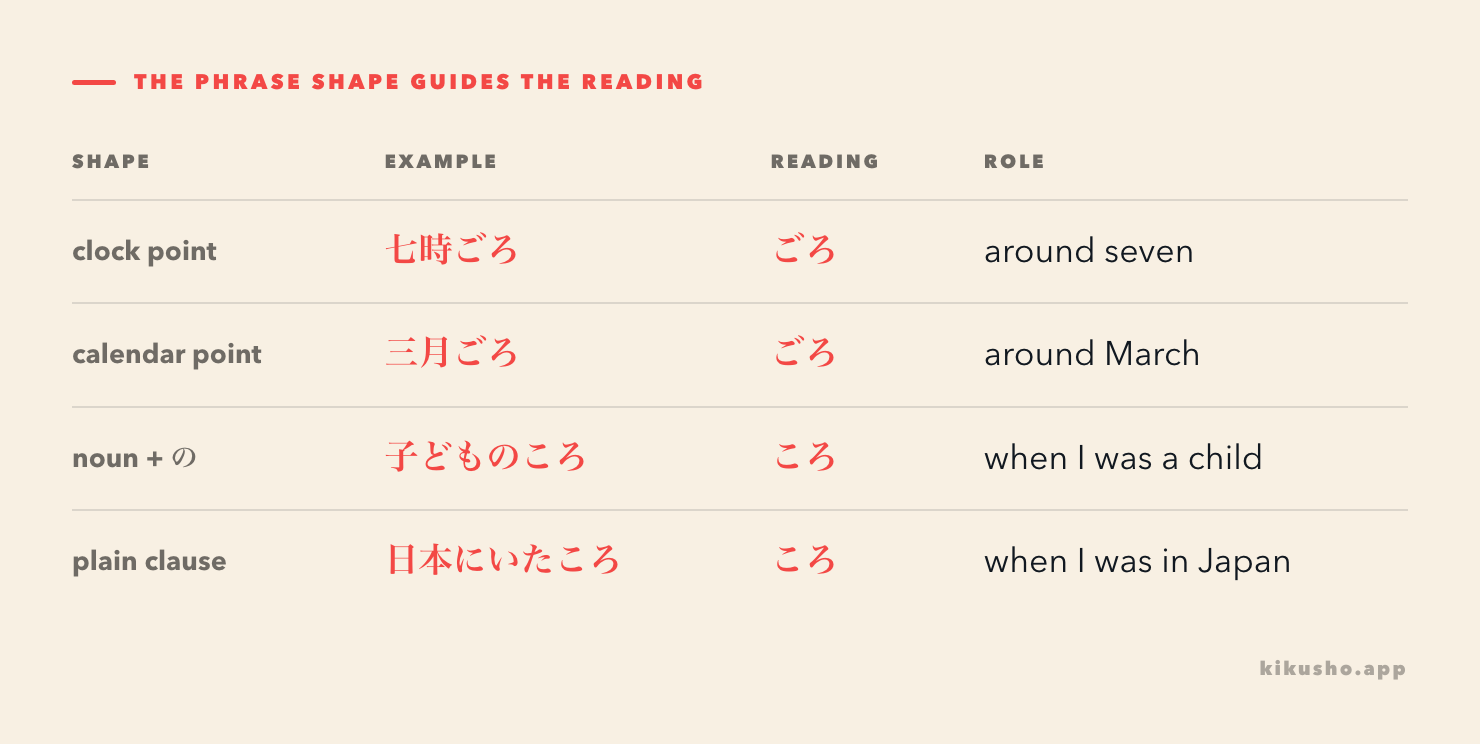
When 頃 means “when” or “during the period,” it is commonly read ころ. A noun plus の or a plain clause can define that period.
| Shape | Example | Meaning |
|---|---|---|
| noun + のころ | 子どものころ | when I was a child |
| plain clause + ころ | 日本にいたころ | when I was in Japan |
| description + ころ | 若いころ | when I was young |
| clock point + ごろ | 七時ごろ | around seven |
子どものころ、毎週この公園で遊びました。
こどものころ、まいしゅう このこうえんで あそびました。
When I was a child, I played in this park every week.
日本にいたころ、よく銭湯へ行きました。
にほんに いたころ、よく せんとうへ いきました。
When I was in Japan, I often went to public baths.
The reading distinction is a practical pattern rather than a reason to guess from the kanji alone. Keep the whole phrase: 七時ごろ, 子どものころ, 日本にいたころ.
おきに measures the gap between repetitions
Unit + おきに schedules an action at intervals. Its connection with 置く, “to place,” helps: imagine placing one occurrence, leaving the stated interval, and placing the next.
一時間おきに水を飲みます。
いちじかんおきに みずを のみます。
I drink water at one-hour intervals.
このバスは一日おきに出ます。
このバスは いちにちおきに でます。
This bus runs every other day.
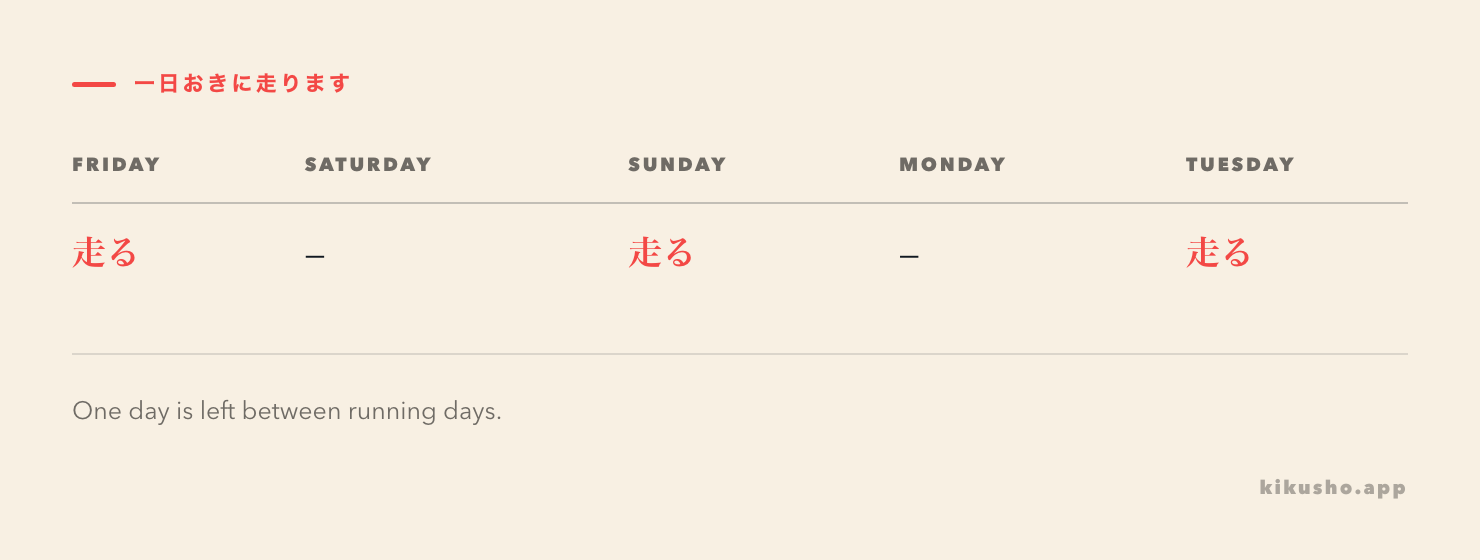
The safest contrast is a calendar-day schedule:
| Expression | Schedule | Usual English |
|---|---|---|
| 一日ごとに走ります | run on each day | run every day |
| 一日おきに走ります | run, leave one day, run again | run every other day |
With hours, minutes and other continuously measured units, English translations can make おきに and ごとに look identical: 一時間おきに確認する can be translated “check every hour.” Bunpro places おきに at N3 and emphasizes the interval, while JLPT Sensei lists it among N4 material. These labels describe where publishers teach the form; the test maker does not release a point-by-point grammar syllabus. More useful than forcing one arithmetic rule onto every unit is checking a complete schedule and asking what lies between two actions.
The から and まで lesson marks the beginning and end of one span. おきに does another job: it repeats an event across a series of spans.
If a notice says 一日おきに交換してください, save the whole instruction in Kikusho. The unit controls the cadence, so a card containing only おきに loses the detail you need. Keep 一日おきに交換してください, confirm the reading, and edit the example if the real schedule gives a clearer starting day.
さっき points to a short time before now
さっき is a relative time word. It does not name an hour or measure a repeating interval; it points to a recent event from the speaker's present moment.
さっき田中さんから電話がありました。
さっき たなかさんから でんわが ありました。
Tanaka called a little while ago.
ついさっき着いたところです。
ついさっき ついたところです。
I arrived just moments ago.
The size of the window depends on context. It is short enough to feel recent, but さっき is not a stopwatch measurement. ついさっき narrows it toward “just moments ago.” Since the event is before now, さっき normally goes with a past event or a present state caused by one.
In polite service or business speech, 先ほど(さきほど) is often a better fit than conversational さっき. Kotobank's dictionary entry for 先ほど gives the same near-past range and lists さっき as a related form. Register changes the choice, not the direction of time.
| Situation | Natural choice | Example |
|---|---|---|
| chat with a friend | さっき | さっき送ったよ。 — I sent it a little while ago. |
| polite call or meeting | 先ほど | 先ほどメールを送りました。 — I sent the email a short while ago. |
Separate a named time from the speaking moment
Compare these two reports after a delivery:
三時ごろ届きました。
さんじごろ とどきました。
It arrived around three.
さっき届きました。
さっき とどきました。
It arrived a little while ago.
The first answer remains anchored to three o'clock. Someone can repeat it later without changing its reference. The second moves with the speaker's “now”; hours later, the same delivery may no longer count as さっき. For other ways to order one event relative to another, use 前に and あとで.
Check yourself
Question 1: grammar choice. The train is expected at approximately 7:00. Which sentence expresses that meaning?
- A. 電車は七時おきに来ます。
- B. 電車は七時ごろ来ます。
- C. 電車はさっき来ます。
- D. 電車は七時間ぐらい来ます。
Question 2: meaning in context. What schedule does 一日おきに走ります normally describe?
- A. running every day
- B. running twice a day
- C. running every other day
- D. running around one o'clock
Question 3: register and time. You tell a friend, “Tanaka called a little while ago.” Which beginning fits best?
- A. さっき、
- B. 三時おきに、
- C. 子どものころ、
- D. 来月ごろ、
Question 4: sentence composition. Write “I go running every other day” using 一日, おきに and 走ります.
Question 5: reading and shape. Which reading and meaning fit 頃 in 子どもの頃?
- A. ごろ, around a clock time
- B. ころ, when I was a child
- C. おき, at intervals
- D. さっき, a little while ago
Question 6: contrast. Explain why 七時ごろ帰ります uses ごろ but 七時間ぐらい寝ました uses ぐらい.
Question 7: text grammar. Read the schedule and message: この薬は一日おきに飲みます。さっき一回目を飲みました。次は日曜日です。 Today is Friday. Which interpretation is correct?
- A. Take the medicine every day; the first dose will be on Sunday.
- B. Take it around one o'clock; the first dose was long ago.
- C. Leave one day between doses; the first dose was a little while ago, so the next is Sunday.
- D. Take it once every hour; the next dose is this evening.
Answers and explanations
Answer 1. B, 電車は七時ごろ来ます. 七時 is a named clock point, and ごろ makes it approximate. おきに would require a time unit that sets a repeating interval; さっき points to the recent past; 七時間ぐらい is an approximate seven-hour duration.
Answer 2. C, running every other day. In this calendar-day example, 一日おきに presents a running day, one day left between, and then the next running day. 一日ごとに would describe each day.
Answer 3. A, さっき. The event is recent relative to the friend's present moment. The other choices describe an interval, a childhood period or an approximate future month.
Answer 4. 一日おきに走ります。 The unit 一日 attaches directly to おきに, and the repeated action follows it.
Answer 5. B, ころ, “when I was a child.” The noun 子ども plus の defines a period of life. Clock and calendar points commonly take the ごろ reading instead.
Answer 6. 七時 names a point on the clock, so ごろ means “around seven.” 七時間 names an amount of elapsed time, so ぐらい means “about seven hours.” One approximates when; the other approximates how long.
Answer 7. C. 一日おきに leaves Saturday between Friday's dose and Sunday's dose. さっき says the first dose happened a little while before the message; it does not name a clock time or a distant past.
When you meet one of these expressions, keep enough of the sentence to preserve its anchor. 七時ごろ needs the clock point, 一日おきに needs the interval unit, and さっき needs the event whose recency the speaker is reporting.
Common questions
What is the difference between ごろ and さっき?
ごろ makes a named time approximate, as in 七時ごろ, around seven. さっき points backward from the moment of speaking and means a little while ago. ごろ can describe past or future times; さっき is recent past.
Does 七時ごろ need に?
Both 七時ごろ帰ります and 七時ごろに帰ります are natural. The time particle に is optional after a clock expression followed by ごろ.
Does 一日おきに mean every day?
Usually it means every other day: an action day, one day in between, then another action day. 一日ごとに means every day. With short continuous units, translations of おきに and ごとに can overlap, so learn the whole schedule.