On this page
At the end of a conversational turn, だけど leaves space for what comes next, while じゃない asks the listener to recognize what came before. The first can hand over an unstated request, contrast, or objection. The second can confirm, remind, warn, criticize, or mark a discovery.
Both endings can sound incomplete in English, and both depend on delivery. Their directions are still different: だけど points forward to a response or missing continuation; じゃない points backward to a proposition the speaker treats as available for recognition.
One ending opens a slot; the other presses a claim
Compare two turns about the same meeting:
明日の会議なんだけど、開始は十時でいい?
あしたの かいぎなんだけど、かいしは じゅうじで いい?
About tomorrow's meeting, is ten a good start time?
明日の会議、十時からじゃない?
あしたの かいぎ、じゅうじからじゃない?
Tomorrow's meeting starts at ten, doesn't it?
The first speaker establishes a topic and then asks the real question. The second supplies 十時から as a likely fact and asks for recognition. Neither sentence is well described by translating one kana string in isolation.
| Ending | Direction of the turn | Listener's likely job |
|---|---|---|
| だけど / んだけど | forward, toward something unstated or newly introduced | infer the concern, request, or next topic |
| じゃない | backward, toward the proposition just spoken | confirm it, notice it, or accept the correction |
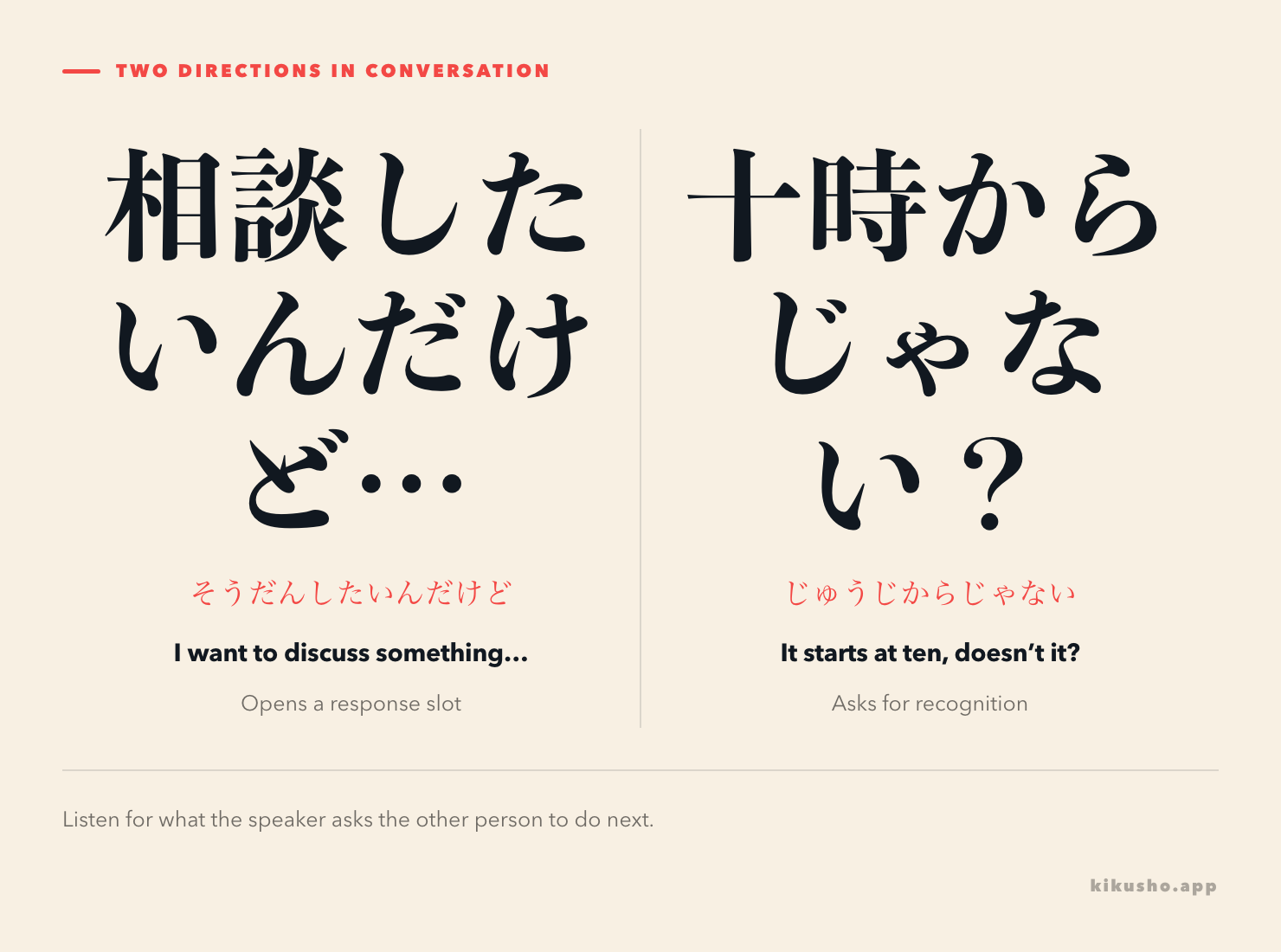
This is a listening rule, not a claim that the endings have only one meaning. A full clause after だけど can state an ordinary contrast. Literal nominal negation can also end in じゃない. The surrounding turn decides which job is active.
Build だけど from the predicate it follows
だけど contains the plain copula だ plus けど. That is why nouns and な-adjective stems take it directly, while verbs and い-adjectives normally use plain けど or add explanatory んだ before けど.
| Predicate | Natural conversational form | Avoid |
|---|---|---|
| noun 学生 | 学生だけど | 学生けど |
| な-adjective 静か | 静かだけど | 静かなだけど |
| verb 行く | 行くけど / 行くんだけど | 行くだけど |
| い-adjective 高い | 高いけど / 高いんだけど | 高いだけど |
The ん in 行くんだけど and 高いんだけど is explanatory の in its conversational form. It frames the situation as relevant background. It is frequent when the speaker wants the listener to respond to a problem, question, or implied request.
相談したいことがあるんだけど。
そうだんしたい ことが あるんだけど。
There is something I want to discuss…
No grammatical second clause tells the listener what to do. In a suitable scene, the turn invites a response such as どうしたの?, “What is it?” The omitted material is recoverable only from context.
JLPT Sensei's N3 だけど reference separates contrast, sentence-final implication, and topic introduction. The more foundational けど and けれども lesson covers the connector family and full attachment table. Here the target is the conversational move made after those basics are known.
Sentence-final だけど does not contain one secret request
The unfinished ending can perform several actions because the scene supplies different continuations.
今はちょっと忙しいんだけど。
いまは ちょっと いそがしいんだけど。
I'm a little busy right now…
After someone asks for help, this can be a restrained refusal. Before a scheduling discussion, it may merely introduce a constraint. It does not mechanically mean “no.”
この席、予約してあるんだけど。
この せき、よやくして あるんだけど。
This seat is reserved, though…
Said to someone occupying the seat, the line can be a correction or request to move. Said while checking a booking, it may ask staff to find the reservation. The speaker presents background and leaves the practical next step open.
The Association for Japanese Language Education's handbook on が and けれど as contrast and preface distinguishes a true adversative link from a prefacing use that prepares what the speaker wants to say. Sentence-final だけど goes one step further by allowing the listener to supply the relevant response.
When you save one of these exchanges in Kikusho, keep the preceding question with the reply. 今は忙しいんだけど becomes a refusal only after a request; the same words can introduce a scheduling problem elsewhere. The captured turn preserves the inference that a one-line gloss would erase.
じゃない can look negative while asserting something positive
At N5, N / な-adjective + じゃない is ordinary plain negation. 学生じゃない can simply mean “is not a student.” At N3, the same visible ending also follows a whole proposition and presents it for recognition.
ほら、ここに鍵があるじゃない。
ほら、ここに かぎが あるじゃない。
Look, the key is right here.
この方法、意外と簡単じゃない。
この ほうほう、いがいと かんたんじゃない。
This method is surprisingly easy, isn't it?
The first points out a fact the other person missed. The second invites recognition of an evaluation. A falling delivery can sound like a discovery or correction; a rising delivery more clearly checks for agreement.
The attachment gives a useful clue:
| Shape | Likely reading |
|---|---|
| 来るじゃない | conversational assertion: “He does come / He'll come, won't he?” |
| 高いじゃない | conversational assertion: “It is expensive, isn't it?” |
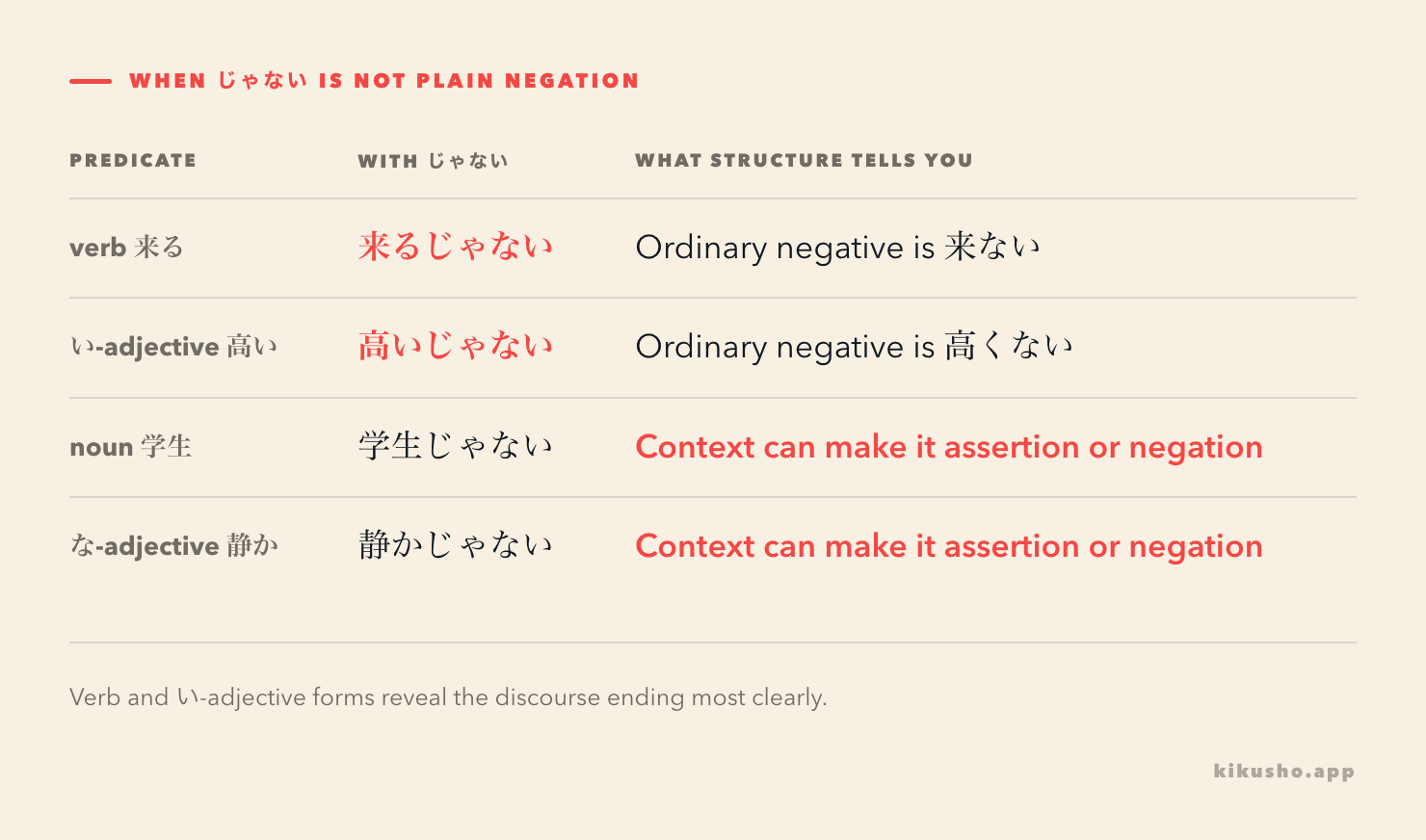
| 学生じゃない | either “not a student” or “a student, isn't he?” depending on context and delivery |
| 静かじゃない | either “not quiet” or “quiet, isn't it?” depending on context and delivery |
A verb's ordinary negative is 来ない, and an い-adjective's ordinary negative is 高くない. Therefore 来るじゃない and 高いじゃない cannot be built as ordinary predicate negation. Nouns and な-adjectives do not give you that structural shortcut, so tone and context carry more weight.
Delivery turns じゃない into a check, discovery, warning, or criticism
The proposition stays central, but the speaker's purpose changes with the scene.
来週は休みじゃない?
らいしゅうは やすみじゃない?
Next week is a holiday, isn't it?
A rising delivery asks for confirmation. The speaker expects the positive proposition 来週は休み to be true.
やればできるじゃない。
やれば できるじゃない。
See, you can do it when you try.
This reacts to a successful result, often with pleased surprise. It need not request an answer.
そこに置いたら危ないじゃない。
そこに おいたら あぶないじゃない。
If you put it there, that's dangerous!
Here the recognizable proposition supports a warning or criticism. Nihon no Kotoba to Bunka groups the N3 use under speculation, confirmation, surprise, and criticism. N1et's teaching note likewise stresses conversational use, the contrast between rising confirmation and falling assertion, and the fact that the negative shape need not carry negative meaning.
Keep three neighboring forms apart
じゃない, じゃないか, and んじゃない overlap, but the extra material matters.
| Form | Typical conversational force | Example |
|---|---|---|
| P + じゃない | recognize P; surprise, reminder, warning, confirmation | 思ったより速いじゃない |
| P + じゃないか | more explicit or forceful appeal for recognition | 前にも説明したじゃないか |
| P + んじゃない | explanatory inference, suggestion, or confirmation | もう帰ったんじゃない? |
The ではないか and じゃないか lesson develops the explicit か form, including its formal counterpart and stronger reminder uses. Explanatory んじゃない packages a proposition as an inference or explanation; in もう帰ったんじゃない?, the speaker suggests “Perhaps they have already gone home?”
Casual じゃん contracts the assertion-seeking じゃない further:
これ、すごく便利じゃん。
This is really convenient!
It is common in informal conversation and can sound blunt or youthful depending on speaker and setting. Learn the stance with じゃない first, then recognize じゃん as a register choice rather than a new logical meaning.
The N3 label belongs to the discourse use
JLPT Sensei places both だけど and conversational じゃない at N3. Other teaching sequences introduce けど as a basic contrast marker and N / な-adjective + じゃない as N5 negation. That is a scope difference: the beginner forms are prerequisites, while this lesson targets omitted continuations, shared propositions, and speaker stance in conversation.
Bunpro places the basic nominal negative じゃない at N5. The N3 sources above isolate a different skill under the same surface string. Since the JLPT publishes no exhaustive official grammar list, the level label is a supported teaching estimate rather than an official boundary.
Practice
Choose the conversational job before translating the ending.
Question 1. A customer wants the clerk to respond to a problem without stating a direct demand. Complete: 予約した__、確認メールが届かないんです。
ア. じゃない
イ. んだけど
ウ. じゃなくて
エ. だけ
Question 2. Your friend finds the missing umbrella and points it out with mild surprise. Choose the natural sentence.
ア. ここにあるじゃない。
イ. ここにあらない。
ウ. ここにあるだけど。
エ. ここにあってじゃない。
Question 3. Which sentence is unambiguously a conversational assertion rather than ordinary predicate negation?
ア. 学生じゃない。
イ. 静かじゃない。
ウ. 高いじゃない。
エ. 先生じゃない。
Question 4. Arrange the fragments into “There is something I would like to ask…”: ある / 聞きたいことが / んだけど
Question 5. A colleague says 今はちょっと忙しいんだけど after you ask for immediate help. What remains unstated, and what in the exchange supports that reading?
Question 6. Choose the form that most directly presents a tentative inference: 田中さんは、もう帰った__?
ア. だけど
イ. んじゃない
ウ. だけ
エ. じゃなくて
Question 7. Read the exchange and choose the pair.
A: 明日の会議のことで相談したい__。
B: 会議は十時から__?
ア. 甲: じゃない / 乙: んだけど
イ. 甲: んだけど / 乙: じゃない
ウ. 甲: だけ / 乙: じゃなくて
エ. 甲: じゃなくて / 乙: だけど
Answers and explanations
Answer 1. イ. んだけど. 予約したんだけど supplies relevant background and opens space for the clerk's response. A verb phrase does not take だけど directly, and the alternatives do not create this conversational preface.
Answer 2. ア. ここにあるじゃない. The affirmative verb ある remains intact before じゃない, so the ending points out a proposition: “Look, it is here.” あらない and the two connector combinations are malformed.
Answer 3. ウ. 高いじゃない. The ordinary negative of the い-adjective 高い is 高くない, so 高いじゃない must use じゃない as a discourse ending here. The noun and な-adjective shapes can also be literal negation without more context.
Answer 4. 聞きたいことがあるんだけど. The complete proposition 聞きたいことがある takes explanatory んだ, followed by けど. The ending invites the listener to ask what the speaker wants to discuss.
Answer 5. A refusal or request to delay is left unstated. The preceding request for immediate help makes that continuation recoverable; in another scene, the same sentence could merely introduce a scheduling constraint.
Answer 6. イ. んじゃない. Explanatory ん frames もう帰った as the speaker's inference for confirmation. Plain じゃない could press recognition, but the requested tentative inference is most clearly marked by んじゃない.
Answer 7. イ. 甲: んだけど / 乙: じゃない. A opens a topic and leaves room for B to respond: 相談したいんだけど. B offers ten o'clock as a likely shared fact: 十時からじゃない?
Common questions
What is the difference between だけど and じゃない at the end of a sentence?
Sentence-final だけど leaves an opening: the contrast, request, objection, or next move is understood from context. Sentence-final じゃない presents a claim as recognizable and can confirm, remind, warn, criticize, or react with surprise.
Does sentence-final じゃない mean “is not”?
Not always. After a verb or い-adjective, as in 来るじゃない or 高いじゃない, it is a conversational ending rather than ordinary negation. After a noun or な-adjective, context and intonation distinguish confirmation from literal negation.
Can だけど follow a verb directly?
A plain verb normally takes けど directly, as in 行くけど, or the explanatory form んだけど, as in 行くんだけど. Nouns and な-adjective stems take だけど directly: 学生だけど and 静かだけど.
Is じゃん the same as じゃない?
じゃん is a more contracted conversational form of the assertion-seeking じゃない. It can sound especially casual or blunt, so this lesson uses じゃない as the safer form for learning the underlying stance.