On this page
けど, けれど and けれども all connect or qualify what a speaker says. Use けど most readily in conversation, けれど as the fuller middle form, and けれども when the delivery is more careful or formal. They can mean “but,” yet they also introduce background or let a request remain politely unfinished.
The length of the connector is only one part of the register. 行くけど is plain and casual; 行きますけど keeps the conversational connector but makes the verb polite. A long けれども does not repair an incorrectly attached noun or adjective.
The three forms share one grammar
The family runs from shortest to longest:
| Form | Where it is most at home | Basic job |
|---|---|---|
| けど | ordinary conversation; casual writing | contrast, qualification, soft lead-in |
| けれど | neutral or careful speech and prose | the same three jobs |
| けれども | more formal or deliberate speech and writing | the same three jobs |
These are tendencies, not three sealed politeness levels. Speakers mix a polite predicate with the compact connector all the time: すみません、聞きたいことが あるんですけど is polite because of the whole turn, not because けど became a formal word. Conversely, 高いけれども、買わない uses the long connector with plain predicates.
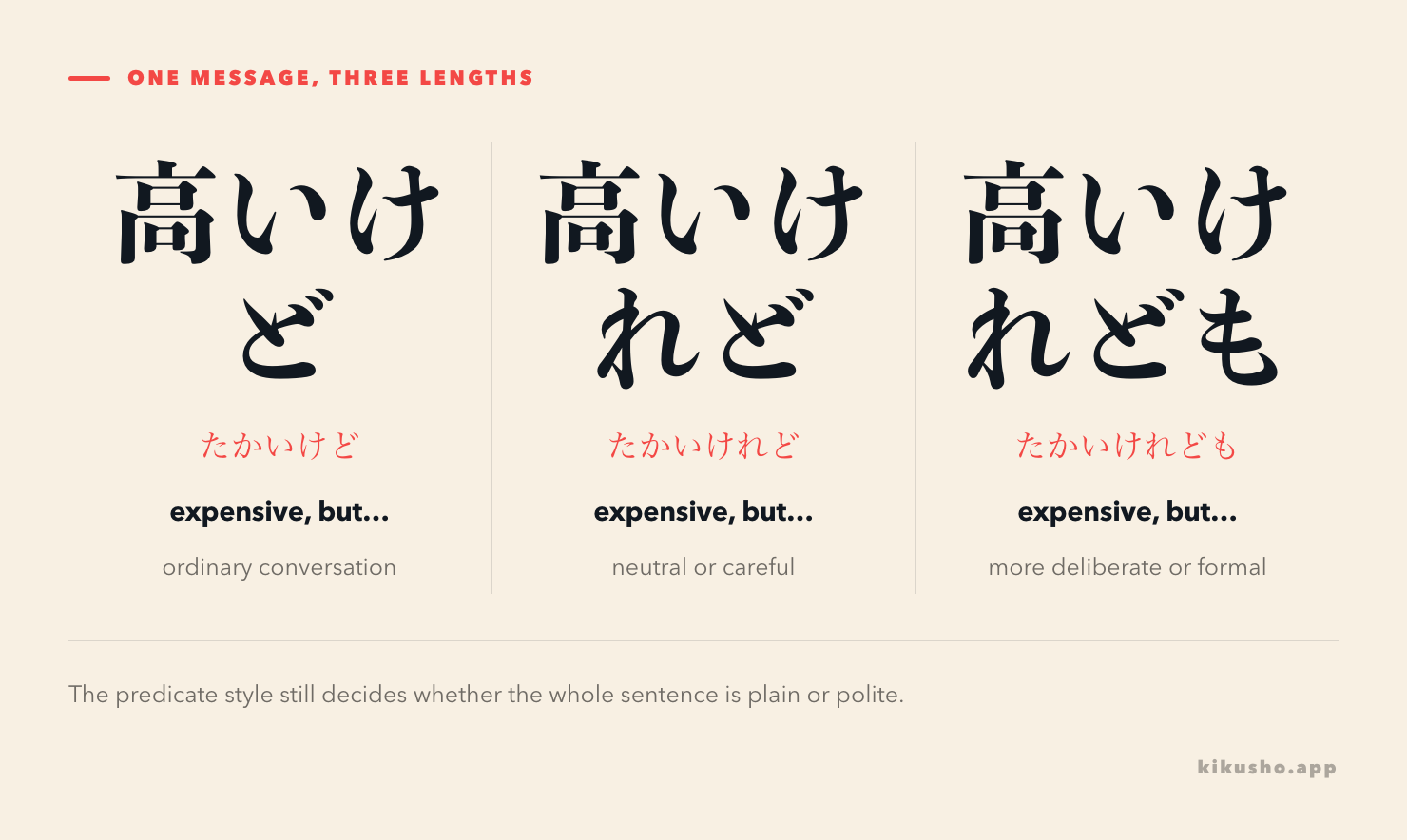
JLPT Sensei’s けれども reference lists all three forms at N5 and describes けど as the less formal member. Bunpro’s comparison also treats けど as the casual shortened form and けれども as the more formal choice. Neither source makes the connector alone responsible for the politeness of the entire sentence.
Attach the connector to a complete predicate
Verbs and い-adjectives can take any member of the family directly after their plain form. A noun or な-adjective needs the copula だ in plain style. Polite style uses the ordinary polite predicate before the connector.
| Predicate type | Plain + けど | Polite + けれども |
|---|---|---|
| verb | 行くけど | 行きますけれども |
| past verb | 行ったけど | 行きましたけれども |
| い-adjective | 高いけど | 高いですけれども |
| な-adjective | 静かだけど | 静かですけれども |
| noun | 学生だけど | 学生ですけれども |
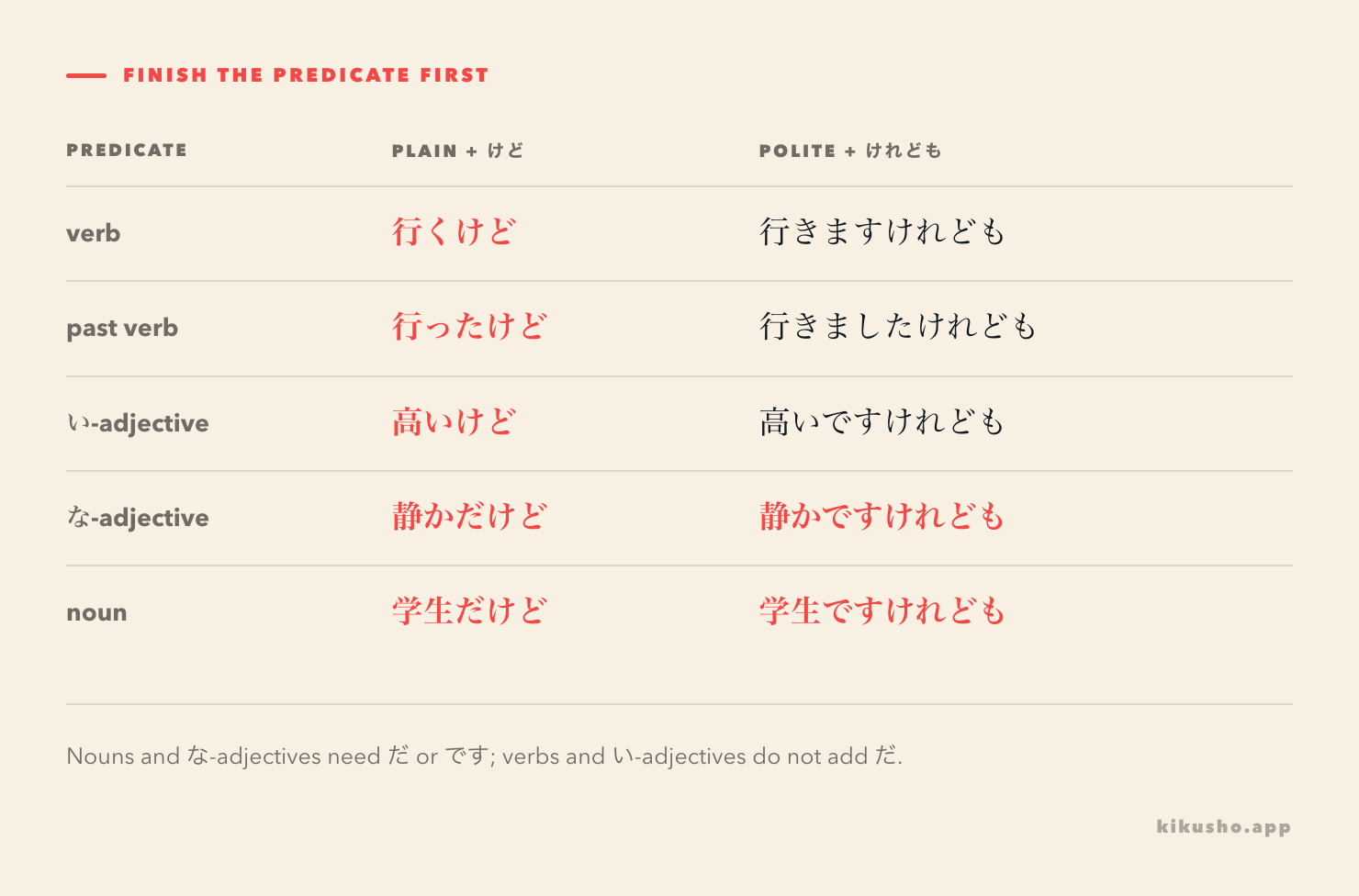
The common errors are 静かなけど and 学生けど. The な in 静かな部屋 belongs before a noun. At the end of a plain predicate, 静か takes だ, giving 静かだけど. 学生 is also a noun predicate, so it gives 学生だけど. The だ and です lesson explains that copula split before the connector is added.
Negative and past forms remain intact: 行かないけど, 高くなかったけれど, 静かじゃないけれども, 学生だったけど. Do not return to the nonpast form merely because a connector follows.
Use a full second clause for a real contrast
The clearest use places two facts against each other:
この部屋は小さいけど、明るいです。 This room is small, but it is bright.
Smallness can suggest an enclosed or dark room. The second clause limits that picture. The connector itself does not say that the first fact is false; both facts remain true.
昨日、先生に聞いたけれど、先生もわかりませんでした。 I asked the teacher yesterday, but the teacher did not know either.
The question was asked. Its expected route to an answer failed. The Association for Japanese Language Education’s handbook section “Ga and Keredo: Adversative Conjunction and Preface” describes this as a simple contrast between the implication of the first clause and the outcome in the second.
The point after けど normally carries the greater weight. In 時間はあるけど、 お金がない, the speaker acknowledges having time, then lands on the obstacle: there is no money. This makes けど useful for correcting or qualifying without turning the first clause into a lie.
A preface can lead to a question without opposing it
Sometimes the first clause simply prepares the listener for the real message:
ちょっと聞きたいことがあるんですけど、今いいですか。 There is something I would like to ask; is now a good time?
No contradiction exists between wanting to ask something and checking the time. The first clause gives background; the second delivers the question. In English, a semicolon or “so” may fit better than “but.” The Japanese handbook cited above calls this the prefacing use: the opening is a path into the main point.
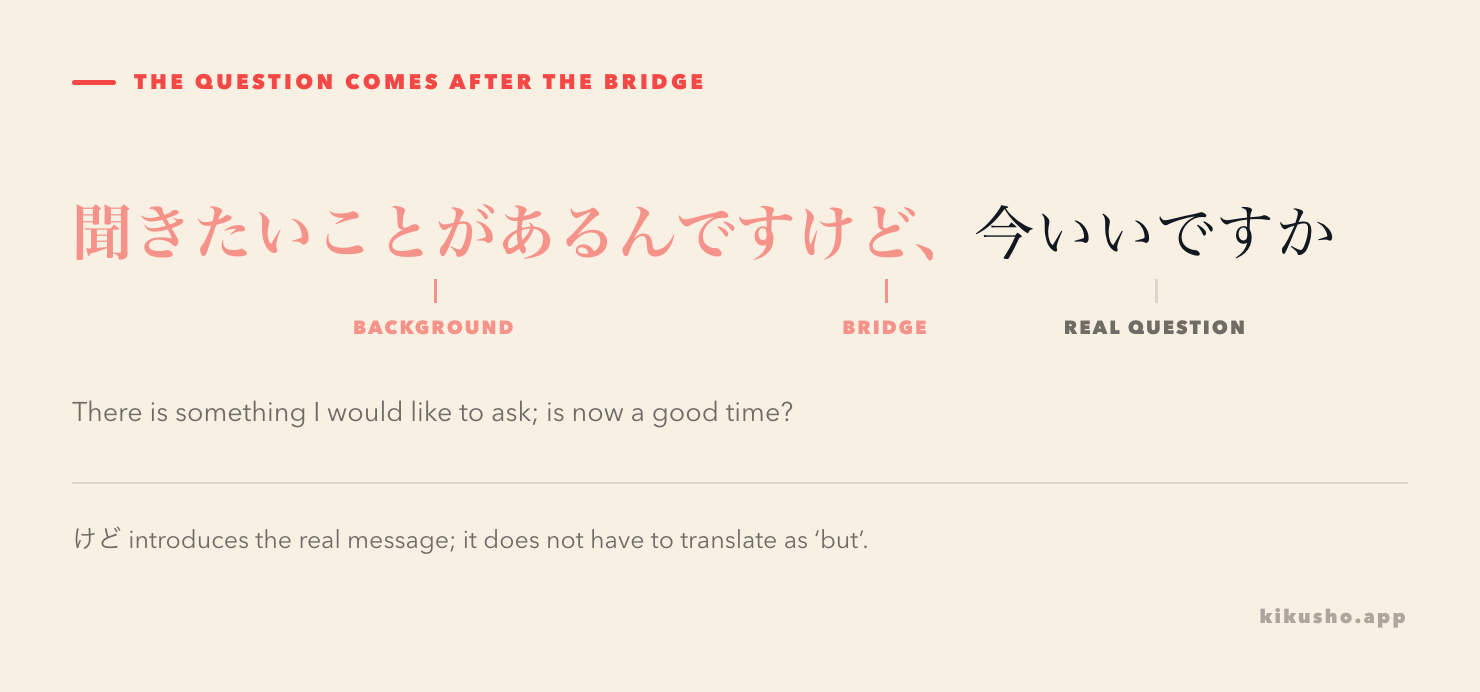
The explanatory んです often appears in these openings because it presents the situation as relevant background. It is not required for every contrast. 高いけど、買います is complete without it. Learn んですけど as a frequent conversation frame, rather than treating those five kana as a single translation.
A captured dialogue needs both sides of this bridge. In Kikusho, keep 聞きたい ことがあるんですけど、今いいですか as one example instead of saving けど by itself. The continuation shows whether the connector opposes a fact, prepares a question or hands the turn to the listener, and you can correct that context on the card before saving it.
An unfinished けど hands the next move to the listener
Conversation can stop after the opening:
すみません、予約したいんですけど…… Excuse me, I would like to make a reservation…
The grammar leaves room after けど, and the situation makes the intended next step recoverable. A receptionist can respond by asking for a date or name. The speaker avoids issuing a bare command, but けど does not contain a secret phrase meaning “please make my reservation.” Context supplies the omitted continuation.
The Nihon Kokugo Daijiten entry on けれども records this sentence-final use as the development of omitting what would have followed and notes that けど and けれど are common forms in conversation. Bunpro also warns that the following phrase is often omitted when it is obvious or the speaker prefers not to state it.
This device needs a shared scene. 行きたいけど…… may invite encouragement, signal an obstacle or gently reject a plan. Without tone and context, the exact continuation is unknown. Translate the hesitation you can justify; do not invent the missing clause.
Do not swap けど, のに and でも by English alone
けど offers a neutral contrast or a conversational bridge. のに more clearly presents an outcome as conflicting with an expectation and can carry a reaction such as surprise or disappointment.
| Sentence | What it foregrounds |
|---|---|
| 安いけど、買いません。 | It is cheap, but I will not buy it: simple qualification. |
| 安いのに、買いません。 | Not buying it is notable despite the low price. |
The dictionary history on Kotobank explicitly distinguishes the criticism or emotional mismatch possible with のに from the plainer opposition of けれども. The ても and のに comparison develops that expectation test.
でも requires a different structural check. It can start a fresh sentence: 高いです。でも、買います。 Attached けど normally closes the preceding predicate: 高いけど、買います。 Japanese also uses けど-family words at the start of a sentence, but a beginner should first recognize whether the word is attached to a clause or linking back across a full stop. The broader N4 connector map compares that second job with それで, それに, すると and だから.
Level labels agree, but the tested skill is broader than “but”
JLPT Sensei and Bunpro both place けど/けれども at N5. That agreement is a study-order observation, since the JLPT does not publish an exhaustive grammar list. Recognizing “but” is the entry point. A useful beginner command of the family also includes noun and な-adjective attachment, the register tendency, and the fact that a polite opening may contain no real contrast at all.
Practice: decide the structure before the translation
Question 1
Choose the ordinary casual connector in この店は高い__、おいしい。
- A. けど
- B. のに
- C. でも
- D. から
Question 2
Complete the plain sentence with the correct attachment: この町は静か__、 便利です。
- A. なけど
- B. けど
- C. だけど
- D. ですだけど
Question 3
Make this polite while keeping the compact conversational connector: 明日行くけど、少し遅くなる。
Question 4
Read 聞きたいことがあるんですけど、今いいですか. Does けど introduce a contradictory fact, background before the real question, or a reason that causes the question?
Question 5
A customer says すみません、予約したいんですけど…… and pauses. What can you safely infer, and what continuation remains unknown?
Question 6
Which sentence most directly presents not buying the bag as surprising given its low price?
- A. 安いけど、買いません。
- B. 安いのに、買いません。
- C. 安いです。でも、買いません。
- D. 安いから、買いません。
Question 7
Write one neutral sentence using けれど to connect “I asked the teacher” and “the teacher did not know either.” Use polite past form in the second clause.
Answers and explanations
Answer 1
A, けど: この店は高いけど、おいしい. It attaches directly to the plain い-adjective 高い and gives the ordinary conversational contrast. でも would normally begin a new sentence here; のに adds an expectation-based stance.
Answer 2
C, だけど: この町は静かだけど、便利です. 静か is a な-adjective. Before the plain connector it forms the complete predicate 静かだ, then adds けど. 静かな belongs before a noun, not before this connector.
Answer 3
明日行きますけど、少し遅くなります。 Both predicates use polite ます forms; the short けど remains natural in conversation. Replacing it with けれども would make the connector more deliberate, but it is not required to make the sentence polite.
Answer 4
It introduces background before the real question. Wanting to ask something does not contradict checking whether now is a good time. The んですけど frame softens the approach and leads the listener to 今いいですか.
Answer 5
You can infer that the customer wants to make a reservation and is handing the turn to the listener. You cannot recover one exact missing sentence: it could have asked whether reservations are available, requested help or simply waited for the receptionist’s next question.
Answer 6
B, 安いのに、買いません. のに presents the decision as a mismatch with the expectation created by the low price. A and C give a plainer contrast; D makes cheapness the reason for not buying.
Answer 7
先生に聞いたけれど、先生もわかりませんでした。 The past verb 聞いた takes けれど directly. The second clause supplies the outcome that did not follow the hope behind asking.
When a sentence seems to end too early at けど, listen for what the speaker has placed in your hands: an objection to answer, a question about to arrive, or an invitation to take the next turn.
Common questions
What is the difference between けど, けれど and けれども?
They share the same basic grammar. けど is shortest and strongly associated with conversation, けれど is the full middle form, and けれども is the longest and suits more careful or formal speech and writing.
Does けど always mean “but”?
No. It can mark a simple contrast, introduce background before the real question, or end a turn while leaving a request or hesitation understood from context.
Do nouns and な-adjectives need だ before けど?
In plain style they do: 学生だけど and 静かだけど. In polite style use 学生ですけど and 静かですけど. Verbs and い-adjectives attach directly in plain style, as in 行くけど and 高いけど.
What is the difference between けど and のに?
けど can connect a neutral contrast or simply lead into more information. のに more clearly presents the second fact as a mismatch with an expectation and can carry surprise, disappointment or criticism.