On this page
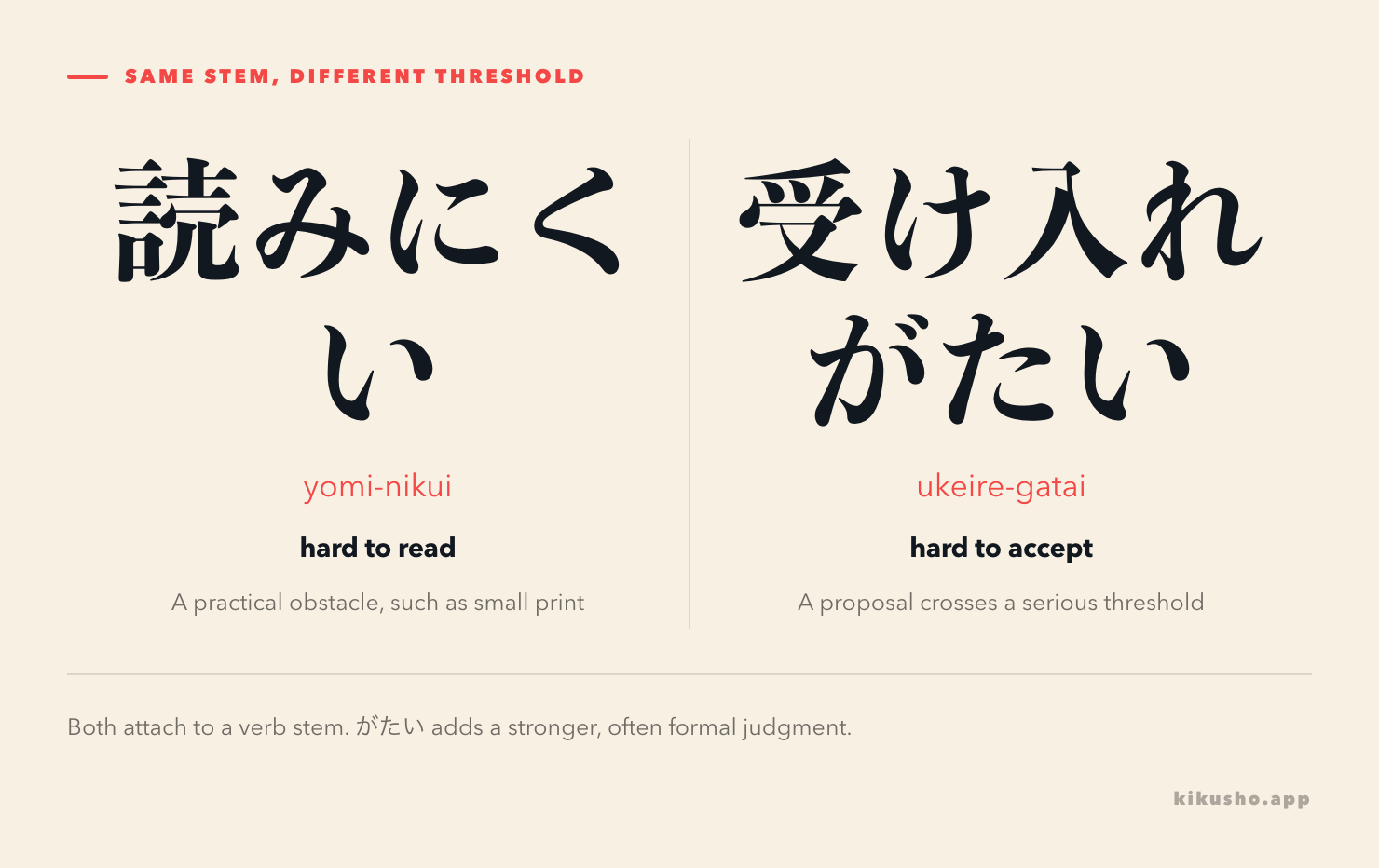
A label printed in tiny letters is 読みにくい, hard to read. A betrayal that feels beyond forgiveness is 許しがたい, almost impossible to forgive. がたい does more than report an inconvenient obstacle: it gives the action a high threshold and often carries a serious evaluation.
Attach it to a verb's ます-stem. The reliable decision test is: Is the action merely troublesome, or does it feel close to impossible to believe, accept, forgive, endure or give up? Use にくい for the first and consider がたい for the second.
Build がたい from the verb stem
Remove ます from the polite form and add がたい:
| Dictionary form | ます-form | Stem | With がたい |
|---|---|---|---|
| 信じる | 信じます | 信じ | 信じがたい |
| 許す | 許します | 許し | 許しがたい |
| 受け入れる | 受け入れます | 受け入れ | 受け入れがたい |
| する | します | し | しがたい |
JLPT Sensei gives the same stem attachment and places the form at N3. Bunpro's がたい entry independently records it as an N3 suffix and notes that hiragana is usual in this function.
The completed form behaves like an い-adjective. It can modify a noun or change for tense, negation and connection:
| Job | Shape | Example |
|---|---|---|
| statement | ~がたい | 信じがたい。 |
| before a noun | ~がたい + noun | 信じがたい話 |
| past | ~がたかった | 受け入れがたかった。 |
| adverbial link | ~がたく | 許しがたく感じた。 |
| negative | ~がたくない | 理解しがたくない。 |
The negative is grammatically possible, but it often sounds less direct than saying the action is understandable or possible. Learn the affirmative combinations first; they account for the clearest and most frequent uses.
がたい evaluates a high barrier
The suffix descends from 難い and marks the action's realization as difficult. Shogakukan's Digital Daijisen entry reproduced by Kotobank defines the suffix as attaching to a verb's continuative form and making that action difficult to realize. The same entry records examples such as 得がたい and 信じがたい.
In modern use, がたい is especially natural with judgments and inner operations. The speaker may struggle to accept a proposal, believe an account, forgive conduct or abandon an attractive option.
調査結果には、信じがたい数字が並んでいた。
ちょうさけっかには、しんじがたいすうじがならんでいた。
The survey results contained figures that were hard to believe.
弱い立場の人をだます行為は、許しがたい。
よわいたちばのひとをだますこういは、ゆるしがたい。
Deceiving people in a vulnerable position is unforgivable.
安全性の説明がないままでは、その提案は受け入れがたい。
あんぜんせいのせつめいがないままでは、そのていあんはうけいれがたい。
Without an explanation of its safety, that proposal is difficult to accept.
These sentences do not merely say that the action takes effort. They evaluate the content or conduct as crossing a serious threshold. English therefore often uses “unbelievable,” “unforgivable” or “unacceptable” rather than the flat phrase “difficult to.”
Frequent partnerships carry established judgments
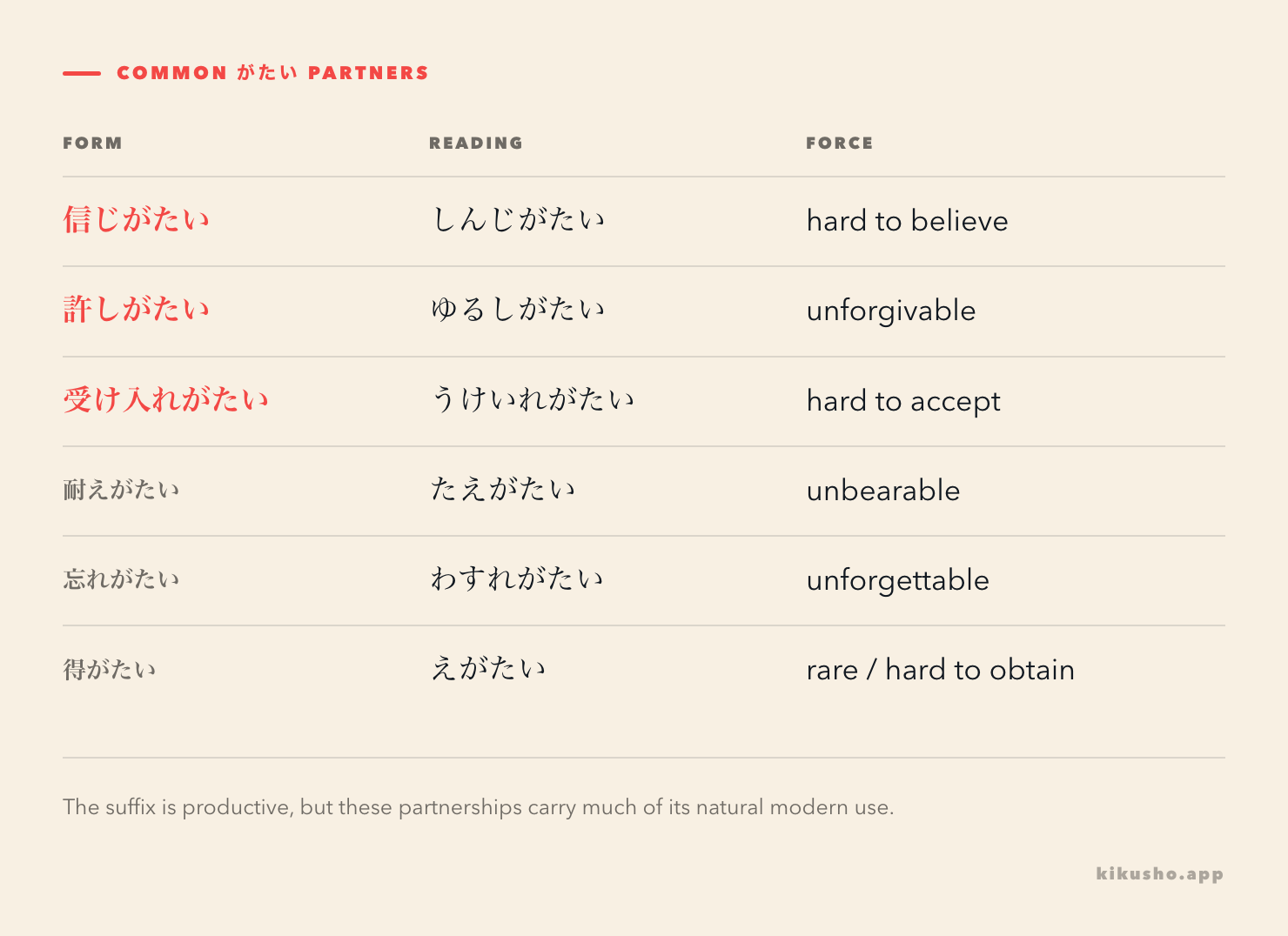
がたい is productive, but it does not combine equally freely with every verb. A compact group of partnerships does much of the work:
| Form | Reading | Typical force |
|---|---|---|
| 信じがたい | しんじがたい | hard to believe |
| 許しがたい | ゆるしがたい | unforgivable |
| 受け入れがたい | うけいれがたい | hard to accept |
| 理解しがたい | りかいしがたい | hard to understand or comprehend |
| 耐えがたい | たえがたい | unbearable |
| 忘れがたい | わすれがたい | impossible to forget |
| 捨てがたい | すてがたい | too valuable or attractive to discard |
| 得がたい | えがたい | difficult to obtain; rare and valuable |
Two of these reveal why a word-for-word “cannot” translation is insufficient:
今回の経験は、忘れがたい思い出になった。
こんかいのけいけんは、わすれがたいおもいでになった。
This experience became an unforgettable memory.
どちらの案にも利点があり、一方を捨てがたい。
どちらのあんにもりてんがあり、いっぽうをすてがたい。
Both proposals have advantages, so it is hard to discard either one.
忘れがたい can be positive or negative; it says the memory resists being forgotten. 捨てがたい can express reluctance because the option still has value. Neither requires moral condemnation.
にくい covers practical friction
Both suffixes attach to the same stem, but their range and force differ.
この説明書は字が小さくて、読みにくい。
このせつめいしょはじがちいさくて、よみにくい。
This manual has small print and is hard to read.
彼の説明には矛盾が多く、信じがたい。
かれのせつめいにはむじゅんがおおく、しんじがたい。
His explanation contains many contradictions and is hard to believe.
Small print is an ordinary obstacle, so 読みにくい is natural. Multiple contradictions create a much stronger barrier to belief, so 信じがたい fits. Replacing the first with 読みがたい would sound unusually weighty for a layout problem. Replacing the second with 信じにくい is possible, but it softens the judgment toward “not easy to believe.”
The full N4 system of practical difficulty and personal burden appears in やすい, にくい and づらい. Its central contrast remains useful here:
| Form | Best first question |
|---|---|
| にくい | What practical feature makes the action difficult? |
| づらい | What physical, emotional or social burden does the person feel? |
| がたい | Why is the action close to impossible or strongly rejected? |
The boundaries can overlap because a difficult situation may be both uncomfortable and nearly impossible. Choose the suffix that matches the judgment you want the sentence to make.
がたい is formal enough to sound deliberate
You can hear common forms such as 信じがたい in conversation, but がたい is at home in writing, news commentary, formal evaluations and deliberate speech. It is stronger and less casual than routine にくい.
現時点では、景気が完全に回復したとは言いがたい。
げんじてんでは、けいきがかんぜんにかいふくしたとはいいがたい。
At present, it is difficult to say that the economy has fully recovered.
~とは言いがたい is a useful cautious assessment. The writer does not assert the opposite; they say that the available evidence does not justify the stated conclusion. That restraint suits reports and analytical prose.
Do not turn this register tendency into a ban on feelings or third-person subjects. Published explanations disagree on narrow restrictions, and ordinary attested combinations include 許しがたい行為, 受け入れがたい要求 and 近寄りがたい雰囲気. A safer rule is semantic: the verb and context must support an unusually high barrier, a strong evaluation or an established がたい partnership.
The kanji spelling 難い is possible, but the suffix is often written がたい. A different construction, に難くない, reads 難く as かたく and means that imagining or inferring something is not difficult. Keep the two patterns separate.
When saving an example in Kikusho, retain the noun or clause that supplies the judgment. 受け入れがたい alone does not tell you whether the barrier is ethical, evidential or practical. Save 安全性の説明がないままでは、その提案は受け入れがたい, then edit the nuance field to record “strong rejection, formal evaluation.”
Practice: find the strength behind the difficulty
Answer all seven questions before opening the single explanation section below.
Question 1 — attachment. Complete “unforgivable conduct”: __行為.
- ア. 許すがたい
- イ. 許しがたい
- ウ. 許してがたい
- エ. 許しにがたい
Question 2 — choice by cause. The type on a medicine label is too small. Complete 字が小さくて、__.
- ア. 読みにくい
- イ. 読みがたい
- ウ. 忘れがたい
- エ. 得がたい
Question 3 — meaning in context. In 証拠と矛盾していて、その説明は信じがたい, is the explanation merely inconvenient to read, or does the evidence create a serious barrier to belief?
Question 4 — sentence composition. Arrange these chunks into a cautious report. Use each once.
- 現時点では
- 回復したとは
- 言いがたい
- 景気が完全に
Question 5 — adjective form. Choose the natural past form of 受け入れがたい.
- ア. 受け入れがたいだった
- イ. 受け入れがたかった
- ウ. 受け入れがたいでした
- エ. 受け入れがたくた
Question 6 — collocation. A rare opportunity is valuable because it is difficult to obtain. Which phrase fits __機会?
- ア. 得がたい
- イ. 読みがたい
- ウ. 許しがたい
- エ. 言いにくい
Question 7 — connected passage. Select the pair that preserves the shift from layout friction to disbelief.
この報告書は専門用語が多く、初めて読む人には( )。しかし、示された数字は過去の記録と大きく矛盾しており、単なる説明不足では( )。
- ア. 読みがたい/許しにくい
- イ. 読みにくい/信じがたい
- ウ. 信じがたい/読みにくい
- エ. 読みづらかった/忘れがたい
Answers and explanations
Answer 1. イ, 許しがたい. Remove ます from 許します to obtain 許し, then add がたい. The resulting phrase gives the conduct an “unforgivable” evaluation. The other options attach the suffix to the wrong verb form or insert an extra particle.
Answer 2. ア, 読みにくい. Small type creates a routine practical obstacle. がたい would make the reading difficulty sound much weightier than this layout problem, while 忘れがたい and 得がたい modify different actions.
Answer 3. The evidence creates a serious barrier to belief. 信じがたい evaluates the claim as almost impossible to accept as true because it conflicts with the evidence. It says nothing about typography or reading comfort.
Answer 4. 現時点では、景気が完全に回復したとは言いがたい. The quoted proposition ends in とは, and 言いがたい makes the writer cautious about asserting it. The sentence does not state that recovery is impossible.
Answer 5. イ, 受け入れがたかった. A がたい form behaves like an い-adjective, so the past replaces final い with かった. It does not take だった or でした directly.
Answer 6. ア, 得がたい機会. 得がたい describes something difficult to obtain and therefore often rare or valuable. The other choices refer to reading, forgiveness or ordinary difficulty in saying something.
Answer 7. イ, 読みにくい/信じがたい. Dense terminology creates ordinary reading friction, which calls for にくい. Numbers that contradict the historical record create a much higher barrier to belief, which calls for がたい.
Why がたい belongs in the N3 sequence
JLPT Sensei and Bunpro both place がたい at N3, and the Kikusho inventory records no level disagreement for the assigned row. Kotobank verifies the stem attachment and meaning without assigning an exam level.
These labels are study estimates. The JLPT FAQ explains why the test does not supply an exhaustive current grammar list. The concrete skill is to form the suffix correctly, recognize its strong and often formal evaluation, and avoid using it for every minor inconvenience.
OpenAI Codex completed an AI language and curriculum review of the attachment, inflection, register, examples, translations, distractors and seven answer mappings. No human language review is claimed.
Common questions
What does がたい mean in Japanese grammar?
Attach がたい to a verb's ます-stem to describe an action as extremely difficult or close to impossible. It is common in evaluations such as 信じがたい, 許しがたい and 受け入れがたい.
What is the difference between がたい and にくい?
にくい covers ordinary practical difficulty, such as text being hard to read. がたい is stronger and often evaluates something as almost beyond belief, acceptance, forgiveness or endurance; it also sounds more formal.
How does がたい attach to a verb?
Remove ます from the polite verb and add がたい: 信じます becomes 信じがたい, 許します becomes 許しがたい, and する becomes しがたい. The result inflects like an い-adjective.
Is がたい written in kanji?
難い is possible, but がたい is commonly written in hiragana as a suffix. Do not confuse it with に難くない, where 難く is read かたく.