On this page
Attach やすい, にくい or づらい to a verb's ます-stem. Choose やすい for ease or a likely tendency, にくい for general difficulty or resistance, and づらい when the action feels physically, emotionally or socially hard for the person doing it.
The cause of difficulty decides between にくい and づらい
Imagine a restaurant menu in tiny print. このメニューは読みにくい says the menu is hard to read, perhaps because of its layout or lettering. このメニューは読みづらい can describe the same page while drawing attention to the reader's strain or discomfort.
| Form | Main question | Example | Natural reading |
|---|---|---|---|
| V-stem + やすい | Is the action easy, or the result likely? | 読みやすい | easy to read |
| V-stem + にくい | Is the action difficult, or the result resistant? | 読みにくい | hard to read |
| V-stem + づらい | Does doing it burden the person? | 読みづらい | uncomfortable or troublesome to read |
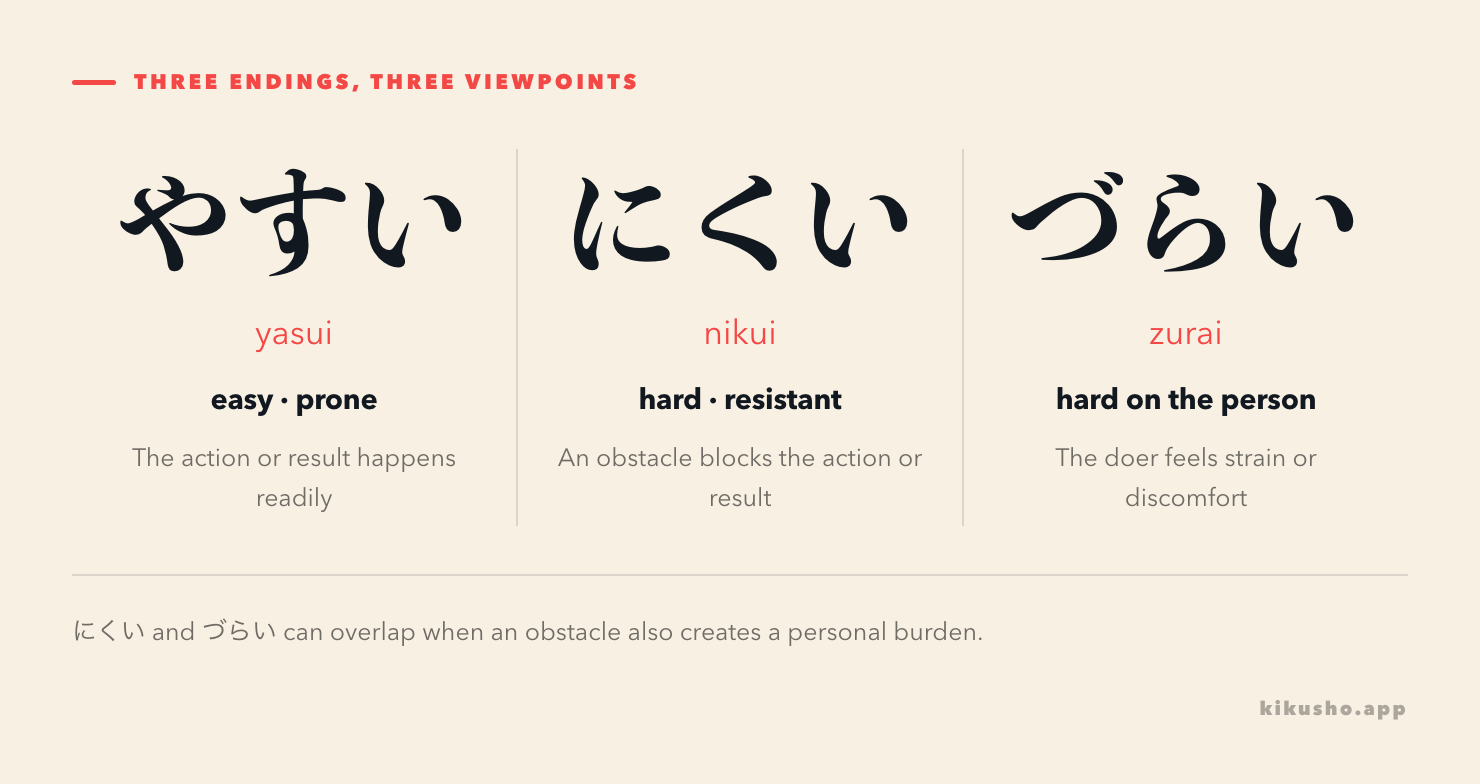
The boundary between the two difficult forms is not a wall. A cramped page creates an objective obstacle and a tiring experience, so either form may fit. The distinction tells you what the speaker chooses to foreground.
Bunpro's にくい entry describes required skill and similar factors, while its づらい entry emphasizes a psychological, emotional or physical burden. Independently, 日本語NET connects づらい with mental or physical strain and warns against using it as a neutral tendency marker.
All three attach to the ます-stem
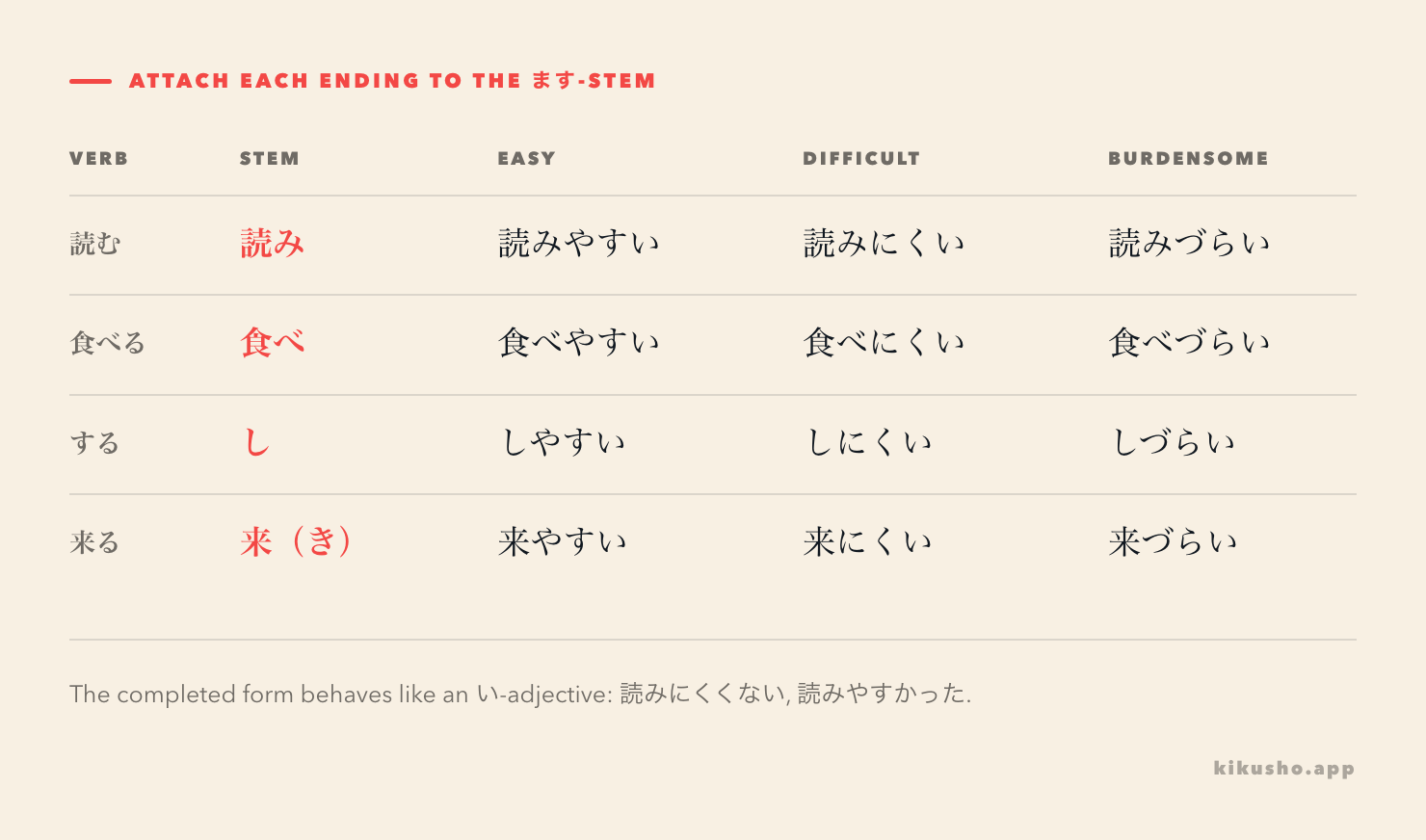
Start with the polite form, remove ます, and add the ending:
| Dictionary form | ます-form | Stem | With the three endings |
|---|---|---|---|
| 読む | 読みます | 読み | 読みやすい・読みにくい・読みづらい |
| 食べる | 食べます | 食べ | 食べやすい・食べにくい・食べづらい |
| する | します | し | しやすい・しにくい・しづらい |
| 来る | 来ます | 来(き) | 来やすい・来にくい・来づらい |
この説明は短くて、分かりやすいです。
この せつめいは みじかくて、わかりやすいです。
This explanation is short and easy to understand.
Do not attach the endings to the dictionary form: 読みやすい, not 読むやすい. The same rule applies to compounds with する, so “easy to organize” is 整理しやすい, not 整理するやすい.
These completed forms behave like い-adjectives. You can negate them, put them in the past, join them with くて, or place them before a noun.
| Job | やすい example | にくい example | づらい example |
|---|---|---|---|
| negative | 使いやすくない | 使いにくくない | 使いづらくない |
| past | 使いやすかった | 使いにくかった | 使いづらかった |
| before a noun | 使いやすい道具 | 使いにくい道具 | 使いづらい道具 |
Polite speech adds です after the adjective: 使いにくいです. Because the ending is already an い-adjective, 使いにくいだ is not the standard plain form.
The Japan Foundation's grammar explanation independently confirms the ます-stem attachment, the two uses of にくい, and its い-adjective inflection. Its companion pattern is やすい.
やすい covers both easy action and likely change
With an intentional action, やすい evaluates how readily someone can perform it:
このペンは軽くて、書きやすいです。
この ペンは かるくて、かきやすいです。
This pen is light and easy to write with.
With a change or event, it often means “prone to” or “likely to”:
このコップは薄いので、割れやすいです。
この コップは うすいので、われやすいです。
This cup is thin, so it breaks easily.
No person is trying to break the cup. 割れやすい describes a property that makes the result occur readily. The same pattern appears in 忘れやすい “easy to forget,” 汚れやすい “prone to getting dirty,” and 疲れやすい “gets tired easily.” JLPT Sensei and Bunpro both list ease and tendency under the same N4 form.
The kanji 安い means “cheap.” Although 易い exists for the easy-to-do suffix, learner-facing Japanese usually writes the suffix in hiragana. 読みやすい cannot mean “cheap to read.”
にくい is the broad opposite of やすい
For an intentional action, にくい marks a practical obstacle:
この瓶はふたが固くて、開けにくいです。
この びんは ふたが かたくて、あけにくいです。
This jar's lid is tight, so it is hard to open.
For an event or change, it can mark resistance:
この素材は水にぬれても、壊れにくいです。
この そざいは みずに ぬれても、こわれにくいです。
This material does not break easily even when it gets wet.
Here 壊れにくい is the clean opposite of 壊れやすい. It describes a tendency of the material, not anyone's feelings. That makes にくい useful for durability, visibility, pronunciation, memory and many other kinds of friction.
難しい makes the action itself the subject of an evaluation: この漢字を覚えるのは難しい means “Memorizing this kanji is difficult.” この漢字は覚えにくい packages the same obstacle as a property of the kanji. Both can be correct, but their sentence designs differ.
づらい brings the doer's burden into the sentence
Use づらい when the difficult action is awkward, painful, embarrassing or emotionally heavy for the person who must do it.
みんなの前では、この失敗について話しづらいです。
みんなの まえでは、この しっぱいについて はなしづらいです。
It is hard for me to talk about this mistake in front of everyone.
足が痛くて、この階段は上りづらいです。
あしが いたくて、この かいだんは のぼりづらいです。
My leg hurts, so these stairs are hard to climb.
The first burden is social and emotional; the second is physical. 話しにくい and 上りにくい would still be possible if you wanted a broader description of difficulty. Choosing づらい lets the listener feel the obstacle from the participant's side.
That participant-centered meaning also sets a limit. このガラスは割れづらい is a poor neutral choice for “this glass resists breaking,” because glass does not experience the action as a burden. Use 割れにくい. With a human action such as 言う, 歩く or 答える, both difficult forms can overlap naturally.
The spelling is づらい, with づ. It comes from 辛い(つらい), “painful” or “tough,” whose initial sound becomes voiced after the verb stem. The form is standard contemporary Japanese; its nuance does not make it rude.
N4 is a study placement, not an official exhaustive list
The three assigned forms are placed at N4 in Kikusho's September 2026 reference inventory. JLPT Sensei and Bunpro label each of them N4. However, the checked 日本語NET page gives the JLPT level for づらい as ? and even titles the page “JLPTに出ない?”
That is a real difference in publisher classification, not a difference in how the form attaches. The JLPT FAQ explains the test's approach, but the organizers do not provide an exhaustive official grammar list. Learn the contrast because it appears in ordinary Japanese; treat “N4” as an editorial estimate.
If you collect one of these forms in Kikusho, keep the cause with it. A card containing ふたが固くて、開けにくい preserves a practical obstacle. みんなの前では話しづらい preserves the social burden that makes づらい the revealing choice. Inspect and edit the card before saving it so that the cue tests the distinction you met.
The ~方 lesson uses the same ます-stem and can reinforce how 読み, 食べ and し are formed. For a different adjective-like suffix, compare すぎる and とても.
Choose the form from the cause
Answer all seven prompts before opening the explanations below.
Question 1: grammar choice. The letters are large and well spaced. Complete この案内は字が大きくて、__です。
- A. 読むやすい
- B. 読みやすい
- C. 読みにくい
- D. 読みづらい
Question 2: tendency. A phone case protects the phone and does not break easily. Which phrase describes that resistance?
- A. 壊れやすい
- B. 壊れづらい
- C. 壊れにくい
- D. 壊すにくい
Question 3: felt burden. You must tell a close friend some painful news and feel emotionally unable to begin. Which ending best foregrounds that burden in この話は言い__。
- A. やすい
- B. づらい
- C. にくかった
- D. やすかった
Question 4: build the sentence. Put the three chunks in order to describe a bag that was easy to carry: 持ち / このかばんは / やすかったです.
Question 5: adjective inflection. Choose the standard negative of 使いにくい.
- A. 使いにくいじゃない
- B. 使いにくくない
- C. 使いにくくありませんだ
- D. 使わないにくい
Question 6: interpretation. What does このシャツは汚れやすい mean here?
- A. This shirt is easy to wash.
- B. This shirt is cheap because it is dirty.
- C. This shirt tends to get dirty.
- D. It is emotionally hard to dirty this shirt.
Question 7: text grammar. Read: 新しい教科書は説明が短くて分かりやすいです。でも、文字が小さいので、目が疲れて読みづらいです。 Which summary is accurate?
- A. The explanations are difficult, but the print is comfortable.
- B. The explanations are easy to understand, but reading the small print strains the reader's eyes.
- C. The textbook resists being opened because it is new.
- D. The reader says the book is cheap and likely to tear.
Answers and explanations
Answer 1. B, 読みやすい. 読み is the ます-stem of 読む, and the large, spaced lettering makes reading easy. A wrongly attaches the suffix to the dictionary form; C and D contradict the stated cause.
Answer 2. C, 壊れにくい. にくい expresses resistance to the change 壊れる. やすい gives the opposite tendency. づらい normally presents a burden on someone performing an action, and 壊すにくい uses the wrong attachment.
Answer 3. B, 言いづらい. The context names a painful social and emotional burden, so づらい foregrounds the speaker's discomfort. 言いにくい could express general difficulty, but it is absent here; the past choices also conflict with the present situation.
Answer 4. このかばんは持ちやすかったです。 持ち is the ます-stem of 持つ. The completed い-adjective changes やすい to やすかった for the past and adds です for politeness.
Answer 5. B, 使いにくくない. The completed form conjugates as an い-adjective, so replace final い with くない. It does not take じゃない, and the negative does not go inside the verb stem.
Answer 6. C. Here やすい marks a tendency: the shirt readily becomes dirty. It says nothing about price, washing or an emotional burden.
Answer 7. B. 分かりやすい evaluates the concise explanations as easy to understand. 目が疲れて読みづらい then presents small print as a tiring experience for the reader, which motivates づらい rather than a neutral durability statement.
When にくい and づらい both seem possible, name the cause. A resistant object points toward にくい; a person carrying pain, embarrassment or strain gives づらい its work.
Common questions
What is the difference between にくい and づらい?
にくい is the broad form for an action that is difficult or a result that resists happening. づらい often brings the person's physical, emotional or social discomfort into view. Both can be natural when a difficult action is also unpleasant for the person doing it.
How do やすい, にくい and づらい attach to a verb?
Use the verb's ます-stem: 読みます becomes 読みやすい, 読みにくい or 読みづらい. For する, use し, as in 理解しやすい. The resulting form behaves like an い-adjective.
Can やすい and にくい describe a tendency?
Yes. With verbs such as 壊れる, やすい can mean prone to a result and にくい can mean resistant to it: 壊れやすい means prone to breaking, while 壊れにくい means not easily broken.
Is it づらい or ずらい?
The standard spelling is づらい. It comes from 辛い, read つらい here; voicing changes the initial つ to づ when the element follows a verb stem.