On this page
Aか何か means “A or something like that.” The speaker names A as the anchor but deliberately leaves the alternative open: it might be A, or another relevant thing or action in the same situation.
A is the anchor, not a complete list
Start with a noun:
箱か何かを探しています。
はこか なにかを さがして います。
I'm looking for a box or something.
The speaker has 箱, “a box,” in mind. However, a basket, container or similar object might also solve the problem. 何か does not name a second candidate; it keeps that second slot unspecified.
The basic noun pattern is:
noun + か何か + particle + predicate
The same idea can follow a plain-form verb phrase:
少し休むか何かしたほうがいいですよ。
すこし やすむか なにか した ほうが いいですよ。
You should rest or do something like that.
Here 休む, “rest,” is one suitable action. The listener could instead slow down, sit quietly or do another action that addresses the same problem. The pattern often continues with する because the whole phrase describes doing A or some comparable action.
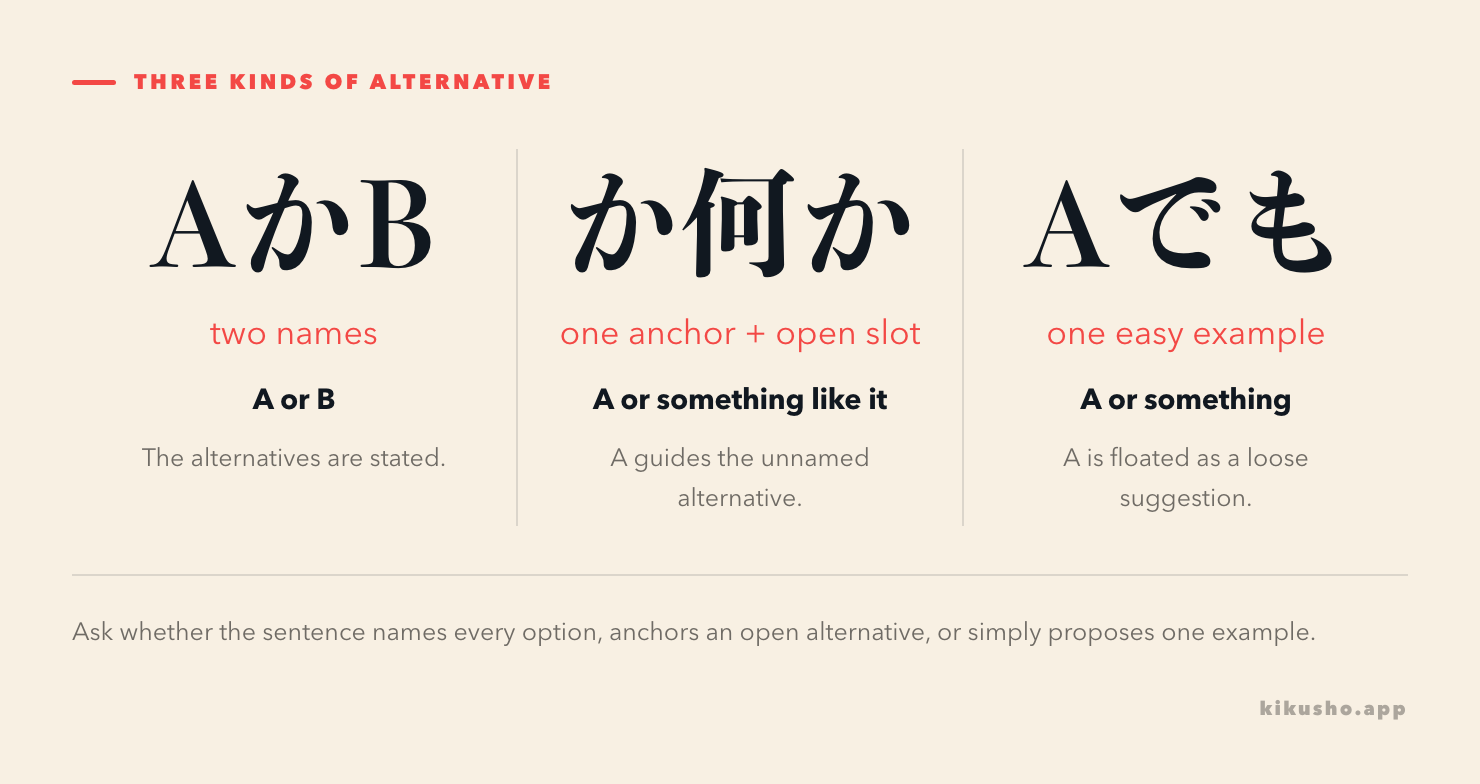
This is why a mechanical translation such as “A or something” is only the beginning. The useful reading question is: what kind of unstated alternative would make sense beside A here? The context supplies that category.
Attach the particle after the whole phrase
Build Aか何か first, then give the complete phrase its role in the larger sentence.
冷たい飲み物か何かを買いましょう。
つめたい のみものか なにかを かいましょう。
Let's buy a cold drink or something.
ペンか何かで名前を書いてください。
ペンか なにかで なまえを かいて ください。
Please write your name with a pen or something.
先生か誰かに聞いてみます。
せんせいか だれかに きいて みます。
I'll try asking the teacher or someone.
In the first sentence, を marks the entire open choice as the thing to buy. In the second, で marks the whole phrase as the instrument. The last sentence uses 誰か, “someone,” because the missing alternative is a person rather than a thing.
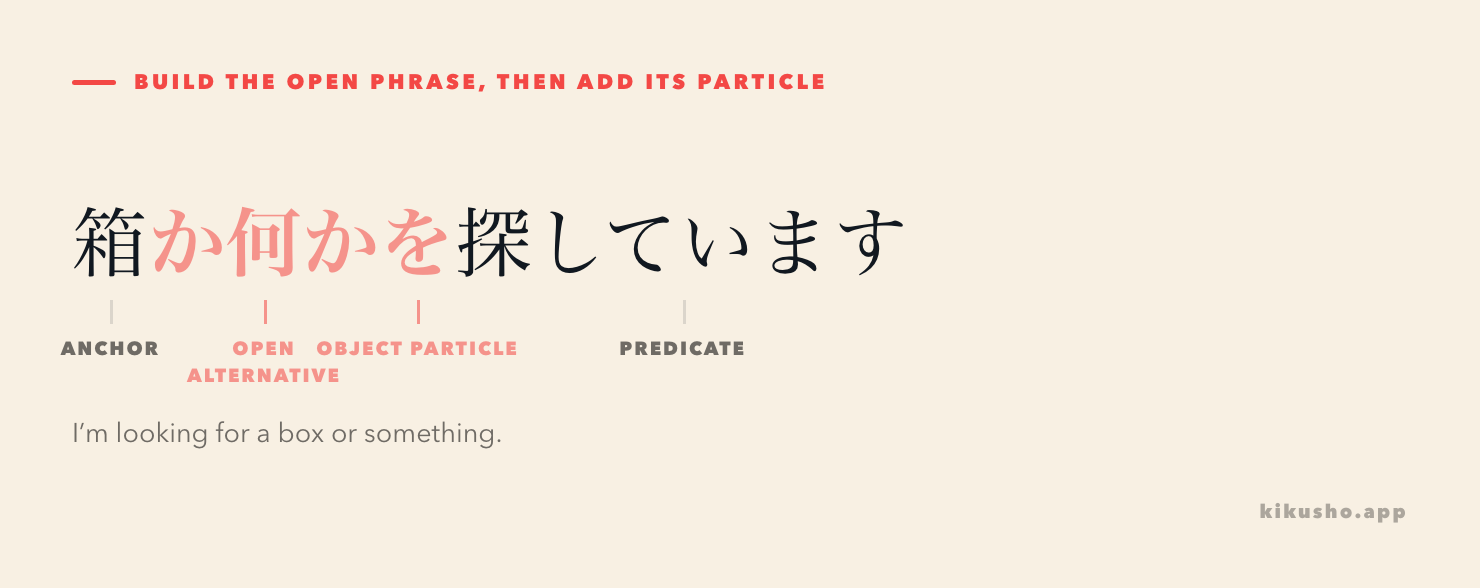
This placement matters in listening. Do not stop parsing at 箱か as if a second named noun must follow. Wait through 何か, then use the following particle to identify the phrase's job.
何か alone does not provide an anchor
Compare these requests:
何か持ってきてください。
なにか もって きて ください。
Please bring something.
タオルか何かを持ってきてください。
タオルか なにかを もって きて ください。
Please bring a towel or something like that.
Bare 何か says only that the thing is unknown or unspecified. タオルか何か gives the listener a direction: a towel is the model, although another useful item may be acceptable.
That anchor can also express uncertainty about what something actually was:
外で猫か何かが鳴いています。
そとで ねこか なにかが ないて います。
A cat or something is making a sound outside.
The speaker suspects a cat but does not claim certainty. In a suggestion, the anchor guides the next action; in a description, it guides the listener toward the speaker's best guess.
Do not confuse open, closed and binary alternatives
Four patterns can look similar in translation, but they answer different questions.
| Pattern | What remains open | Example |
|---|---|---|
| AかB | the choice between two named alternatives | 電車かバスで行く |
| Aか何か | an alternative related to named anchor A | 電車か何かで行く |
| 何か | the identity of the thing, with no named anchor | 何かで行く |
| clause + かどうか | whether the proposition is true | 電車で行くかどうか決める |
電車かバス names both relevant transport options. 電車か何か points first to the train, then leaves another plausible method unnamed. 何かで says only “by some means.” 電車で行くかどうか packages the yes-or-no question “whether to go by train” inside a larger sentence.
The lesson on かどうか develops that last construction. Do not insert 何か when you mean “whether or not”: 来るか何か分かりません does not replace 来るかどうか分かりません.
か何か and でも can overlap in suggestions
Both forms may produce English “or something,” but the speaker organizes the choice differently.
お茶か何かを飲みますか。
おちゃか なにかを のみますか。
Will you have tea or something?
お茶でも飲みませんか。
おちゃでも のみませんか。
Would you like to have tea or something?
With お茶か何か, tea is the named candidate and the identity of the drink remains open. With お茶でも, tea is floated as one convenient example in a relaxed proposal. The second sentence especially invites the shared activity of having a drink.
These are tendencies, not translations that force different real-world answers. Context and intonation can make the invitations very close. The practical distinction is that か何か explicitly builds “A or an unspecified alternative,” while noun + でも selects A as one easy example. The comparison of でも, または, とか and など places that suggestion use beside other kinds of alternatives.
かなんか is conversational
In casual speech, you may hear かなんか:
映画かなんか見ない?
えいがか なんか みない?
Want to watch a film or something?
This can function as the conversational counterpart of 映画か何か. It keeps the film as the anchor while making the suggestion sound loose. Use か何か in careful writing and when you want the structure to remain transparent.
Do not assume every なんか is this contraction. 私なんかには無理です, “It's impossible for someone like me,” downplays 私, and sentence-opening なんか can introduce a vague impression. The comparison of とか, なんて, なんか and など separates those uses. The sequence Aかなんか and the surrounding predicate are what support the open-alternative reading here.
Use vagueness where the listener can recover the category
か何か is useful when precision is unnecessary, unavailable or deliberately softened. A friend can say 週末、散歩に行くか何かしよう, “This weekend, let's go for a walk or do something.” The shared situation makes “some similar activity” easy to recover.
In a rule, contract or safety instruction, the missing alternative may matter. 身分証明書か何かを見せてください sounds vague if only specific documents are accepted. Name the accepted items or category instead. Conversational openness should not replace information the reader needs to act correctly.
JLPT Sensei's か何か page, Mainichi Nonbiri's teacher reference, Meshclass and Shigure no Machi place the pattern at N3 and show noun and plain-form verb attachments. Bunpro's reference labels it N2 while teaching the same core open-alternative meaning and the casual かなんか form. The level disagreement is normal for third-party study lists: the official JLPT FAQ explains that an exhaustive current vocabulary, kanji and grammar specification is not published.
Kikusho works best when the full anchor survives the capture. Save タオルか何かを持ってきて rather than reducing the card to 何か = something. Keep the particle too: it shows that タオルか何か forms one object phrase. A short note such as “towel is the anchor; another useful item is acceptable” turns the vagueness into a decision you can recall.
Practice: keep every alternative visible
Question 1 — grammar choice. You need a writing tool but do not insist on a pen: ペン__で書いてください。
① かどうか
② か何か
③ しか
④ ほど
Question 2 — interpretation. In 外で猫か何かが鳴いています, is the speaker certain that the animal is a cat? What does 猫 contribute?
Question 3 — particle placement. Complete the request with を in the correct place: 冷たい飲み物/か何か/買ってきてください.
Question 4 — sentence composition. Use 休む, か何か, and したほうがいい to tell a tired friend, “You should rest or do something like that.”
Question 5 — contrast. Explain the difference between お茶か何かを飲みますか and お茶でも飲みませんか. Which one more clearly floats tea as an easy social suggestion?
Question 6 — correction. A learner wants to say “I don't know whether Mika will come” and writes ミカさんが来るか何か分かりません. Replace the incorrect part and explain why.
Question 7 — text grammar. Read the exchange:
A: 会議の前に何を準備すればいい?
B: 資料か何かを印刷しておいて。
What does B's answer imply?
North. Only printed materials called 資料 are acceptable.
East. 資料 is the anchor, but another useful meeting document or similar item may work.
South. B does not know whether printing happened.
West. B is choosing between 資料 and one specific unnamed object.
Answers and explanations
Answer 1: ②, か何か. ペンか何かで means “with a pen or something.” ペン is the anchor, 何か leaves a relevant alternative open, and で marks the whole phrase as the writing instrument.
Answer 2: The speaker is not certain. 猫 gives a best guess and establishes the kind of source the speaker imagines; か何か allows another animal or sound-producing thing instead.
Answer 3: 冷たい飲み物か何かを買ってきてください。 Build 冷たい飲み物か何か as one open choice, then put を after it because the entire phrase is the object of 買ってくる.
Answer 4: 少し休むか何かしたほうがいいですよ。 The plain-form verb 休む provides the action anchor. か何かする leaves room for another action that helps the tired friend.
Answer 5: お茶か何か explicitly presents tea or another relevant drink. お茶でも offers tea as one easy example and is especially natural for proposing the shared activity, so the second sentence more clearly has the loose social-suggestion effect.
Answer 6: Use ミカさんが来るかどうか分かりません. The unknown issue is the truth of the proposition “Mika will come,” so かどうか means “whether or not.” か何か would ask the listener to imagine an alternative like Mika's coming, which is not the intended binary question.
Answer 7: East. 資料か何か names meeting materials as the useful anchor without creating a strict two-item list. The other item is unspecified and recoverable from the preparation context. West is wrong because 何か does not hide one fixed second object; it leaves the relevant alternative open.
Common questions
What does か何か mean in Japanese?
Aか何か means “A or something like that.” The speaker names A as a useful anchor but leaves room for another relevant item or action instead of listing every alternative.
Where does the particle go after Aか何か?
Put the particle after the complete Aか何か phrase: 箱か何かを探す, “look for a box or something,” and ペンか何かで書く, “write with a pen or something.” The particle marks the role of the whole open alternative.
How is Aか何か different from Aでも?
Aか何か presents A as a likely category or identity while leaving it uncertain. Aでも offers A as one convenient example, especially in a suggestion. The translations can overlap, so read the speaker's purpose.
Is かなんか the same as か何か?
かなんか is a casual spoken form that can replace か何か in many open- alternative phrases. Because なんか has other uses, including tentative suggestions and dismissive evaluations, use the full sentence to identify the meaning.