On this page
A cat described as 庭を横切った crossed the garden; 部屋から飛び出した says it rushed out of a room. These Japanese compound verbs, together with 申し込む, show how familiar parts can help you recognise a word while its complete form determines the reading, meaning and conjugation.
This N3 vocabulary set contains three verbs: 飛び出す・申し込む・横切る. It builds on how compound verbs conjugate, rather than repeating that earlier set. Here the work is to distinguish outward movement, making an application, and crossing a space.
Three compounds, three situations
| Headword | Reading | Part of speech | Sense practised here | Useful phrase |
|---|---|---|---|---|
| 飛び出す | とびだす | Godan verb, ending in す | Rush or jump out | 部屋から飛び出す: rush out of a room |
| 申し込む | もうしこむ | Godan verb, ending in む | Apply or sign up | 講座に申し込む: sign up for a course |
| 横切る | よこぎる | Godan verb, ending in る | Cross or traverse | 道を横切る: cross a road |
These are selected everyday senses, not exhaustive dictionary entries. Shogakukan's entries verify the readings and the outward-motion sense of 飛び出す, the application sense of 申し込む, and the crossing sense of 横切る.
The level boundary needs a qualification. Meshclass labels 飛び出す N3, and JapaneseTest4You labels 横切る N3. For 申し込む, the JapaneseTest4You N3 list agrees with this curriculum's reference inventory, but Meshclass places it at N4. Treat it as useful earlier vocabulary being consolidated here. Study lists are estimates, not an official exhaustive JLPT syllabus.
The last verb carries the changing ending
In 飛び出す, 飛ぶ supplies 飛び, the stem used before ます. 出す supplies the final ending. In 申し込む, the first element is 申し, from 申す, and the ending belongs to 込む. You do not attach ます to both parts.
横切る has a different first element: 横, a noun referring to the side or horizontal direction. Its second element is pronounced ぎる in this word. It is a compound, but it is not an example of two verb stems joined together.
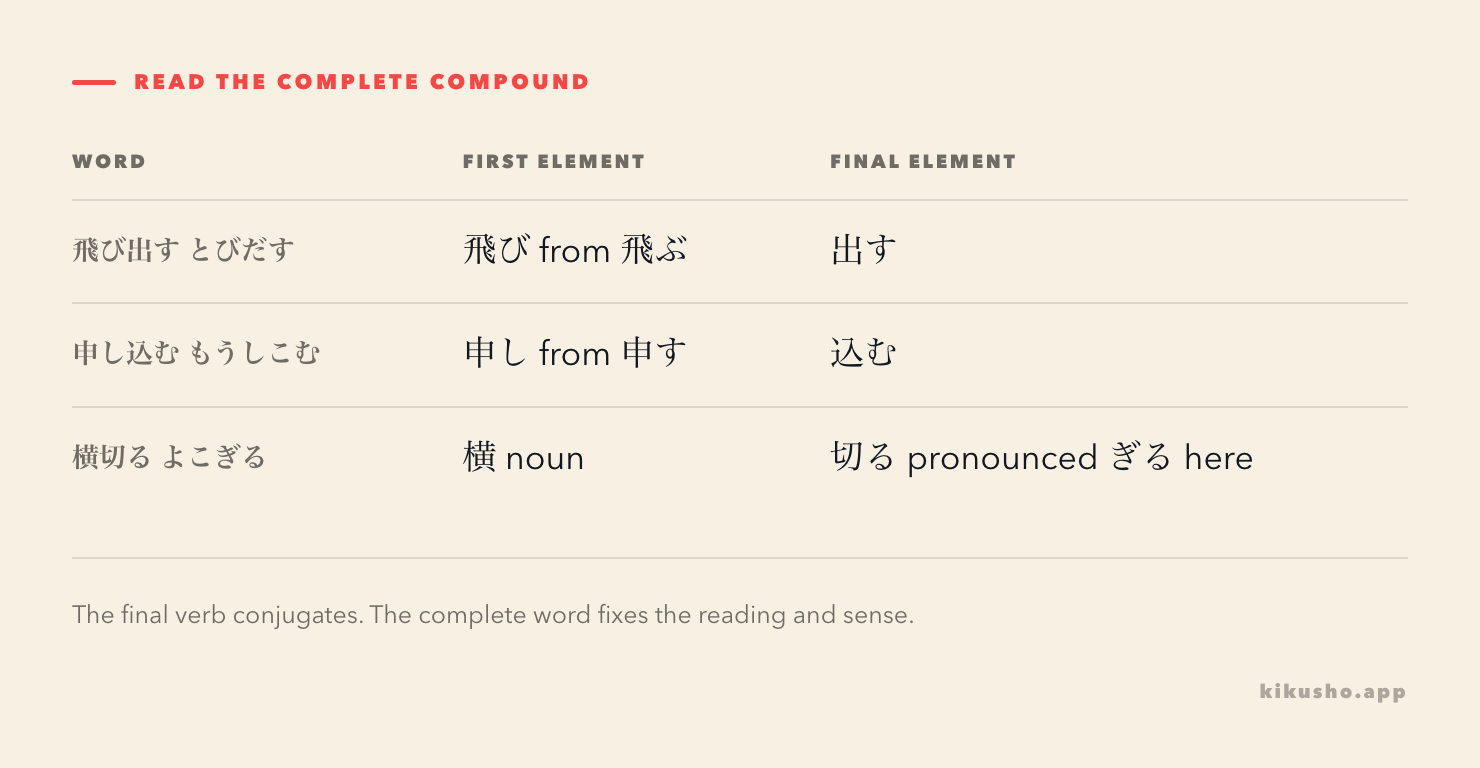
All three are godan verbs. 横切る remains godan despite its る ending. If the basic changes are unfamiliar, start with verb groups and the ます form.
| Dictionary form | Polite form | Plain negative | Plain past | て form |
|---|---|---|---|---|
| 飛び出す | 飛び出します | 飛び出さない | 飛び出した | 飛び出して |
| 申し込む | 申し込みます | 申し込まない | 申し込んだ | 申し込んで |
| 横切る | 横切ります | 横切らない | 横切った | 横切って |
Watch the whole ending: す → した, む → んだ, る → った. Keeping the first element fixed gives you these forms without inventing a separate conjugation for compounds.
出す, 込む and 切る cannot each give you one meaning
The elements are clues, but these three words resist a mechanical translation.
飛び出す often describes movement out of somewhere, sometimes abrupt enough to be dangerous:
猫が部屋から飛び出した。
The cat rushed out of the room.
The phrase 部屋から names the source. 出す also occurs in compounds describing a sudden beginning, such as 泣き出す, but that does not make “start flying” the default translation of this sentence.
申し込む means applying or signing up through an appropriate request or procedure:
昨日、日本語の講座に申し込んだ。
Yesterday I signed up for a Japanese course.
Do not translate it as “speak into”. Nor does the presence of 申す mean every ordinary use of 申し込む needs a special humble translation. Tofugu's guide to 込む compounds includes 申し込む among meanings you need to learn as complete words. Applying also does not by itself establish that your application was approved; that distinction connects to 許可 and 承認.
横切る describes crossing from one side to another:
子どもが道を横切った。
A child crossed the road.
The を marks the path traversed. The child is not cutting the road, and 切る does not mean “finish completely” in this word. Learn よこぎる, including the voiced ぎ, alongside that movement.
Keep the phrase that tells you where the action goes
| Phrase | What the particle identifies | What happens |
|---|---|---|
| 部屋から飛び出す | から: source | Someone or something rushes out |
| 講座に申し込む | に: course applied for | Someone signs up |
| 道を横切る | を: traversed path | Someone crosses the road |
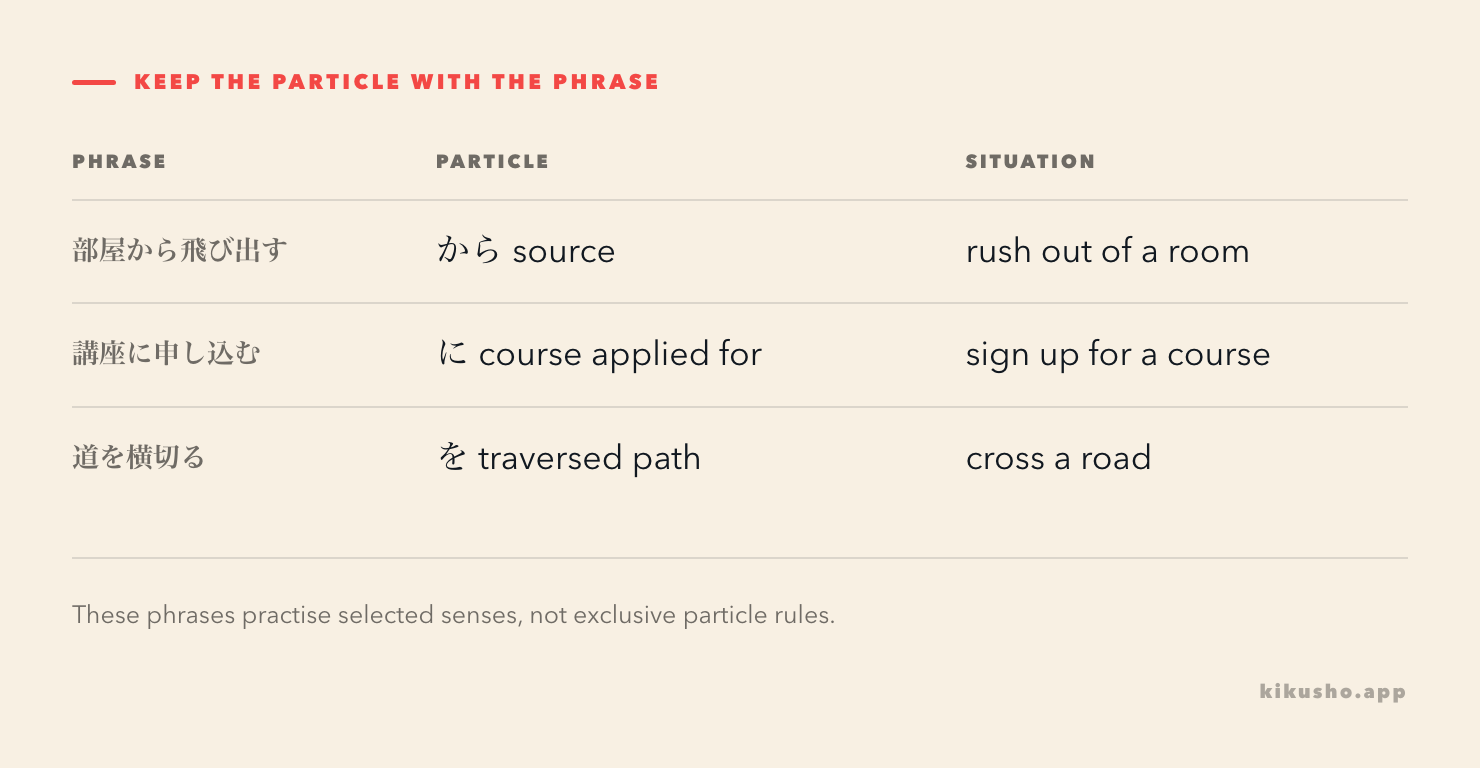
These are useful constructions, not exclusive particle rules for every sense. You can also encounter 家を飛び出す, where を marks the place left, and 予約を申し込む, where を marks the reservation requested. The course sentence above uses に because 講座 is what you are applying to join.
Look for 飛び出す in movement descriptions and warnings, 横切る in descriptions of a route across a space, and 申し込む on course or event registration pages. A registration notice gives you more than an isolated 込む: the surrounding course name tells you what the application is for. In Kikusho, photograph that notice and select 申し込む as a complete word. Check the draft card's reading and meaning against the notice before saving it, so you keep the application sense you encountered instead of a guess assembled from the two elements.
Practice
Choose one option for each item. The solution block follows the entire exercise.
Question 1
A movement caption contains 横切る. Select its reading.
A. よこきる
B. よこぎる
C. おうぎる
D. よぎこる
Question 2
Which spelling gives the verb もうしこむ, “apply or sign up”?
A. 申す込む
B. 申し混む
C. 申込みる
D. 申し込む
Question 3
A dog suddenly rushed out of the room. Complete the description.
犬が部屋から( )。
A. 飛び出した
B. 申し込んだ
C. 横切った
D. 申し込まない
Question 4
You submitted your registration for a Japanese course yesterday. Pick the verb that describes that action.
昨日、日本語の講座に( )。
A. 横切った
B. 飛び出した
C. 申し込んだ
D. 切った
Question 5
What does 猫が庭を横切った tell you?
A. The cat signed up for the garden.
B. The cat cut everything in the garden.
C. The cat began flying.
D. The cat crossed the garden.
Question 6
Fill the particle slot in a sentence about signing up for a course.
来月の講座( )申し込みます。
A. に
B. から
C. まで
D. より
Question 7
Turn 飛び出す into its plain past form.
A. 飛んで出す
B. 飛び出った
C. 飛び出した
D. 飛び出んだ
Question 8
You decided not to apply today. Choose the plain negative form for this sentence.
今日は講座に( )。
A. 申し込むない
B. 申し込まない
C. 申し込みない
D. 申し込めない
Record your eight choices before checking the explanations below.
Answers and explanations
Answer 1. B. 横切る is よこぎる. The second element has ぎ in this complete word; よこきる misses that voiced sound.
Answer 2. D. 申し込む spells もうしこむ. Keep 申し, then 込む. 混む is a different verb meaning to be crowded, and neither 申す込む nor 申込みる is the target word's standard spelling.
Answer 3. A. 飛び出した supplies the outward rush described in the prompt. 部屋から identifies where the dog came out of. 横切った would describe crossing a space, not rushing out of it.
Answer 4. C. 申し込んだ describes the application made yesterday. The む ending gives んだ in the past. The sentence reports registration, without asserting that the course accepted the applicant.
Answer 5. D. 庭を横切った means crossed the garden. The を phrase identifies the traversed area. Reading 切る as physical cutting or as completion loses this word's established sense.
Answer 6. A. 講座に申し込みます uses に for the course you are signing up for. The other choices introduce a source, endpoint or comparison that does not fit the stated application construction.
Answer 7. C. 飛び出した is the past form. The final す conjugates to した while 飛び stays in place. 飛んで出す is a separate sequence, not this compound's past form.
Answer 8. B. 申し込まない is the plain negative of 申し込む: む changes to ま before ない. 申し込めない is a negative potential form, “cannot apply”, which would change the intended decision into inability.
Common questions
Does 出す always mean that an action starts suddenly?
No. That is one productive use, as in 泣き出す, but 飛び出す commonly describes rushing or jumping out. Learn the meaning of the complete word.
Is 横切る read よこきる?
No. The standard reading is よこぎる, with ぎ. It means to cross or traverse something such as a road, and its past form is 横切った.
Why is 申し込む included in an N3 vocabulary lesson?
The reference inventory and JapaneseTest4You place it at N3, while Meshclass teaches it at N4. This lesson keeps the assigned word and makes that disagreement explicit; the basic godan forms are prerequisites.