On this page
Use noun or counter + きり when that person, number or occasion is the complete limit: 二人きり means “just the two of us.” Use Vた + きり when one completed event became the last point and the expected next event has still not happened: 去年会ったきり、連絡がない means “We met last year, and there has been no contact since.”
One boundary creates two related meanings
The core image is a cut line. Nothing is added beyond a stated amount, or nothing expected has happened beyond a past event.
| Form | What stops at the boundary | Example |
|---|---|---|
| number/counter + きり | the quantity | 一度きり: only once |
| selected noun + きり | the included people or occasion | 二人きり: just two people, alone together |
| Vた + きり | later development | 出かけたきり戻らない: left and has not returned |
| これ/それ + きり | anything after this/that point | それきり話していない: have not spoken since then |
The two uses cannot be reduced to one English word. “Only” works for 一度きり, while “since” exposes the time relationship in 一度会ったきり、会っていない.
この舞台に立てる機会は一度きりです。
この ぶたいに たてる きかいは いちどきりです。
I have only one opportunity to stand on this stage.
兄は朝、散歩に出たきり、まだ帰ってきません。
あには あさ、さんぽに でたきり、まだ かえってきません。
My older brother went out for a walk this morning and still has not come back.
Counters and selected nouns set an exact limit
With a counter, きり says that the counted amount is the whole set. Common combinations include 一度きり (only once), 一回きり (one time only), 一人きり (all alone) and 二人きり (just the two people).
面接を受けられるのは一回きりです。
めんせつを うけられるのは いっかいきりです。
You can take the interview only once.
放課後、教室にいたのは私たち二人きりでした。
ほうかご、きょうしつに いたのは わたしたち ふたりきりでした。
After school, it was just the two of us in the classroom.
Here きり does more than report a small number. It closes the set. 二人きり often suggests privacy or being alone together because no third person is included.
The particle can take another particle after the completed phrase:
- 二人きりで話す: talk with just the two people present
- 一度きりの機会: a one-time opportunity
- 今回きりにする: make this the last time
- 一回きりしかない: have only one single chance
The last form is grammatical. きり establishes the exact limit and しか~ない places that limited amount inside a negative frame. It is emphatic rather than an accidental double “only.”
Do not attach きり freely to every noun as a universal replacement for だけ. The counter, person-count and occasion patterns are productive and common, but “only water” is ordinarily 水だけ, not a newly formed 水きり. The broad neutral limiter belongs to the dedicated だけ lesson.
Vたきり makes the first event the last event
The verb before きり appears in the plain past form. That event occurred; after it, an expected return, reply, meeting or change did not occur.
図書館から資料を借りたきり、まだ返していません。
としょかんから しりょうを かりたきり、まだ かえしていません。
I borrowed the materials from the library and still have not returned them.
The borrowing is the cutoff. Returning the materials is the expected later event, and まだ返していません states that the gap remains unresolved.
高校を卒業して町を出たきり、彼には会っていません。
こうこうを そつぎょうして まちを でたきり、かれには あっていません。
Since leaving town after high school, I have not seen him.
The negative continuation is common, but it need not appear as a visible ない immediately after きり. A sentence can end with きりです when context supplies the missing continuation:
あの喫茶店に行ったのは、三年前に一度行ったきりです。
あの きっさてんに いったのは、さんねんまえに いちど いったきりです。
The only time I went to that café was once three years ago.
The frame still implies “and I have not gone again.” MLC Japanese Language School's lesson gives both the explicit negative continuation and sentence-final きりです, and it separates the counter attachment from Vたきり. Mainichi Nonbiri's teacher reference likewise notes that the negative can be omitted when きりだ closes the sentence.
それきり points back to the last contact or event
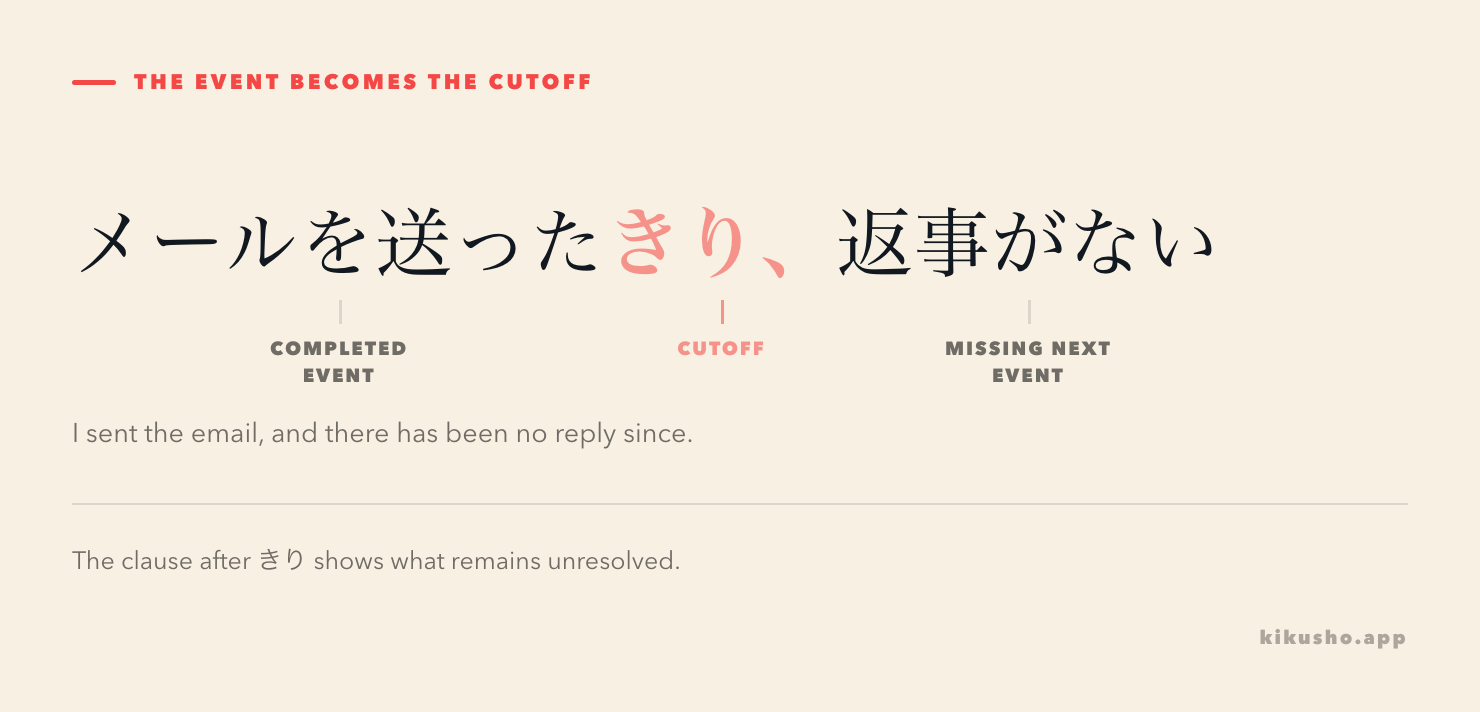
それきり packages an earlier event as the cutoff without repeating its verb.
春に一度メールを送りました。それきり、返事はありません。
はるに いちど メールを おくりました。それきり、へんじは ありません。
I sent an email once in spring. There has been no reply since then.
これきり can instead draw the boundary at the present occasion:
夜更かしはこれきりにします。
よふかしは これきりに します。
I will make this the last time I stay up late.
The surrounding sentence decides whether the natural English is “only this much,” “for the last time” or “nothing after this.” The Japanese demonstrative supplies the point; きり closes what comes beyond it.
A retained state is possible, but do not turn every verb into one
Some Vたきり expressions directly describe the state left by the action.
祖父は手術の後、寝たきりになりました。
そふは しゅじゅつの あと、ねたきりに なりました。
After the operation, my grandfather became bedridden.
寝たきり is a common expression for remaining in bed and can carry serious medical or care implications. Use it with care about a real person. Other verbs may support the same logic when the context clearly supplies a state that has not changed, but learners should not mechanically append きり to any た-form.
This is narrower than まま. 窓を開けたまま寝た simply says the window remained open while someone slept. 出かけたきり戻らない chooses leaving as the last event and highlights the expected return that never came.
| Sentence | Focus |
|---|---|
| ドアを開けたまま話した | the open-door state continued during the conversation |
| 部屋を出たきり戻らない | leaving became the cutoff; no return followed |
まま accepts negative verbs, adjectives and noun + の as well. The N3 きり pattern taught here centers on a counter/noun limit or a past event boundary.
っきり changes the sound, not the core relationship
っきり is the more conversational variant: 二人っきり, 一度っきり and 会ったっきり carry the same central meanings as their きり counterparts. The small っ closes the sound before k; do not write きっり.
Use きり as a neutral default in formal study writing. Recognize っきり in conversation, dialogue and personal narration. Bunpro's きり entry labels the grammar standard and っきり more casual, while confirming the counter, noun, demonstrative and Vた attachments.
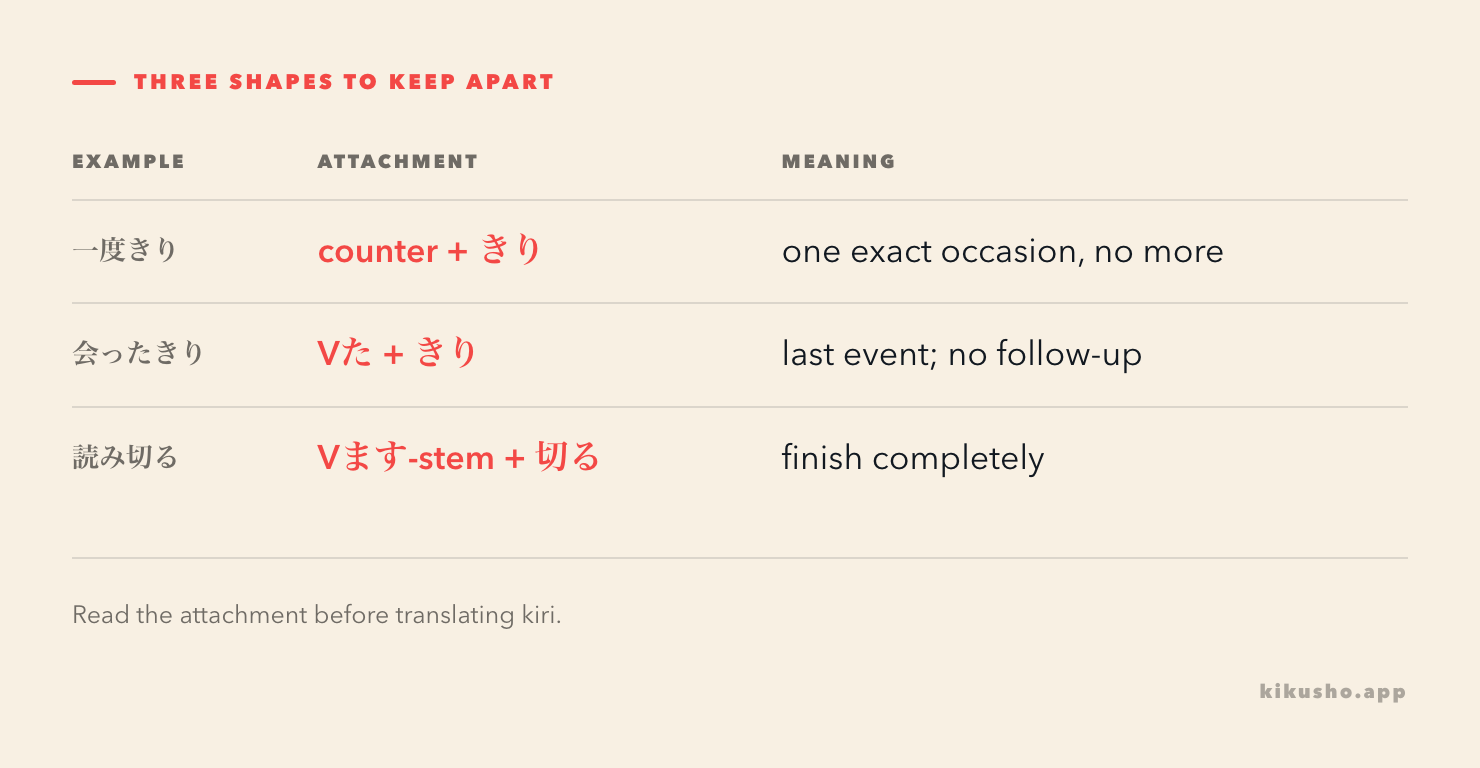
きり is not the verb suffix ~切る
The grammar particle is normally written in hiragana and does not conjugate. The verb suffix ~切る attaches to the ます-stem and means completing something fully or carrying it through.
| Form | Attachment | Meaning |
|---|---|---|
| 一度きり | counter + particle | only once |
| 会ったきり | Vた + particle | since meeting; no later development |
| 読み切る | Vます-stem + 切る | finish reading completely |
長い小説を一晩で読み切りました。
ながい しょうせつを ひとばんで よみきりました。
I finished the long novel in one night.
Because 切る is the second verb, it changes form: 読み切ります, 読み切った, 読み切れない. The ~かける, ~切る and ~切れない lesson covers that completion system. A space in romanization cannot replace the Japanese attachment test.
When you capture きり in Kikusho, preserve both sides of the boundary. A card containing only きり = only loses the reason 出かけたきり戻らない feels unresolved. Keep the counter or past event and the missing later development, then check the editable meaning before saving.
N3 is a study placement
JLPT Sensei, Bunpro, MLC and the curriculum's Tanos comparison all place the relevant きり material at N3. Some Japanese-teacher resources split broader noun and continuative-stem uses into an N2 lesson while retaining Vたきり~ない at N3. This article teaches the single assigned inventory scope through its securely attested counter/noun and Vた patterns; it does not absorb every compound ending in きり.
The official JLPT FAQ explains that the revised test does not publish an exhaustive fixed grammar list. N3 is therefore a useful publisher consensus here, not a guarantee about a particular test form.
Practice: find the closed side of the boundary
Work through all six tasks before opening the explanation block.
Question 1 — attachment choice. Complete “I have not seen her since we spoke last winter”: 去年の冬に話した( )、彼女には会っていません。
- A. きり
- B. きる
- C. だけで
- D. ままで
Question 2 — quantity limit. Which sentence means “It was just the two of us in the room”?
- A. 部屋にいたのは私たち二人をきりでした。
- B. 部屋にいたのは私たち二人きりでした。
- C. 部屋にいたのは私たち二人切りました。
- D. 部屋にいたのは私たち二人のきりでした。
Question 3 — expected continuation. Which event is presented as still missing in 朝、猫が外へ出たきりです?
- A. The cat going outside
- B. The morning beginning
- C. The cat returning
- D. Someone opening a window
Question 4 — sentence composition. Arrange 資料を, 借りた, きり, and まだ返していません to say “I borrowed the materials and still have not returned them.”
Question 5 — choose きり or ~切る. Fill both blanks: この小説を最後まで読み( )のは一度( )です。 The intended meaning is “I have finished this novel all the way through only once.”
- A. きり / 切った
- B. 切った / きり
- C. 切って / きり
- D. 切った / まま
Question 6 — connected text. Read: 春に友達へ手紙を送りました。それきり、返事がありません。会える機会も今年は一度きりです。 Which account is supported?
- A. The friend replied once, and they meet every spring.
- B. No reply followed the spring letter, and there is only one chance to meet this year.
- C. The writer finished reading a letter and cancelled every meeting.
- D. The letter remains physically open, and two meetings are planned.
Answers and explanations
1. A — きり. 話したきり sets last winter's conversation as the cutoff, and 会っていません states the expected later meeting has not happened. ~切る requires a ます-stem and expresses completion.
2. B. The person counter attaches directly: 二人きり. No object particle enters the phrase, and 切りました would be the past polite form of the verb “cut.”
3. C — the cat returning. Going outside is the completed event before きり. Sentence-final きりです leaves the natural continuation implicit: the cat has not come back.
4. 資料を借りたきり、まだ返していません。 The past plain form 借りた comes before きり. The following negative clause identifies returning as the unresolved next event.
5. B — 切った / きり. 読み切った is the past form of the compound verb “finished reading completely.” 一度きり limits that completed experience to one occasion.
6. B. それきり points back to the spring letter and says no reply followed it. 一度きり closes the number of this year's opportunities at one. Neither phrase means a book was read completely or a physical object stayed open.
Common questions
What does きり mean in Japanese grammar?
After a number, counter or certain nouns, きり means only that amount or no more than that. After a verb in the た-form, it marks the last event before an expected return, contact or other development failed to happen.
What form comes before きり?
Use a noun or counter directly, as in 二人きり and 一度きり, or a plain past verb, as in 会ったきり. Demonstratives also form これきり and それきり.
What is the difference between きり and だけ?
だけ is a broad neutral limiter. Counter plus きり emphasizes an exact, often final limit, while Vたきり adds a time cutoff and an unresolved absence of a later event. だけ cannot automatically replace that since-then meaning.
Are きり and っきり different?
They have the same core grammar. っきり is the more conversational variant, while きり is the safer default in neutral written explanations.