On this page
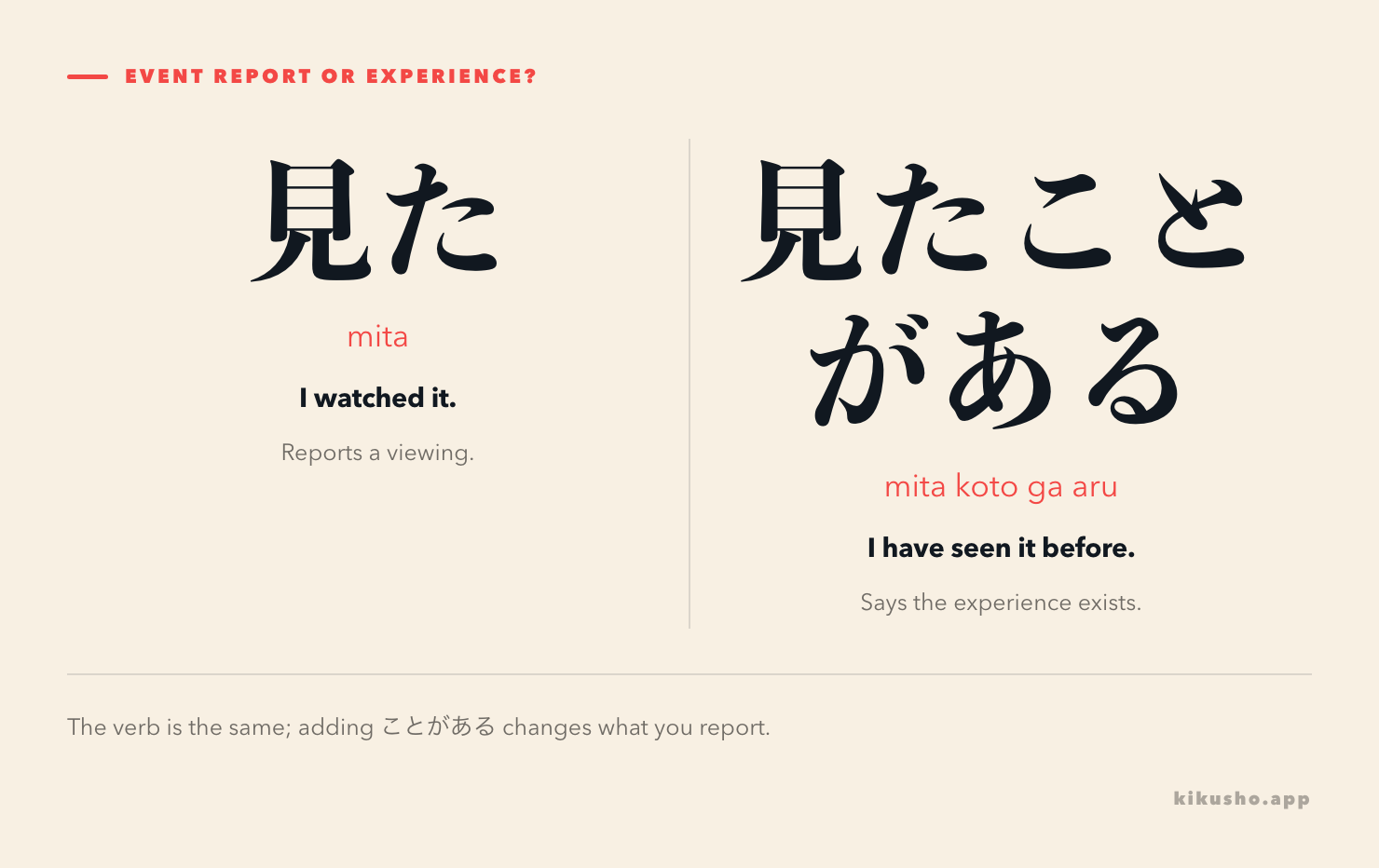
昨日、この映画を見ました reports watching the film yesterday; この映画を見たことがあります says you have seen it at some point before. Build that experience pattern from a verb's plain た-form + ことがある, changing the final ある to あります for polite speech.
The difference is what you are reporting: a particular viewing, or the fact that the film is already part of your experience. 昨日(きのう) means “yesterday,” and 映画(えいが) means “film.” You can have both things to say, but they do different work in a conversation.
This lesson sits in our N4 grammar sequence. JLPT Sensei and Bunpro both classify this basic construction as N5 grammar. It is an earlier foundation being used here, not a form exclusive to N4. The JLPT's own FAQ says the test no longer supplies an exhaustive vocabulary, kanji and grammar specification.
Put the plain past before ことがある
Start with the action you want to describe. Keep its object, place or other necessary phrases, and put the verb in the plain affirmative past:
この料理を作ったことがあります。
このりょうりをつくったことがあります。
I have made this dish before.
料理(りょうり) means “dish/cooking,” and 作る(つくる) means “make.” The phrase この料理を作った becomes the event whose existence you assert with ことがある. が belongs to that final frame; the dish keeps を as what was made.
You need the verb's actual past form, which may end in た or だ:
| Dictionary form | Plain past | Experience, plain style |
|---|---|---|
| 見る(みる), see/watch | 見た | 見たことがある |
| 食べる(たべる), eat | 食べた | 食べたことがある |
| 飲む(のむ), drink | 飲んだ | 飲んだことがある |
| 行く(いく), go | 行った | 行ったことがある |
| する, do | した | したことがある |
| 来る(くる), come | 来た(きた) | 来たことがある |
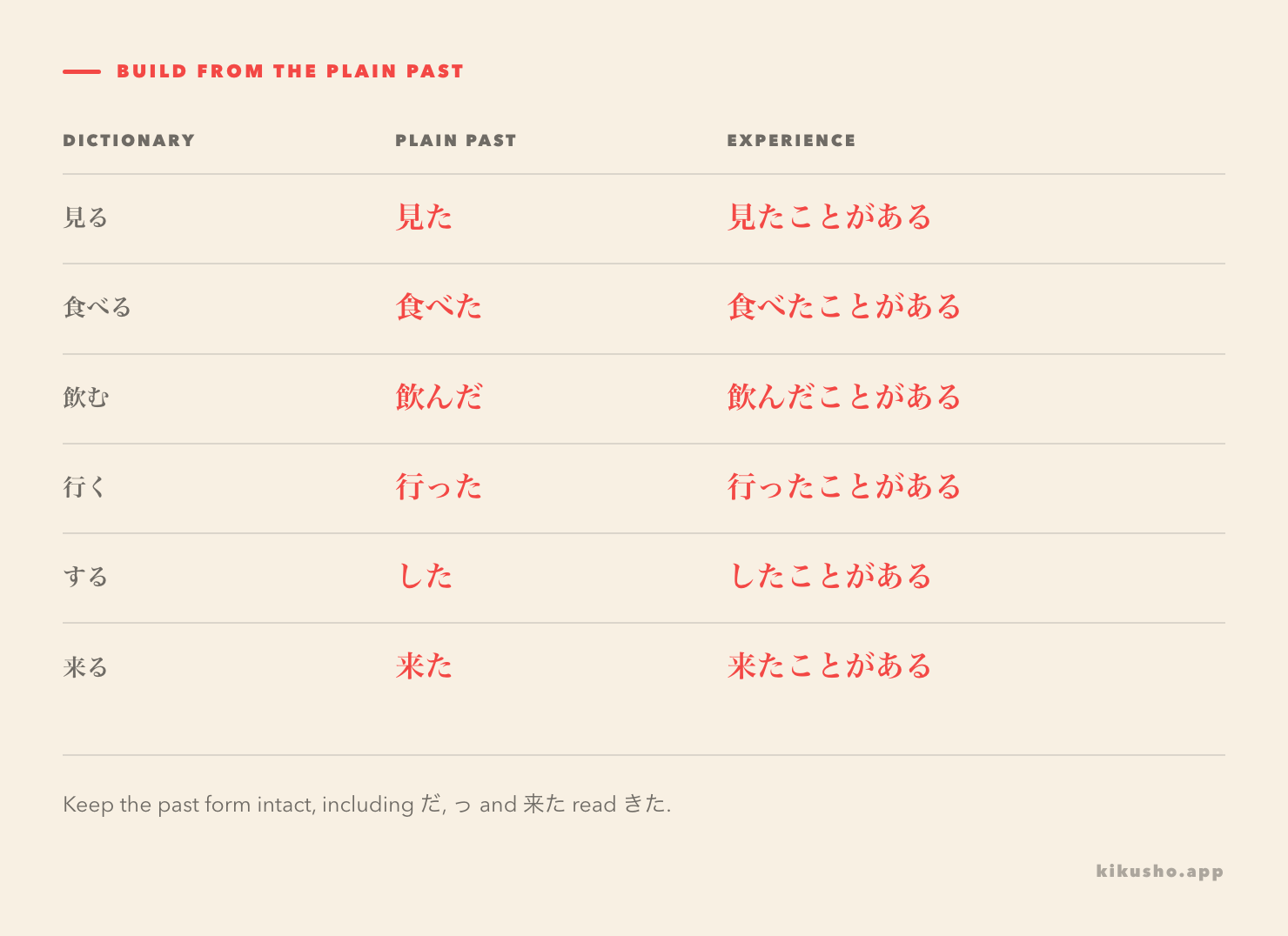
The た-form lesson supplies the full conjugation chart. Here, notice the two forms that are easy to misbuild: 行く → 行った, with small っ, and 来る → 来た, read きた. Neither 行いた nor くた is the form to attach.
The Japan Foundation's Irodori Lesson 8 teaches this attachment and checks the て→た / で→だ relationship. Keep こと in this experience frame; Bunpro explicitly distinguishes it from substitutable nominalizers. This is not permission to exchange こと and の in every larger construction.
Make the final ある polite, not the verb before こと
見たことがある is plain. 見たことがあります is polite. The past verb 見た stays exactly where it was; the final existence verb carries the polite ending.
| What you want to say | Plain | Polite |
|---|---|---|
| Have seen it before | 見たことがある | 見たことがあります |
| Have never seen it | 見たことがない | 見たことがありません / 見たことがないです |
| Have you seen it before? | 見たことがある? | 見たことがありますか。 |
Do not turn the first version into 見ましたことがある. ました is a polite ending for an ordinary past report; this frame requires the plain form before こと. Nor is 見たことがあるです the standard polite affirmative. Use あります.
That division also explains why a polite sentence can contain a plain verb. “Plain” does not mean that every sentence containing it addresses a friend casually. The form required inside the construction and the way the final predicate addresses the listener are separate decisions.
Ask about experience, then report the particular occasion
An experience question opens a possible story:
この料理を作ったことがありますか。
このりょうりをつくったことがありますか。
Have you ever made this dish?
One possible answer is はい、一度あります (はい、いちどあります), “Yes, once.” 一度(いちど) means “once.” A longer answer, 一度、この料理を作ったことがあります, makes the experience explicit. ことがある alone does not mean exactly once; the count adds that information.
Now the listener asks いつ作りましたか (いつつくりましたか), “When did you make it?” Answer 去年の冬に作りました (きょねんのふゆにつくりました), “I made it last winter.” 去年の冬 gives the time of the particular occasion. You have moved from whether the experience exists to its details.
| Conversation task | Example | What it supplies |
|---|---|---|
| Say whether you have the experience | この映画を見たことがあります。 | I have seen this film before. |
| Report yesterday's viewing | 昨日、この映画を見ました。 | I watched this film yesterday. |
Sachiko Dorsey's instructor-authored Mango guide separates an ordinary past report from the present relevance of having an experience. Tofugu specifically explains why an ordinary past is more natural for reporting something done yesterday.
Use that as a test of the intended report, rather than a ban on mentioning time anywhere in an experience conversation. The follow-up above names last winter perfectly well. If you are answering what happened yesterday, simply adding ことがある changes the task; it does not make the past tense more fluent.
For “never,” make the existence of the experience negative
Keep the action affirmative and deny that the experience exists:
この料理を作ったことがありません。
このりょうりをつくったことがありません。
I have never made this dish.
The plain version is 作ったことがない; 作ったことがないです is another polite version. The negative is at ある → ない/ありません, not at the action 作った. Tae Kim's experience lesson gives negative experience and a separate later event; Irodori supplies both ないです and ありません as negative answers.
You can add まだ, “not yet”:
まだ納豆を食べたことがありません。
まだなっとうをたべたことがありません。
I have not eaten natto yet.
納豆(なっとう) is fermented soybeans. Here まだ leaves the experience pending up to now. It can suit a conversation about foods you might try, but the word does not promise you will eat it later.
Eating is an ordinary action; it does not have to be a grand achievement to use this frame. Asking about a particular unfamiliar food makes the experience relevant. Asking whether somebody has already finished today's lunch is a different question. Irodori contrasts experience with もう + polite past, which checks an expected action's completion. The negative-form lesson develops that “not yet” versus “did not” distinction.
A past checkpoint takes a past negative ending
The usual 作ったことがあります already describes a past action. You do not need ありました just to make that action past. The final non-past あります says that the experience exists at the time of the current report.
If you describe what you had not experienced at an earlier point, make the final predicate past negative:
日本に来る前は、納豆を食べたことがありませんでした。今はよく食べます。
にほんにくるまえは、なっとうをたべたことがありませんでした。いまはよくたべます。
Before I came to Japan, I had never eaten natto. Now I eat it often.
来る前(くるまえ) means “before coming,” 今(いま) means “now,” and よく means “often” here. The past negative ありませんでした belongs to the earlier checkpoint. It does not assert that the speaker has still never eaten natto now.
Plain style gives 食べたことがなかった for that earlier lack of experience. Mango checks this change of reference point, and Tae Kim illustrates someone who had never eaten a food and subsequently ate it. The action's た and the final predicate's tense need separate attention.
The spoken form can lose が without losing the experience meaning
Between friends, you may hear この映画、見たことある? (このえいが、みたことある), “Have you seen this film before?” The film is understood as what was watched; が in ことがある is also omitted.
That is the same experience pattern in a conversational shape. Irodori explicitly notes V-たことあります, and Mango checks omission where the short context remains clear. The spoken-Japanese article places this alongside other particles and endings that fall away in familiar conversation.
Keep the complete form available too. ことがある is standard Japanese; an omitted が is not compulsory whenever you speak. Changing the ending to あります or leaving it plain should still fit the listener and situation. This lesson does not prescribe one particle shape for every conversational context.
For an experience question you hear in a film discussion, Kikusho's text capture gives you a place to keep the short line. Before saving its editable card, pair 見たことある? with 見たことがありますか in the example or note. They let you rehearse the same question for different listeners. Keep the whole ending: a card containing only 見る would test the verb while hiding the experience question you wanted to recognise.
A dictionary-form verb changes the construction
仕事で大阪に行くことがあります (しごとでおおさかにいくことがあります) means “There are times when I go to Osaka for work.” 仕事(しごと) means “work.” It uses non-past 行く for an occasional occurrence, not past 行った to report experience.
仕事で大阪に行ったことがあります says “I have been to Osaka for work before.” The difference is a verb form, not the spelling of こと. Mango, Bunpro and Tofugu distinguish these constructions. The occasional-occurrence pattern needs its own treatment; this page focuses on past experience.
Likewise, experience does not establish ability. Having made a dish once does not by itself say that you can make it well today. The potential-form lesson addresses ability and possibility. Keep the experience claim as large as your evidence and no larger.
Seven prompts to try before the explanations
At N4, the JLPT's item table lists three ways of testing grammar: selecting a form, putting sentence pieces in order and interpreting a form within a text. The seven original prompts below practise those tasks with this experience pattern.
Question 1. Use 泳ぐ(およぐ), “swim,” to say you have swum in a river before: 川で(_____)ことがあります。 川 is かわ. Choose the required verb form.
A. 泳ぐ B. 泳ぎた C. 泳いだ D. 泳ぎます
Question 2. Report one completed listening event yesterday in standard polite ます style: 昨日、この歌を(_____)。 歌(うた)means “song,” and 聞く(きく)means “listen/hear.”
A. 聞きました B. 聞いた C. 聞いたことがあります D. 聞きます
Question 3. Say you have never made this dish up to now: この料理を作ったことが(_____)。 Choose the final predicate for that claim.
A. ありました B. ありません C. あります D. ありませんでした
Question 4. Reassemble a polite experience statement meaning “I have seen this film before.” The pieces are 見た / ことが / あります / この映画を; この映画を must occupy the first position. Include the four pieces without adding words.
Question 5. Complete the reply by giving the particular completed visit in polite past, after confirming the experience:
「この店に来たことがありますか。」
「はい、あります。去年、友達と(_____)。」
店(みせ)means “shop/restaurant,” 去年(きょねん)means “last year,” and 友達(ともだち)means “friend.” The second sentence reports the visit itself.
A. 来ることがあります B. 来ました C. 行きたいです D. 来たです
Question 6. Change 京都に行ったことがある into the standard polite affirmative while keeping the experience meaning. 京都 is きょうと. Change the ending that addresses the listener.
Question 7. Read the complete account and choose its meaning:
日本に来る前は、納豆を食べたことがありませんでした。今はよく食べます。
A. The speaker has never eaten natto, including now.
B. The speaker did not eat natto today.
C. The speaker had never eaten natto before coming to Japan, but now eats it often.
D. The speaker had eaten natto before coming to Japan and never eats it now.
Mark the time of the report as well as the action form before looking below.
Answers and explanations
Answer 1. C — 泳いだ. 川で泳いだことがあります means you have swum in a river before. Godan ぐ takes いだ in the plain past. A makes an occasional-occurrence construction rather than the required experience claim; B uses a malformed past; D puts a polite non-past verb before a frame requiring the plain past.
Answer 2. A — 聞きました. 昨日、この歌を聞きました reports yesterday's listening in polite style. B is a grammatical ordinary past but plain. C changes the report to having the experience, so it does not answer the specified single-event task. D is non-past. The test is what the sentence has been asked to report, not a blanket claim that experience conversations cannot mention time.
Answer 3. B — ありません. 作ったことがありません denies that the experience exists up to now. C affirms it; A is affirmative and past. D describes a lack of experience at an earlier checkpoint, which does not by itself establish the requested lack through the present. Keep 作った affirmative and change the final predicate.
Answer 4. この映画を見たことがあります。 The fixed order is この映画を → 見た → ことが → あります. Read it このえいがをみたことがあります. The film is the object of watching, 見た supplies the plain past, and the final あります makes the statement polite.
Answer 5. B — 来ました. はい、あります。去年、友達と来ました first confirms experience, then reports last year's visit with the friend. A uses non-past occasional occurrence; C says the speaker wants to go and does not report the visit. D attaches です directly to 来た, rather than using the standard polite past 来ました(きました).
Answer 6. 京都に行ったことがあります。 Keep 行った before こと and change ある → あります. 行きましたことがある would put the polite past in the wrong slot. 京都に行きました is a polite past report, but removes the explicit experience construction the exercise asks you to retain.
Answer 7. C. ありませんでした sets the absence of the experience before coming to Japan. 今はよく食べます explicitly supplies the changed situation now. A ignores that final sentence; B invents a report about today; D reverses both periods. The plain version of the earlier lack would be 食べたことがなかった.
Choose an experience you can truthfully discuss: a film seen, a dish made or a place visited. Give the experience answer first and let your partner ask when or where. Supply that occasion in an ordinary past sentence, then exchange roles. You now have a reason to retrieve both endings within the same conversation.
Common questions
How do I form ta koto ga aru?
Put the verb in its plain affirmative past form and add ことがある. 見る becomes 見たことがある and 飲む becomes 飲んだことがある. For polite speech, change the final ある to あります: 見たことがあります. Do not put the polite past 見ました directly before こと.
How is ta koto ga aru different from the ordinary past?
見た or 見ました reports a viewing. 見たことがある or 見たことがあります says you have had that experience before. Use the ordinary past when giving a specific completed-event report, such as watching a film yesterday. An experience answer can then lead to a separate past-tense sentence giving details.
How do I say I have never done something?
Keep the action in its affirmative た-form and make the final existence verb negative: 作ったことがない, 作ったことがないです or 作ったことがありません. These mean you have never made it. まだ adds not yet; it does not promise that you will do it later.
Is ta koto ga aru N4 grammar?
This lesson belongs to Kikusho's N4 sequence, but JLPT Sensei and Bunpro place the basic experience construction at N5. Treat it as an earlier-level foundation used here, rather than a uniquely N4 form. The JLPT does not publish an exhaustive grammar syllabus.