
On this page
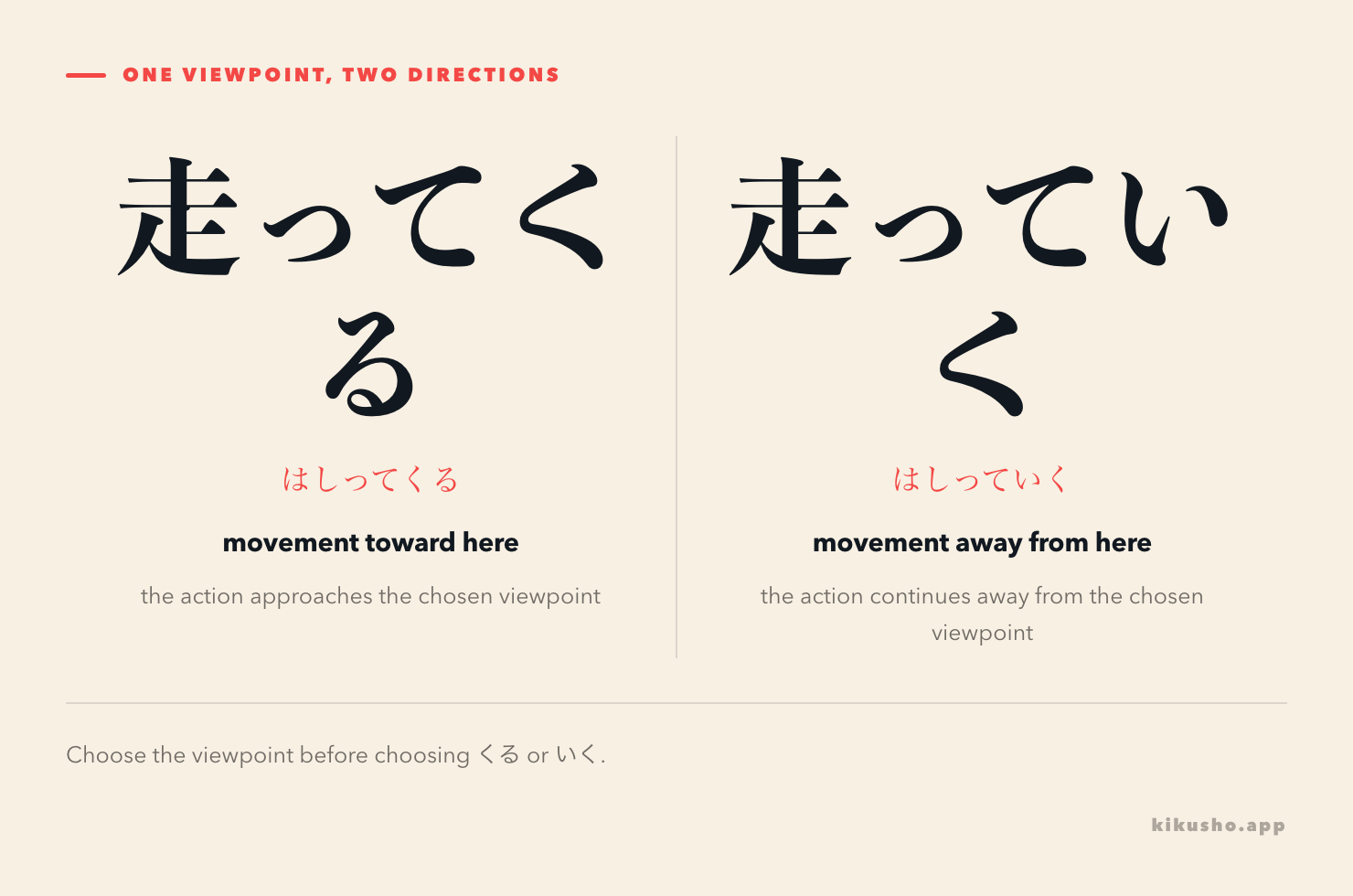
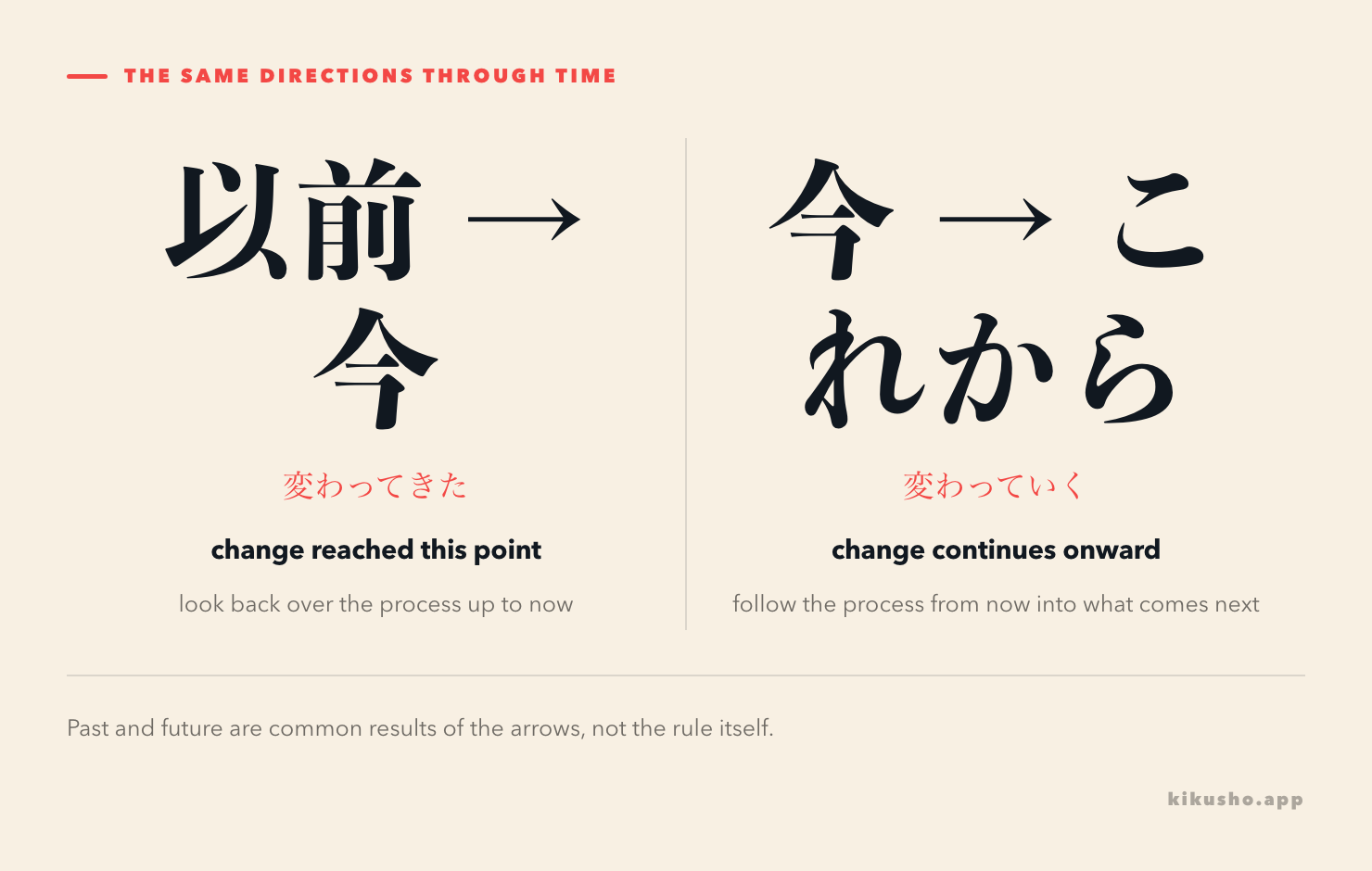
~てくる points toward a chosen viewpoint, while ~ていく points away from it. That direction can be physical, as in 鳥が飛んでくる “a bird flies toward here,” or temporal: 変わってきた traces a change up to now, while 変わっていく sends it onward from now.
The useful test is not simply past versus future. Ask where “here” or “now” is in the scene, then ask whether the action approaches that point or continues away from it.
One direction rule covers space and time
Both forms attach to the verb て-form:
verb て-form + くる/いく
| Viewpoint | Physical direction | Direction through time |
|---|---|---|
| ~てくる | toward here | from an earlier point up to now |
| ~ていく | away from here | from now onward |
The final verb carries tense and politeness. 飛んでくる/飛んできます/飛んできた keep 飛んで unchanged and conjugate くる. The same is true of 飛んでいく/飛んでいきます/飛んでいった.
When いく and くる function as grammatical helpers rather than literal travel verbs, they are commonly written in kana. 人口が増えていく presents change over time; writing 増えて行く is possible, but the kana spelling makes the helper role easy to see. Literal movement is more likely to keep the kanji, as in 駅まで歩いて行く, though spelling is not a perfect meaning test.
てくる approaches the viewpoint
Physical ~てくる says that a person, object or action moves toward the place treated as “here.”
子どもが走ってきた。
こどもがはしってきた。
A child came running toward me.
The running and the approach happen together. The viewpoint need not be the speaker's body. In a story, the speaker can adopt the station, house or another person's position as the relevant “here.”
With an object, this direction produces the ordinary meaning “bring”:
パーティーに傘を持ってきてください。
パーティーにかさをもってきてください。
Please bring an umbrella to the party.
The umbrella travels toward the party, the destination taken as the conversational viewpoint. 持っていく would carry it away from the current or adopted point toward somewhere else.
~てくる also describes leaving to do something and returning:
ちょっと水を買ってきます。
ちょっとみずをかってきます。
I am going to buy some water and come back.
The speaker goes out, buys the water, and returns to the starting point. English often compresses the return into “I'll go get some water,” but Japanese makes the round trip visible with くる.
ていく moves away from the viewpoint
Physical ~ていく follows movement away from “here.”
鳥が海のほうへ飛んでいった。
とりがうみのほうへとんでいった。
The bird flew away toward the sea.
The past tense does not force てくる. This is a past event, yet 飛んでいった is correct because the bird moved away from the viewpoint. Direction comes before tense.
An action can also occur before departure or while someone travels:
時間があるなら、コーヒーを飲んでいってください。
じかんがあるなら、コーヒーをのんでいってください。
If you have time, please have some coffee before you go.
駅まで歩いていきます。
えきまであるいていきます。
I will go to the station on foot.
In the first sentence, drinking happens before the listener leaves. In the second, walking is the manner of the outward movement. Context tells you how the first action and the going overlap.
Time keeps the same arrows
Treat the present moment as “here.” A process arriving at that point takes ~てくる; a process continuing away from it takes ~ていく.
最近、朝が寒くなってきた。
さいきん、あさがさむくなってきた。
Recently, the mornings have been getting colder.
The change started before now and has become noticeable at the current point. 最近 supports that backward-looking view.
これから、もっと寒くなっていくでしょう。
これから、もっとさむくなっていくでしょう。
From now on, it will probably keep getting colder.
これから sets now as the starting point and projects the change onward. The pair can therefore describe one season from two sides: what has developed so far, and what is expected to continue.
Actions as well as states can stretch across the timeline:
三年間、日本語を勉強してきました。
さんねんかん、にほんごをべんきょうしてきました。
I have studied Japanese for three years up to now.
これからも、日本語を勉強していきます。
これからも、にほんごをべんきょうしていきます。
I will keep studying Japanese from now on.
| Time cue | Natural focus | Example |
|---|---|---|
| 最近, これまで, ~年間 | process reaching the reference point | 慣れてきた |
| これから, 今後, この先 | process continuing from the reference point | 慣れていく |
These cues make a reliable N4 choice, but they describe a viewpoint rather than an automatic tense formula.
Onset is a change arriving now
Japanese often uses ~てきた when a sensation, weather event or understanding has begun to reach the speaker.
雨が降ってきた。
あめがふってきた。
It has started raining.
お腹がすいてきた。
おなかがすいてきた。
I am starting to get hungry.
外から音が聞こえてきた。
そとからおとがきこえてきた。
A sound began to come in from outside.
The English translation may use “start,” but くる still contributes arrival at the viewpoint. Rain enters the present situation, hunger becomes perceptible, and sound reaches the listener. This also explains だんだん分かってきた, “I am gradually starting to understand”: understanding has developed to the point where the speaker can notice it.
Do not replace every “start” with ~てくる. 始める directly marks the beginning of an intentional action, as in 勉強を始めた, “I started studying.” 分かってきた instead views a developing result as it reaches the current point.
Adjectives need なる before the direction
~ていく/~てくる attach to a verb's て-form. An adjective first becomes a change with なる.
| Word class | Change verb | With viewpoint |
|---|---|---|
| い-adjective | 寒い → 寒くなる | 寒くなってきた |
| な-adjective | 静かだ → 静かになる | 静かになっていく |
| noun | 大人 → 大人になる | 大人になっていく |
✗寒くてきた uses the adjective's connecting form but supplies no verb of change. The complete chain is 寒い → 寒くなる → 寒くなってきた.
The same distinction matters for static descriptions. 町は静かです describes the town now. 町は静かになってきました says a change toward quietness has unfolded up to the reference point.
Do not confuse ていく with purpose に行く
The surface word 行く appears in two different constructions:
| Construction | Formation | Meaning |
|---|---|---|
| 食べに行く | verb stem + に行く | go somewhere in order to eat |
| 食べていく | verb て-form + いく | eat and go, or continue eating onward |
The purpose に行く lesson uses 食べ, the form before ます. The present lesson uses 食べて. Compare:
レストランへ昼ご飯を食べに行きます。
I will go to a restaurant to eat lunch.
ここで昼ご飯を食べていきます。
I will eat lunch here before going.
Changing に to て changes the relationship between eating and movement. The first sentence names the purpose of the trip; the second puts eating before departure from the current place.
Past and future are a shortcut, not the rule
At N4, ~てきた = up to now and ~ていく = from now on is an excellent production guide. It becomes misleading when treated as a ban.
その後、町は急速に発展していった。
そのご、まちはきゅうそくにはってんしていった。
After that, the town went on developing rapidly.
Everything is in the past, but the narrator stands at the process's earlier starting point and watches development continue away from it. Conversely, literal 戻ってくる can refer to next week because the person will return toward the chosen viewpoint: 彼は来週戻ってくる.
The full decision is therefore:
- Find the spatial or temporal viewpoint.
- Decide whether the action approaches it or continues away.
- Use the surrounding time words and the final conjugation to locate the event.
This also prevents a common false correction. てきた is often past because a process has reached now, but くる itself does not mean “past.” ていく often points into the future, but いった can narrate a process moving onward from a past reference point.
Save the viewpoint with the sentence
A bare card reading てくる = come cannot tell you why 寒くなってきた is natural. In Kikusho, keep the cue that fixes the axis: 最近 with なってきた, これから with なっていく, or the destination that makes 持ってくる point toward the scene.
When you edit the card, swap only the cue first. Change 最近 to これから, then decide whether the helper must also change. That review forces the directional choice before the translation appears, and it preserves the sentence that supplied the original viewpoint.
Practice
Fix the viewpoint in each of the seven scenes first. Keep every choice unanswered until you reach the shared solution block.
Question 1. You are standing in a park. A dog is running toward you. Choose the ending: 犬がこちらへ走って__。
- ア. きます
- イ. いきます
- ウ. あります
- エ. おきます
Question 2. You are already at a picnic and ask a friend on the phone to bring a blanket. Which sentence fits?
- ア. 毛布を持っていってください。
- イ. 毛布を持ってきてください。
- ウ. 毛布を持ちにきてください。
- エ. 毛布を持っていてください。
Question 3. Choose the natural completion: 最近、日本語のニュースが少し分かるようになって__。
- ア. いきました
- イ. きました
- ウ. おきました
- エ. みました
Question 4. Complete the sentence after これから to mean “From now on, this town will become quieter.”
- 静かに
- なっていく
- この町は
- でしょう
Question 5. Which sentence means “I am going to a restaurant to eat”?
- ア. レストランへ食べていきます。
- イ. レストランへ食べに行きます。
- ウ. レストランへ食べてきます。
- エ. レストランへ食べるて行きます。
Question 6. Correct the starred part: 朝が★寒くてきました。
Question 7. Choose the pair that completes the connected text.
この町には十年間住んでいます。店が増えて便利になって__。これからも、町は少しずつ変わって__でしょう。
- ア. いきました・きた
- イ. きました・いく
- ウ. いました・くる
- エ. きます・いった
Answers and explanations
Answer 1. ア. きます. The dog approaches the speaker's physical viewpoint, so 走ってきます fits. 走っていきます would describe the dog running away from that point.
Answer 2. イ. 毛布を持ってきてください. The blanket should move toward the picnic, the place adopted as “here.” ア asks someone to take it away toward another destination; ウ incorrectly turns 持ち into the purpose of coming; エ asks the person to keep holding it.
Answer 3. イ. きました. 最近 looks from an earlier stage toward the current result, so 分かるようになってきました presents understanding that has developed up to now.
Answer 4. これからこの町は静かになっていくでしょう. After the supplied これから, この町は names the topic, 静か becomes the change verb 静かになる, and ていく projects that change onward.
Answer 5. イ. レストランへ食べに行きます. Verb stem + に行く names the purpose of the journey. 食べていく instead places eating before outward movement or, in another context, presents it as continuing onward.
Answer 6. 朝が寒くなってきました. An い-adjective changes with ~くなる before the viewpoint helper: 寒い → 寒くなる → 寒くなってくる. 寒くてきた lacks the necessary change verb.
Answer 7. イ. きました・いく. Ten years of change reaches the speaker's present in 便利になってきました. これからも then opens the future path, so the town will 変わっていく from this point onward.
Level evidence and the limit of the labels
JLPT Sensei's ていく page and its てくる page place both constructions at N4. Bunpro independently labels ていく and てくる N4 and separates them from the N5 purpose construction verb stem + に行く.
The MIT OpenCourseWare Japanese V notes verify both the physical direction and the default timeline from a past point through now toward the future. Tofugu's detailed comparison supports the same core test while documenting viewpoint choices that make a mechanical past/future rule too narrow.
PassJapanese groups the pair with N3, even though its stated direction and timeline rules match the N4 sources. The official JLPT publishes test formats rather than an exhaustive grammar list. Kikusho keeps the inventory's N4 placement, with ordinary て-form creation, 行く/来る and adjective + なる as prerequisites.
Codex, an AI agent, checked the forms, readings, translations, viewpoint claims and exercise answers against those independent sources and the saved inventory. No human language review is claimed.
Common questions
What is the basic difference between ていく and てくる?
てくる points toward the speaker's viewpoint; ていく points away from it. In time, てきた often traces a process up to now, while ていく often sends a process onward from now.
How do ていく and てくる attach to a verb?
Put the first verb in its て-form, then add いく or くる: 増える becomes 増えていく, and 走る becomes 走ってくる. Conjugate only the final motion verb.
Why does 雨が降ってきた mean it started raining?
The rain is presented as a change that has reached the speaker's current situation. てきた can therefore mark the onset of rain, hunger, a sound or another change that has just become perceptible.
What is the difference between 食べに行く and 食べていく?
食べに行く uses the verb stem plus に to name the purpose: go somewhere to eat. 食べていく uses the て-form and can mean eat before going or, in a suitable temporal context, continue eating from this point onward.