On this page
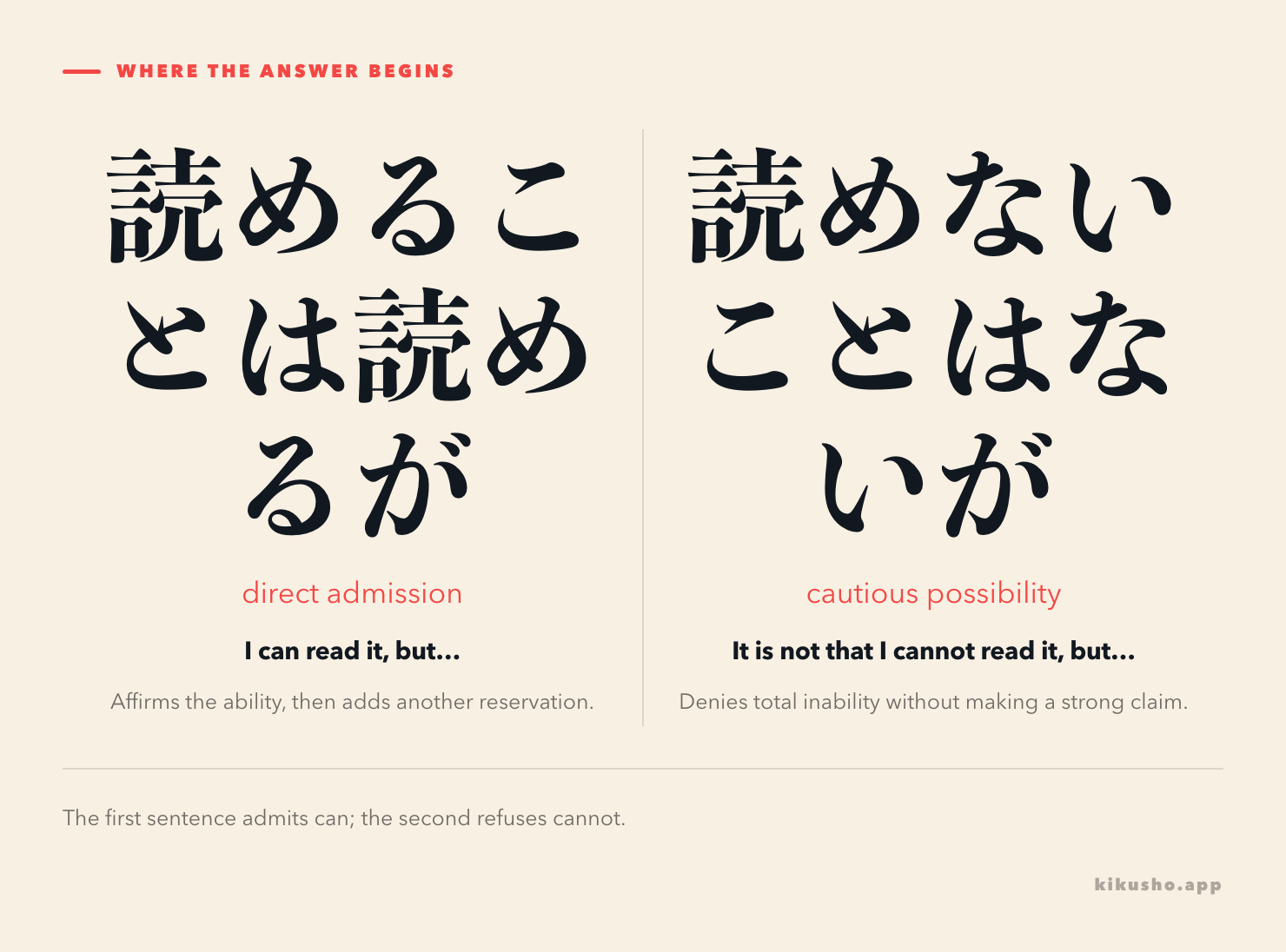
Use ことは~が when you admit a clear positive and then limit it; use ないことはない when you reject a complete negative and leave a cautious positive. 読めることは読めるが、時間がかかる says “I can read it, but it takes time,” while 読めないことはないが、辞書が必要だ says “It is not that I cannot read it, but I need a dictionary.”
Both answers agree only partway. The difference is where they begin: one repeats “yes,” while the other backs away from “no.”
The test is whether you affirm or remove a negative
Ask what you want the first half of the sentence to do.
| Your first move | Construction | Effect |
|---|---|---|
| admit that X is true | XことはXが | “X is true, but…” |
| deny that X is impossible or false | Xないことはない | “It is not that X is impossible, but…” |
この本は読めることは読めるが、専門用語が多い。
この ほんは よめることは よめるが、せんもんようごが おおい。
I can read this book, but it has a lot of technical terms.
この本は読めないことはないが、辞書が必要だ。
この ほんは よめないことは ないが、じしょが ひつようだ。
It is not that I cannot read this book, but I need a dictionary.
The first speaker owns the positive claim 読める and then adds a separate difficulty. The second speaker denies 読めない, “cannot read,” without offering an unreserved 読める. In conversation, that double negative often suggests effort, reluctance or a narrow margin.
コトハジメ's Japanese-teacher comparison examines this exact choice and notes that affirmative repetition can open the discussion to another issue, while the double negative tends to keep attention on whether the action is possible. That is a useful tendency, not a mechanical ban: context still decides what the following clause can add.
ことは~が repeats the predicate you concede
The word or phrase before ことは normally appears again after it. Keep the repeated form the same, then use が, けど or a polite continuation such as んですが.
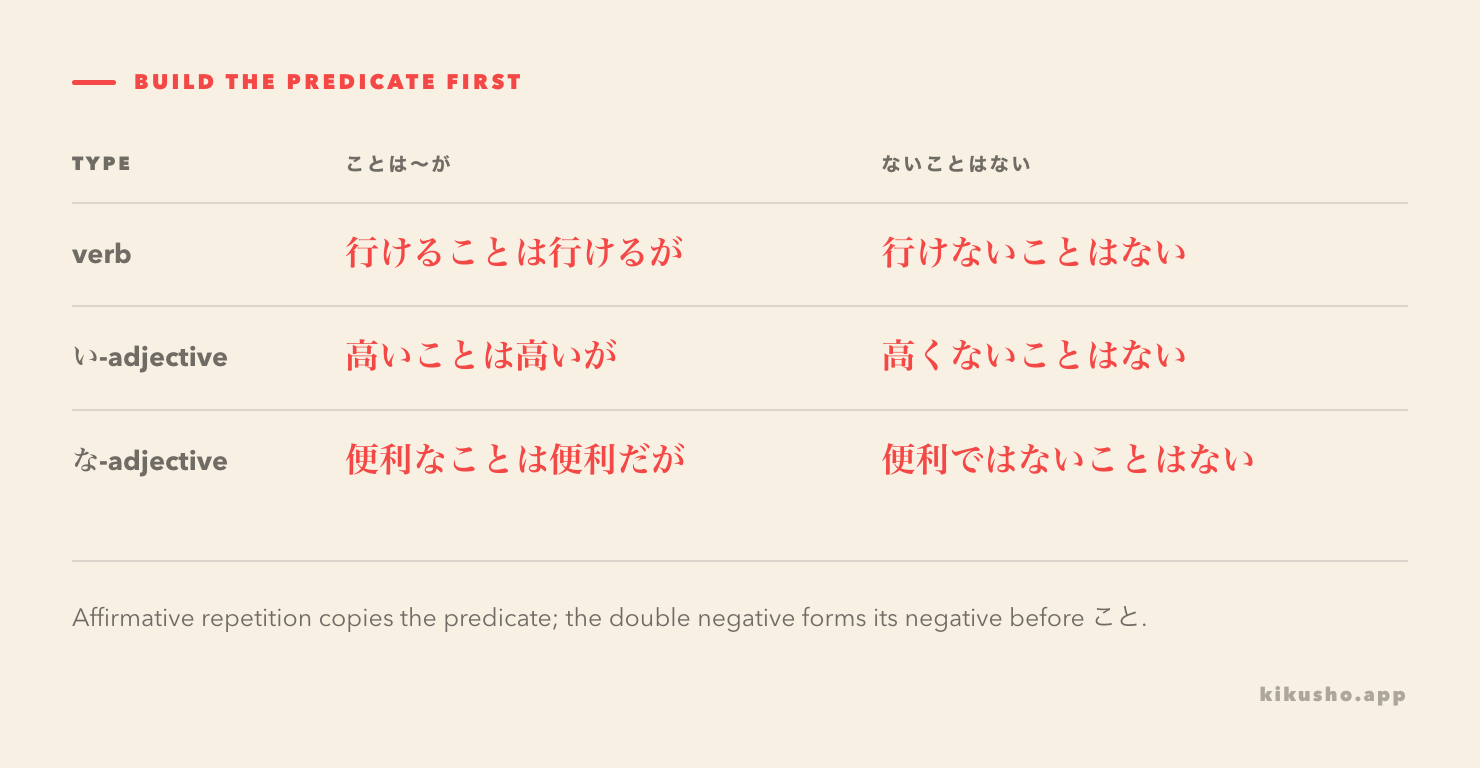
| Predicate | Pattern | Example |
|---|---|---|
| verb | V + ことは + same V + が | 行けることは行けるが |
| い-adjective | Aい + ことは + same Aい + が | 高いことは高いが |
| な-adjective | Aな + ことは + same A + だが | 便利なことは便利だが |
このかばんは高いことは高いが、十年は使えそうだ。
この かばんは たかいことは たかいが、じゅうねんは つかえそうだ。
This bag is expensive, that is true, but it looks usable for ten years.
この機能は便利なことは便利ですが、毎日は使いません。
この きのうは べんりなことは べんりですが、まいにちは つかいません。
This feature is convenient, but I do not use it every day.
The な appears before こと because 便利 modifies the noun-like こと: 便利なこと. The repeated predicate becomes 便利だが in plain style or 便利ですが in polite style. Writing 便利だことは便利だ breaks the attachment before こと.
Tense and modality can be repeated too. 勉強したことは勉強したが、自信がない admits that studying happened; 行けることは行けるが、遅くなる admits that going is possible. Repeat the exact claim you are conceding rather than switching from 行く to 行ける halfway through.
JLPT Sensei lists verb, い-adjective and な-adjective formations and places the construction at N3. Bunpro's grammar index assigns the same construction to N2. The lesson remains in Kikusho's N3 sequence because the N3 source record is explicit; the disagreement is editorial, not an official JLPT ruling.
ないことはない turns a negative into limited possibility
Build the negative form first, then add ことはない.
| Base | Negative before こと | Complete form |
|---|---|---|
| 行ける | 行けない | 行けないことはない |
| 食べる | 食べない | 食べないことはない |
| 高い | 高くない | 高くないことはない |
| 便利だ | 便利ではない | 便利ではないことはない |
Potential verbs are common because the construction is well suited to reluctant ability:
土曜日なら、参加できないことはない。
どようびなら、さんかできないことは ない。
If it is Saturday, it is not impossible for me to participate.
The speaker has not promised to attend. Saturday makes attendance possible, but the wording holds something back. A follow-up often names the condition:
参加できないことはないけど、子どもを預ける人を探さないといけない。
さんかできないことは ないけど、こどもを あずける ひとを さがさないと いけない。
It is not that I cannot participate, but I have to find someone to look after my child.
The same double negative can soften an evaluation:
この料理はおいしくないことはないが、少し塩辛い。
この りょうりは おいしくないことは ないが、すこし しおからい。
It is not that this dish is not tasty, but it is a little salty.
Bunpro classifies ないことはない as standard-register N3 grammar and describes the double negative as possibility with reduced confidence. JLPT Sensei likewise gives the N3 placement and notes that the action may require effort.
The following clause reveals the size of the reservation
Neither form tells you the exact objection by itself. Read beyond が or けど.
日本語は話せることは話せるが、仕事の交渉は難しい。
にほんごは はなせることは はなせるが、しごとの こうしょうは むずかしい。
I can speak Japanese, but negotiating at work is difficult.
This speaker directly affirms speaking ability, then narrows its range. The contrast does not cancel the first clause.
日本語は話せないことはないが、ゆっくり話してもらう必要がある。
にほんごは はなせないことは ないが、ゆっくり はなしてもらう ひつようが ある。
It is not that I cannot speak Japanese, but I need people to speak slowly.
Here the ability is presented more cautiously. The speaker may be avoiding a flat 話せない, but is not ready to claim ordinary fluency. Translating both sentences as “I can speak Japanese, but…” loses the stance that the double negative contributes.
The ending can remain implicit in a short answer. 行けないことはないけど… trails off after “I could go, but…” and invites the listener to infer a complication. In formal or careful speech, 行けないことはありませんが keeps the same logical shape. Politeness changes the ending, not the cautious positive.
Dictionary-form ことはない is a different construction
One negative before こと changes the meaning.
| Form | Meaning |
|---|---|
| 急ぐことはない | there is no need to hurry |
| 急がないことはない | it is not that I never hurry / I do hurry sometimes |
| 急げないことはない | it is not that I cannot hurry / I can hurry if needed |
The ことはない and 必要はない lesson teaches the no-need pattern. Its verb is affirmative dictionary form: 急ぐことはない. The double-negative construction requires a negative predicate before こと: 急がないことはない or potential 急げないことはない.
Do not count the visible ない at the end and assume every ことはない is the same. Inspect the predicate immediately before こと. This also separates the construction from 食べたことがない, “have never eaten,” where past た and particle が build the experience pattern.
You may encounter ないこともない with も. Many teaching resources treat it as a close alternative for tentative possibility. Japanese teacher たのすけ notes that most grammar books do not draw a firm distinction, while intonation and context can shift how positive the reply sounds. For this lesson, produce the assigned ないことはない and recognise も as a neighbour rather than inventing a fixed contrast.
Practice
Question 1 — choose the direct admission
You want to say, “The room is convenient, but the rent is high,” clearly admitting that it is convenient. Which opening fits?
A. 便利なことは便利ですが
B. 便利ではないことはないですが
C. 便利ことは便利ですが
Question 2 — choose the cautious possibility
You may be able to attend, but first you must arrange childcare. Which opening best keeps attendance possible without promising it?
A. 参加できることは参加するけど
B. 参加できないことはないけど
C. 参加することはないけど
Question 3 — repeat the same predicate
Complete the sentence with the repeated form of 高い:
このかばんは高いことは( )が、長く使えそうだ。
A. 高くない
B. 高い
C. 高かった
Question 4 — rebuild a complete concession
Put these four parts in order to mean “I can read this book, but it takes time.”
読めるが / この本は / 時間がかかる / 読めることは
Question 5 — identify the no-need form
Which sentence tells a worried person that there is no need to hurry?
A. 急ぐことはないよ。
B. 急がないことはないよ。
C. 急げないことはないよ。
Question 6 — text grammar
Read the exchange:
A:この資料、一人で読めますか。
B:読めないことはないですが、専門用語が多いので、辞書を使いたいです。
Does B deny all ability, claim easy reading, or leave reading possible with a condition? Which words supply the condition?
Question 7 — form the な-adjective pattern
Complete the polite sentence: “This feature is convenient, but I do not use it every day.”
この機能は( )、毎日は使いません。
A. 便利だことは便利ですが
B. 便利なことは便利ですが
C. 便利ではないことはありませんが
Answers and explanations
Answer 1. A. 便利なことは便利ですが directly admits that the room is convenient and prepares a different reservation. B is a cautious double negative, so it weakens the admission. C omits the な required when 便利 modifies こと.
Answer 2. B. 参加できないことはないけど denies complete inability to participate while leaving room for the childcare problem. A fails to repeat the same predicate: できる changes to する. C does not express cautious ability; depending on context, 参加することはない can state no need or nonoccurrence.
Answer 3. B. The construction repeats the admitted predicate: 高いことは高いが. A changes the second half to a negative. C changes present 高い to past 高かった, so it no longer repeats the same claim.
Answer 4. この本は読めることは読めるが、時間がかかる。 The first 読める appears before ことは, and the same potential form follows it. 時間がかかる then supplies the limitation.
Answer 5. A. 急ぐことはないよ uses affirmative dictionary-form 急ぐ before こと and means “There is no need to hurry.” B means it is not that the person never hurries. C means hurrying is possible, a double negative built from potential 急げない.
Answer 6. B leaves reading possible with a condition. 読めないことはない rejects total inability, while 専門用語が多いので gives the reason and 辞書を使いたい names the support B wants. Nothing claims that reading will be easy.
Answer 7. B. A な-adjective takes な before こと, then returns as a predicate: 便利なことは便利ですが. A incorrectly puts だ before こと. C is grammatical as a double negative in a suitable context, but it gives a more hesitant “not that it is inconvenient” instead of the requested direct admission.
Keep the hesitation attached to its reason
A reply such as 読めないことはないですが、専門用語が多いです is useful because the reservation is explicit. Saving only 読める, “can read,” erases the dictionary, the effort and the speaker's caution.
When you capture that reply in Kikusho, keep the complete sentence as the card's example and use the editable explanation to mark which side was conceded. Later review should ask you to recover both the small yes and the reason it stayed small.
Common questions
What does ことは~が mean in Japanese?
It repeats a predicate to acknowledge that it is true, then が or けど introduces a qualification. 読めることは読めるが、時間がかかる means “I can read it, but it takes time.”
What does ないことはない mean?
It is a double negative meaning that something is possible or partly true, often with reluctance or a practical limitation. 読めないことはない means “It is not that I cannot read it.”
What is the difference between 読めることは読める and 読めないことはない?
読めることは読める directly admits the ability before changing to another reservation. 読めないことはない denies complete inability and therefore sounds more cautious: reading is possible, though perhaps difficult.
Are ことは~が and ないことはない N3 grammar?
JLPT Sensei places both at N3, and Bunpro also places ないことはない at N3. Bunpro teaches ことは~が at N2. These are editorial study levels because the JLPT does not publish an exhaustive official grammar list.