On this page
Use verb dictionary form + のに when the action before のに is the practical purpose or task being evaluated. The part after it usually tells you what serves that purpose, what is needed for it, whether it is convenient, or how much time and money it takes.
The predicate after のに reveals the purpose reading
Start with this sentence:
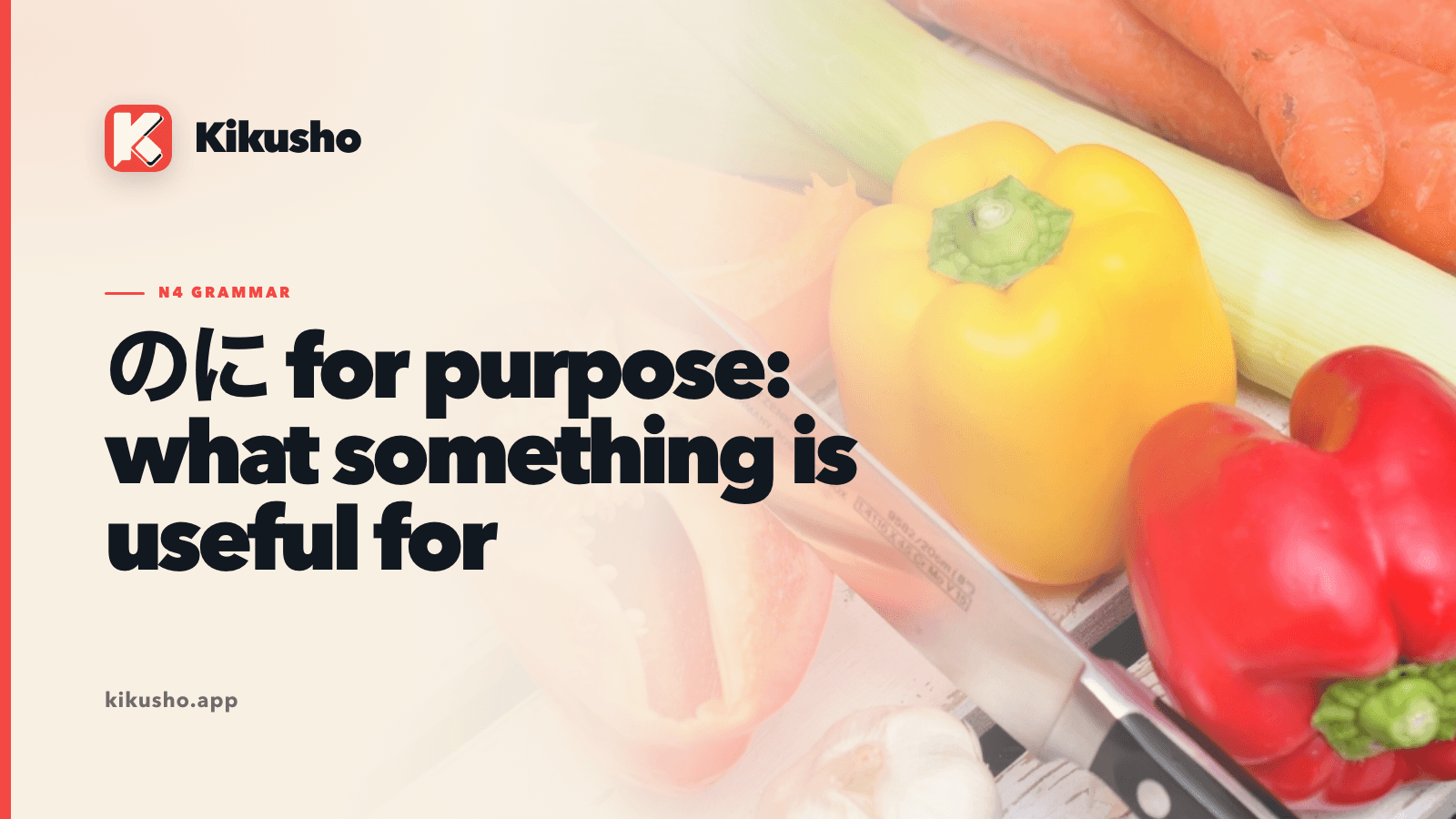
この包丁は野菜を切るのに使います。
この ほうちょうは やさいを きるのに つかいます。
This kitchen knife is used for cutting vegetables.
The action 野菜を切る becomes a noun-like unit with の. The particle に then marks that action as the purpose or task connected to 使います. A literal analysis is close to “as for this knife, we use it for the act of cutting vegetables.”
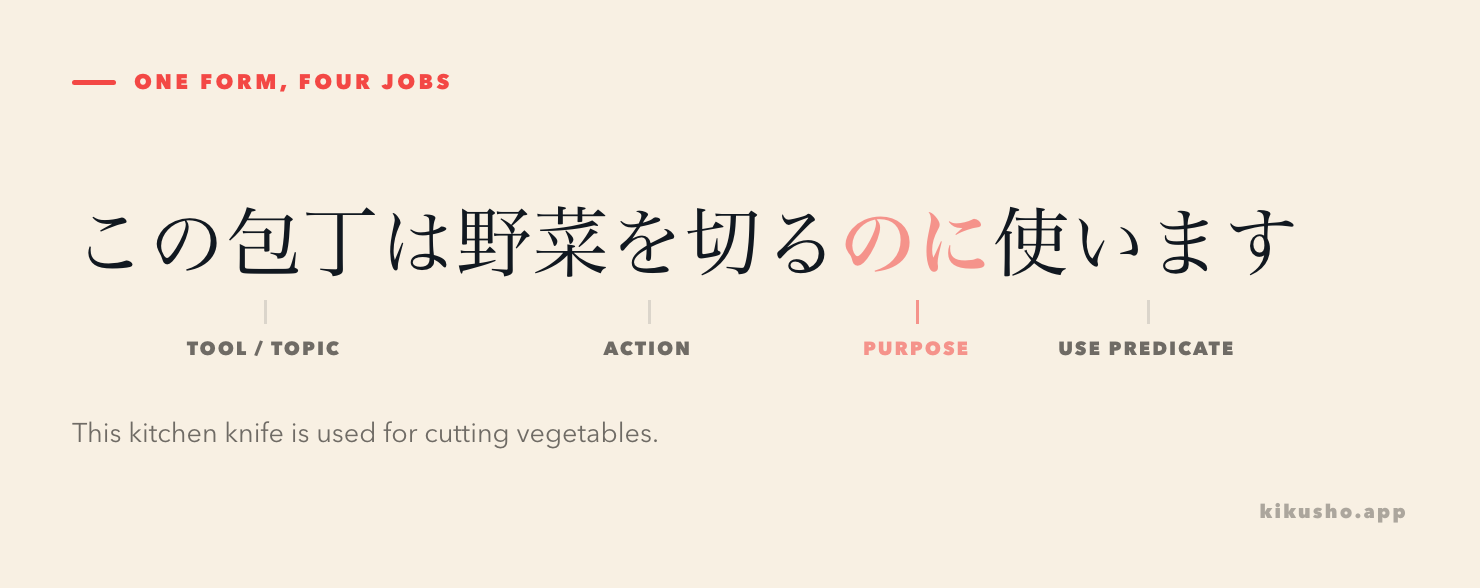
The most reliable clue is not のに alone. It is the relationship between the action before it and the predicate after it.
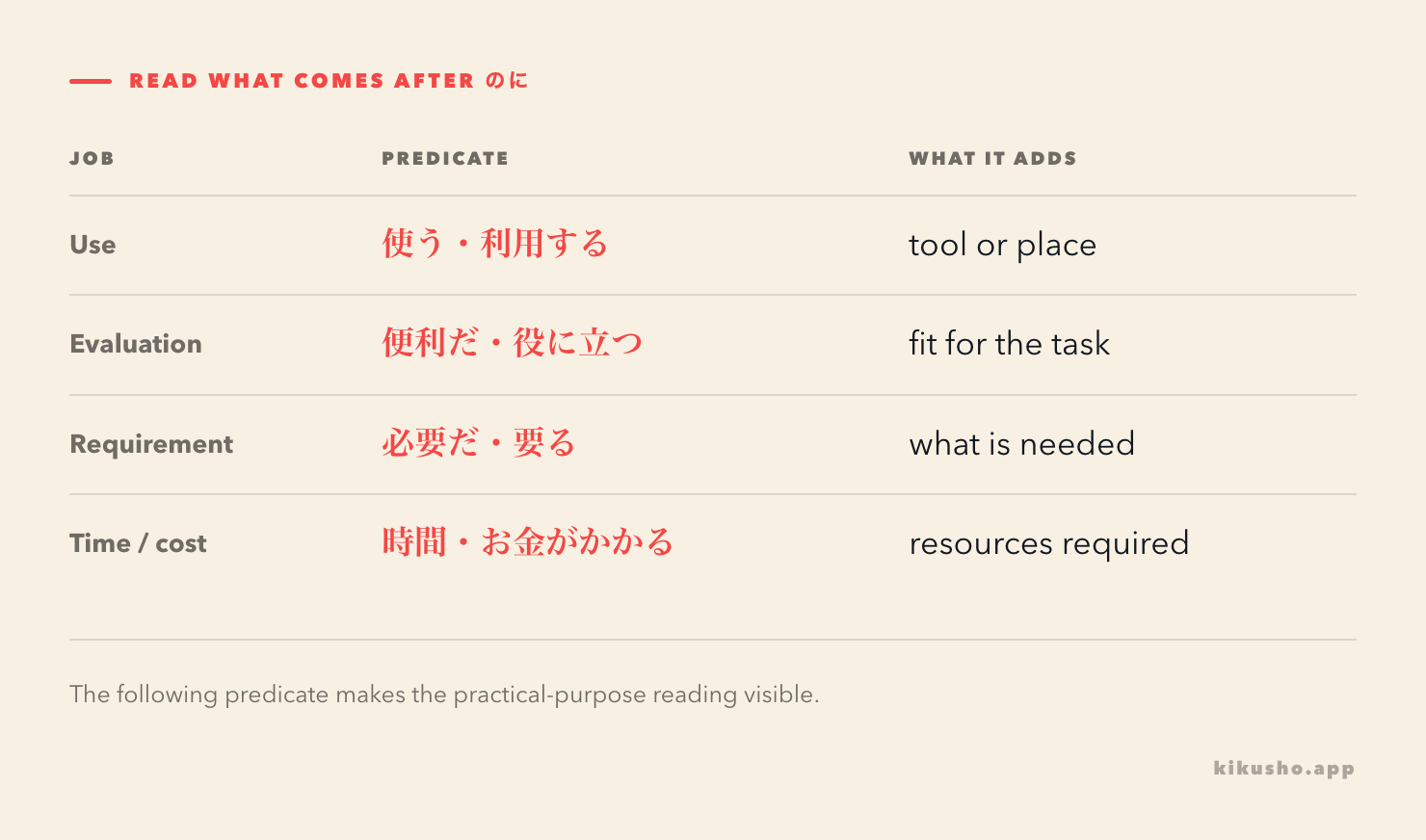
| What follows | What the sentence tells you | Example |
|---|---|---|
| 使う・利用する | the use of a tool or place | 勉強するのに図書館を利用する |
| 便利だ・いい・役に立つ | an evaluation for that task | このアプリは復習するのに便利だ |
| 必要だ・要る | a requirement for the task | 申し込むのに住所が必要だ |
| 時間・お金がかかる | the task's time or cost | 修理するのに一万円かかる |
The National Institute for Japanese Language and Linguistics pattern bank describes the related noun + に pattern in exactly these semantic families: use, time or money, convenience, necessity and usefulness. JLPT Sensei gives the N4 attachment as verb dictionary form + のに, while Bunpro analyzes the form as nominalizing の plus goal-marking に.
Put a dictionary-form verb before のに
The form is compact:
verb dictionary form + のに + use, evaluation, requirement or cost
| Verb group | Dictionary form | Purpose phrase |
|---|---|---|
| godan | 書く | 書くのに |
| ichidan | 食べる | 食べるのに |
| irregular | する | するのに |
| irregular | 来る(くる) | 来るのに |
このペンは小さい字を書くのに便利です。
この ペンは ちいさい じを かくのに べんりです。
This pen is convenient for writing small characters.
駅からここまで来るのに二十分かかりました。
えきから ここまで くるのに にじゅっぷん かかりました。
It took twenty minutes to get here from the station.
Do not change the verb to its ます-stem. “Convenient for writing” is 書くのに便利, not 書きのに便利. The dictionary form names the complete action that becomes the purpose or standard.
The action is often intentional, but the sentence does not have to describe an object with a designed use. 朝起きるのに時間がかかる means “It takes time to get up in the morning.” Here getting up is the task whose difficulty is measured.
Four predicate families make useful sentence frames
Learn the construction with the word after it. That gives のに a job instead of asking you to choose among several unrelated translations.
Use: 使う and 利用する
このはさみは布を切るのに使います。
この はさみは ぬのを きるのに つかいます。
These scissors are used for cutting cloth.
This frame answers 何をするのに使いますか, “What is it used for?” A place can serve a purpose too: 試験の勉強をするのに図書館を利用します, “I use the library to study for exams.”
Evaluation: 便利だ, いい and 役に立つ
このサイトは漢字を調べるのに役に立ちます。
この サイトは かんじを しらべるのに やくに たちます。
This site is useful for looking up kanji.
The thing being evaluated normally takes は. The action before のに supplies the standard: useful for what? PassJapanese's purpose lesson likewise groups 便利だ, 必要だ and かかる after the dictionary-form verb.
Requirement: 必要だ and 要る
この仕事を始めるのに特別な資格は必要ありません。
この しごとを はじめるのに とくべつな しかくは ひつようありません。
No special qualification is necessary to start this job.
The required item usually takes が when it is new information: 身分証明書が必要です. It can take は when contrasted or made the topic, as in the example above.
Time, money and effort: かかる
このパソコンを直すのに三万円かかりました。
この パソコンを なおすのに さんまんえん かかりました。
It cost 30,000 yen to repair this computer.
The resource takes が in the full pattern: 時間がかかる, お金がかかる, 手間がかかる. A quantity can appear directly before かかる, as in 三日かかる or 三万円かかる.
Purpose のに is different from “although” のに
Japanese writes both forms the same way, but their sentence structures point in different directions.
| Reading | Shape | Relationship |
|---|---|---|
| purpose or task | V dictionary + のに + use/evaluation/requirement/cost | the second part serves or measures the first action |
| although/even though | plain clause + のに + unexpected result | the second event goes against the first fact |
Compare the pair:
日本語を勉強するのに、この辞書は便利です。
This dictionary is convenient for studying Japanese.
日本語を勉強したのに、試験ができませんでした。
Although I studied Japanese, I could not do the exam.
In the first sentence, 便利です evaluates the dictionary for the task of studying. In the second, できませんでした is an outcome that conflicts with the expectation created by studying. The tense before のに also helps: the purpose form names an action with the non-past dictionary form, while concessive のに can follow a past verb, adjective or noun-based clause.
With nouns and な-adjectives, concessive のに uses なのに: 雨なのに出かけました, “Although it was raining, I went out,” and 静かなのに眠れません, “Although it is quiet, I cannot sleep.” Those are not purpose sentences.
ために states a goal; のに evaluates what serves it
Both constructions can be translated with “in order to,” but a direct translation hides their usual division of labor.
日本へ行くために、お金を貯めています。
I am saving money in order to go to Japan.
The person performs お金を貯める to achieve the goal 日本へ行く. This is the broad goal-to-action connection taught with ために.
日本へ行くのに、お金が必要です。
Money is necessary to go to Japan.
Now 日本へ行く is the task against which a requirement is stated. The sentence does not describe saving or another deliberate step taken to reach the goal; it evaluates what the trip requires.
This difference predicts natural combinations. ために勉強する, ために練習する and ために貯金する describe what someone does for a goal. のに便利だ, のに必要だ and のに時間がかかる assess a tool, condition or resource for a task. The ために comparison lesson gives the broader purpose pattern and its subject constraints.
With an action noun, use noun + に
When an action already has a noun form, it can connect directly to に:
この辞書は日本語の勉強に便利です。
This dictionary is convenient for Japanese study.
この辞書は日本語を勉強するのに便利です。
This dictionary is convenient for studying Japanese.
Both are natural. The first uses the action noun 勉強 + に. The second builds a full verbal action, including its object 日本語を, then nominalizes it with の. Avoid the hybrid 日本語の勉強のに便利です.
You may also see のには, especially when the task becomes the topic or receives contrastive focus: 日本語を覚えるのには時間がかかります, “As for learning Japanese, it takes time.” Adding は does not create the concessive meaning. The following predicate and the sentence's relationship still identify the reading.
When collecting an example in Kikusho, keep the predicate after のに on the card. A fragment such as 勉強するのに does not reveal whether the complete sentence concerns a useful tool, a requirement, a cost or something else. Review the card before saving it so the clue you want to remember remains visible.
Read the predicate before choosing the meaning
Work through the seven situations first. The explanations remain together after the final prompt so that none of them gives away an earlier choice.
Question 1: grammar choice. You want to say that this app is convenient for practicing kanji. Complete このアプリは漢字を練習__便利です。
- A. するのに
- B. したのに
- C. するためを
- D. しのに
Question 2: sentence meaning. What does この鍵はドアを開けるのに使います mean?
- A. Although I opened the door, I used this key.
- B. This key is used to open the door.
- C. I need a door because I have this key.
- D. Opening the door took a long time.
Question 3: build the sentence. Put the four chunks in order: 必要です / パスポートが / 海外へ行くのに / 。
Question 4: purpose or concession. Which sentence uses のに to mean “although”?
- A. この靴は山を歩くのにいいです。
- B. 山を歩くのに地図が必要です。
- C. 山を歩くのに三時間かかりました。
- D. 三時間歩いたのに、山頂に着きませんでした。
Question 5: choose のに or ために. You are describing an action taken to reach a personal goal: “I practice every day in order to win the match.” Complete 試合に勝つ__、毎日練習しています。
- A. のに
- B. ために
- C. なのに
- D. のには
Question 6: noun boundary. Choose the natural sentence meaning “This room is convenient for meetings.”
- A. この部屋は会議のに便利です。
- B. この部屋は会議に便利です。
- C. この部屋は会議するの便利です。
- D. この部屋は会議なのに便利です。
Question 7: reading in context. Read: この古いパソコンは文章を書くのには使えますが、動画を編集するのに時間がかかります。新しいパソコンを買うために、お金を貯めています。 Select the interpretation supported by all three clauses.
- A. The old computer cannot write text, so the speaker already bought a new one.
- B. Although video editing is fast, saving money is unnecessary.
- C. The old computer can serve for writing, video editing takes time, and the speaker saves toward buying a new computer.
- D. Every のに in the passage means “although.”
Answers and explanations
Answer 1. A, するのに. The dictionary-form action 漢字を練習する becomes the standard for the evaluation 便利です. B would begin a concessive relationship, C uses the wrong particle after ため, and D incorrectly uses the verb stem.
Answer 2. B. ドアを開ける is the purpose and この鍵を使う identifies the tool used for it. The sentence contains no unexpected result, requirement or duration.
Answer 3. 海外へ行くのにパスポートが必要です。 The action before のに is the task; パスポートが必要です states its requirement.
Answer 4. D. Walking for three hours creates an expectation of reaching the summit, and the second clause contradicts it. A evaluates shoes, B states a requirement, and C measures time for a task.
Answer 5. B, ために. The speaker deliberately practices as a step toward winning. Purpose のに would normally lead to an evaluation, requirement, use or cost predicate rather than directly to this goal-driven action.
Answer 6. B, 会議に便利です. 会議 is an action noun, so it connects directly to に. To use のに, build a verbal action such as 会議をするのに便利です.
Answer 7. C. 文章を書くのには使えます states a possible use, and 動画を編集するのに時間がかかる measures the task's duration. The final 買うために貯めています describes saving as an intentional step toward the goal of buying.
When のに appears, read one predicate farther. A use, evaluation, requirement or cost makes the practical-purpose reading visible; an unexpected outcome points to “although.”
Common questions
What does のに mean when it expresses purpose?
Verb dictionary form + のに presents an action as the purpose, task or standard being discussed. What follows usually says what serves that purpose, whether it is convenient or necessary, or how much time, money or effort the action takes.
How can I tell purpose のに from “although” のに?
Look at the second half. Purpose のに is commonly followed by predicates such as 使う, 便利だ, 必要だ, 役に立つ or 時間がかかる. Concessive のに joins a fact to an unexpected result, as in 雨なのに出かけた, “Although it was raining, I went out.”
What is the difference between のに and ために for purpose?
ために broadly links a goal or reason to an action taken for it. Purpose のに often makes the goal a standard for evaluating a tool, requirement, method or cost. Compare 日本へ行くために貯金する, “save in order to go to Japan,” with 日本へ行くのにお金が必要だ, “money is needed to go to Japan.”
Can a noun come before purpose のに?
This pattern takes a dictionary-form verb before のに. With an action noun, use noun + に instead, such as 日本語の勉強に便利です. Do not say 日本語の勉強のに便利です.