On this page
Use のでしょうか when clues or background make you wonder and you ask carefully for an explanation or confirmation. It combines explanatory の, tentative でしょう, and question particle か, so it does more than turn a statement into a yes-or-no question.
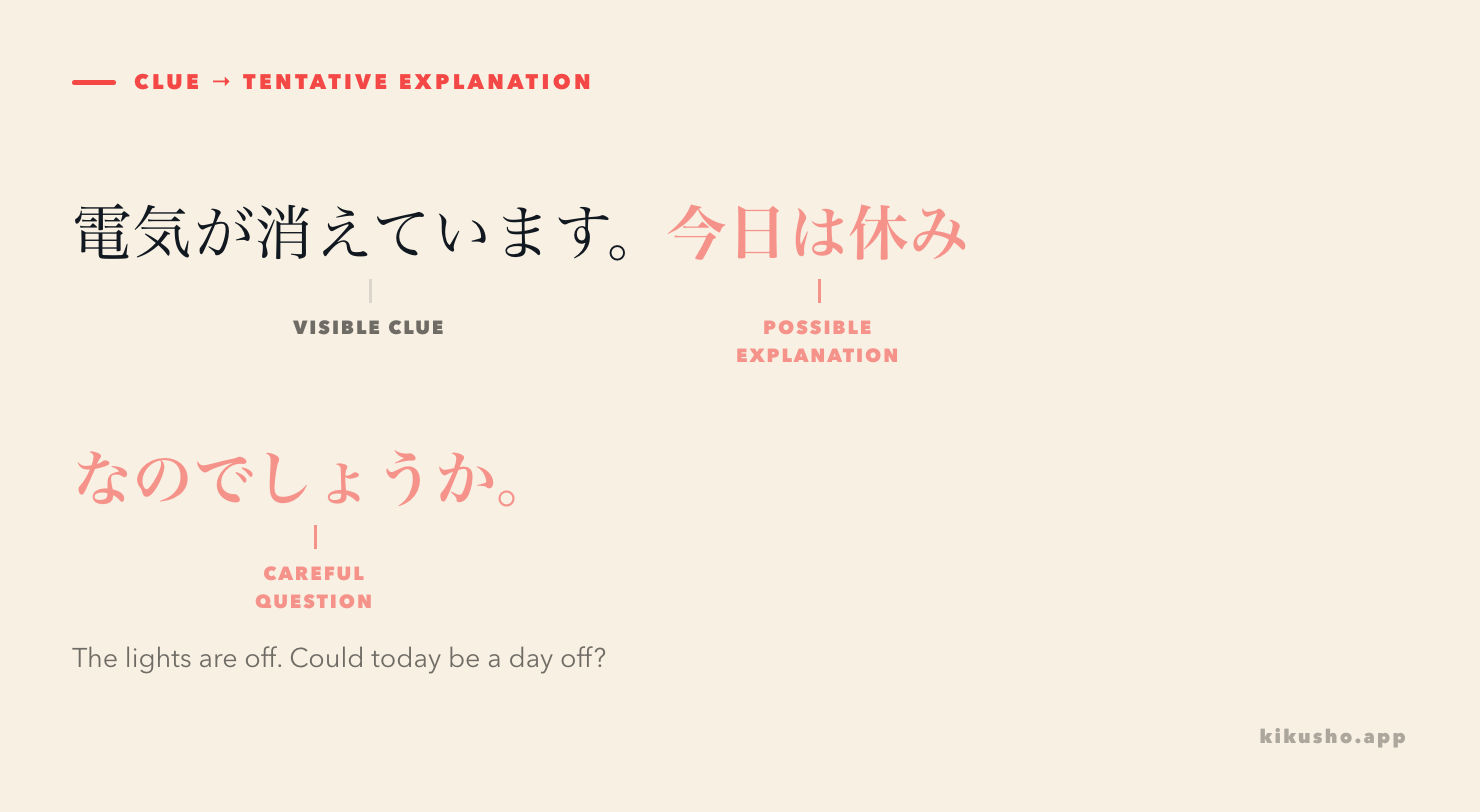
電気が消えています。今日は休みなのでしょうか。
でんきが きえています。きょうは やすみなのでしょうか。
The lights are off. Could today be a day off?
The first sentence supplies a clue. The second asks whether “today is a day off” explains it. That link to the situation is the centre of this N3 grammar point.
Explanatory の connects the question to a situation
A simple question can request a fact with no special premise:
会議は三時に始まりますか。
かいぎは さんじに はじまりますか。
Does the meeting start at three?
With のでしょうか, the speaker is trying to understand something already noticed, heard, or considered:
まだ誰も来ていません。会議は三時に始まるのでしょうか。
まだ だれも きていません。かいぎは さんじに はじまるのでしょうか。
Nobody has arrived yet. Does the meeting really start at three, I wonder?
The second question may seek confirmation from a listener, but it also reveals the speaker's reasoning. Nobody is here creates the gap that needs explaining.
This explanatory base is the same family taught in the んです and のです lesson. The N3 step adds でしょうか: the speaker leaves room for uncertainty instead of directly pressing for the missing explanation.
Shigure's comparison describes の as connecting the utterance to prior context and でしょうか as lowering the demand for a definite answer. NIHONGO NET likewise defines the pattern as a polite way to voice something the speaker wonders about.
Attach plain forms, with な after a noun or な-adjective
Put the plain predicate before のでしょうか. Present affirmative nouns and な-adjectives insert な.
| Predicate type | Attachment | Example |
|---|---|---|
| verb | plain verb + のでしょうか | 行くのでしょうか |
| い-adjective | plain adjective + のでしょうか | 難しいのでしょうか |
| noun | noun + なのでしょうか | 休みなのでしょうか |
| な-adjective | な-adjective + なのでしょうか | 必要なのでしょうか |
なぜこの店はこんなに人気があるのでしょうか。
なぜ この みせは こんなに にんきが あるのでしょうか。
Why is this shop so popular?
この方法は初心者には難しいのでしょうか。
この ほうほうは しょしんしゃには むずかしいのでしょうか。
Is this method difficult for beginners, I wonder?
あの方は新しい先生なのでしょうか。
あの かたは あたらしい せんせいなのでしょうか。
Could that person be the new teacher?
Past and negative forms already contain the plain material they need:
| Meaning | Correct form |
|---|---|
| did they leave? | 帰ったのでしょうか |
| are they not going? | 行かないのでしょうか |
| was it a holiday? | 休みだったのでしょうか |
| is it not necessary? | 必要ではないのでしょうか |
Do not insert an extra な after だった or ではない. Also avoid polite forms inside the frame: × 行きますのでしょうか duplicates politeness. Use 行くのでしょうか.
JLPT Sensei and NIHONGO NET both give the plain-form attachment and the special な for present affirmative nouns and な-adjectives. Both place the construction at N3. The JLPT publishes no exhaustive official grammar list, so that level is a study estimate.
ですか, んですか and のでしょうか ask at different distances
These questions can describe the same event while placing different demands on the listener.
| Question | Usual stance |
|---|---|
| 田中さんは帰りましたか。 | direct request for the fact |
| 田中さんは帰ったんですか。 | asks for confirmation or background prompted by context |
| 田中さんは帰ったのでしょうか。 | considers that explanation tentatively and asks with more distance |
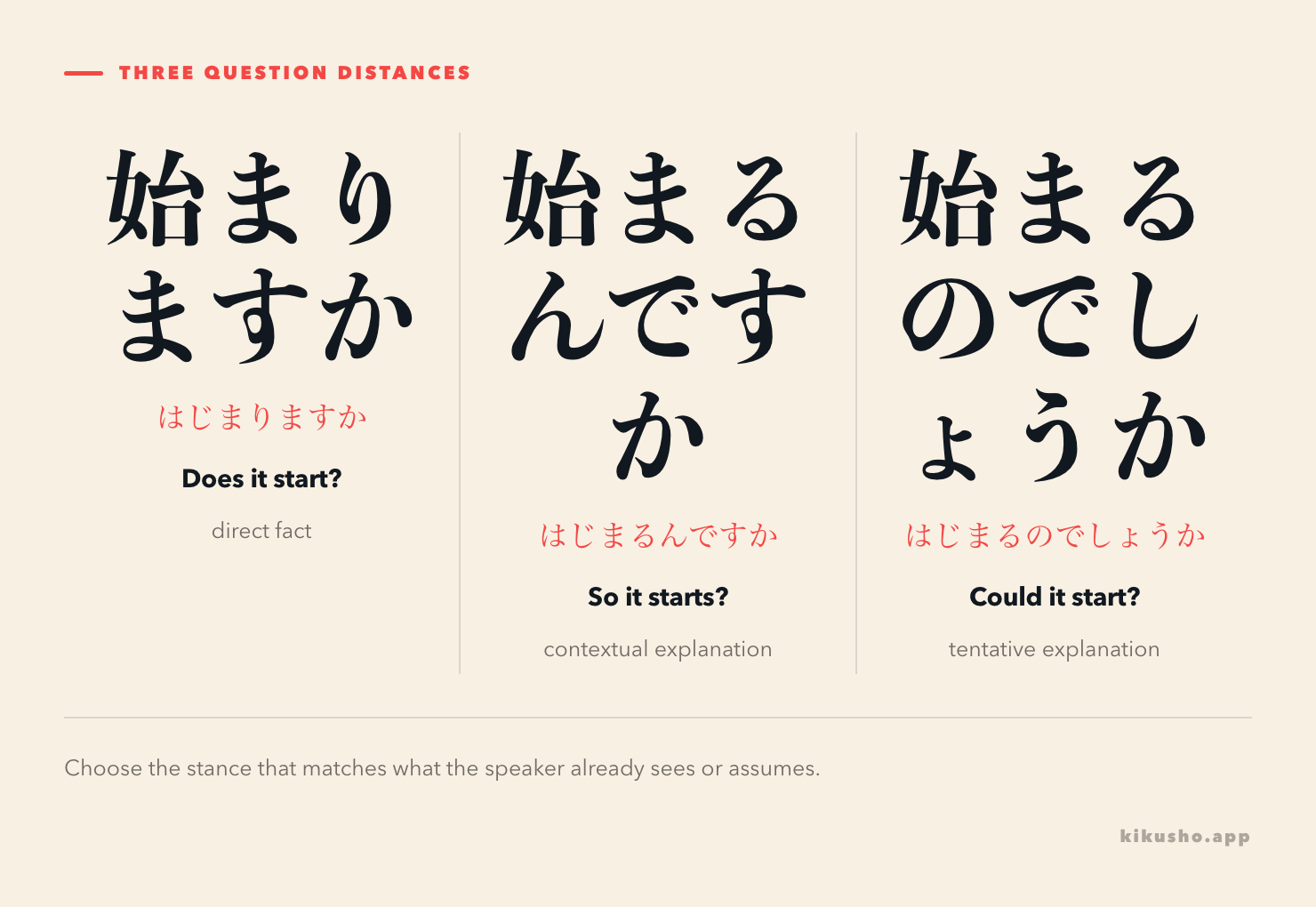
The middle form is not rude by default. んですか is ordinary polite conversation and often the natural choice when you expect the listener to know. The longer のでしょうか can be useful when you do not want to presume that the listener has a definite answer, when you are checking an inference, or when the question is partly addressed to yourself.
木村さんが連絡もせずに遅れています。何かあったのでしょうか。
きむらさんが れんらくも せずに おくれています。なにか あったのでしょうか。
Kimura is late without contacting us. Could something have happened?
The speaker has evidence but no conclusion. The sentence can invite another person's view, yet it does not sound like a demand that the listener explain Kimura's actions.
Question words often seek the missing reason or method
なぜ, どうして, どう, いつ, どこ, and other question words can sit inside the pattern.
なぜ予定が変わったのでしょうか。
なぜ よていが かわったのでしょうか。
Why was the schedule changed?
この場合、どうすればいいのでしょうか。
この ばあい、どうすれば いいのでしょうか。
What should I do in this situation?
次の発表はいつ行われるのでしょうか。
つぎの はっぴょうは いつ おこなわれるのでしょうか。
When will the next presentation take place?
The pattern does not make every question more respectful. Content still matters. Asking a stranger なぜ結婚しないのでしょうか remains intrusive even with a careful ending. Politeness cannot erase the pressure created by the topic.
For a routine request where no inference or explanation is involved, a shorter question is often better:
トイレはどこですか。
Where is the restroom?
トイレはどこなのでしょうか can sound as if the location has become a puzzle. The N5 question guide covers direct fact, reason, method, and choice questions. Choose のでしょうか because the situation calls for reflection or explanation, not because longer always means more polite.
Spoken んでしょうか and written のだろうか keep the same core
In conversation, のでしょうか commonly contracts to んでしょうか:
どうして今日はこんなに混んでいるんでしょうか。
どうして きょうは こんなに こんでいるんでしょうか。
Why is it so crowded today?
The contraction does not remove the explanatory function. For present affirmative nouns and な-adjectives, keep the linking な: 先生なんでしょうか, 静かなんでしょうか.
The plainer counterpart のだろうか often appears in essays, narration, headings, or inner questions:
なぜ同じ間違いが繰り返されるのだろうか。
なぜ おなじ まちがいが くりかえされるのだろうか。
Why is the same mistake repeated, one wonders?
No listener has to answer. The writer presents a question to investigate. Nihongo Arekore contrasts careful spoken のでしょうか with written or self-directed のだろうか, while noting that both grow from the same explanatory and tentative structure.
Practice
Complete the whole set before moving to the explanations below.
Question 1 — verb attachment. Choose the correct form: 会議は何時に始まる( )。
- ア. のでしょうか
- イ. ますのでしょうか
- ウ. なのでしょうか
- エ. のですでしょうか
Question 2 — noun attachment. Complete: 今日は休み( )。
- ア. のでしょうか
- イ. だのでしょうか
- ウ. なのでしょうか
- エ. んのでしょうか
Question 3 — choose the stance. You see the office lights off and wonder whether today is a holiday. Which question best connects that clue to a tentative explanation?
- ア. 今日は休みですか。
- イ. 今日は休みなのでしょうか。
- ウ. 今日は休みによって。
- エ. 今日は休みをしますか。
Question 4 — sentence composition. Arrange every chunk once: のでしょうか / なぜ / 変わった / 予定が
Question 5 — spoken contraction. Which spoken form correctly asks whether the room is quiet?
- ア. 静かんでしょうか
- イ. 静かなんでしょうか
- ウ. 静かだんでしょうか
- エ. 静かにんでしょうか
Question 6 — choose the direct transaction. You simply need the restroom's location from a staff member. Which question is the clear default?
- ア. トイレはどこですか。
- イ. トイレはどこなのでしょうか。
- ウ. トイレはなぜですか。
- エ. トイレはどこだったのでしょうか。
Question 7 — text grammar. Choose the pair that fits the writer's reasoning.
木村さんはいつも連絡をします。しかし今日は連絡がなく、まだ来ていません。何か( 甲 )。もし体調が悪いなら、私たちはどう( 乙 )。
- ア. 甲: あったのでしょうか / 乙: すればいいのでしょうか
- イ. 甲: ありますか / 乙: しましたか
- ウ. 甲: あるによって / 乙: するので
- エ. 甲: あったなんですか / 乙: すればいいですのでしょうか
Answers and explanations
Answer 1. ア. のでしょうか. The plain verb 始まる attaches directly. 始まりますのでしょうか puts a polite form inside the construction; な is reserved for present affirmative nouns and な-adjectives.
Answer 2. ウ. なのでしょうか. 休み is a noun, so the present affirmative form needs な before explanatory の. The other choices omit or duplicate the copular link.
Answer 3. イ. 今日は休みなのでしょうか. The visible darkness supplies a clue, and the speaker tentatively considers a holiday as its explanation. A can ask the same basic fact but does not mark that reasoning as clearly. C and D do not form this meaning.
Answer 4. なぜ予定が変わったのでしょうか. なぜ asks for the reason, 予定が marks what changed, and the plain past verb 変わった attaches to のでしょうか.
Answer 5. イ. 静かなんでしょうか. The contraction んでしょうか still requires な after a present affirmative な-adjective. The other options lose or misplace that link.
Answer 6. ア. トイレはどこですか. This is a routine request for a location, with no clue or explanatory puzzle to frame. B is grammatically possible in a reflective context, but it is needlessly indirect for the stated transaction. C asks the wrong kind of question; D introduces an unsupported past setting.
Answer 7. ア. 甲: あったのでしょうか / 乙: すればいいのでしょうか. Kimura's unusual silence gives the writer grounds to wonder whether something happened. The following question carefully considers the appropriate response. B loses the reflective link, while C and D are malformed.
Keep the clue beside the question
A card containing only のでしょうか = I wonder hides the reason the form was chosen. Save the clue with the question: lights off before 休みなのでしょうか, or an unexplained delay before 何かあったのでしょうか. Kikusho lets you edit the example and nuance before saving, so a later review can ask you to recover the speaker's reasoning rather than one loose English gloss.
Common questions
What does のでしょうか mean?
It asks a careful question connected to clues, background or a problem the speaker is considering. Depending on context, English may use “why,” “I wonder,” “could it be” or an ordinary question.
What is the difference between んですか and のでしょうか?
Both can seek an explanation. んですか is an ordinary conversational question; のでしょうか adds the tentative distance of でしょう and can sound more careful or less demanding.
How does のでしょうか attach to nouns and な-adjectives?
Present affirmative nouns and な-adjectives take な: 学生なのでしょうか and 静かなのでしょうか. Verbs and い-adjectives attach directly in plain form, as in 行くのでしょうか and 難しいのでしょうか.
Is んでしょうか different from のでしょうか?
They share the same core construction. んでしょうか is the common spoken contraction, while full のでしょうか fits careful speech and writing.