On this page
Use を中心に when one noun is the centre or main focus; use をはじめ when one noun is a representative member of a larger group. The quickest test is to ask whether the sentence organises something around A, or opens a set with A as its leading example.
この授業では、会話を中心に練習します。
この じゅぎょうでは、かいわを ちゅうしんに れんしゅうします。
In this class, we practise mainly conversation.
この授業では、会話をはじめ、読解や作文も練習します。
この じゅぎょうでは、かいわを はじめ、どっかいや さくぶんも れんしゅうします。
In this class, we practise conversation, reading comprehension, writing and more.
The first class has a focus. The second has a set. English may translate both loosely with “mainly,” “including,” or “starting with,” so the Japanese relationship has to decide.
Ask whether A is the centre or one member of the set
を中心に answers “What is this activity, area or organisation centred on?” The noun before it stays important throughout the rest of the sentence.
をはじめ answers “Which prominent example introduces the wider group?” The clause after it must make that group visible or recoverable.
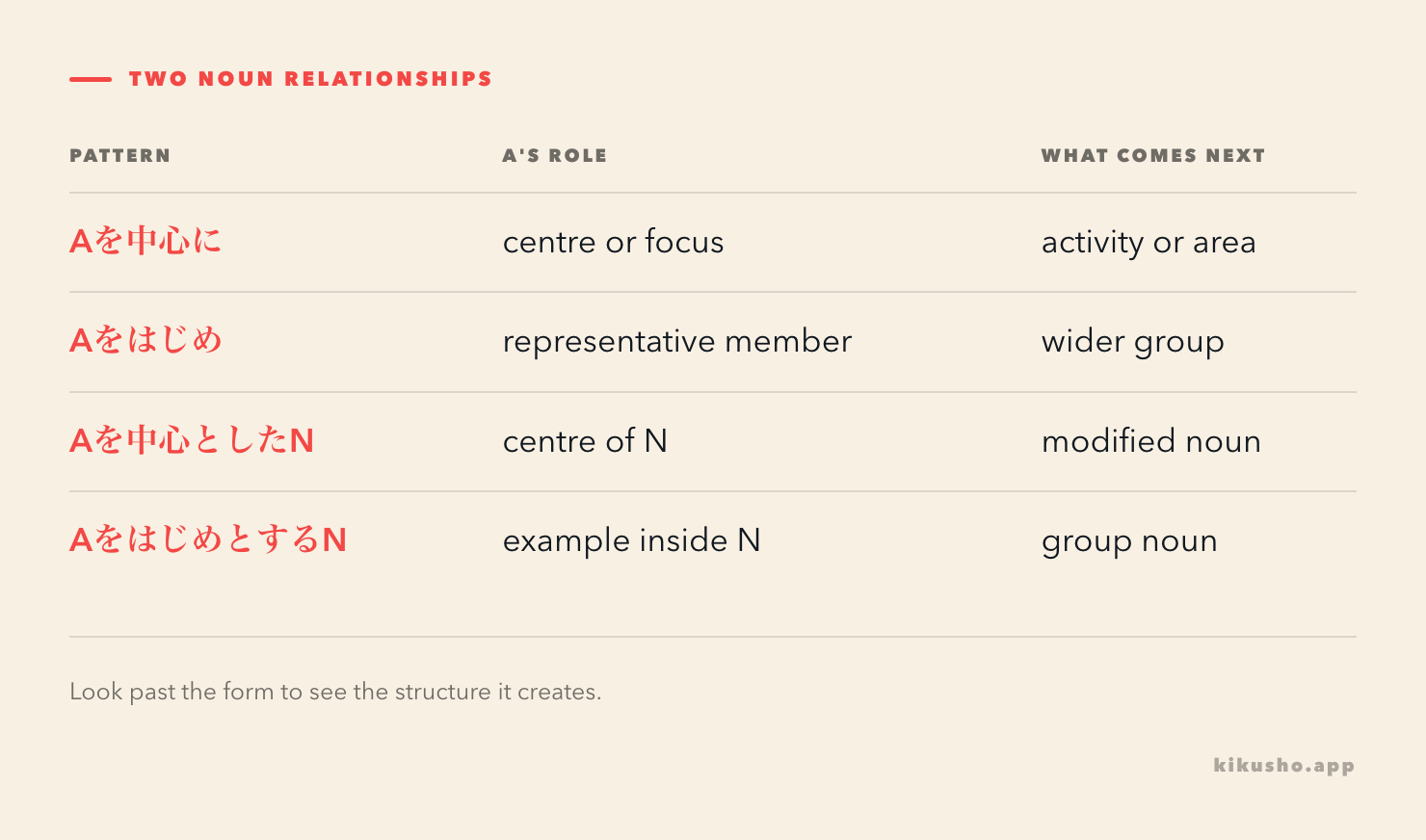
| Relationship | Choose | What follows |
|---|---|---|
| A is the physical or abstract centre | Aを中心に | an activity, arrangement, spread or focus |
| A is one representative member | Aをはじめ | more members or a phrase naming their group |
Compare two travel plans:
京都を中心に関西を旅行しました。
きょうとを ちゅうしんに かんさいを りょこうしました。
I travelled around Kansai with Kyoto as my main base or focus.
京都をはじめ、関西の古い町を旅行しました。
きょうとを はじめ、かんさいの ふるい まちを りょこうしました。
I travelled to Kyoto and other old towns in Kansai.
Kyoto can fill either slot because the speaker can view it in two ways. The first sentence organises the trip around Kyoto. The second selects Kyoto from the places visited and signals that other members follow.
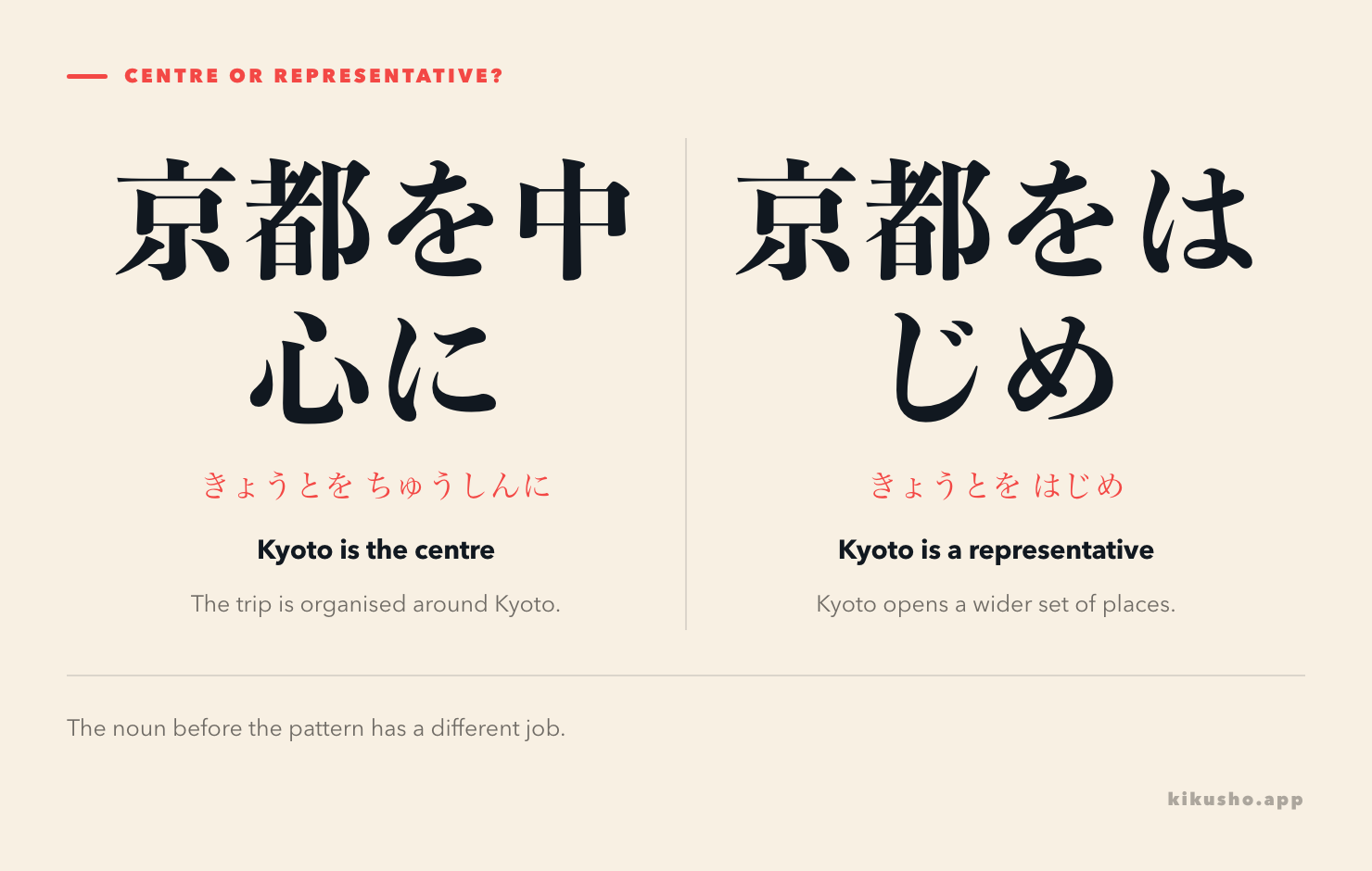
Tanosuke's comparison states the distinction directly: を中心に places something at the centre, while をはじめ presents a representative example before the others. That relation, rather than the English gloss, is the reliable test.
を中心に keeps one point at the centre
Attach を中心に, を中心にして, or を中心として to a noun, then continue with the predicate.
| Pattern | Function | Example |
|---|---|---|
| Nを中心に + predicate | makes N the centre or main focus | 文法を中心に復習する |
| Nを中心にして + predicate | explicitly frames N as the centre | 駅を中心にして町が広がる |
| Nを中心として + predicate | a slightly fuller variant | 委員長を中心として準備を進める |
| Nを中心とする + noun | modifies the following noun | 東京を中心とする地域 |
| Nを中心とした + noun | modifies the following noun | 会話を中心とした授業 |
The centre can be physical:
駅を中心に商店が集まっています。
えきを ちゅうしんに しょうてんが あつまっています。
Shops are clustered around the station.
It can also be the main content of an activity:
会議では、新しい予算案を中心に話し合いました。
かいぎでは、あたらしい よさんあんを ちゅうしんに はなしあいました。
At the meeting, we mainly discussed the new budget proposal.
Or it can identify the group in which a tendency is especially strong:
このサービスは若い世代を中心に利用されています。
この サービスは わかい せだいを ちゅうしんに りようされています。
This service is used mainly by younger generations.
That last sentence does not say that only younger people use the service. It marks them as the main concentration. The pattern can leave a surrounding range open, but it does not turn the younger generation into the first item of a list.
NIHONGO NET's を中心に reference verifies the noun attachment and the base-point or concentration senses. MIT OpenCourseWare's intermediate Japanese grammar material independently gives the adverbial and noun-modifying forms, including を中心として, を中心に, and を中心とした N.
をはじめ opens a wider group with a representative
Attach をはじめ or をはじめとして to a noun. The rest of the sentence then names more members or a collective that contains them.
| Pattern | Function | Example |
|---|---|---|
| Nをはじめ + wider set | introduces a representative member | 京都をはじめ、多くの町 |
| Nをはじめとして + wider set | fuller version of the same relation | 社長をはじめとして、社員全員 |
| Nをはじめとする + noun | modifies a noun naming the wider group | 京都をはじめとする観光地 |
校長先生をはじめ、先生方全員が式に参加しました。
こうちょうせんせいを はじめ、せんせいがた ぜんいんが しきに さんかしました。
The principal and all the teachers attended the ceremony.
The principal is a prominent member of 先生方. The sentence does not claim that everyone gathered physically around the principal.
この店では、抹茶をはじめとする日本のお茶を販売しています。
この みせでは、まっちゃを はじめとする にほんの おちゃを はんばいしています。
This shop sells Japanese teas, including matcha.
Here 日本のお茶 names the set and 抹茶 supplies its representative member. The modifier cannot end at をはじめ: 抹茶をはじめとする needs the noun it modifies.
JLPT Sensei's をはじめ page records the noun attachment and the をはじめとする modifier. Bunpro adds a useful limit: unlike a neutral “not only A but also B,” をはじめ presents A as a leading or representative member of a broader set.
A list is required for をはじめ, but not for を中心に
The missing continuation often exposes the wrong choice.
会議では予算を中心に話し合いました。
At the meeting, we focused on the budget.
This is complete. The sentence tells us what stood at the centre of the discussion.
会議では予算をはじめ、来年度の計画や人員について話し合いました。
At the meeting, we discussed the budget, next year's plan, staffing and other matters.
This is also complete because 来年度の計画や人員 supplies more discussion topics. By contrast, 会議では予算をはじめ話し合いました leaves the reader waiting for the group that the budget was meant to introduce.
The members must belong to a sensible class. 富士山をはじめ、日本の山々 works because Mount Fuji belongs to the group “Japanese mountains.” 富士山をはじめ、日本の文化 is hard to interpret as a clean set: a mountain is not itself a type of culture. If the intended meaning is “Japanese culture with Mount Fuji as a central symbol,” rewrite the whole relation instead of forcing をはじめ.
This pattern also differs from the paired addition forms in the だけでなく and ばかりでなく lesson. Those forms add B to A without requiring A to represent a larger class. をはじめ makes that representative relationship part of the sentence.
“Starting with” does not have to describe time order
The はじめ inside the expression can tempt you to read every sentence as a chronological beginning. Often no sequence of events exists.
北海道をはじめ、全国で雪が降りました。
ほっかいどうを はじめ、ぜんこくで ゆきが ふりました。
Snow fell nationwide, notably in Hokkaido.
Hokkaido is a representative place within the nationwide area. The sentence does not necessarily mean that snow began there and moved elsewhere. If time order is the point, use wording that states it directly, such as まず北海道で始まり、その後、全国に広がりました.
Likewise, 社長をはじめ、社員全員が参加した identifies the president prominently within the participants. It does not prove that the president arrived first.
Both target forms suit reports, presentations and explanatory prose. They can occur in speech, but an everyday conversation may prefer 主に for “mainly” or たとえば~など for an example. Register does not change the core test: centre versus representative member.
A useful Kikusho card for either pattern needs the material to its right. 会話を中心に練習する preserves the activity arranged around conversation. 会話をはじめ、読解や作文も練習する preserves the wider set. The editable card can then carry the relation you need to recall, rather than the isolated gloss “mainly.”
Level labels differ across study references
The Kikusho curriculum teaches both forms here as intermediate grammar. JLPT Sensei and Tanosuke label them N3, and Bunpro labels をはじめ N3. Bunpro places を中心に at N2, while NIHONGO NET labels を中心に N3 and をはじめ N2.
That difference is an editorial boundary, not a change in meaning. No complete official list of testable JLPT grammar has been released, so these labels remain study-guide estimates. For study order, learn the concrete noun relationships first: centre, representative member, and wider group. Those remain stable whichever book introduces the forms.
Practice
Try the full set before scrolling to the explanations.
Question 1 — choose the relationship. The trip used Osaka as its base and concentrated on the surrounding area. Complete: 大阪( )関西を旅行しました。
- ア. をはじめ
- イ. を中心に
- ウ. をはじめとする
- エ. を中心とする
Question 2 — complete the representative set. Choose the natural sentence.
- ア. 校長先生を中心に、先生方全員が式に参加しました。
- イ. 校長先生をはじめ、先生方全員が式に参加しました。
- ウ. 校長先生をはじめとする、式に参加しました。
- エ. 校長先生を中心とする、先生方全員が式に参加しました。
Question 3 — noun modification. Complete: 東京( )関東の地域で事業を展開しています。 The company operates in areas centred on Tokyo.
- ア. を中心とした
- イ. をはじめ
- ウ. を中心に
- エ. をはじめとして
Question 4 — sentence composition. Put the four chunks in order so environmental problems form the discussion's focus: 話し合いました / 会議では / 環境問題を / 中心に
Question 5 — find the continuation. Which ending completes 抹茶をはじめ、… by naming a wider set that contains matcha?
- ア. 日本のお茶をいろいろ販売しています。
- イ. 店の中心に棚があります。
- ウ. 抹茶だけが売り切れました。
- エ. 茶道を始めました。
Question 6 — meaning in context. What does the sentence imply? 若い世代を中心に、このアプリの利用者が増えています。
- ア. Only young people may use the app.
- イ. Young people are the first item in an explicit list.
- ウ. Growth is especially concentrated among younger generations.
- エ. Young people created the app before everyone else.
Question 7 — text grammar. Which pair gives the festival a physical hub and introduces representative participants?
今回の祭りでは、駅前広場を( 甲 )イベントを行います。地元の店を( 乙 )、多くの団体が参加します。
- ア. 甲: 中心に / 乙: はじめ
- イ. 甲: はじめ / 乙: 中心に
- ウ. 甲: 中心とする / 乙: はじめとする
- エ. 甲: はじめとして / 乙: 中心とした
Answers and explanations
Answer 1. イ. を中心に. Osaka is the base or focus around which the trip is organised. をはじめ would need Osaka to introduce other members of a set. The noun-modifying choices ウ and エ need a following noun.
Answer 2. イ. 校長先生をはじめ、先生方全員が式に参加しました。 The principal is a prominent member of the wider group 先生方全員. ア could describe an event organised around the principal, which is a different claim. ウ and エ leave a noun-modifying form without a noun.
Answer 3. ア. を中心とした. It modifies 関東の地域 and describes those areas as centred on Tokyo. ウ is adverbial and would need a predicate directly after the phrase. イ and エ would present Tokyo as a representative example rather than a centre.
Answer 4. 会議では環境問題を中心に話し合いました。 環境問題を中心に identifies the main focus of 話し合いました. A sentence with をはじめ would need additional discussion topics or a collective phrase after the representative example.
Answer 5. ア. 日本のお茶をいろいろ販売しています。 Matcha belongs to the wider group “Japanese teas,” so it can introduce that set. イ changes to a physical centre, ウ gives no wider set, and エ uses the lexical verb 始めました, “started,” rather than the grammar pattern.
Answer 6. ウ. Growth is especially concentrated among younger generations. を中心に marks the main concentration while allowing users from other age groups. It does not impose an exclusive rule, create a list, or identify who developed the app.
Answer 7. ア. 甲: 中心に / 乙: はじめ. The events are organised around the station plaza, so it is their physical centre. Local shops are representative participants within the larger group 多くの団体. ウ needs nouns after both modifying forms, while イ and エ reverse the intended relationships.
The most useful final check is visible in the noun after the blank. A centre can stand on its own before an action. A representative example points ahead to company.
Common questions
What is the difference between を中心に and をはじめ?
を中心に makes a noun the centre, focus or main area of an activity. をはじめ presents one prominent member as a representative example of a wider group.
How does を中心に modify a noun?
Use noun + を中心とする + noun or noun + を中心とした + noun, as in 東京を中心とする地域 and 文法を中心とした授業.
How does をはじめ modify a noun?
The usual pattern is noun + をはじめとする + noun, where the final noun names the wider group, as in 京都をはじめとする観光地.
Are を中心に and をはじめ N3 grammar?
Several study references place both at N3, while other references place one or both at N2. These are editorial estimates because the JLPT publishes no exhaustive official grammar list.