On this page
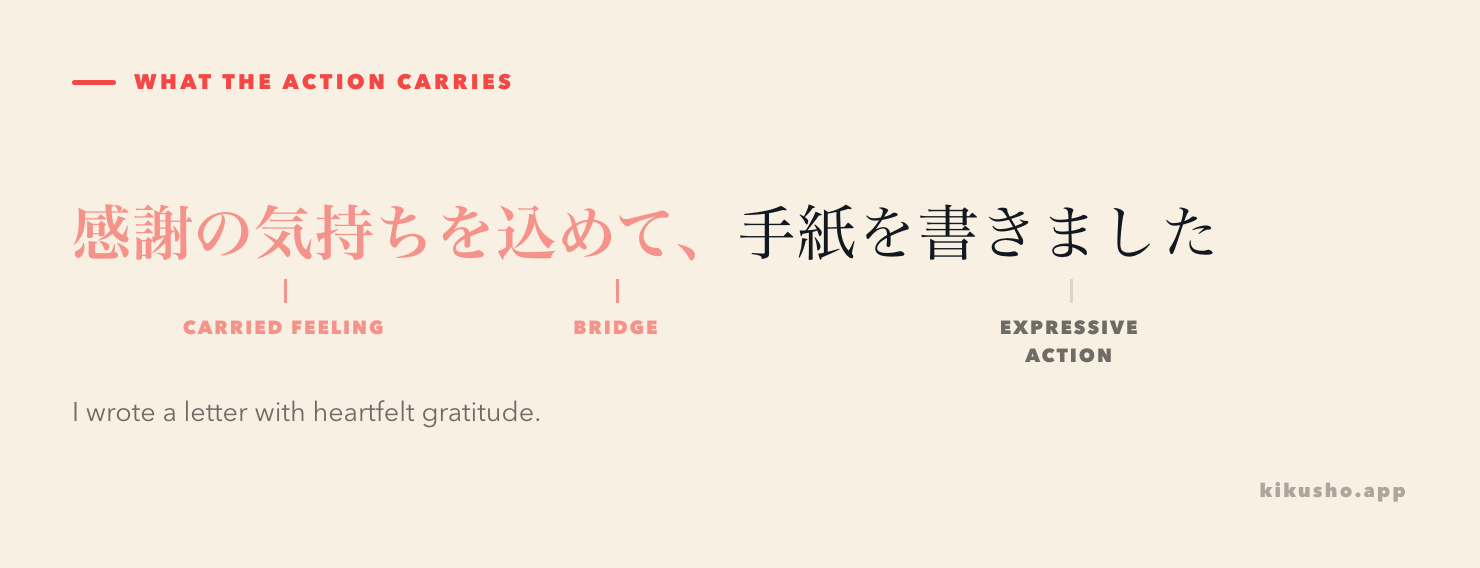
Put a noun for a feeling, wish or effort before を込めて, then name the action that carries it. In 感謝の気持ちを込めて手紙を書く, gratitude is what the writer puts into the act of writing; the letter is how that feeling reaches someone else.
感謝の気持ちを込めて、先生に手紙を書きました。
かんしゃの きもちを こめて、せんせいに てがみを かきました。
I wrote my teacher a letter with heartfelt gratitude.
The English “with” is convenient, but it hides the useful picture. を marks the feeling as the object of 込める (“to put into” or “to fill with”), and the following action becomes its vehicle.
Put the carried feeling before を込めて
The basic attachment is noun + を込めて + action. The noun usually names an inner attitude that the speaker deliberately expresses through the action.
| Carried noun | Reading | Natural continuation | What the action conveys |
|---|---|---|---|
| 心 | こころ | 心を込めて作る | care and sincerity |
| 感謝の気持ち | かんしゃのきもち | 感謝の気持ちを込めて書く | gratitude |
| 愛情 | あいじょう | 愛情を込めて作る | affection |
| 願い | ねがい | 願いを込めて折る | a wish or hope |
| 祈り | いのり | 祈りを込めて歌う | a prayer |
| 敬意 | けいい | 敬意を込めて話す | respect |
母は愛情を込めて弁当を作りました。
ははは あいじょうを こめて べんとうを つくりました。
My mother made the lunch with love.
合格への願いを込めて、お守りを渡しました。
ごうかくへの ねがいを こめて、おまもりを わたしました。
I gave them a lucky charm with a wish for their success.
NIHONGO NET gives N + を込めて and describes the pattern as putting a feeling or effort into an action. Bunpro independently explains the same construction through the literal verb 込める and stresses that the set phrase primarily carries a feeling or emotion.
The action should offer a plausible way to express the feeling. Letters, gifts, cooking, songs, speeches and handmade objects work readily because another person can receive or perceive the care behind them. 感謝を込めて寝ました is difficult without an unusual context: sleeping does not normally communicate gratitude.
The action is a vehicle, not a purpose
Two questions keep the pattern clear:
- What feeling, wish or effort is being invested?
- What action or object carries it?
In 祈りを込めて鶴を折る, 祈り answers the first question and 鶴を折る answers the second. The phrase does not simply say why the person folds the crane.
平和への祈りを込めて、鶴を折りました。
へいわへの いのりを こめて、つるを おりました。
I folded a crane with a prayer for peace.
Compare a purpose sentence:
平和を願うために、式を開きました。
へいわを ねがう ために、しきを ひらきました。
We held a ceremony in order to pray for peace.
ために states the goal of holding the ceremony. 祈りを込めて presents an attitude carried through the folding. The distinction is close to the wider contrast between intention and purpose in the ように and ために lesson.
The phrase also differs from merely having a feeling. 先生に感謝しています states that you are grateful to the teacher. 感謝を込めて先生に手紙を書きました shows what you did with that gratitude.
を込めた puts the same relation before a noun
When the whole expression modifies a noun, change 込めて to 込めた:
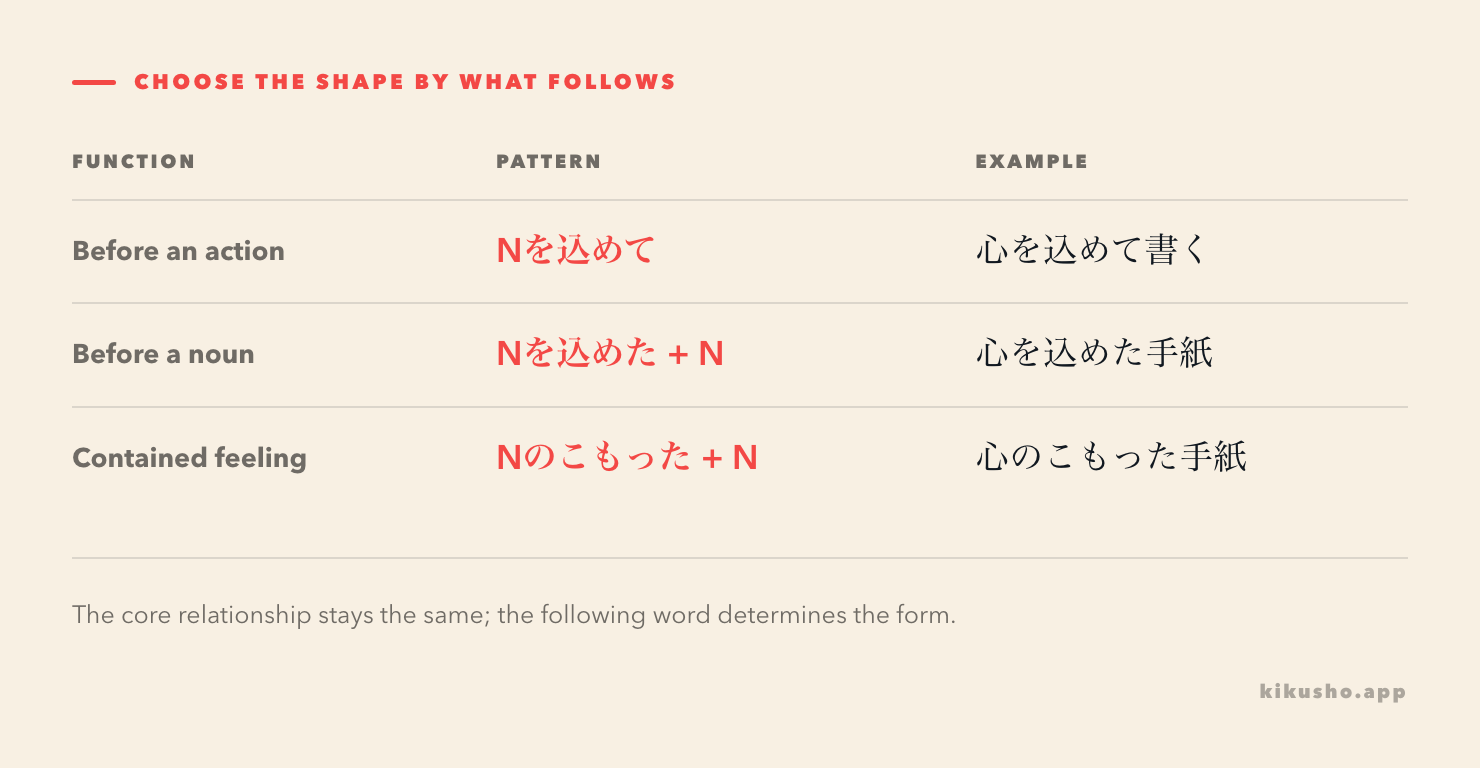
| Function | Pattern | Example |
|---|---|---|
| Continue to an action | Nを込めて + action | 心を込めて手紙を書く |
| Modify the product or action | Nを込めた + noun | 心を込めた手紙 |
| Describe something containing the feeling | Nのこもった + noun | 心のこもった手紙 |
これは皆さんへの感謝を込めた歌です。
これは みなさんへの かんしゃを こめた うたです。
This is a song filled with gratitude for everyone.
The past form 込めた does not make the whole sentence past. It is the form that directly modifies 歌. Tanosuke's grammar reference confirms both Nを込めたN and NのこもったN for noun modification.
The two modifier patterns look at the relation from different sides. 心を込めた手紙 foregrounds the person who invested care in the letter. 心のこもった手紙 describes the letter as containing that care. In many everyday contexts, both can describe the same letter.
Warm feelings are common, but they are not required
Cards, presents and meals make 愛情 and 感謝 easy first examples. The construction itself does not promise kindness. A speaker can put anger, resentment or irony into an action as well.
彼は怒りを込めて、その言葉を繰り返しました。
かれは いかりを こめて、その ことばを くりかえしました。
He repeated those words with anger.
This is still the same relation: 怒り is the feeling, and repeating the words is the act that carries it. 日本語教師のまる得's を込めて reference records positive and negative collocations including love, gratitude, anger, hatred and resentment. It also notes common extensions such as 力を込めて and 魂を込めて.
力を込めて can describe physical force rather than emotion:
力を込めて、重いドアを押しました。
ちからを こめて、おもい ドアを おしました。
I pushed the heavy door with force.
That sentence uses the same verb and attachment, but 力 is the effort applied to the movement. Keep it as a common extension instead of assuming that every noun before を込めて must name an emotion.
Literal uses of 込める extend further. Someone can load a gun or include a charge in a total. Those are lexical senses of the verb, not automatic substitutes for this feeling-and-action construction. For this lesson, test whether the noun is an attitude, wish or effort that the following act can carry.
を and に point to different roles
The target pattern answers what is put in:
感謝を込めて、手紙を書きました。
かんしゃを こめて、てがみを かきました。
I wrote a letter with gratitude.
If the sentence names where the feeling is placed, that container takes に:
感謝を手紙に込めて、送りました。
かんしゃを てがみに こめて、おくりました。
I put my gratitude into a letter and sent it.
In the second sentence, 感謝を remains the thing invested and 手紙に marks its destination. Do not replace one particle mechanically. Ask which role each noun has: feeling with を, container with に.
This is particularly useful when the action involves giving. The transfer verbs explain who sends and receives the object; を込めて explains the attitude carried by it. Review that separate viewpoint in the あげる, くれる and もらう lesson.
Study guides disagree on the level
NIHONGO NET, Tanosuke and 日本語教師のまる得 label を込めて as N3 grammar. Bunpro places it at N2. This lesson keeps it in Kikusho's N3 sequence because multiple independent teaching references introduce it there and its attachment builds on familiar noun particles and the て-form.
The difference is an editorial estimate, not a competing meaning. Because the test makers do not provide a complete form-by-form syllabus, study sites draw their own boundaries. Learn the stable facts first: the noun before を is what gets invested, the following action carries it, and を込めた modifies a noun.
Practice
Complete every question before opening the explanations below.
Question 1 — choose the natural completion
The speaker wants to say, “I made this present with gratitude.”
- ア. 感謝の気持ちを込めて、このプレゼントを作りました。
- イ. 感謝の気持ちに込めて、このプレゼントを作りました。
- ウ. このプレゼントを込めて、感謝の気持ちを作りました。
- エ. 感謝の気持ちを込めた、このプレゼントを作りました。
Question 2 — choose the modifier
Complete: これは祖母が心( )料理です。 The intended meaning is “This is a meal my grandmother made with care.”
- ア. を込めて
- イ. を込めた
- ウ. に込めて
- エ. が込めて
Question 3 — identify the role
In 願いを込めて、お守りを作りました, what role does 願い have?
- ア. It is the object being sold.
- イ. It is the place where the charm was made.
- ウ. It is the wish invested in the act of making the charm.
- エ. It is the person receiving the charm.
Question 4 — compose the sentence
Put the chunks in order to say “I sang with a prayer for peace.”
歌いました / 平和への祈りを / 込めて
Question 5 — choose the two roles
Complete the sentence: 感謝( 甲 )手紙( 乙 )込めて、先生に送りました。
- ア. 甲: を / 乙: に
- イ. 甲: に / 乙: を
- ウ. 甲: が / 乙: を
- エ. 甲: で / 乙: が
Question 6 — text grammar
Choose the pair that fits the passage.
卒業式で、先生への感謝の気持ちを( 甲 )、歌を歌いました。そのあと、みんなで心を( 乙 )カードを渡しました。
- ア. 甲: 込めて / 乙: 込めた
- イ. 甲: 込めた / 乙: 込めて
- ウ. 甲: 込める / 乙: 込めて
- エ. 甲: 込めて / 乙: 込める
Answers and explanations
Answer 1
ア. 感謝の気持ちを込めて、このプレゼントを作りました。 感謝の気持ち is what the maker invests, so it takes を. 込めて then connects that feeling to the action 作りました. エ would need a noun immediately after 込めた, such as 感謝の気持ちを込めたプレゼント.
Answer 2
イ. を込めた. The expression directly modifies the noun 料理, so use the attributive form 心を込めた料理. 心を込めて would instead continue to an action, as in 心を込めて料理を作りました.
Answer 3
ウ. It is the wish invested in the act of making the charm. 願いを identifies what is carried, while お守りを作りました names the action and its product. The sentence does not identify a shop, location or recipient.
Answer 4
平和への祈りを込めて歌いました。 平和への specifies what the prayer concerns, 祈りを込めて presents it as the feeling carried, and 歌いました is the action through which it is expressed.
Answer 5
ア. 甲: を / 乙: に. 感謝を marks the feeling being invested. 手紙に marks the container or destination into which that feeling is placed. The full sentence is 感謝を手紙に込めて、先生に送りました.
Answer 6
ア. 甲: 込めて / 乙: 込めた. The first blank connects the feeling to 歌を歌いました, so it needs 込めて. The second expression modifies カード, so it needs 心を込めたカード. Both clauses use the same core relation, but what follows determines the shape.
Do not stop at translating を込めて as “with.” Name what travels through the action. Once the feeling and its vehicle are both visible, the particle and form usually choose themselves.
Common questions
What does を込めて mean in Japanese?
Noun + を込めて means that someone performs the following action while putting the named feeling, wish or effort into it. 感謝を込めて手紙を書く is writing a letter with gratitude invested in the act.
What can come before を込めて?
Common nouns include 心, 気持ち, 感謝, 愛情, 願い, 祈り, 敬意 and even negative feelings such as 怒り. 力を込めて is also common when physical force is applied deliberately.
How does を込めて modify a noun?
Use noun + を込めた + noun, as in 心を込めた手紙. Japanese also commonly uses noun + のこもった + noun, as in 心のこもった手紙.
Is を込めて N3 or N2 grammar?
Several teaching references place it at N3, while Bunpro places it at N2. These are editorial estimates because the JLPT publishes no exhaustive official grammar list.