On this page
思う (omou) commonly presents what you believe or feel; 考える (kangaeru) emphasizes considering something, and 気がする (ki ga suru) presents a hunch. When English gives you only “I think,” choose the Japanese expression by deciding whether you are stating a view, working something out or reporting an impression.
This lesson teaches six words: 思う, 考える, 意見, 気, 気持ち and 心. Their readings and useful combinations appear below. 気がする supplies the third point of comparison; it is a phrase built around 気, not another spelling of 思う.
Decide what your thinking is doing
| Your purpose | Useful starting point | What it emphasizes |
|---|---|---|
| Give your view | ~と思う | The conclusion you hold |
| Consider a question or plan | ~を考える | The thinking process |
| Present a considered conclusion | ~と考える | Your judgment after consideration |
| Report a hunch | ~気がする | How the situation seems to you |
These are tendencies, not separate boxes for rational and irrational people. You can have reasons for something you express with 思う. You can also spend a long time thinking and reach the wrong conclusion with 考える.
The NINJAL explanation by linguist Yuki Watanabe connects the contrast to deliberate, sustained thinking versus thoughts and feelings that arise more spontaneously. That helps with a practical test: if someone needs time to reach an answer, 考える is usually the verb you need.
思う lets you state a view
思う(おもう) is a godan, or う-verb. Its polite form is 思います, its negative is 思わない and its past is 思った. The verb-group lesson explains how these groups affect endings.
To say what you think, put a plain-form statement before と:
| Kind of statement | Example | Meaning |
|---|---|---|
| Verb | 田中さんは来ると思います。 | I think Tanaka will come. |
| い-adjective | この店は安いと思います。 | I think this shop is inexpensive. |
| な-adjective | この道具は便利だと思います。 | I think this tool is useful. |
| Noun | 明日は休みだと思います。 | I think tomorrow is a day off. |
Read 道具 as どうぐ, “tool,” and 便利 as べんり, “convenient/useful.” Keep だ before と after an affirmative noun or な-adjective: 便利だと思います. The politeness is carried by 思います at the end; you do not need 便利ですと思います.
思っている can describe a view you continue to hold. It does not automatically mean that you are busy debating the question. 私はこの方法がいいと思っています means “I believe this method is good.” 方法(ほうほう)means “method.”
考える gives a question your attention
考える(かんがえる) is an ichidan, or る-verb: 考えます, 考えない, 考えた. Use it with the thing you are considering, such as a plan, an answer or a way of doing something.
明日の予定を考えています。
あしたの よていを かんがえています。
I am thinking about tomorrow's plans.
Here 考えています describes an ongoing mental task. The plans are what you are working on, so they take を. A question can also be the content of that task:
どちらを買うか、考えています。
どちらを かうか、かんがえています。
I am considering which one to buy.
The か closes the embedded question “which one to buy.” It does not ask your listener to answer a separate question. Compare a decision you have already reached: 安いほうを買おうと思います, “I think I'll buy the cheaper one.” Here 買おう expresses an intention, and 思います presents it. The presence of a future decision does not make 考える compulsory in every sentence about buying.
Both verbs can introduce the same opinion
この方法がいいと思います and この方法がいいと考えます can both mean “I think this method is good.” The second presents the judgment as considered. It fits an explanation in which you are ready to discuss your reasons. It need not mean that you are still undecided.
The Tofugu comparison by Kanae Nakamine distinguishes thinking about a problem from presenting an opinion. That distinction also prevents a register mistake: 考える is perfectly ordinary in conversation about choosing or planning. An opinion ending in と考える can sound more formal or deliberative than one ending in と思う. 思います itself is already polite.
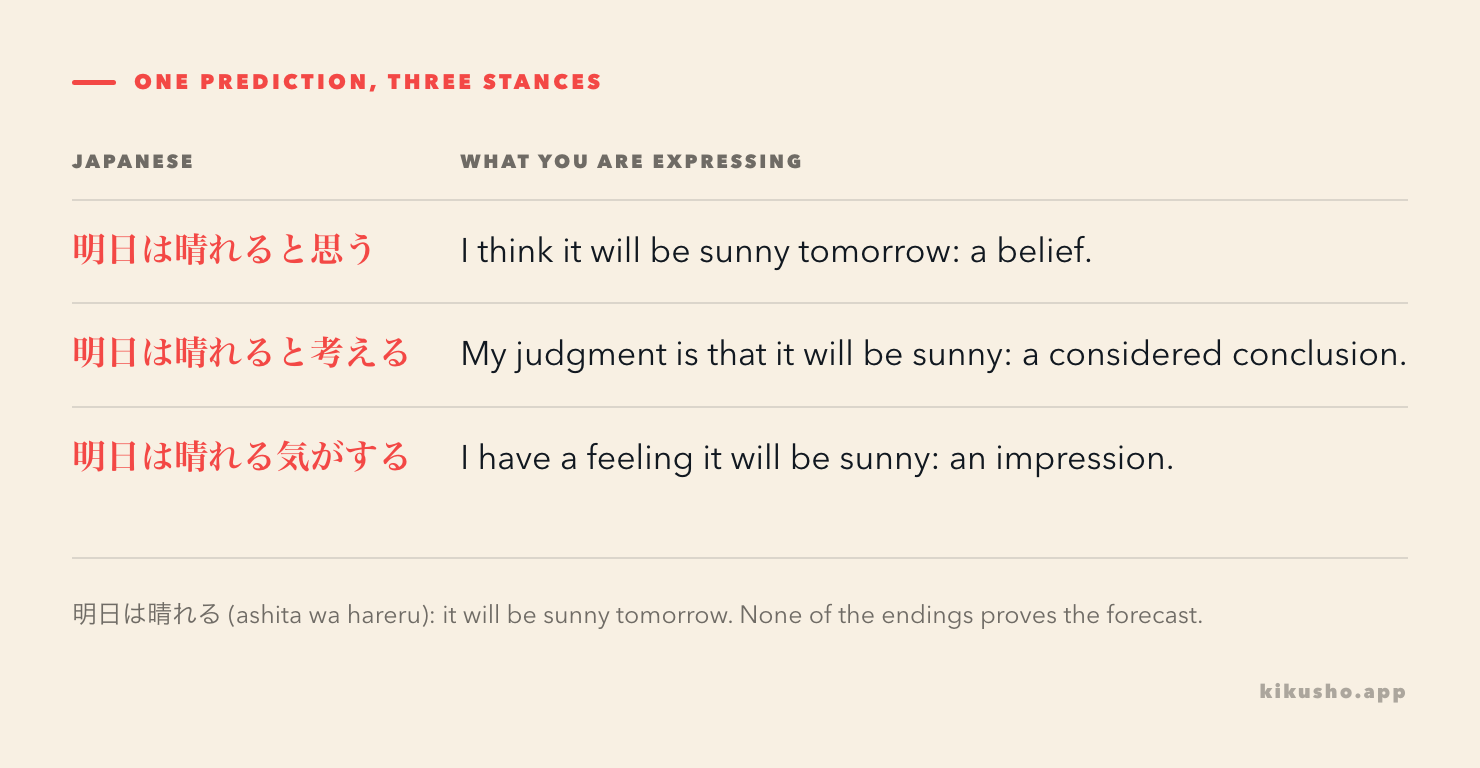
The figure uses 明日は晴れる(あしたは はれる), “it will be sunny tomorrow.” In selectable text, its endings are:
| Sentence | Suggested English |
|---|---|
| 明日は晴れると思う。 | I think it will be sunny tomorrow. |
| 明日は晴れると考える。 | My judgment is that it will be sunny tomorrow. |
| 明日は晴れる気がする。 | I have a feeling it will be sunny tomorrow. |
None of these phrases establishes the weather. They describe your stance toward the prediction.
気がする reports an impression
気がする(きがする) means “have a feeling that” or “get the impression that.” With a plain verb or an い-adjective, the basic pattern can attach directly: 来る気がする, 高い気がする. Do not insert the と from と思う into this pattern.
前にもこの道を歩いた気がします。
まえにも このみちを あるいた きがします。
I have a feeling I have walked along this road before.
This reports an impression of familiarity. It does not claim certain recall. If you mean the act of remembering, 思い出す is a different word, introduced in the lesson on compound verbs.
The longer expression ような気がする also marks an impression. A verb can precede ような directly, as in 歩いたような気がする; a noun takes の, as in 明日は休みのような気がする, “I have a feeling tomorrow is a day off.” Bunpro's explanation treats the longer pattern as N3 grammar. It is a useful extension here, rather than a claim that every expression on this page belongs to the same level.
Daijisen's entry for 気がする also includes feeling inclined to do something. For example, 出かける気がしない means “I don't feel like going out.” The phrase therefore needs its context; it cannot always be translated as a prediction or hunch.
意見, 気, 気持ち and 心 name different parts of the picture
These four are nouns. Keep them with a useful phrase so that “opinion,” “feeling” and “mind” do not collapse into one interchangeable English gloss.
| Word and reading | Sense taught here | Useful combination |
|---|---|---|
| 意見(いけん) | An opinion or view | 意見を言う: express an opinion |
| 気(き) | A mental state, attention or inclination | 気が楽になる: feel more at ease |
| 気持ち(きもち) | A feeling, emotional state or bodily sensation | 気持ちを伝える: convey your feelings |
| 心(こころ) | The mind or heart, one's inner feelings | 心から: sincerely, from the heart |
意見 is something you can offer in a discussion. 会議で自分の意見を言いました(かいぎで じぶんの いけんを いいました)means “I expressed my opinion at the meeting.” In this sense, learn 意見を言う rather than constructing 意見する from the English “give an opinion.” Dictionaries also record 意見する for admonishing someone, a separate use. See Daijisen on 意見.
気 acquires much of its meaning from its surroundings. 友達と話して、気が楽になりました(ともだちと はなして、きが らくに なりました)means “Talking with a friend made me feel more at ease.” That mental state differs from the impression in 気がする. Daijisen's 気 entry records these mental senses alongside other meanings; this lesson does not cover them all.
気持ち can name what you feel emotionally: 自分の気持ちを手紙で伝えました(じぶんの きもちを てがみで つたえました), “I conveyed my feelings in a letter.” It also covers bodily comfort: この風は気持ちいいです(このかぜは きもちいいです), “This breeze feels pleasant.” 気持ちいい expresses the pleasant sensation; it is not an opinion that the breeze's character is good. These uses are distinguished in Daijisen's 気持ち entry.
心 covers the inner mind and feelings, rather than just a single opinion. 心から感謝しています(こころから かんしゃしています)means “I am sincerely grateful.” The expression 心から gives the gratitude its sincerity. Read the standalone word here as こころ; the reading しん appears in other words and uses. Daijisen on 心 separates these readings and senses.
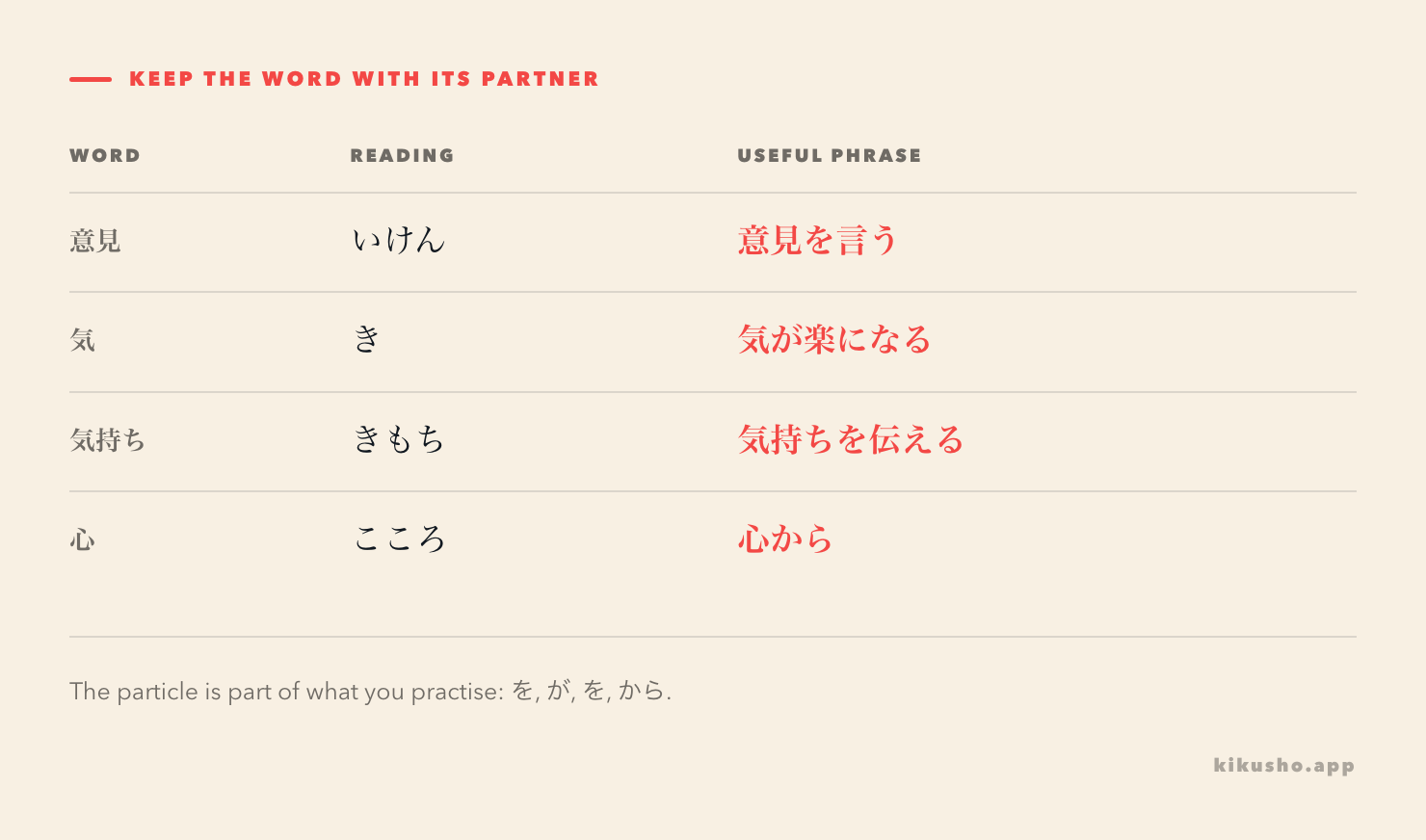
For review in Kikusho, paste a sentence where the distinction mattered. Check the drafted card's meaning and example, then keep the particular use you met: a hunch for 気がする, or emotional relief for 気が楽になる. A bare “feeling” on both cards would hide what you need to remember.
These six headwords sit in the curriculum's N4 vocabulary inventory, based on the Waller/Tanos list family. JapaneseTest4You also labels 思う and 考える N4. These are study-list estimates, not an official exhaustive JLPT syllabus. A word's placement does not assign all of its senses and phrases to N4.
Five questions to test the distinctions
The questions are original practice. Check the answer after choosing; for the final writing question, more than one natural sentence is possible.
Question 1: read 考える
How do you read the bold word in 明日の予定を考える?
A. かんがえる · B. おもう · C. こたえる · D. おぼえる
Answer 1: A, かんがえる. おもう reads 思う; こたえる reads 答える, “answer”; おぼえる reads 覚える, “remember/learn.” Those are different verbs, not alternate readings of 考える.
Question 2: write いけん
Choose the spelling meaning “opinion”: 自分の(いけん)を言ってください。
A. 意味 · B. 経験 · C. 意見 · D. 意外
Answer 2: C, 意見. The sentence asks you to express your opinion. 意味(いみ)means “meaning,” 経験(けいけん)means “experience,” and 意外(いがい)means “unexpected.” Matching only the first character is insufficient.
Question 3: choose the thinking process
You are comparing two methods and have not decided. Complete: どちらの方法がいいか、今( )。
A. 思っています · B. 考えています · C. 気がします · D. 意見を言いました
Answer 3: B, 考えています. “I am considering which method is better.” The embedded question ends in か and supplies the problem under consideration. A would fit a stated belief with と, such as この方法がいいと思っています. C would fit an impression, such as この方法がいい気がします. D says that you expressed an opinion in the past; it does not describe the current task or fit this sentence.
Question 4: identify the paraphrase
Which sentence keeps the meaning of 友達の気持ちを考えてください?
A. 友達がどう感じるか、考えてください。
B. 友達が何を買うか、考えてください。
C. 自分がどう感じるか、考えてください。
D. 友達に何を買ったか、聞いてください。
Answer 4: A. Both ask you to consider how your friend feels. B changes the subject to what the friend will buy. C asks about your own feelings. D asks you to find out what the friend bought. The person whose feelings matter is part of the meaning.
Question 5: use 心から in a thank-you
Someone helped you when you were having a difficult time. Write one sentence expressing sincere gratitude with 心から.
Answer 5: one natural answer is 心から感謝しています。 It means “I am sincerely grateful.” 心から modifies the expression of thanks; it is not a replacement for と思う or the noun 意見. 心からお礼を言いたいです, “I would like to thank you from the heart,” also works. Accept a different sentence if 心から naturally expresses the sincerity of the thanks.
Common questions
What is the difference between 思う and 考える?
思う commonly presents a belief, impression or feeling. 考える emphasizes considering something or working toward a decision. Both can introduce an opinion with と, but 考える presents it as a considered judgment.
Does 思う mean that I have no evidence?
No. 思う does not rule out evidence. It presents the statement as your view; 考える puts more emphasis on the reasoning. Neither word guarantees that the conclusion is correct.
How does 気がする differ from と思う?
気がする presents an impression or hunch, while と思う states what you think. After a plain verb, use 来る気がする for a feeling that someone will come, and 来ると思う for your belief that they will.
Are all expressions with 気 N4 vocabulary?
No. A level attached to the word 気 does not classify every expression containing it. This N4 vocabulary lesson introduces 気がする for comparison; the longer pattern ような気がする is placed at N3 by Bunpro.