On this page
それとも introduces another possible answer to the same question. In 電車で行きますか。それとも、バスで行きますか, the speaker is not merely naming transport methods: the listener is being asked to choose which one applies.
Keep both alternatives inside one question
The basic relationship is simple:
| First alternative | Link | Second alternative |
|---|---|---|
| Aですか | それとも | Bですか |
| Aますか | それとも | Bますか |
| Aか | それとも | Bか |
会議は午前ですか。それとも、午後ですか。
かいぎは ごぜんですか。それとも、ごごですか。
Is the meeting in the morning, or is it in the afternoon?
The first sentence already asks a complete question. それとも opens a second candidate answer without changing the subject. Both parts belong to one choice.
You can also place the alternatives in one sentence:
この席を予約しますか、それとも別の席を探しますか。
この せきを よやくしますか、それとも べつの せきを さがしますか。
Will you reserve this seat, or will you look for another one?
The full stop and comma change the rhythm, not the core relationship. A full stop lets the speaker pause before offering the next option. A comma keeps the alternatives in one written sentence.
The Shogakukan dictionary entry reproduced by Kotobank classifies それとも as a conjunction and defines its central modern use as presenting another matter for selection. Bunpro's それとも reference likewise places it between option A and option B and notes that it can follow a comma or begin a new sentence.
Repeat only what the contrast needs
The second alternative may repeat the whole predicate:
飲み物は温かいものにしますか、それとも冷たいものにしますか。
のみものは あたたかい ものに しますか、それとも つめたい ものに しますか。
Will you have a hot drink, or will you have a cold one?
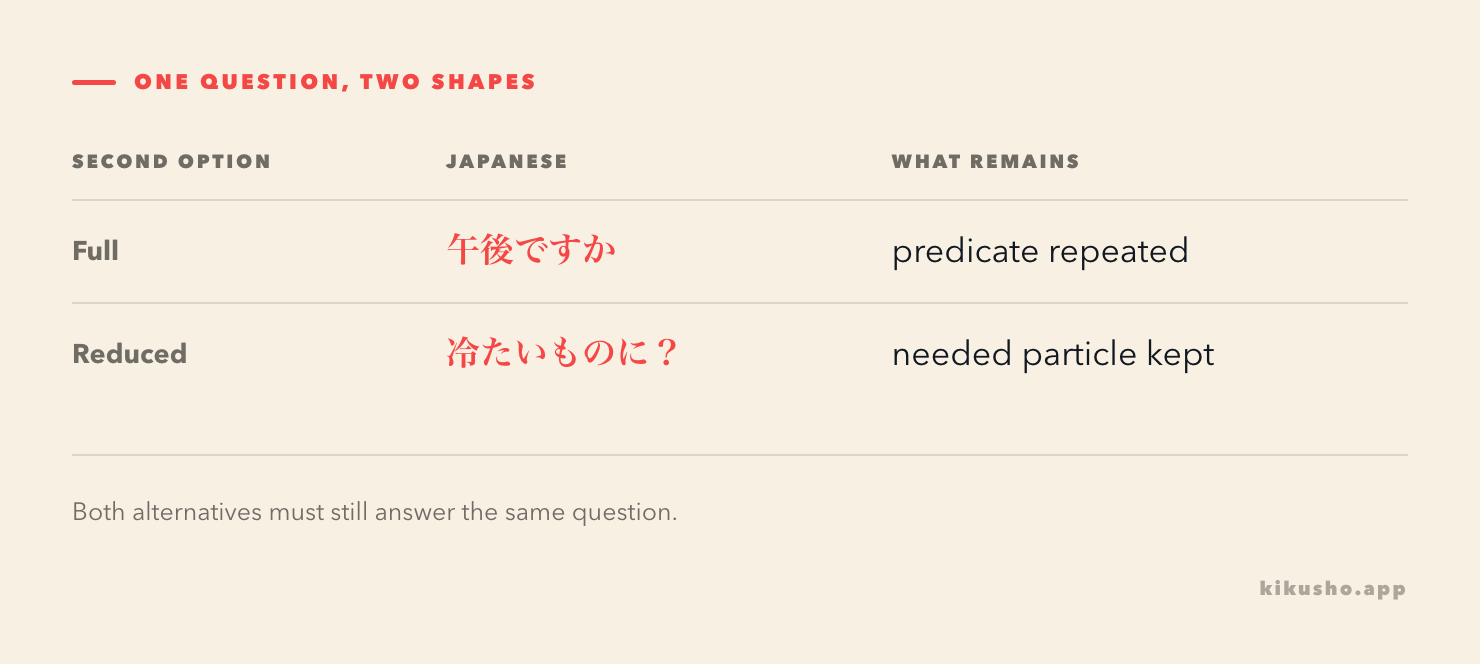
When the shared material is obvious, ordinary conversation often leaves it out:
飲み物は温かいものにしますか。それとも、冷たいものに?
のみものは あたたかい ものに しますか。それとも、つめたい ものに?
Will you have a hot drink? Or a cold one?
The particle に remains because it marks the role of the second option in ~にする, “choose or decide on.” Omitting repeated words is safe only when the listener can restore them. A bare それとも冷たいもの? can work in a clear conversation, but the version with に preserves the grammatical parallel more precisely.
That principle extends beyond nouns. The alternatives can be times, descriptions, actions or complete propositions:
| What is contrasted? | Example |
|---|---|
| time | 今日出発しますか、それとも明日ですか。 |
| identity | 受付の方ですか、それとも先生ですか。 |
| action | ここで待ちますか、それとも先に行きますか。 |
| explanation | 道に迷ったのですか、それとも電車が遅れたのですか。 |
The pieces do not have to be opposites. They need to be plausible alternatives under the same question.
Use か、それとも…か inside a larger sentence
An alternative question can be embedded as the object of deciding, knowing, asking or considering. In that shape, か marks each unresolved option:
参加するか、それとも断るか、今夜決めます。
さんかするか、それとも ことわるか、こんや きめます。
I will decide tonight whether to participate or decline.
本人に電話するか、それともメールを送るか、担当者に確認しました。
ほんにんに でんわするか、それとも メールを おくるか、たんとうしゃに かくにんしました。
I asked the person in charge whether to phone the person directly or send an email.
The whole Aか、それともBか sequence supplies the unresolved content. It is not a direct question to the reader, so the sentence can end with 決める, 分からない, 考える or another predicate.
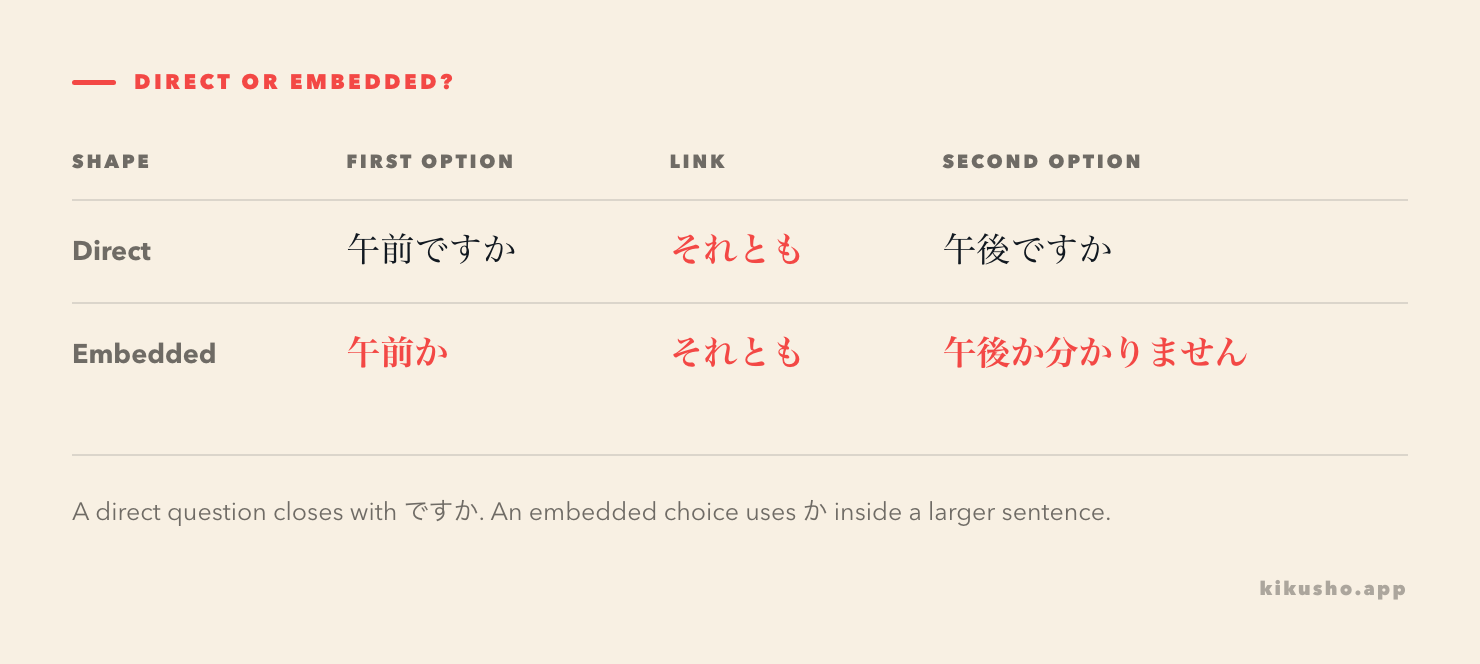
Do not mechanically add か after every short option. In a direct polite question, 午前ですか、それとも午後ですか is complete. In an embedded question, 午前か、それとも午後か分かりません uses か to mark the alternatives before 分かりません.
The simpler lesson on か in questions and alternatives explains how か closes a direct polite question and how it can connect noun alternatives. それとも becomes useful when you want the second option to stand out as another answer, especially when each side is a clause.
Contrast それとも with または
Both forms can translate as “or,” but they organize the message differently.
受け取りは店頭ですか、それとも郵送ですか。
うけとりは てんとうですか、それとも ゆうそうですか。
Will collection be in the shop, or will it be by post?
商品は店頭または郵送で受け取れます。
しょうひんは てんとう または ゆうそうで うけとれます。
The product can be collected in the shop or received by post.
The first sentence asks which method applies. The second states the available methods. ARC Tokyo Japanese Language School's comparison makes this question-versus-stated-choice distinction explicit: それとも asks the listener to choose, while または commonly presents alternatives from which a choice may be made.
| Form | Main job | Common setting |
|---|---|---|
| それとも | offers another answer within a question | conversation, interviews, deliberation |
| または | joins named alternatives in a statement or instruction | forms, notices, careful or formal writing |
| か | marks a question or directly links compact alternatives | speech and writing |
These are tendencies, not a ban on every overlap. A formal questionnaire can contain both a question and written alternatives. The reliable test is the job of the connector: それとも actively turns from one candidate answer to another; または can simply coordinate the items.
The comparison of または, でも, とか and など covers formal alternatives and open-ended examples in more detail. Use that distinction when the sentence is telling readers what is allowed rather than asking which answer is true.
Do not confuse それとも with それでも
One kana changes the logical relationship:
雨です。それとも、予定を変更しますか。
It is raining. Or will you change the plan?
This is awkward because the first statement, 雨です, is not an alternative answer to 予定を変更しますか. To offer two actions, make both sides questions:
雨ですが、予定どおり出かけますか。それとも、予定を変更しますか。
It is raining, but will you go out as planned, or will you change the plan?
By contrast, それでも means “even so” or “nevertheless”:
雨です。それでも、予定どおり出かけます。
It is raining. Even so, we will go out as planned.
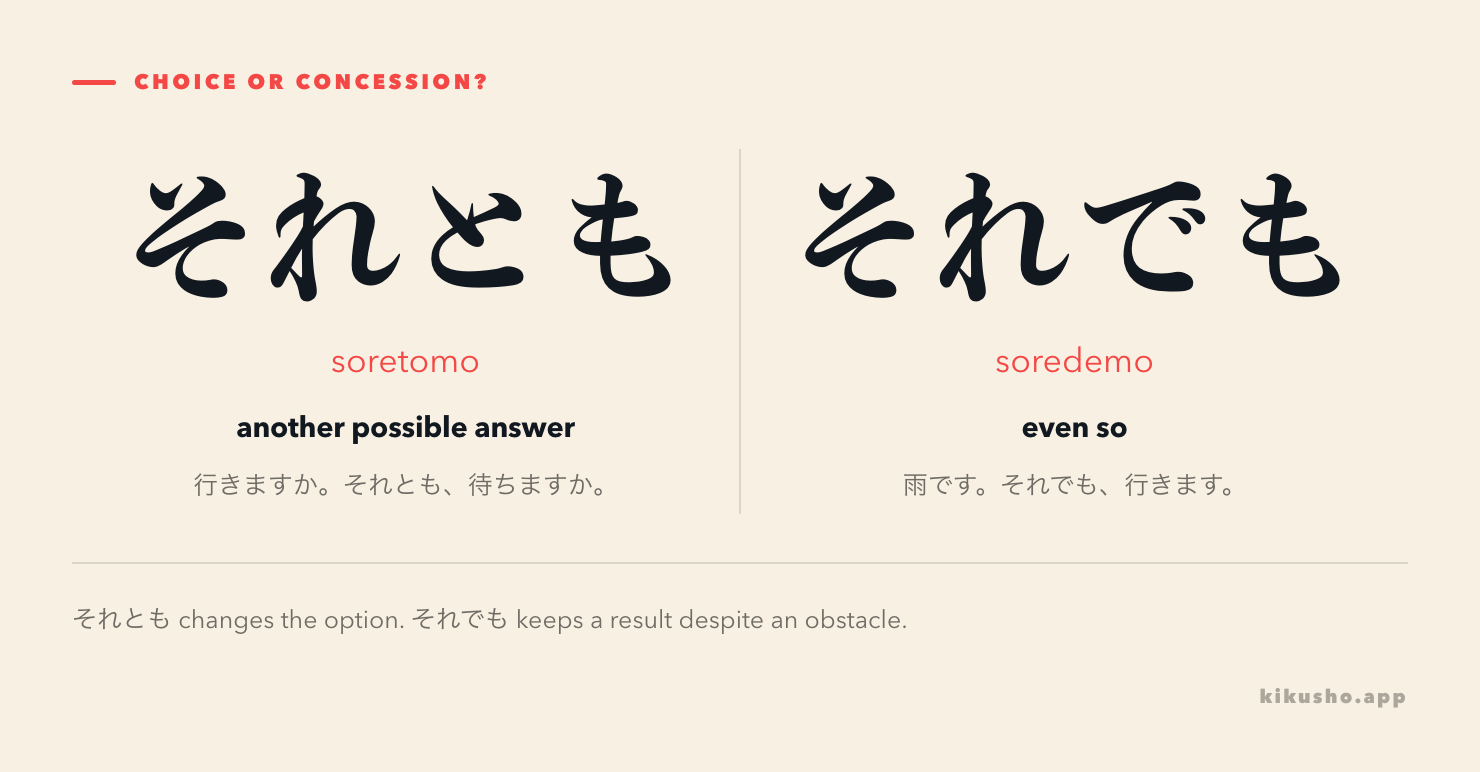
The lesson on し, それに and それでも shows how それでも carries a result across an obstacle. With それとも, no concession is present; the speaker is still deciding between possibilities.
Treat the JLPT level as a study placement
JLPT Sensei lists それとも as N3 grammar, while Bunpro places the same conjunction at N2. ARC teaches the practical contrast with または in material tagged for earlier learners. The disagreement is about curriculum order, not about three different modern forms.
The test authority provides no itemized grammar syllabus for the current JLPT, so no source can prove that それとも belongs exclusively to one level. For N3 study, learn the exact scope covered here: direct alternative questions, reduced parallel options, and embedded Aか、それともBか. Those shapes matter more than memorizing a disputed label.
When saving an example in Kikusho, keep both alternatives. A card containing only それとも removes the question that gives the connector its function. A complete pair lets you recall what the speaker is asking the listener to choose.
Practise the question boundary
Complete all six questions before opening the answer block.
Question 1: grammar choice. Complete the direct alternative question: 予約は今日しますか、__明日にしますか。
- ア. それでも
- イ. それとも
- ウ. それから
- エ. それに
Question 2. Which sentence most naturally states two accepted submission methods without asking the reader to choose an answer?
- ア. 申請書は窓口に持参しますか、それとも郵送しますか。
- イ. 申請書は窓口への持参または郵送で提出できます。
- ウ. 申請書は窓口に持参します。それでも郵送します。
- エ. 申請書は窓口、それに郵送ですか。
Question 3. Choose the natural embedded alternative question.
- ア. 出席するか、それとも欠席するか、今日中に知らせてください。
- イ. 出席しますか、それとも欠席するか、今日中に知らせてください。
- ウ. 出席するそれとも欠席する、今日中に知らせてください。
- エ. 出席して、それでも欠席して、今日中に知らせてください。
Question 4: sentence composition. Arrange the pieces to ask “Will you wait here, or will you go ahead?”: 先に行きますか / ここで待ちますか / それとも.
Question 5. The first clause is 電車で行きますか. Which shorter continuation preserves the role of バス as the means of travel?
- ア. それとも、バスで?
- イ. それでも、バスを?
- ウ. または、バスが。
- エ. それから、バスに。
Question 6: text grammar. A receptionist first asks a visitor a question, then explains the written rule: 資料は日本語にしますか、__英語にしますか。提出方法はメール__窓口です。 Choose the pair that fits both jobs.
- ア. それとも / または
- イ. または / それでも
- ウ. それでも / それとも
- エ. それに / それから
Answers and explanations
Answer 1. イ, それとも. Both clauses ask when the reservation will be made, so the connector turns from today's option to tomorrow's. それでも expresses concession, while それから and それに add sequence or information.
Answer 2. イ. 窓口への持参または郵送 names the accepted methods in a statement. ア asks which method applies to the particular application. ウ and エ do not express a coherent choice between submission methods.
Answer 3. ア. 出席するか、それとも欠席するか forms one embedded question before 知らせてください. Both alternatives use plain form plus か. イ mixes a direct polite question ending with an embedded-question shape; ウ lacks the necessary markers; エ expresses neither an alternative nor the requested report.
Answer 4. ここで待ちますか、それとも先に行きますか。 Each side is a complete polite question, and それとも introduces the second possible action.
Answer 5. ア, それとも、バスで? The full continuation would be それとも、バスで行きますか. The shared predicate can disappear, but で remains to mark the means of travel. The other particles assign the noun the wrong role or use a connector with a different relationship.
Answer 6. ア, それとも / または. The receptionist uses それとも to ask which language the visitor chooses. The written rule uses または to state two available submission methods. Reversing them blurs the difference between asking for an answer and listing accepted options.
A correct それとも sentence keeps one choice in view from beginning to end. Build the first candidate, turn to the second, and check that both could answer the same question.
Common questions
What does それとも mean in Japanese?
それとも means “or” when a speaker presents another possible answer to a question. It commonly connects two full questions, shorter parallel options, or alternatives inside an embedded question.
What is the difference between それとも and または?
それとも frames alternatives as possible answers to a question. または neutrally joins named alternatives and is common in written instructions, forms and notices that state available choices.
Can それとも begin a new sentence?
Yes. A speaker can ask the first question, then begin the second alternative with それとも. The second option may also follow a comma in the same sentence.
Is それとも N3 grammar?
JLPT Sensei places それとも at N3, while Bunpro lists it at N2 and some schools teach the everyday contrast earlier. These are study classifications because the JLPT does not publish an exhaustive grammar list.