On this page
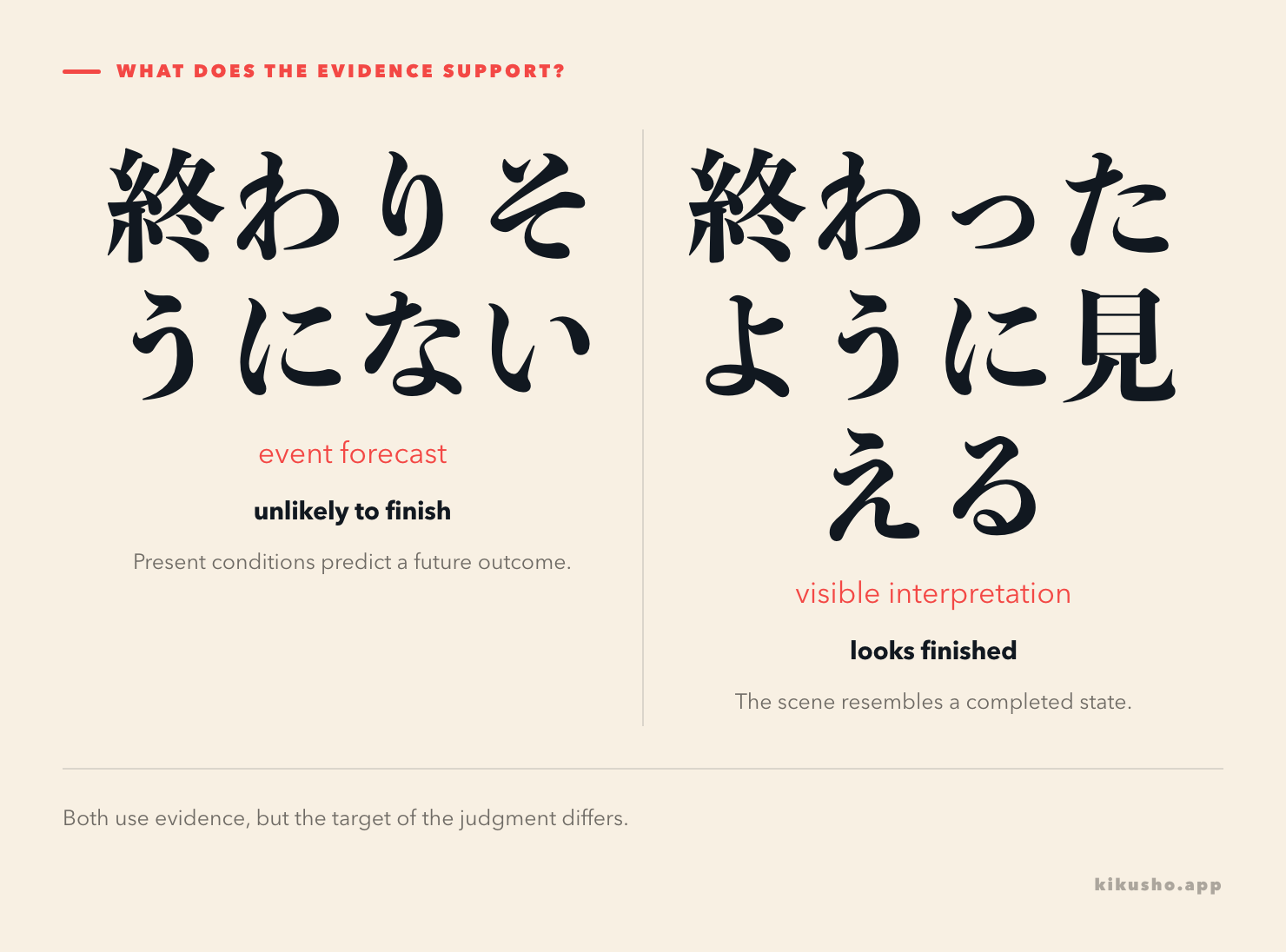
Two scenes can both produce “it looks…” in English. このペースでは、今日中に終わりそうにない predicts that finishing today is unlikely. 画面では、もう終わったように見える says the screen gives the visual impression that the work is finished. The first judges whether an event will happen; the second describes what a situation appears to be.
Decide between probability and visual appearance
| Form | Evidence question | Main claim |
|---|---|---|
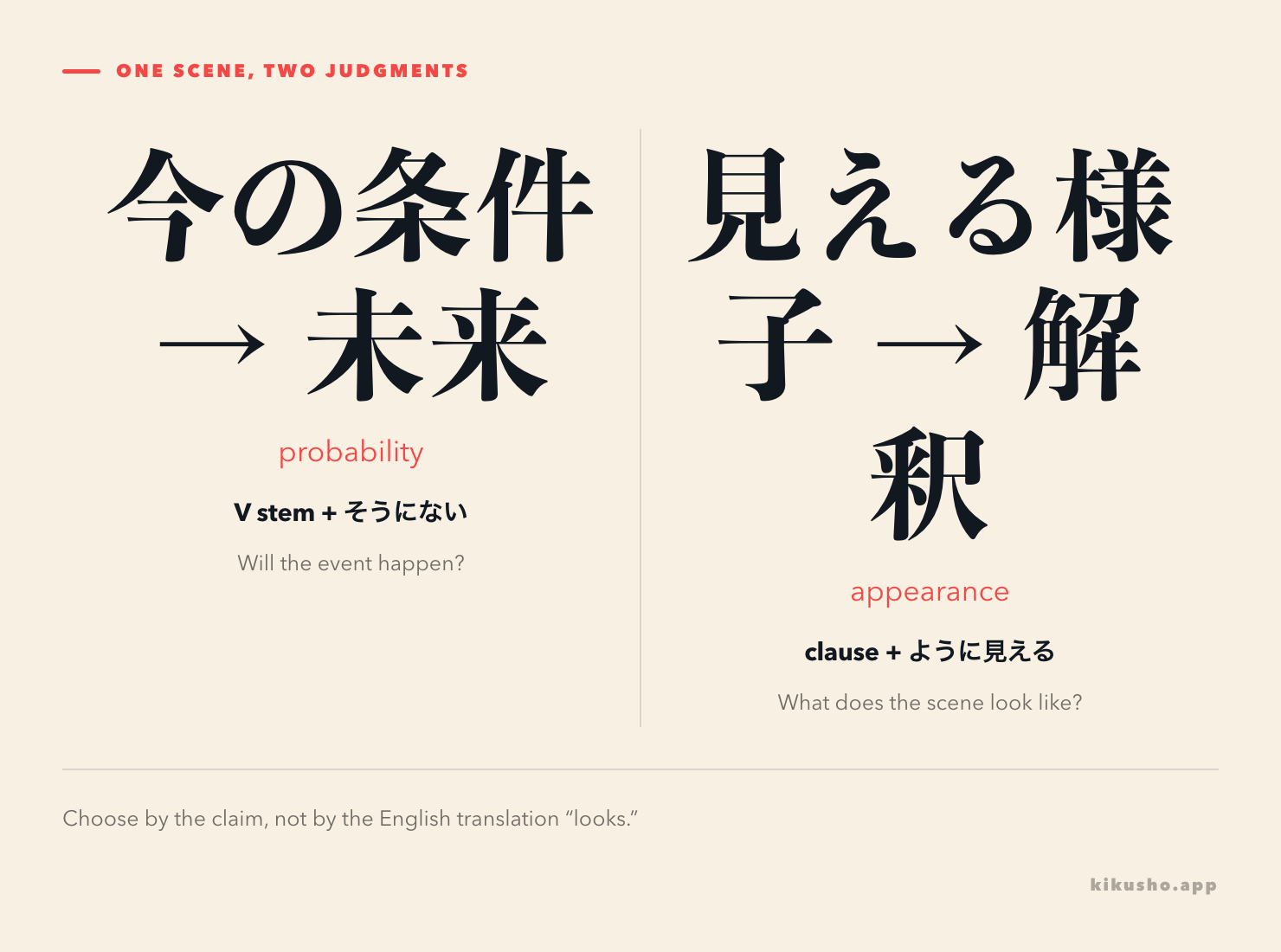
| V stem+そうにない | Do present conditions suggest the event will happen? | The event looks unlikely |
| V stem+そうもない | Same question, often with stronger emphasis | The event shows little or no sign of happening |
| clause+ように見える | What situation does the visible evidence resemble? | It looks as if the clause is true |
空が明るくなってきたので、雨は降りそうにない。
そらが あかるく なってきたので、あめは ふりそうにない。
The sky is getting brighter, so it does not look likely to rain.
道がぬれていて、さっきまで雨が降っていたように見える。
みちが ぬれていて、さっきまで あめが ふっていたように みえる。
The road is wet, and it looks as if it was raining until a short while ago.
The first speaker forecasts a future event from the improving sky. The second interprets a visible trace and presents a complete past situation. Both use evidence, but they answer different questions.
Build そうにない from the verb stem
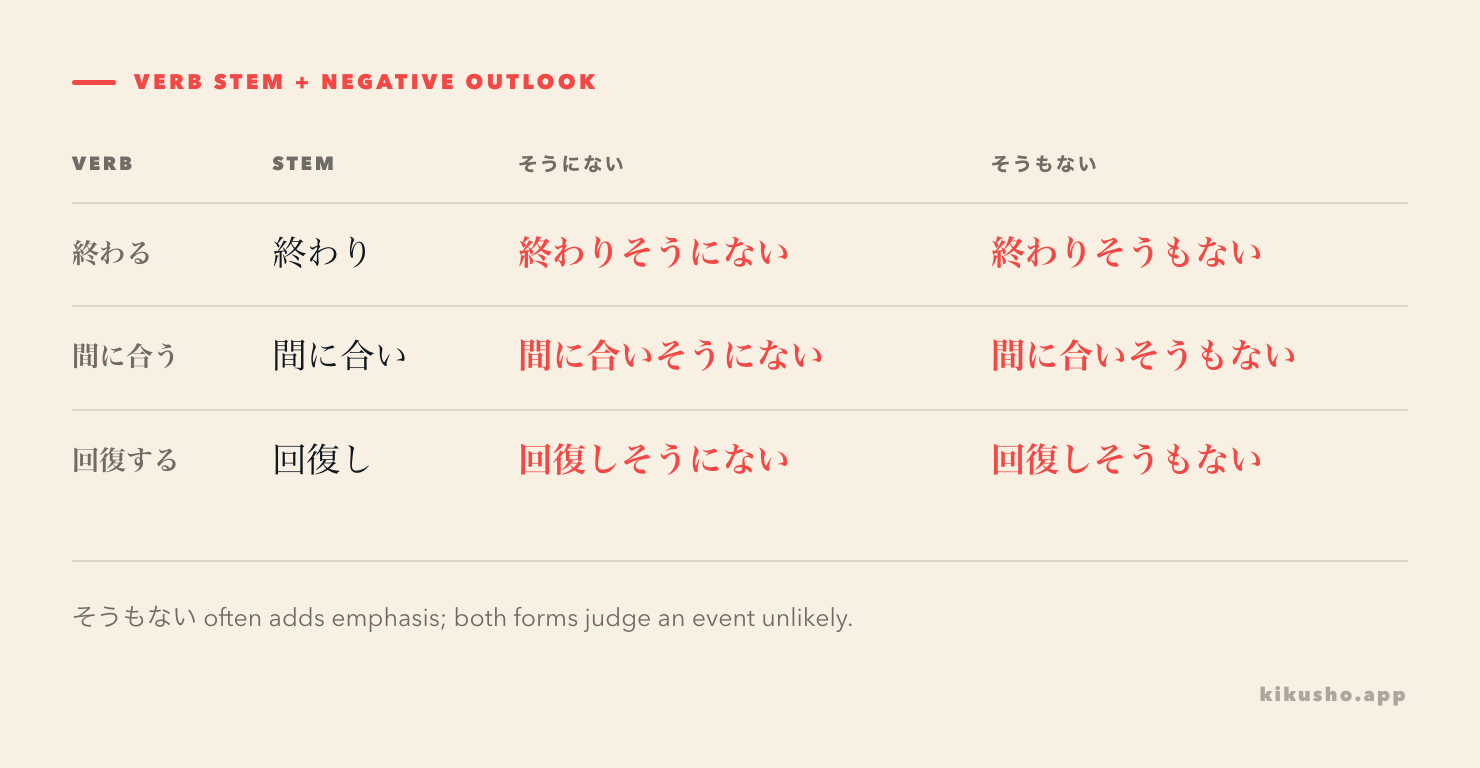
Start with the polite form, remove ます, and add そうにない or そうもない:
| Dictionary form | ます form | Stem | Negative outlook |
|---|---|---|---|
| 終わる | 終わります | 終わり | 終わりそうにない |
| 間に合う | 間に合います | 間に合い | 間に合いそうもない |
| できる | できます | でき | できそうにない |
| 回復する | 回復します | 回復し | 回復しそうもない |
電車が止まっているので、九時の会議には間に合いそうにありません。
でんしゃが とまっているので、くじの かいぎには まにあいそうに ありません。
The trains have stopped, so it does not look like I will make the nine o'clock meeting.
The polite endings are そうにありません and そうもありません. The negative sits after そう; the verb itself does not become negative. 間に合わなそうです is a different way to say that it appears one will not make it, while the assigned patterns make the low likelihood especially explicit.
Nihongo Net gives the same verb-stem attachment and describes the form as a judgment of low possibility based on the situation. Bunpro's そうにない reference also treats it as an event showing no sign of happening.
そうもない adds emphasis without changing the forecast
The particles に and も produce close variants:
この量では、一人で全部運べそうにない。
With this amount, it does not look like one person can carry everything.
この量では、一人で全部運べそうもない。
With this amount, there seems to be virtually no chance one person can carry everything.
Both sentences judge the attempt unlikely. も often strengthens the negative assessment, especially beside expressions such as とても, 全然 or 今のままでは. The difference is a tendency rather than a rigid scale; context and intonation can make the variants nearly equivalent.
Do not confuse this action pattern with そうではない after an adjective:
このケーキはおいしそうではない。
This cake does not look delicious.
この大きなケーキは、一人では食べきれそうにない。
It looks unlikely that one person can finish this large cake.
The first negates an apparent quality. The second predicts that the action 食べきる will probably not be completed. The noun or adjective lesson on そう, よう, らしい and みたい supplies the broader appearance system.
ように見える presents a visible interpretation
With a complete verb clause, keep the predicate in plain form and add ように見える:
二人は意見が違うように見える。
ふたりは いけんが ちがうように みえる。
It looks as if the two people have different opinions.
写真では、建物が少し傾いているように見えます。
しゃしんでは、たてものが すこし かたむいているように みえます。
In the photograph, the building looks as if it is leaning slightly.
The speaker does not guarantee that the interpretation is correct. 見える anchors it in visible presentation: a face, posture, photograph, screen or scene supports the judgment.
Nouns take の before よう, and な-adjectives take な:
| Before ように見える | Example |
|---|---|
| plain verb clause | 眠っているように見える |
| い-adjective | 忙しいように見える |
| な-adjective+な | 元気なように見える |
| noun+の | 本物のように見える |
The older lesson on に気がつく and に見える owns the wider attachment system: 学生に見える, 若く見える, and clause+ように見える. Here the clause form matters because it contrasts with a forecast about whether an action will occur.
The same scene can support two different claims
Imagine a runner limping during a race:
足を痛めたので、このままでは完走できそうにない。
Because of the leg injury, it looks unlikely that the runner can finish.
遠くから見ると、右足をかばっているように見える。
From a distance, it looks as if the runner is protecting the right leg.
The first sentence projects forward to 完走できる, finishing the race. The second interprets the runner's current movement. Switching the forms would switch the claim, even though the visible scene stays the same.
JLPT Sensei places both そうもない/そうにない and ように見える at N3. Bunpro separates the close variants across N3 and N2, and Nihongo Net also teaches そうにない/そうもない at N2. These labels reflect course order rather than different grammaticality. The stable learning target is the form, evidence and scope of each construction.
When saving either pattern in Kikusho, keep the evidence with the judgment. 終わりそうにない needs the pace, remaining work or deadline. 傾いているように見える needs the photograph or viewpoint. The surrounding clue makes the choice recallable.
Practise what the evidence supports
Work through the six prompts, then check every solution together below.
Question 1: grammar choice. The train has stopped and the meeting starts soon. Complete: 九時の会議には間に合い__。
- ア. そうにない
- イ. ように見える
- ウ. そうではない
- エ. ようがない
Question 2. Which sentence reports a visible interpretation of a complete situation?
- ア. この雨は止みそうもない。
- イ. 写真では、二人が話しているように見える。
- ウ. 二人は話しそうにないですか。
- エ. 写真は話しているそうです。
Question 3. Which choice correctly transforms 回復します into the target pattern?
- ア. 回復するそうにない
- イ. 回復してように見える
- ウ. 回復しそうもない
- エ. 回復しないそうもない
Question 4: build the sentence. Use these pieces to say “The building looks as if it is leaning”: ように見えます / 建物が / 傾いている.
Question 5. Which sentence means that the cake lacks an appetizing appearance, rather than predicting that someone cannot finish eating it?
- ア. ケーキは食べきれそうにない。
- イ. ケーキはおいしそうではない。
- ウ. ケーキを食べたように見える。
- エ. ケーキは終わりそうもない。
Question 6: text grammar. Read: 選手は右足をかばっている__。このままでは、試合を続けられ__。 Choose the pair that first describes the visible posture and then predicts a low chance of continuing.
- ア. そうもない / ように見える
- イ. ように見える / そうにない
- ウ. そうではない / ように見える
- エ. ようがない / そうではない
Answers and explanations
Answer 1. ア, 間に合いそうにない. The current transport problem makes arriving on time unlikely. ように見える would need a visual interpretation of a complete clause, while ようがない says no method exists and is a different construction.
Answer 2. イ. 二人が話している is a complete plain clause before ように見える, and the photograph supplies visual evidence. ア forecasts that the rain is unlikely to stop. ウ is possible only in a suitable question context but does not report the photograph's present appearance.
Answer 3. ウ, 回復しそうもない. Remove ます from 回復します to obtain 回復し, then add そうもない. ア uses the dictionary form, and the other choices do not form either target pattern.
Answer 4. 建物が傾いているように見えます。 The plain progressive state 傾いている stays intact before ように見える.
Answer 5. イ, おいしそうではない. This negates the cake's apparent quality. ア instead predicts that finishing the cake is unlikely, while ウ claims that someone appears to have eaten it.
Answer 6. イ, ように見える / そうにない. The first blank interprets the runner's visible posture. The second uses the potential stem 続けられ to predict that continuing the match is unlikely.
The decisive difference is the target of the judgment. Use そうにない or そうもない for an event that shows little chance of happening; use ように見える for the situation the eyes appear to reveal.
Common questions
What does そうもない mean in Japanese?
Verb stem plus そうもない means that an event looks very unlikely to happen under the present conditions. そうにない has the same core meaning and often sounds slightly less emphatic.
How do you form そうにない?
Remove ます from the polite verb and add そうにない: 終わります becomes 終わりそうにない, and できます becomes できそうにない.
What is the difference between そうにない and ように見える?
そうにない predicts that an action or event is unlikely. ように見える reports how a person, object or complete situation appears to the eyes.
Are そうもない and ように見える N3 grammar?
JLPT Sensei lists both at N3. Bunpro lists そうもない at N3 but そうにない at N2, and other teacher resources also use N2. These are study placements because the JLPT publishes no exhaustive grammar list.