On this page
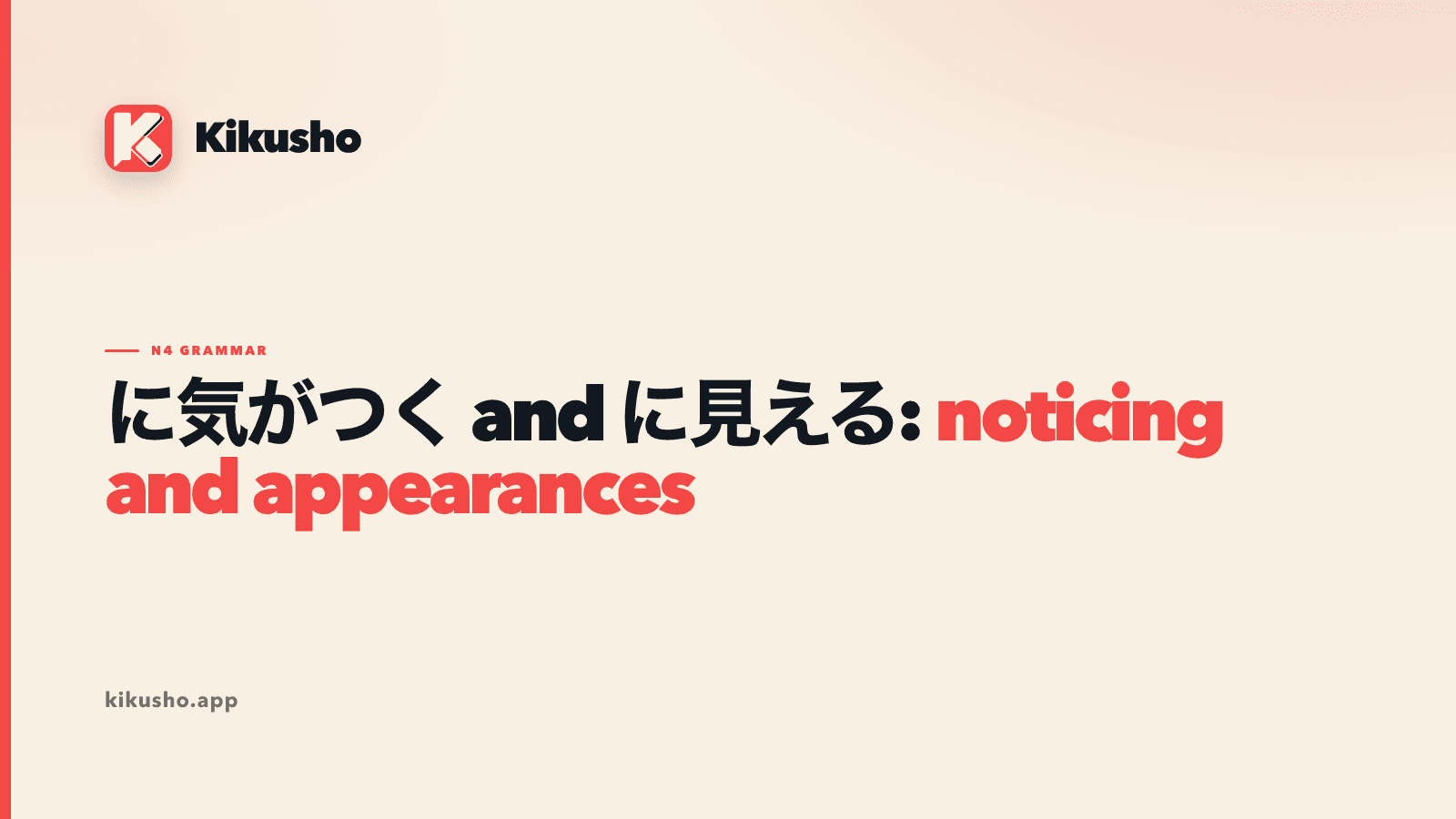
Use に気がつく when something enters a person's awareness; use に見える when the eyes give something an appearance. 間違いに気がついた means “I noticed the mistake,” while 学生に見える means “They look like a student.”
Awareness and appearance ask different questions
The shared particle に can hide two different sentence designs. With 気がつく, に marks the target that attention reaches. With 見える, に marks the identity or quality that something appears to have.
| Ask yourself | Form | Example | Meaning |
|---|---|---|---|
| What entered awareness? | target + に気がつく | 間違いに気がつく | notice a mistake |
| What does it look like? | appearance + に見える | 学生に見える | look like a student |
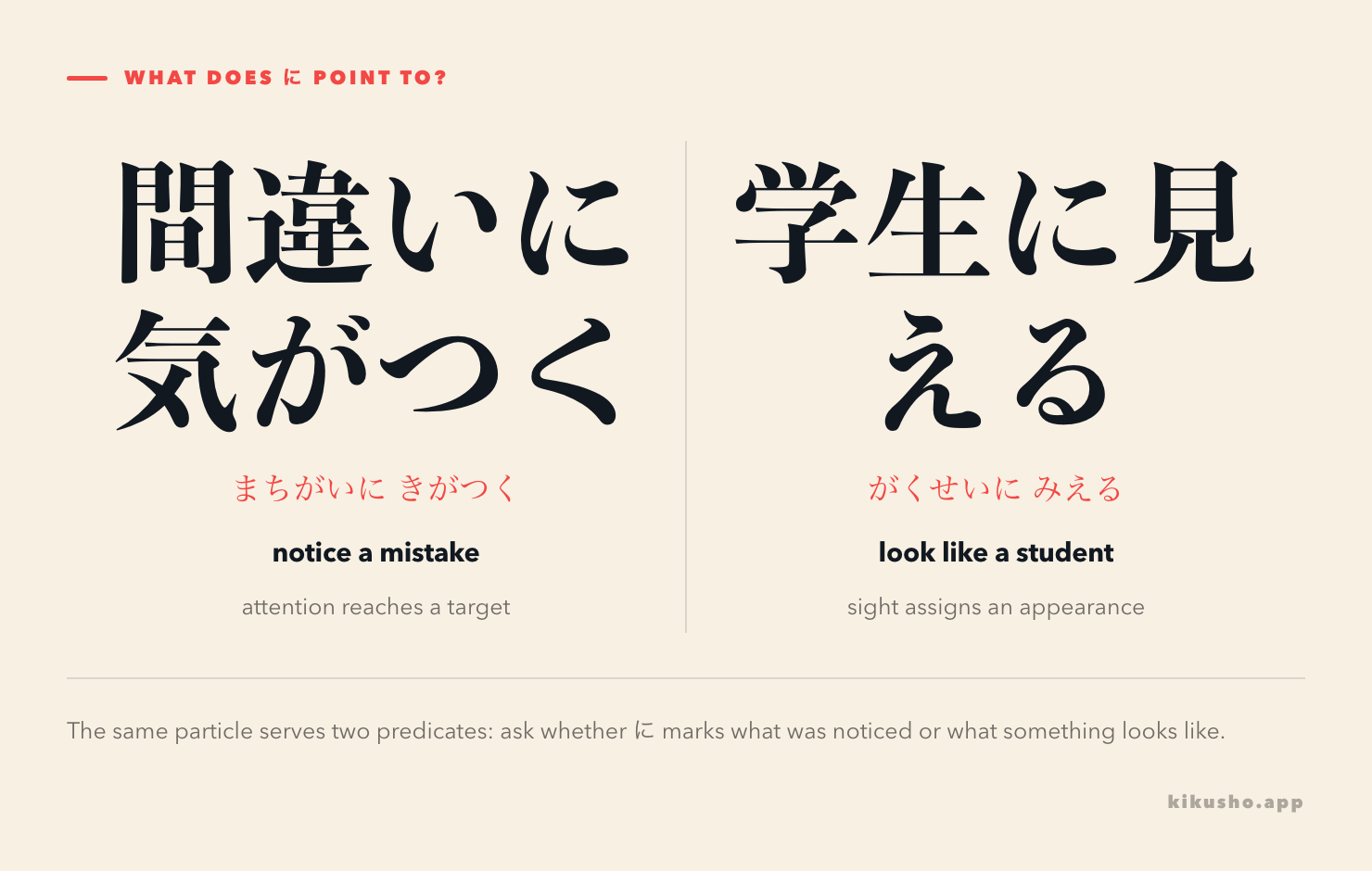
The two can describe the same scene in sequence. 彼が疲れているように見えて、顔色が悪いことに気がついた means “He looked tired, and I noticed that his complexion was poor.” The first clause interprets what the speaker sees. The second reports a fact becoming conscious.
JLPT Sensei and Bunpro both give noun + に気がつく and clause + ことに気がつく as N4 patterns. Their に見える references place visual appearance at N4 as well.
A noun or a nominalized fact precedes に気がつく
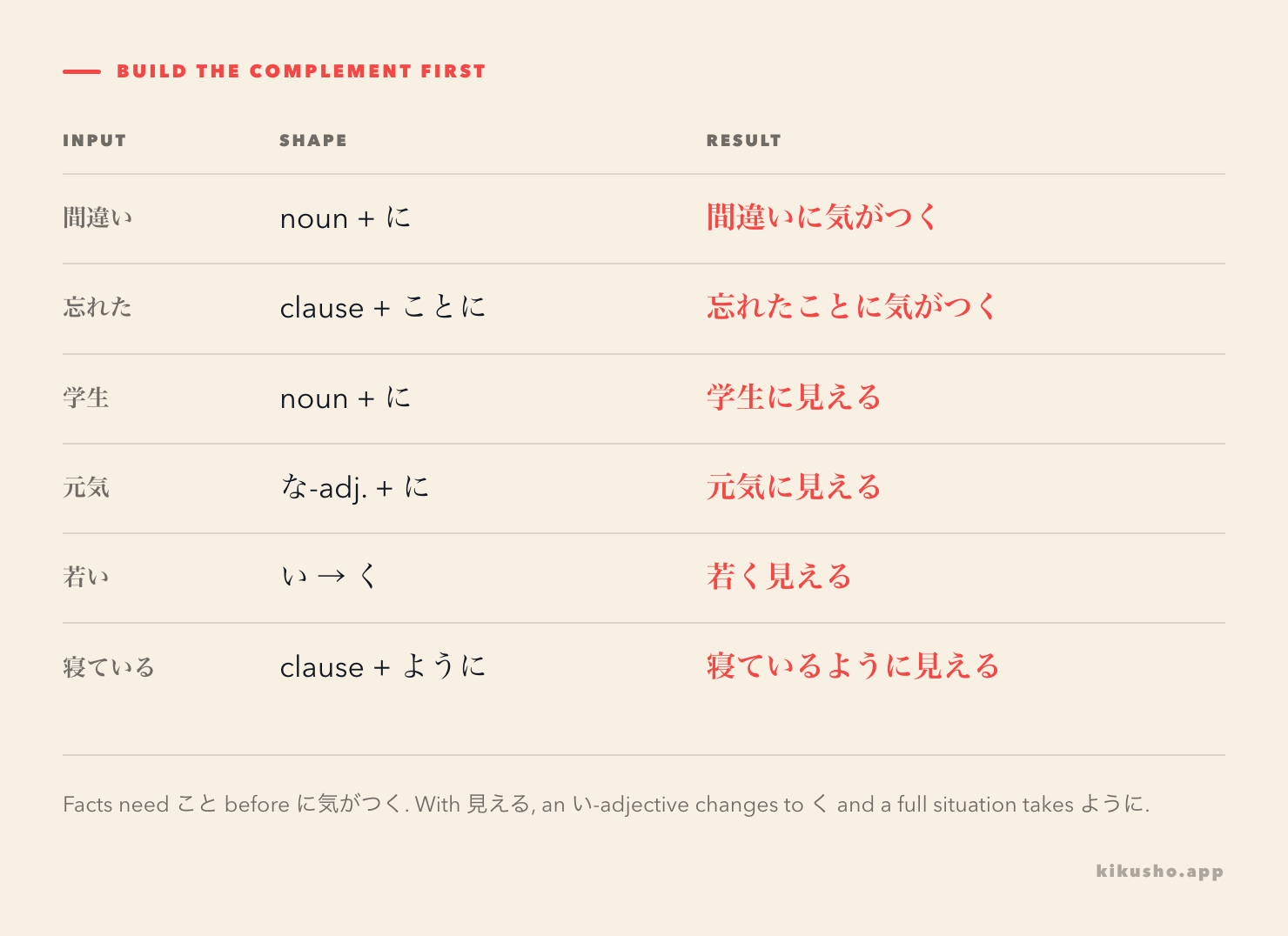
A noun attaches directly:
財布がないことに気がついた。
さいふが ないことに きがついた。
I realized that my wallet was missing.
That example contains a complete fact, 財布がない. Add こと to turn the clause into something that awareness can reach, then attach に気がつく. The predicate before こと stays in plain form:
| What becomes known | Shape | Example |
|---|---|---|
| a thing | noun + に気がつく | 誤りに気がついた |
| a positive fact | plain clause + ことに気がつく | 窓が開いていることに気がついた |
| a negative fact | plain clause + ことに気がつく | 鍵がないことに気がついた |
| a past fact | plain clause + ことに気がつく | 名前を間違えたことに気がついた |
MIT OpenCourseWare's Tobira grammar notes independently set out noun + に気がつく and sentence + ことに気がつく, with both error and completed-action examples.
The form often appears in the past because noticing has a moment: 気がついた, “noticed” or “realized.” The negative creates an aspect choice:
- 気がつかなかった: did not notice at the relevant time.
- 気がついていない: has not noticed yet; remains unaware now.
In 田中さんはまだ間違いに気がついていません, Tanaka's lack of awareness continues. The sentence does not merely report one missed opportunity in the past.
気づく/気付く is the compact lexical form of the same awareness idea; 気がつく/気が付く exposes the internal particle. Both take the noticed target with に, as in 間違いに気づく, but this lesson keeps the assigned longer form visible so its structure is easier to read.
に見える assigns a visible identity or quality
For a noun or な-adjective, the form before 見える ends in に:
あの人は医者に見えます。
あの ひとは いしゃに みえます。
That person looks like a doctor.
今日は元気に見えます。
きょうは げんきに みえます。
You look well today.
The sentence does not guarantee that the person is a doctor or is well. It reports the classification produced by appearance. Context usually supplies the person or thing being judged with は or が; the に phrase supplies what it resembles.
An い-adjective changes い to く:
この部屋は写真より広く見えます。
この へやは しゃしんより ひろく みえます。
This room looks larger than it does in the photo.
広いに見える is not the form. The same change gives 若い → 若く見える, 高い → 高く見える, and おいしい → おいしく見える.
A full situation needs ように見える
To present a complete clause as a visual impression, place ように before 見える:
彼は少し疲れているように見える。
かれは すこし つかれているように みえる。
He looks a little tired.
The clause 疲れている stays plain and ように connects the whole apparent situation to 見える. This is useful when the appearance includes an action or state rather than a single noun or adjective.
Appearance そう can also precede 見える: その料理はおいしそうに見える, “That dish looks delicious.” The form おいしく見える describes the dish as looking delicious; おいしそうに見える explicitly packages the speaker's visual impression with そう. The そう, よう, らしい and みたい lesson develops those evidence markers without turning every visual judgment into the same construction.
Bunpro separates direct noun + に見える from clause + ように見える and adjective attachments. JLPT Sensei's に見える page likewise lists noun, な-adjective, い-adjective and ように shapes at N4.
見える alone reports visibility
Compare the particle before 見える:
窓から山が見える。
まどから やまが みえる。
The mountain is visible from the window.
雲が山に見える。
くもが やまに みえる。
The cloud looks like a mountain.
In the first sentence, 山が names what can be seen. In the second, 雲が names the thing being viewed and 山に gives its apparent identity. Replacing が with に does more than change a particle: it changes “is visible” into “looks like.”
Visual appearance also differs from other spontaneous senses. Japanese uses 音がする for the presence of a sound and 音が聞こえる for audibility. The がする lesson maps those senses and explains why sight normally uses 見える instead.
Three neighbouring 気 expressions describe different states
Do not exchange 気がつく with a similar-looking phrase merely because each contains 気.
| Expression | Core meaning | Example |
|---|---|---|
| Nに気がつく | become aware of N | ミスに気がつく |
| Nに気をつける | take care regarding N | 車に気をつける |
| Nが気になる | N occupies or bothers the mind | 結果が気になる |
車に気をつけてください warns someone to watch out for cars. It does not mean that the cars have just been noticed. 結果が気になる says the result is on your mind or concerns you; it does not mark a sudden realization.
The target particle is another clue. に appears with the target of 気がつく and 気をつける, but the concerned item normally takes が in 気になる. Learn the full predicate rather than treating 気 as a portable translation of “attention.”
Both assigned items are placed at N4 by JLPT Sensei and Bunpro, so the inspected references show no level disagreement here. These remain publisher estimates: the JLPT does not publish an exhaustive grammar list.
When a line surprises you, a Kikusho card is more useful with the whole complement intact. Save 窓が開いていることに気がついた rather than 気 alone, or 写真より広く見える rather than 見える alone. The captured clause preserves the nominalizer, particle and evidence type you need to reconstruct the sentence during review.
Follow the evidence through the sentence
Work through all seven prompts before reading the single answer section.
Question 1: grammar choice. Your key is missing and the realization has just arrived. Choose the bridge in 鍵がない__気がついた。
- A. ことに
- B. ように
- C. そうに
- D. までに
Only one option turns the missing-key clause into the target of awareness.
Question 2: interpretation. Choose the English reading of あの人は先生に見えます.
- A. That person can see the teacher.
- B. The teacher is visible to that person.
- C. That person looks like a teacher.
- D. That person noticed the teacher.
Question 3: adjective form. Complete “This room looks bright”: この部屋は明る__見えます。
- A. いに
- B. く
- C. な
- D. だに
Question 4: sentence composition. Arrange these pieces to say “I noticed the mistake”: 気がつきました / に / 間違い.
Question 5: aspect. Tanaka remains unaware of the error now. Which sentence fits?
- A. 田中さんは間違いに気がつきます。
- B. 田中さんは間違いに気がつきませんでした。
- C. 田中さんはまだ間違いに気がついていません。
- D. 田中さんは間違いに見えません。
Question 6: visibility or resemblance. Which sentence means “The cloud looks like a mountain”?
- A. 雲が山を見える。
- B. 雲に山が見える。
- C. 雲が山に見える。
- D. 雲が山に気がつく。
Question 7: text grammar. Read: 店に入ると、店員は少し疲れているように見えました。話しているうちに、声もいつもより小さいことに気がつきました。 What happened?
- A. The clerk first looked tired, and the speaker later noticed that the clerk's voice was quieter than usual.
- B. The clerk noticed that the speaker looked tired.
- C. The speaker could not see the clerk and heard a loud voice.
- D. The clerk only looked quiet; no fact entered the speaker's awareness.
Answers and explanations
Answer 1. A, 鍵がないことに気がついた. A complete fact takes こと before に気がつく. ように would belong before 見える when a whole situation forms a visual impression.
Answer 2. C. 先生に gives the apparent identity: the person looks like a teacher. Visibility would use 先生が見えます, and noticing would require 先生に気がつきます.
Answer 3. B, 明るく見えます. An い-adjective changes its final い to く before 見える. The other endings do not form the required adverbial adjective.
Answer 4. 間違いに気がつきました。 The noun 間違い is the target of awareness and takes に; 気がつきました supplies the polite past predicate.
Answer 5. C. まだ~気がついていません presents the lack of awareness as continuing now. B only says Tanaka did not notice at a past reference point and does not by itself establish the current state.
Answer 6. C, 雲が山に見える. が marks the thing being viewed, and に marks the identity it resembles. 山が見える would instead say that a mountain is visible.
Answer 7. A. 疲れているように見えました is a visual interpretation. 声もいつもより小さいことに気がつきました then marks the quieter voice as a fact that entered the speaker's awareness.
The useful clue is not the English verb “seem.” Trace what the に phrase contributes: a target reached by attention, or an appearance assigned by sight.
Common questions
What is the difference between に気がつく and に見える?
に気がつく says that a thing or fact enters someone's awareness: 間違いに気がつく means notice a mistake. に見える reports a visual appearance or classification: 学生に見える means look like a student.
What comes before に気がつく?
A noun can attach directly with に, as in 間違いに気がつく. To notice or realize a complete fact, put the plain clause before ことに気がつく, as in 財布がないことに気がついた.
How do adjectives attach to に見える?
A な-adjective uses its adverbial form, as in 元気に見える. An い-adjective changes い to く, as in 若く見える. A complete clause normally uses ように見える.
Is に見える the same as 見える?
No. 山が見える says that a mountain is visible. 山に見える says that something looks like a mountain. が marks what is visible, while に marks the appearance assigned to something else.