On this page
焼きたてのパン is bread whose newly baked state still matters: it may be warm, fragrant and crisp. Japanese ~たて attaches to a verb's ます-stem and presents the result as fresh, new or newly completed.
That focus on the result separates it from simply reporting that the baking happened a short time ago.
Attach ~たて to the ます-stem
Start from the polite form, remove ます, and add たて. The result behaves like a noun-like expression: it can end a sentence, modify a noun with の, or stand before a particle.
| Dictionary form | Polite form | Stem + たて | Meaning |
|---|---|---|---|
| 焼く(やく) | 焼きます | 焼きたて | freshly baked or roasted |
| 作る(つくる) | 作ります | 作りたて | freshly made |
| 炊く(たく) | 炊きます | 炊きたて | freshly cooked, especially rice |
| 洗う(あらう) | 洗います | 洗いたて | freshly washed |
| できる | できます | できたて | newly made or completed |
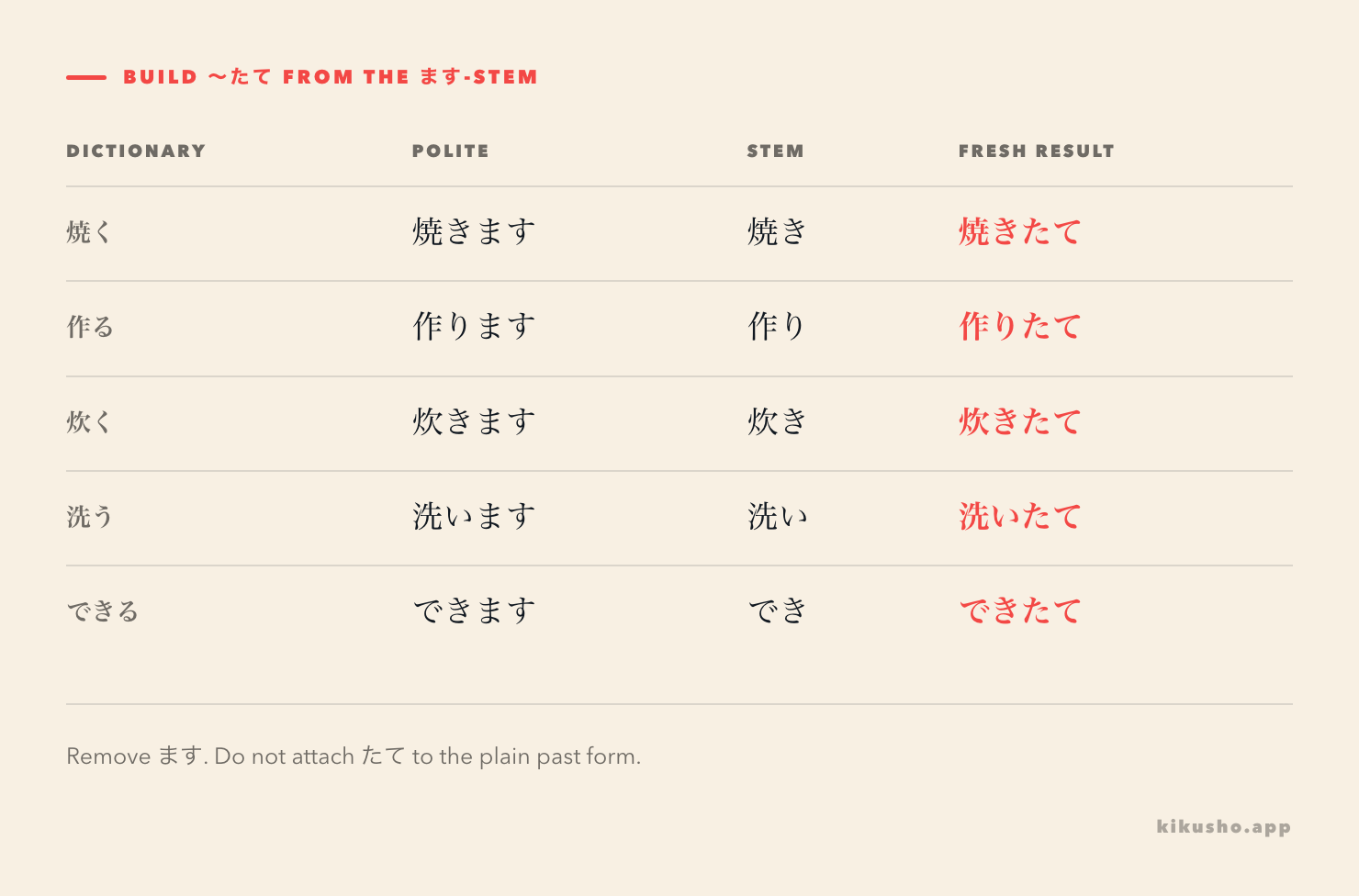
The common error is to start from the plain past. 焼きたて is correct; 焼いたて is not. In 生まれたて (うまれたて, newborn), the sequence れた may look like a past ending, but the structure is still 生まれ + たて: 生まれ is the ます-stem of 生まれる.
Three sentence frames cover most uses:
| Frame | Example | Function |
|---|---|---|
| X は V-stem + たてです | このパンは焼きたてです。 | predicates the fresh state |
| V-stem + たて + の + noun | 焼きたてのパン | modifies the resulting thing |
| V-stem + たて + particle | できたてを食べる | treats the result as a noun-like unit |
このパンは焼きたてです。
このパンはやきたてです。
“This bread is freshly baked.”
炊きたてのご飯を食べました。
たきたてのごはんをたべました。
“I ate freshly cooked rice.”
JLPT Sensei's ~たて reference gives the same stem attachment and labels it N3. A Japanese-teacher reference at 日本語NET labels it N2. Those labels are publisher estimates: the official JLPT FAQ explains that the test no longer publishes an exhaustive grammar list.
The completion must leave a noticeable new state
The construction does more than place an event in the recent past. It asks the listener to notice a property that exists because the action has just finished.
入れたてのコーヒーは香りが強い。
いれたてのコーヒーはかおりがつよい。
“Freshly brewed coffee has a strong aroma.”
洗いたてのシャツは気持ちがいい。
あらいたてのシャツはきもちがいい。
“A freshly washed shirt feels pleasant.”
The coffee has aroma and heat that will change. The shirt has the clean feel left by washing. This is why food, drink, laundry, paint and things just produced appear so often with ~たて.
The same logic extends beyond objects. 入社したての社員 means an employee who has only just joined the company. The person is still in the new state created by joining. なりたての先生 describes someone newly in the role of teacher. These examples do not have to praise freshness; they mark a condition that is new and has not yet settled.
There is no fixed number of minutes built into ~たて. Bread loses its “just baked” quality faster than a new employee loses the feeling of being new. The relevant window depends on what changed and why the speaker is mentioning it.
Many recent events do not accept ~たて naturally
Because ~たて describes a fresh result, it is not a general replacement for English “just.” A recent event that leaves no relevant new state normally calls for another construction.
Suppose you moved to a town last month and still do not know the roads. 先月、この町に引っ越したばかりです is natural: the move still feels recent from your perspective. 引っ越したて can occur when the unsettled, newly moved-in state is the point, but it is more restricted. The speaker has to be characterizing that new condition, not merely dating the move.
The same test helps with 知る. To report “I only just learned that,” use 知ったばかりです. A mechanical 知りたてです is not the neutral way to locate the learning event. Choose ~たて when the completed act produces a state you can sensibly describe as new, fresh or newly in effect.
~たて, ~たばかり and ~たところ answer different questions
All three constructions can appear near a recent completion. Their viewpoints differ.
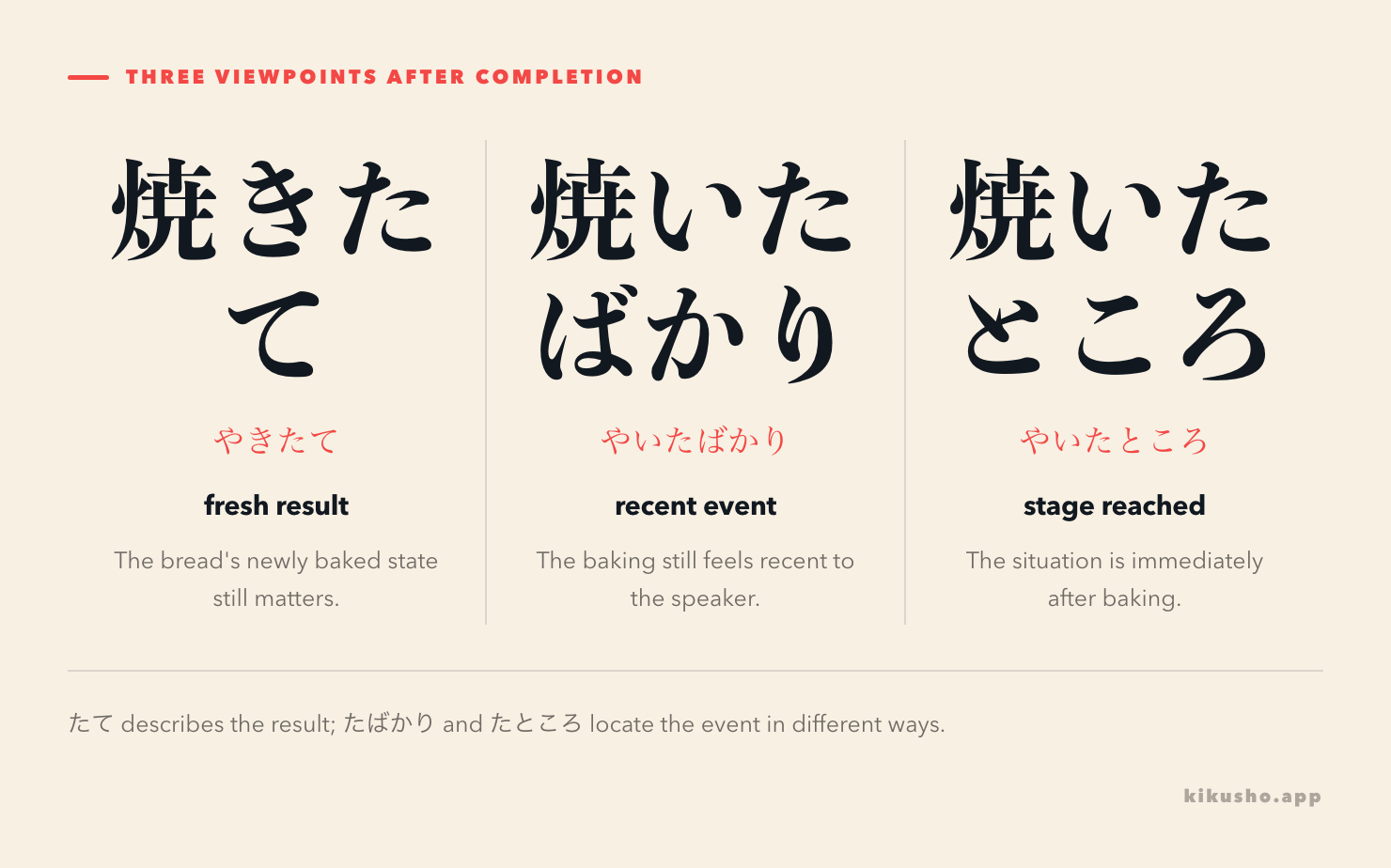
| Form | Main question | Example | What it contributes |
|---|---|---|---|
| V-stem + たて | Is the result still in its new state? | 焼きたてのパン | the bread's fresh condition |
| Plain past + ばかり | Does the event still count as recent? | パンを焼いたばかりだ | the speaker's view of elapsed time |
| Plain past + ところ | What stage has just been reached? | パンを焼いたところだ | the point immediately after baking |
パンを焼いたばかりです。
パンをやいたばかりです。
“I baked the bread recently / I have just baked the bread.”
The sentence reports and evaluates the timing of the event. Depending on context, たばかり can cover more than a few moments. The detailed ~ばかり comparison develops that subjective recency.
今、パンを焼いたところです。
いま、パンをやいたところです。
“I have just finished baking the bread now.”
Here the event timeline matters. The speaker has reached the stage immediately after baking. The ~ところ lesson compares the stages before, during and after an action.
焼きたてのパンです。 instead characterizes the bread. The baker need not even be the topic. This noun-modifying strength is one reason ~たて is common on menus, shop signs and product descriptions.
Keep の between ~たて and the following noun
In 焼きたてのパン, the particle の connects the noun-like 焼きたて to パン. It is not optional in this pattern.
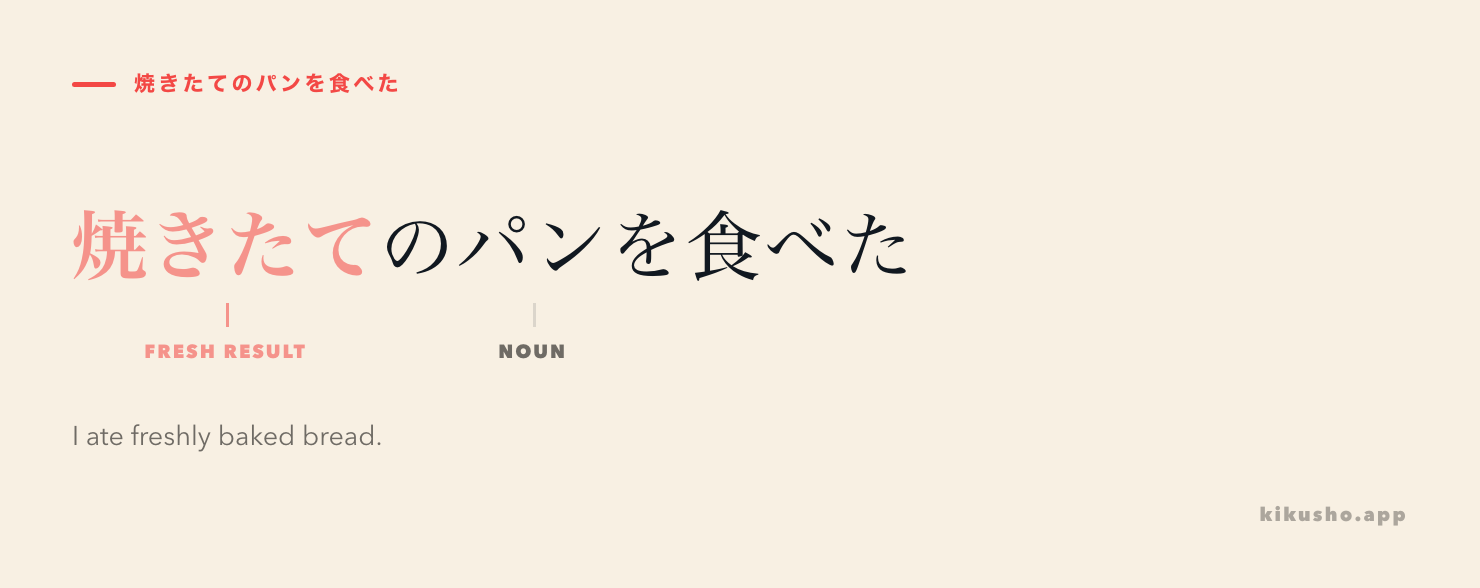
焼きたてのパンを食べた。
やきたてのパンをたべた。
“I ate freshly baked bread.”
Do not confuse this の with a nominalizer replacing the bread. The word パン is present, and の links the fresh-state expression to it. When the noun is clear from context, ~たて itself can stand before a particle:
できたてをどうぞ。
できたてをどうぞ。
“Please have it while it is freshly made.”
You will also meet ~たてのうちに, “while it is still fresh/new”:
天ぷらは揚げたてのうちに食べてください。
てんぷらはあげたてのうちにたべてください。
“Please eat the tempura while it is freshly fried.”
This phrasing makes the fading window explicit. An independent grammar reference from Elon.io likewise notes both the noun-linking の and the ~たてのうち frame.
Save the result and the evidence together
When you meet 塗りたて on a sign, the useful memory is not “たて means just.” Save enough of the sentence to preserve the result: ペンキ塗りたてだから、触らないで (ぺんきぬりたてだから、さわらないで), “The paint is fresh, so don't touch it.” The warning shows exactly why the new state matters.
In Kikusho, capture the whole line and keep 塗りたて with the clause that follows. The review card can then remind you of the consequence while the scheduler brings the example back later. A card with only “たて = just” would invite the wrong attachment and erase the restriction this lesson depends on.
Practice: six questions
Complete all six before moving to the answer section. These are original practice items, not official JLPT questions.
Question 1: formation.
Choose the correct ~たて form of 焼く.
- A. 焼くたて
- B. 焼きたて
- C. 焼いたて
- D. 焼いてたて
Question 2: noun modification.
Choose the natural phrase for “freshly brewed coffee.”
- A. 入れたてコーヒー
- B. 入れたばかりコーヒー
- C. 入れたてのコーヒー
- D. 入れところのコーヒー
Question 3: choose the viewpoint.
You moved to this town last month. You simply want to say that the move still feels recent. Fill the blank.
先月、この町に( )、まだ道がよく分かりません。
- A. 引っ越したばかりで
- B. 引っ越したての
- C. 引っ越すところで
- D. 引っ越してばかりで
Question 4: put the cause before its result.
Put the four chunks in Japanese order to mean “Because this bread is freshly baked, it is still warm.”
- まだ温かいです
- このパンは
- ので
- 焼きたてな
Use every chunk once.
Question 5: meaning.
What does 洗いたてのシャツ emphasize?
- A. The shirt is in the fresh state produced by washing.
- B. The speaker plans to wash the shirt next.
- C. The washing happens repeatedly.
- D. The shirt was washed at an unspecified old time.
Question 6: follow two kinds of recency.
Choose the pair that keeps fresh rice separate from a recent arrival.
朝ご飯には( )のご飯を食べた。私は先月日本に来た( )なので、まだ炊飯器の使い方に慣れていない。
- A. 炊いたところ / たて
- B. 炊きたて / ばかり
- C. 炊いたばかり / ところ
- D. 炊いてばかり / たて
Commit both choices on paper, then compare the two time perspectives below.
Answers and explanations
Answer 1. The correct form is B, 焼きたて. 焼きます loses ます, leaving 焼き, then たて is added. C incorrectly attaches たて to the plain past 焼いた.
Answer 2. C, 入れたてのコーヒー. 入れ is the ます-stem of 入れる, たて marks the newly brewed state, and の links that unit to コーヒー. A omits the required linker.
Answer 3. A, 引っ越したばかりで. The event is subjectively recent and the clause gives a present consequence. B cannot fit because の requires a following noun, and the prompt does not ask you to characterize a newly moved-in state. C means the move is about to happen; D describes repeated moving.
Answer 4. 2–4–3–1: このパンは焼きたてなので、まだ温かいです。 The noun-like 焼きたて takes な before the explanatory connector ので. The warmth is evidence that the result is still fresh.
Answer 5. A. 洗いたて characterizes the shirt through the clean, newly washed state left by the action. It does not express a plan, repetition or remote timing.
Answer 6. B: 炊きたて describes the rice in its freshly cooked state, while 来たばかり presents the speaker's arrival last month as still recent. The two forms are not interchangeable merely because both can be translated with “just.”
Common questions
How do you form ~たて in Japanese?
Remove ます from the polite form and add たて: 焼きます becomes 焼きたて, 作ります becomes 作りたて, and できます becomes できたて. Do not attach it to the plain past form.
What is the difference between ~たて and ~たばかり?
~たて describes the fresh state of a new result, often with a limited set of verbs. ~たばかり presents an event as recent from the speaker's point of view and works with a much wider range of events.
What is the difference between ~たて and ~たところ?
~たて characterizes the result as fresh or new. ~たところ locates the situation at the stage immediately after an event, without describing the result's freshness.
Can ~たて be used with every verb?
No. It is most natural when completing the action creates a result whose newness can still be felt, such as baked bread, brewed coffee, cooked rice, washed clothes, fresh paint or someone new to a role.