On this page
てもいい gives permission and てはいけない forbids: that pairing is correct, and a textbook prints it as a tidy symmetry, one form granting and the other refusing. What the table leaves out is that the two halves do not lead the same life. You can ask 借りてもいいですか of almost anyone, but you will rarely hear a friend say 借りてはいけません, because the prohibition half sounds like a posted sign or a parent laying down a rule. Between equals, real speech reaches for だめ, softens the ban into a request, or drops it for plain advice.
Both endings hang off the て-form
Take the て-form, the same one behind requests and 〜ている, then add もいい for permission or はいけない for prohibition. 読む becomes 読んで, so 読んでもいい means "you may read it" and 読んではいけない means "you must not read it." Make either polite by finishing with です or by turning いけない into いけません; the force does not change.
One thing happens in speech that the written form hides: ては contracts to ちゃ, and では contracts to じゃ. That is why 読んではいけない is usually heard as 読んじゃいけない, or shorter still 読んじゃだめ. The permission-and-prohibition reference walks the full paradigm across verbs, adjectives and nouns. The rest of this page is about which of these you should say out loud, and to whom.
てもいい is the half that travels everywhere
Permission gives you no trouble. 使ってもいい? to a friend and 使ってもいいですか to a stranger are the same grammar at two politeness levels, and both are what a native would say. Granting works the same way: 使ってもいいよ, 使ってもいいですよ. The permission half survives the trip from the textbook to the street intact, because asking whether something is allowed is a normal thing to do to anyone.
Note that permission has its own negative, and it is not prohibition. なくてもいい removes an obligation rather than banning an action: 行かなくてもいい means "you don't have to go," which the なくてもいい lesson separates from the flat "you must not go" of 行ってはいけない. Keep those two apart, and the permission side of the pair holds together cleanly.
This is also how you ask whether something is off-limits: you reach for the permission form, not the prohibition. 入ってもいいですか, may I go in, is the natural question. 入ってはいけませんか is grammatical, but it sounds like you are half-quoting a rule back at whoever you are asking. You produce てはいけない mostly when you are the one setting the rule, which for most learners is seldom. The prohibition side is where the textbook symmetry breaks.
Why てはいけない sounds like a rule handed down
Look at what てはいけない is built from. 〜ては is the て-form marked with は, the same contrastive は that lifts a topic out for comment: "as for doing this." いけない is the plain negative of いける, "to be able to go," which settled long ago into the fixed sense "it won't do, no good." Assembled, 食べてはいけない says something close to "as for eating it, that won't do."
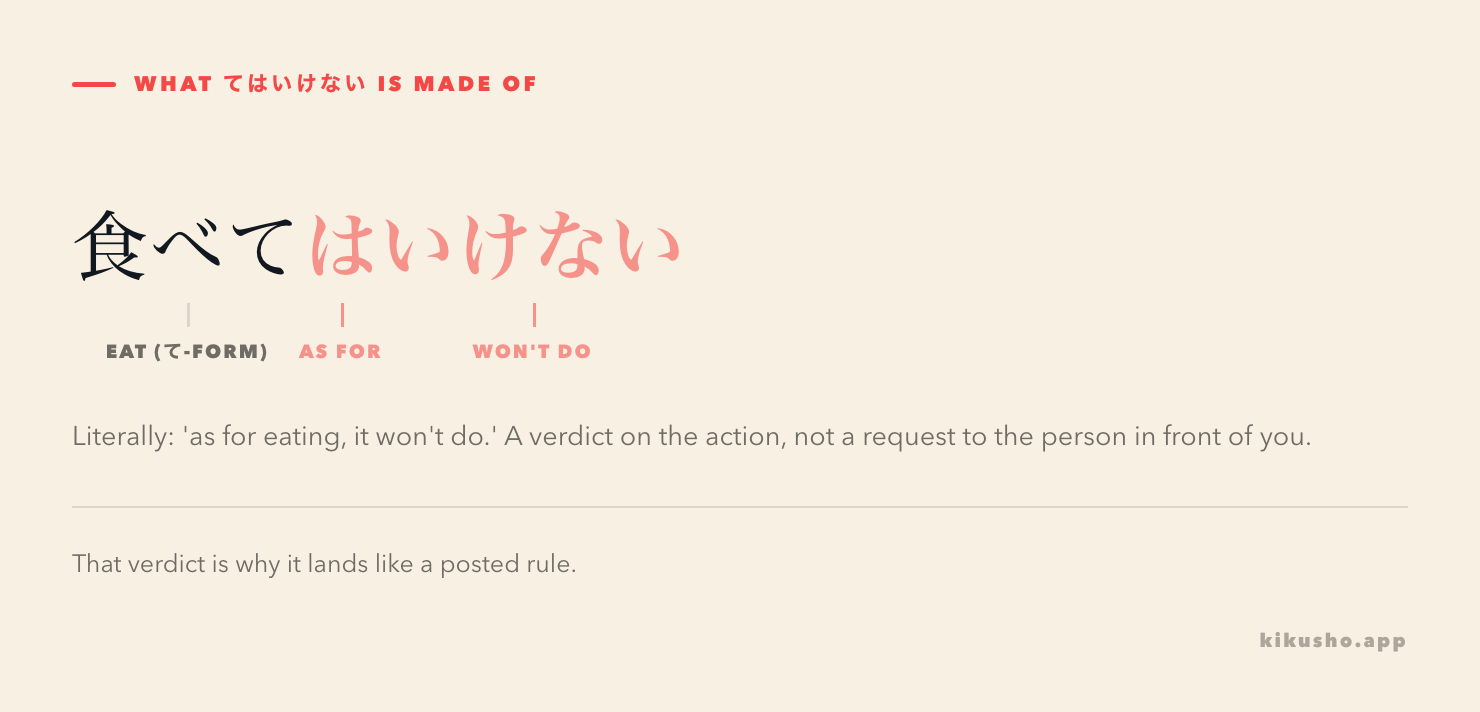
That is the whole reason it reads as a regulation. Grammatically it delivers a verdict on the action, the way a sign or a policy does, rather than asking the listener for anything. The sentence is about the deed, not about the person in front of you. So when the situation calls for a ruling handed down, てはいけない is exactly right, and when it does not, the same words sound stiff.
Polite does not mean soft
The reflex, when a form feels blunt, is to make it more polite, and here that instinct misfires. 食べてはいけません is fully polite. It is also still a rule, because ます changes how respectfully you address the listener, not whether you are handing down a verdict. Politeness and softness are separate dials. You can be maximally polite and completely institutional at once, which is what a public notice is: 芝生に入ってはいけません could not be more courteous, and it is still the park telling you what to do.
Softening a prohibition means changing the construction, not raising the politeness. だめ is casual and ないでください is polite, yet both feel gentler than てはいけません, because both stop pronouncing a rule. One is a personal reaction, the other a request aimed at you. That is why the way out is a different form, not a more formal ending on the same one.
Where you actually meet てはいけない
Its natural home is anywhere a verdict on an action is the point. Posted rules and warnings: 芝生に入ってはいけません, keep off the grass. Workplace and school policy. A parent or a teacher to a child: まだ寝てはいけませんよ, you mustn't sleep yet. In each case the speaker has the standing to set the rule and the listener is expected to take it. Read a Japanese sign, a form or a page of instructions and てはいけません is everywhere, doing the job it was made for.
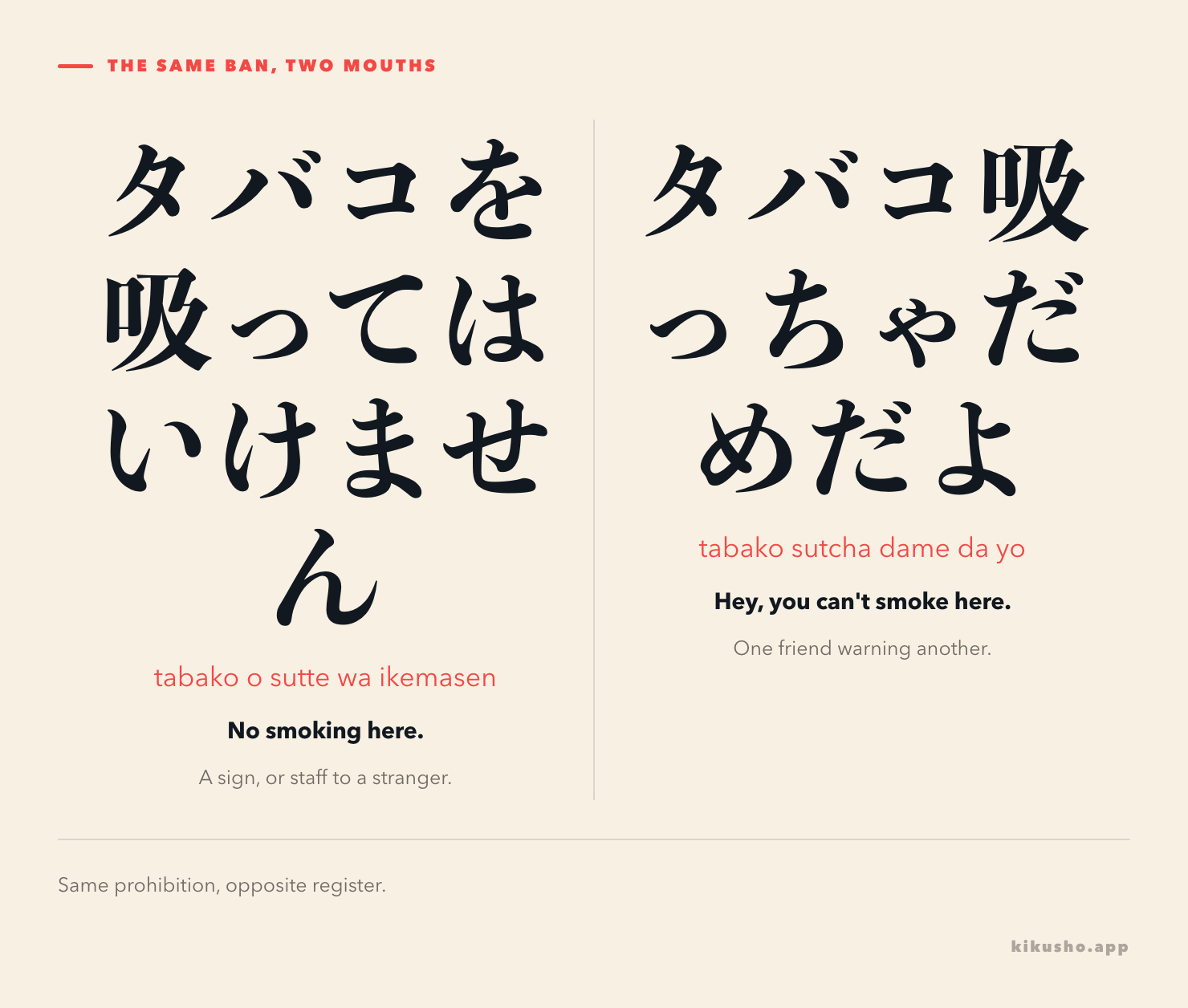
Turn the same ban toward a friend without changing the form and you can hear the seam. 吸ってはいけません to someone you are drinking with sounds like you are reading them the house rules. The information is fine. The posture is wrong.
What you say instead between equals
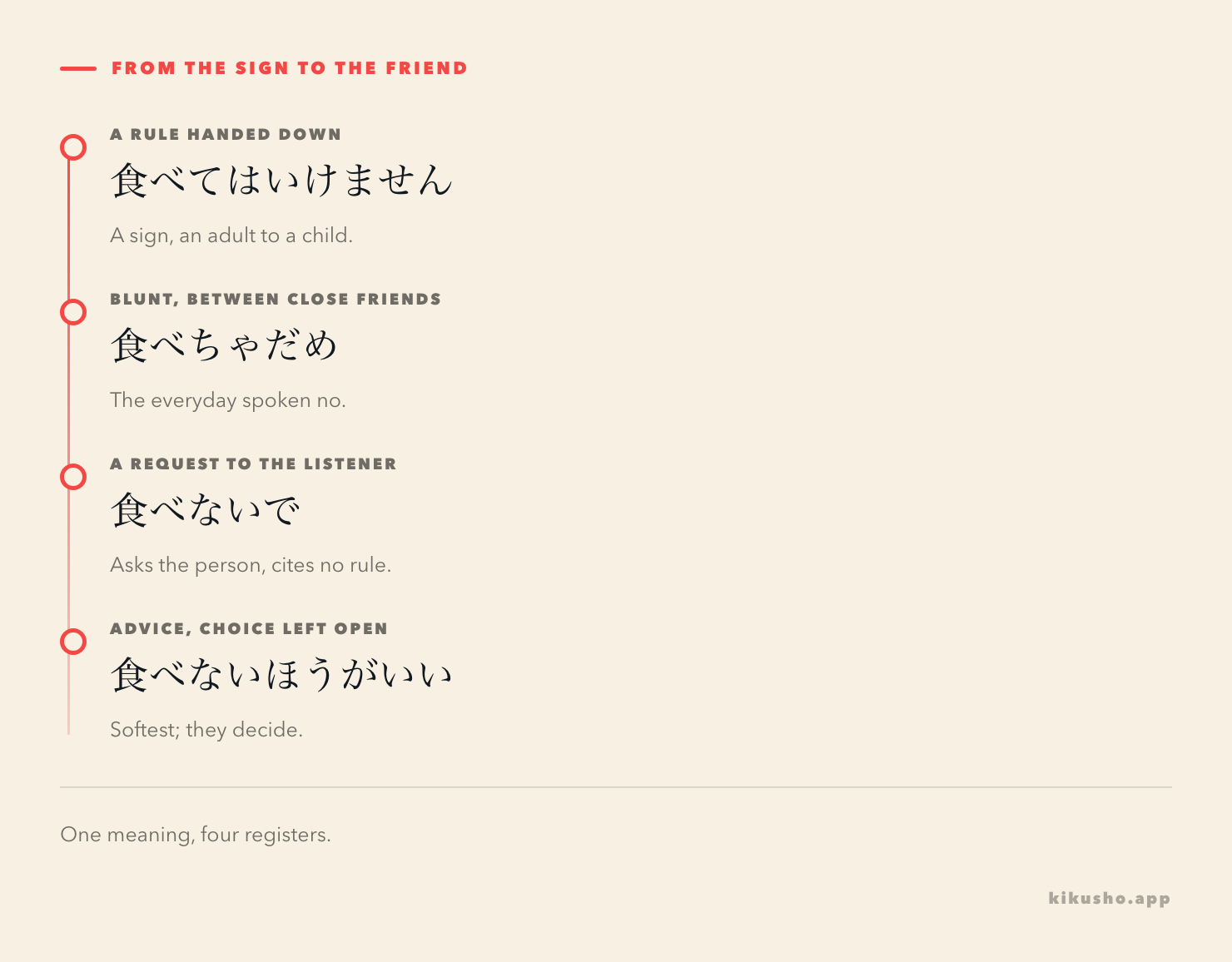
Between friends the ban still gets said, just not like a sign. Three moves cover almost all of it.
First, だめ. Blunt and personal, it is the everyday no between people who are close: 食べちゃだめ, don't eat that; まだ見ちゃだめだよ, no peeking yet. The contracted ちゃ carries the prohibition while だめ takes the place of the stiff いけない.
Second, turn the ban into a request. Rather than ruling the action out, you ask the person not to do it: 食べないで, or politely 食べないでください. This points the sentence at the listener instead of at the rule, which is why it fits between equals. The ないで and ないでください lesson sets that negative request beside the "without doing" use of the same form.
Third, drop the prohibition and give advice. 食べないほうがいい, you'd better not eat it, leaves the decision with them, and a trailing それはちょっと…, that's a bit…, refuses without ever naming a rule. These land softer because they no longer pretend to be rulings.
The register that sorts a sign from a friend is not something a conjugation table can hold, because it lives in who is speaking and where. That is the case for keeping the sentence you met rather than the bare form. Kikusho is built around that habit: capture the 〜てはいけません off a real sign or the ちゃだめ a friend just said, and each card keeps the politeness note next to the reading and meaning, so you review the phrase with the room it belongs to still attached.
The mistake that gives you away
The tell is using てはいけません with someone you are not in charge of. Say 写真を撮ってはいけませんよ to a friend at a gallery and it lands as though you were quoting the regulations, or telling them off; a friend would say 写真だめみたいだよ, looks like no photos, or 撮らないほうがいいよ. Nothing about the form is broken, and you will be understood. It simply casts you as the authority in a room where you hold none, which is a stranger impression to leave than any conjugation slip.
The repair is not more grammar. It is checking who is across from you before you choose the ending, and stepping down from the rule to a request whenever that person is your equal.
Common questions
Is it wrong to use てはいけない with friends?
No. It is grammatically correct and you will be understood. It sounds like you are quoting a rule or telling someone off, because the form passes a verdict on the action rather than asking the person. Between equals, だめ, ないで or ないほうがいい carry the same meaning without that tone.
What is the difference between てはいけない and だめ?
Both forbid an action. てはいけない, or polite てはいけません, reads as a stated rule and belongs on signs, in policies and from an adult to a child. だめ, usually as the contraction ちゃだめ, is the blunt spoken no between people who are close: だめ replaces the stiff いけない while ちゃ carries the prohibition.
How does てはいけない become ちゃだめ?
In speech ては contracts to ちゃ and では contracts to じゃ. So 食べてはいけない becomes 食べちゃいけない, and shorter still 食べちゃだめ; 飲んではいけない becomes 飲んじゃだめ. The いけない or だめ that follows keeps the phrase a prohibition.