On this page
A parent watches a child hesitate over a difficult kanji and says 読んでごらん. The pattern is verb て-form + ごらん: it encourages the listener to try the action, while presenting the speaker as a guide.
That relationship is part of the grammar. The English “try” can sound neutral, but ~てごらん commonly travels from a parent to a child, a teacher to a student, or another person who can naturally take a guiding role. With a boss or teacher, the same wording can sound patronising.
This lesson covers the N3 item てごらん, inventory item g-c0dc9cca5e4e. JLPT Sensei gives verb て-form + ごらん(なさい) and the meaning “try to / look.” JapaneseTest4You independently marks the direction toward a subordinate. Benkyou Mashou's N3 guide also separates the warm invitation from a neutral or upward request. These sites agree on N3, though the JLPT does not publish an exhaustive grammar syllabus.
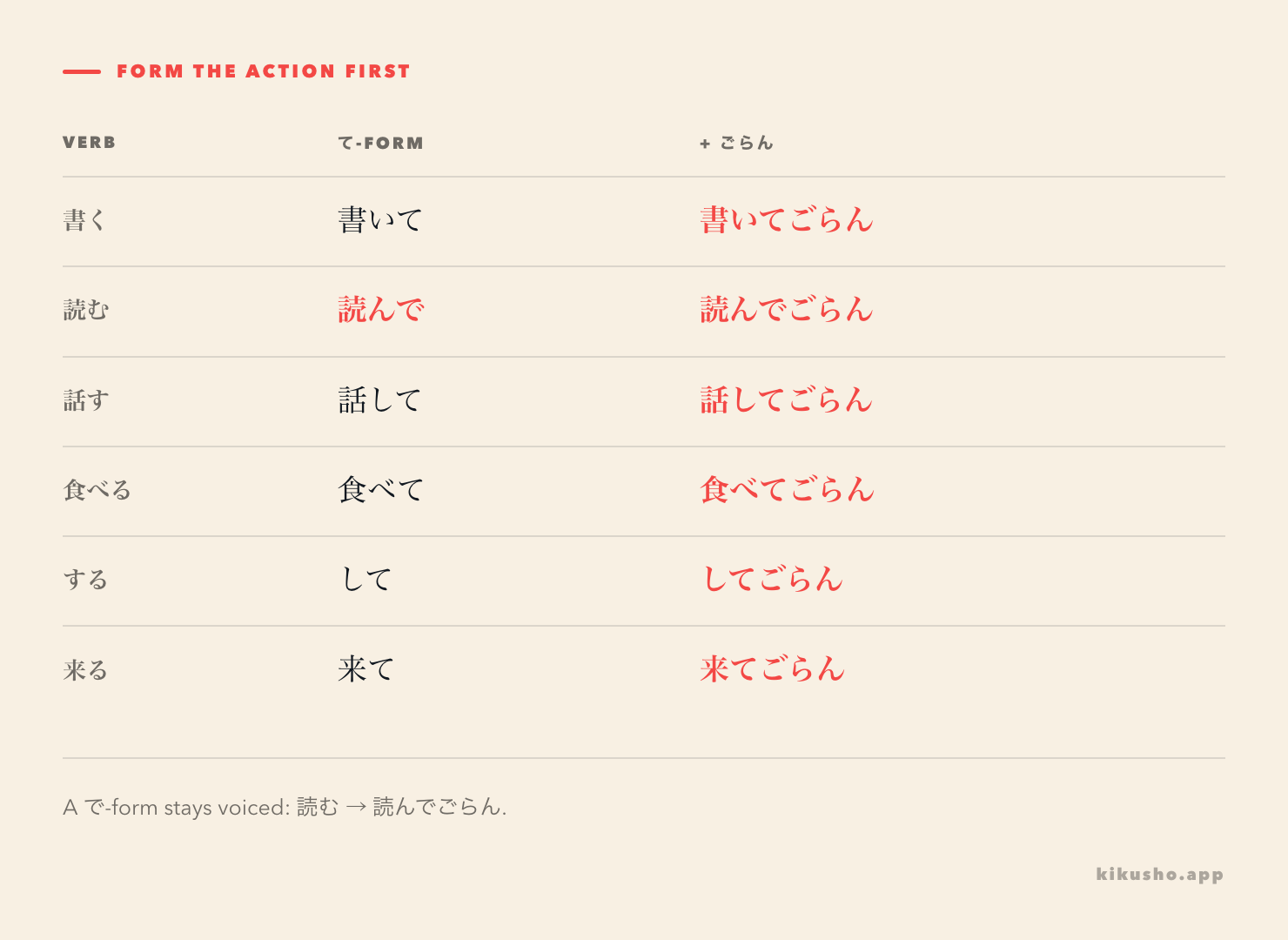
Attach ごらん to the complete て-form
Build the action verb first. A form ending in で stays voiced: 読む → 読んでごらん, not × 読んてごらん. The ending does not change according to the verb group.
| Dictionary form | て-form | With ごらん | Natural prompt |
|---|---|---|---|
| 書く(かく) | 書いて | 書いてごらん | Try writing it. |
| 読む(よむ) | 読んで | 読んでごらん | Try reading it. |
| 話す(はなす) | 話して | 話してごらん | Try talking. |
| 食べる(たべる) | 食べて | 食べてごらん | Try eating it. |
| する | して | してごらん | Try doing it. |
| 来る(くる) | 来て(きて) | 来てごらん(きてごらん) | Try coming over. |
The complete phrase addresses a listener:
この漢字を読んでごらん。
この かんじを よんでごらん。
Try reading this kanji.
The speaker expects the other person to attempt the reading. A translation such as “Have a go” can preserve the encouraging tone, but the Japanese still carries a direction from speaker to listener.
The speaker takes a guiding position
The pattern often feels warm because a guide is helping someone take the next step. Warmth does not erase the social direction.
もう一度やってごらん。きっとできるよ。
もう いちど やってごらん。きっと できるよ。
Try it once more. I am sure you can do it.
A coach may say this after a learner hesitates. A parent can offer food with まず一口食べてごらん, “Try one bite first.” An older sibling may say 窓の外を見てごらん, “Look outside the window.” In each case, the speaker directs attention or action and expects the listener to discover something.
Among close equals, tone and shared roles can make ~てごらん playful or affectionate. It is still a marked choice. Saying it to a customer, manager or teacher can put the speaker above the listener and sound condescending. A soft voice does not automatically repair that mismatch.
Use the relationship test before the dictionary gloss: Can this speaker naturally guide this listener here? If the answer is uncertain, choose a neutral or polite alternative.
~てみる describes a trial; ~てごらん directs the listener
Both constructions can contain an idea of trying, but they organise the scene differently.
| Form | Main job | Example | Who tries? |
|---|---|---|---|
| Vてみる | describe an exploratory trial | 私も読んでみます。 | the grammatical subject, here the speaker |
| Vてごらん | encourage or direct someone to try | 読んでごらん。 | the listener |
| Vてみてください | politely invite someone to try | 読んでみてください。 | the listener |
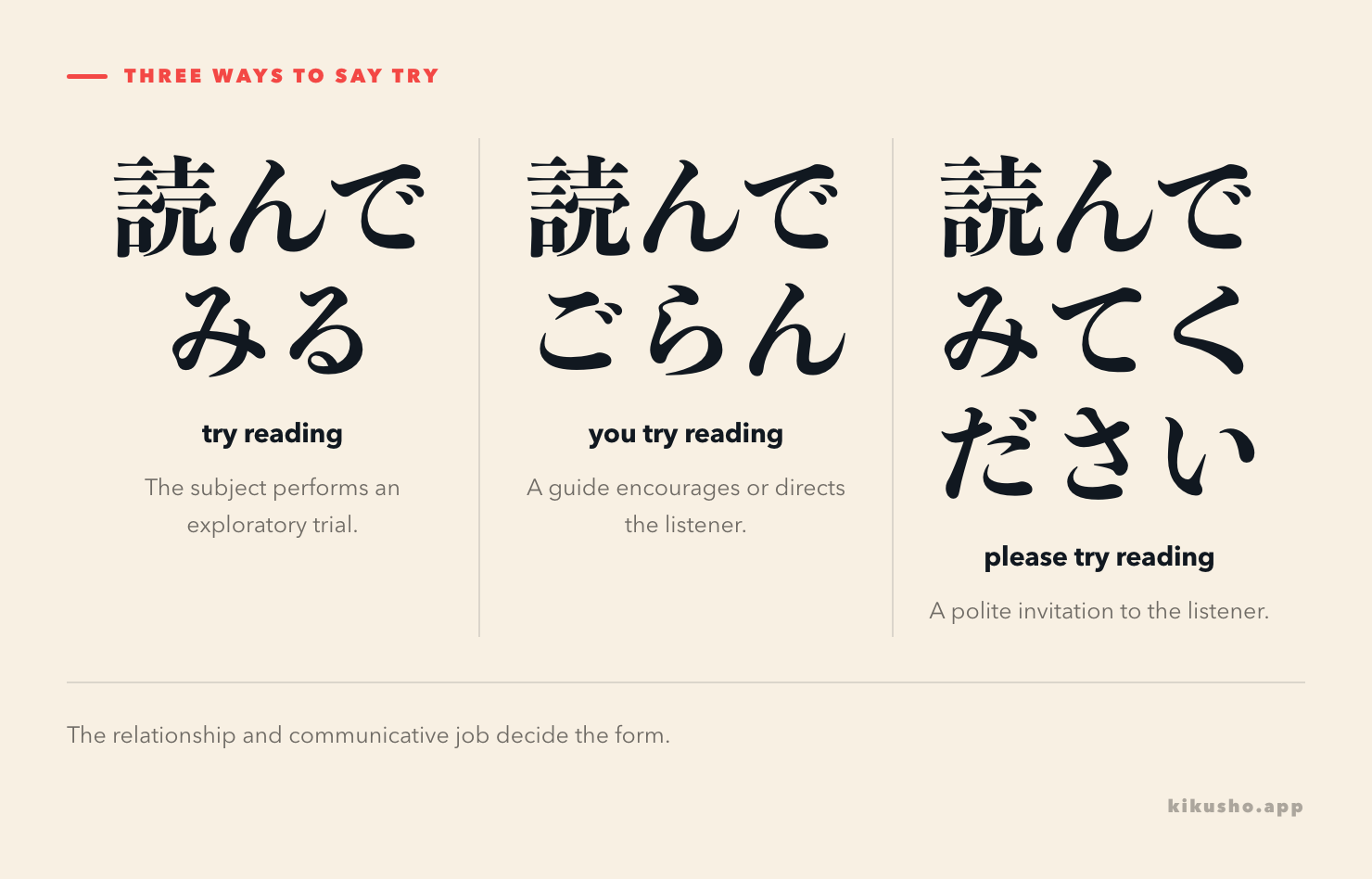
私も食べてみます means “I will try eating it too.” The speaker describes their own experiment. 食べてごらん turns toward another person: “You try it.” The ~てみる lesson develops the trial meaning and its past forms.
When the listener deserves polite treatment, このアプリを使ってみてください is a safer invitation to try the app. It combines the exploratory ~てみる with the polite request pattern ~てください. It does not cast the speaker as a parent or teacher.
ごらんなさい makes the direction more explicit
Adding なさい gives ~てごらんなさい. It can still be encouraging, but it makes the instruction clearer and often firmer:
その言葉を辞書で調べてごらんなさい。
その ことばを じしょで しらべてごらんなさい。
Try looking that word up in the dictionary.
This suits a teacher assigning the next learning step or a parent telling a child what to attempt. It is not a polite upgrade for speaking to a superior. The extra syllables strengthen the guiding direction; they do not reverse it.
Compare the broader command 調べなさい, “Look it up.” The version with ~てごらんなさい frames the action as something the listener should try and learn from. The ~なさい lesson covers that authoritative instruction separately.
ご覧ください is a different construction
The spelling ご覧 appears in respectful language, but that fact does not make every expression containing ごらん respectful to the listener.
| Expression | Meaning | Typical direction |
|---|---|---|
| 見てごらん | Look / try looking. | guide toward learner or child |
| 読んでごらん | Try reading it. | guide toward learner or child |
| ご覧ください | Please look. | respectful request to customer, visitor or superior |
In ご覧ください, ご覧 is the honorific equivalent of 見る in an established polite request. It does not attach productively after another verb's て-form. The Japan Foundation's Irodori Lesson 4 grammar notes give こちらをご覧ください as service language meaning “Please look here.”
Therefore この漢字を読んでごらん and こちらをご覧ください solve different problems. The first encourages a listener to attempt reading. The second respectfully asks someone to look. Do not replace one with the other merely because both can involve seeing.
Keep the relationship on the card
Consider an advice sentence:
分からなければ、先生に聞いてごらん。
わからなければ、せんせいに きいてごらん。
If you do not understand, try asking the teacher.
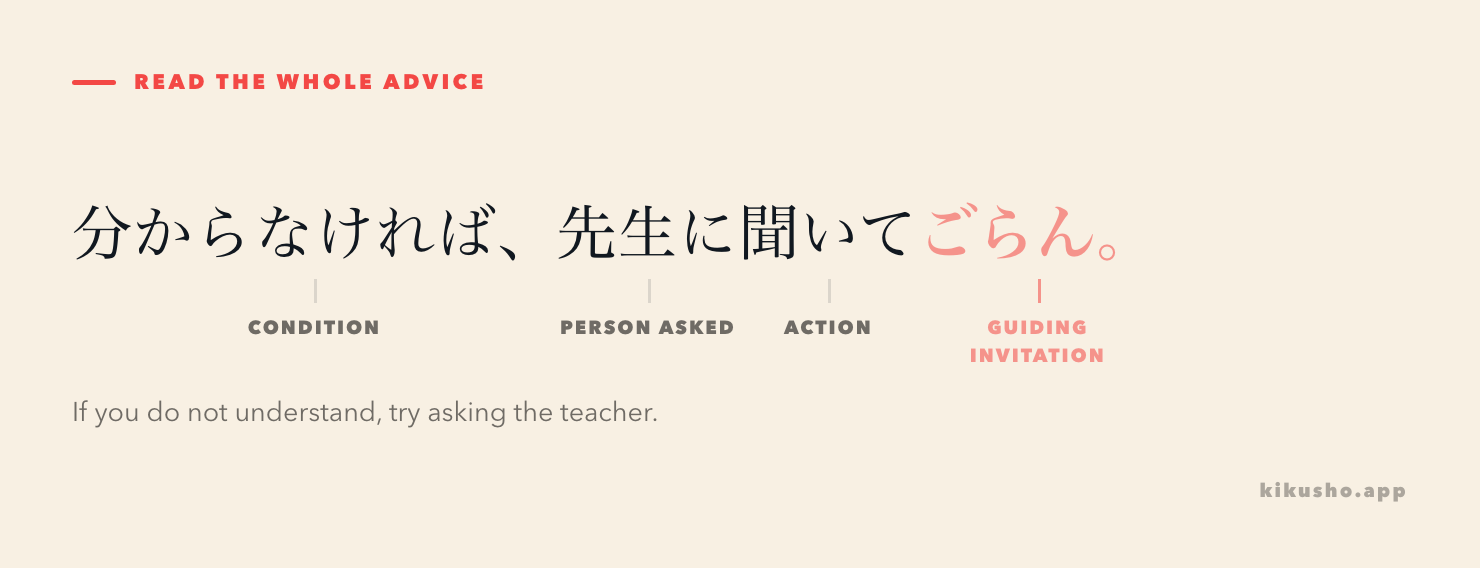
The advice does not say that the speaker will ask. 先生に聞いて names the listener's next action, and ごらん presents it from a guiding position. Removing the first clause would keep the grammar intact, but the condition explains why the suggestion helps.
When a drama subtitle says やってごらん, capture the line before it in Kikusho too. A card glossed only as “try it” loses whether a parent is encouraging, a coach is directing, or an equal is teasing. Keep who spoke, who was addressed and what action followed; that social frame is what lets you retrieve the expression accurately later.
Practice: form the action and read the relationship
Work through all six prompts in order. Keep the speaker, listener and requested action visible until you reach the answer block.
Question 1 — parent and child. A parent points to a kanji and encourages a child to try reading it. Select the line that delivers this encouragement.
- A. この漢字を読んでごらん。
- B. この漢字をご覧ください。
- C. この漢字を読みます。
Question 2 — manager and employee. You invite your manager to try using a new tool. Select the wording that preserves polite distance.
- A. この道具を使ってごらん。
- B. この道具を使ってごらんなさい。
- C. この道具を使ってみてください。
Question 3 — sentence composition. Change もう一度やる into an encouraging direction meaning “Try it once more.” Use ~てごらん.
Question 4 — sentence composition. Complete the advice with the correct form of 聞く: 分からなければ、先生に__。
Question 5 — sentence order. Arrange every chunk once to make a teacher's direction meaning “Try looking that word up in the dictionary.”
その言葉を / 辞書で / 調べて / ごらんなさい
Question 6 — text grammar. Read the pair below. Who is expected to try in each sentence, and what difference does the ending create?
- 私もこの本を読んでみます。
- この本を読んでごらん。
Answers and explanations
Answer 1. A, この漢字を読んでごらん。 読む → 読んで supplies the complete action form, and ごらん encourages the child to attempt it. B respectfully says “Please look at this kanji,” while C states that someone reads or will read it.
Answer 2. C, この道具を使ってみてください。 It politely invites the manager to test the tool. A and B place the speaker in a guiding or authoritative position toward the manager; ごらんなさい makes that direction more explicit rather than more deferential.
Answer 3. もう一度やってごらん。 やる changes to やって, then takes the unchanged ending. The sentence addresses the person who should make the new attempt.
Answer 4. 聞いてごらん completes 分からなければ、先生に聞いてごらん。 聞く → 聞いて uses the regular く → いて change. The condition explains when asking the teacher would be useful.
Answer 5. その言葉を辞書で調べてごらんなさい。 (その ことばを じしょで しらべてごらんなさい). その言葉を marks what to investigate, 辞書で gives the tool or means, and 調べてごらんなさい supplies the directed trial.
Answer 6. In sentence 1, the speaker plans to try reading the book; ~てみます describes that person's exploratory action. In sentence 2, the listener is invited or directed to try reading it; ~てごらん also presents the speaker as a guide. The shared English word “try” does not preserve that difference by itself.
Common questions
What does ~てごらん mean?
It encourages or directs the listener to try an action: 読んでごらん means “Try reading it.” The speaker normally sounds like a parent, teacher, mentor or another person guiding the listener.
How do you form ~てごらん?
Change the action verb to its complete て- or で-form, then add ごらん. 書く becomes 書いてごらん, and 読む becomes 読んでごらん. ごらんなさい gives the direction a more explicit, often firmer ending.
What is the difference between ~てごらん and ~てみる?
~てみる describes someone trying an action to discover the result. ~てごらん addresses a listener and encourages that person to try it. 私も読んでみます means “I will try reading it too”; 読んでごらん means “You try reading it.”
Can I use ~てごらん with my boss or teacher?
Usually not. Its guiding stance can sound patronising when directed upward. ~てみてください can politely invite someone to try something, while ご覧ください is the established respectful expression meaning “please look.”