On this page
忘れてはいけないから、予定をメモした takes action before a feared problem: “I wrote down the appointment so I would not forget.” メモを探している場合じゃない。もう出発しよう rejects what is happening now: “This is no time to be looking for the note. Let's leave.” Both warn, but they point in opposite directions through time.
The first looks ahead and prevents X. The second looks at an activity already under way or being considered and says that a more urgent priority must replace it.
Ask whether X is a risk or the wrong activity now
This lesson teaches inventory items g-957cb5cafa7c, てはいけないから, and g-ce8754d6b7d6, ている場合じゃない(ているばあいじゃない). The decision between them begins with the role of X.
| Question | Xてはいけないから、Y | Xている場合じゃない |
|---|---|---|
| What is X? | an event the speaker wants to prevent | an activity judged unsuitable now |
| Where is the response? | Y gives the precaution | often in the next sentence or context |
| Time direction | act now before X happens | stop or reject X now |
| Typical translation | so that X does not happen; in case X happens | this is no time to be doing X |
| Example | 遅れてはいけないから、早く出る | 急いでいるのに、休んでいる場合じゃない |
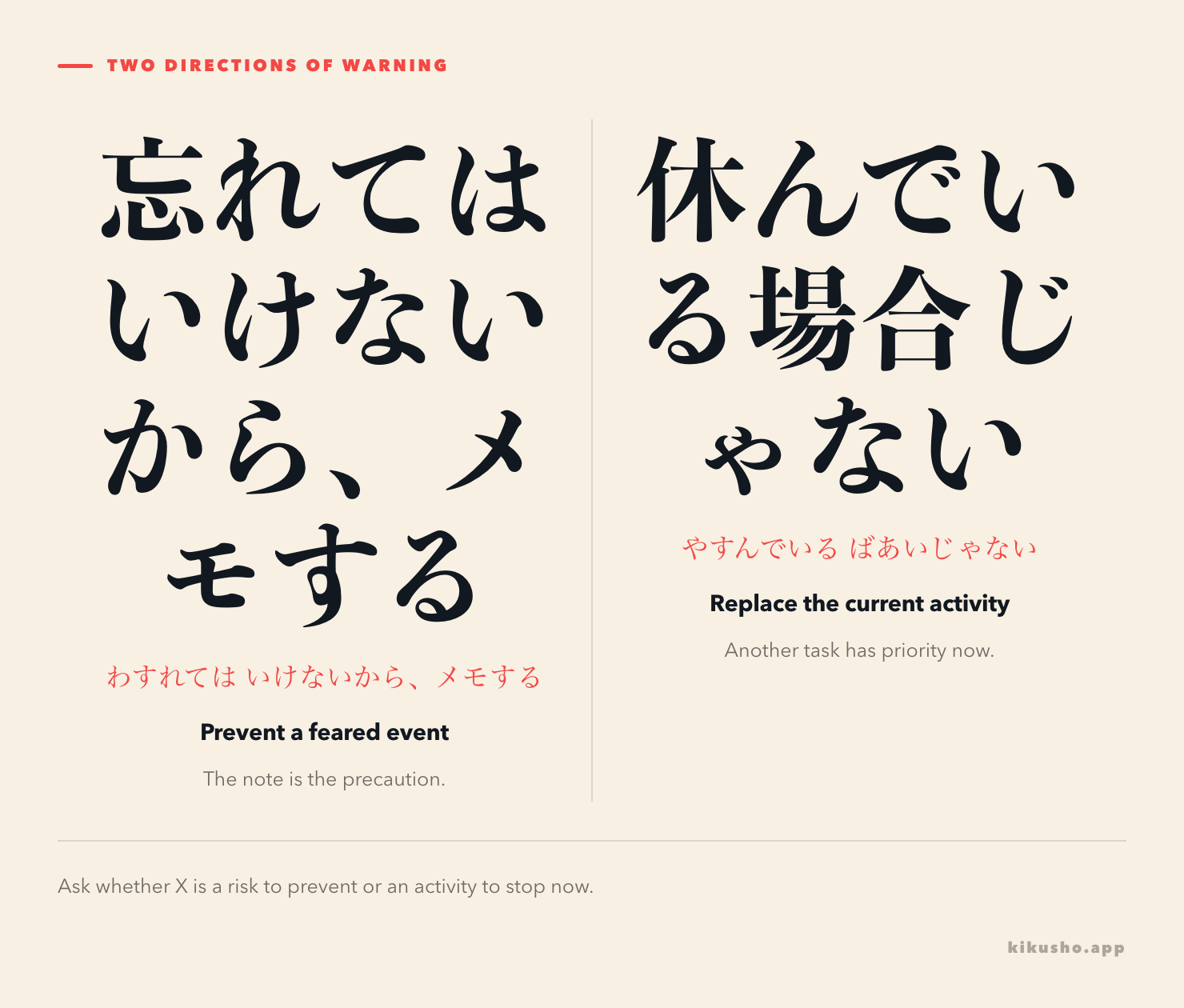
Both patterns contain a negative judgment, but neither is merely a stronger version of the other. The conditional ては lesson supplies the prerequisite distinction between an unfavourable condition and a direct prohibition.
てはいけないから makes the risk a reason for precaution
Build the verb's て-form, then add はいけないから. A verb whose て-form ends in で keeps it: 忘れる → 忘れてはいけないから, 転ぶ → 転んではいけないから.
道に迷ってはいけないから、地図を保存しておいた。
みちに まよっては いけないから、ちずを ほぞんしておいた。
I saved the map in advance so I would not get lost.
The speaker does not issue a rule against getting lost. Getting lost is an unwanted possibility, and saving the map is the preventive response. JLPT Sensei's N3 entry describes the pattern as preventing a negative situation. MaruMori independently analyzes the first clause as “X would not do, so Y.”
The subject of the feared event need not be the person taking the precaution:
子どもが起きてはいけないから、ドアを静かに閉めた。
こどもが おきては いけないから、ドアを しずかに しめた。
I closed the door quietly so the child would not wake up.
Here the child might wake, while the speaker closes the door. That subject split is a strong clue that 起きてはいけない is not functioning as a command to the child.
から can be replaced by ので when the reason is presented more softly: 子どもが起きてはいけないので、静かに話しましょう. The preventive relationship remains. The following clause may state an action already taken, a suggestion, an instruction, or a plan.
といけないから often frames the same feared possibility
The inventory item names てはいけないから, but dictionary form + といけないから is a close and common neighbour.
雨が降るといけないから、洗濯物を中に入れよう。
あめが ふると いけないから、せんたくものを なかに いれよう。
Let's bring the laundry inside in case it rains.
電車に乗り遅れるといけないから、十分早く出よう。
でんしゃに のりおくれると いけないから、じゅっぷん はやく でよう。
Let's leave ten minutes early so we do not miss the train.
MaruMori notes a somewhat more speaker-centred “I do not want X to happen” nuance for といけないから, while also treating the variants as very close. Do not invent a rigid one-to-one translation. Context, the kind of risk, and ordinary collocation often decide which version sounds natural.
The simple prohibition remains a separate prerequisite:
- ここで写真を撮ってはいけない。 Taking photographs here is forbidden.
- 写真がぼけてはいけないから、三脚を使った。 I used a tripod so the photograph would not blur.
The second sentence contains a consequence to avoid and a precaution that answers it. The first states a rule and stops.
ている場合じゃない rejects the current priority
Attach 場合じゃない to Vている. The uncontracted 場合ではない carries the same central meaning with a more measured surface.
締め切りは一時間後だ。休んでいる場合じゃない。
しめきりは いちじかんごだ。やすんでいる ばあいじゃない。
The deadline is in an hour. This is no time to be resting.
客がもう来る。飾り方で迷っている場合ではありません。
きゃくが もう くる。かざりかたで まよっている ばあいでは ありません。
The guests are about to arrive. This is no time to be hesitating over the decorations.
日本語NET defines the pattern as advising someone to stop what they are doing and do something else. 日本の言葉と文化 likewise gives N3 examples in which a deadline or goal makes the present activity inappropriate. The criticism can target the listener, a group including the speaker, or the speaker alone:
ここで諦めている場合じゃない。もう一度試してみよう。
ここで あきらめている ばあいじゃない。もういちど ためしてみよう。
This is no time to give up here. Let's try once more.
Vている need not describe a visible physical action. It can name hesitation, worrying, crying, joking, resting, or remaining undecided. What matters is that the speaker treats that state or activity as a poor use of the present moment.
The second clause reveals which warning you heard
The two patterns make different discourse shapes.
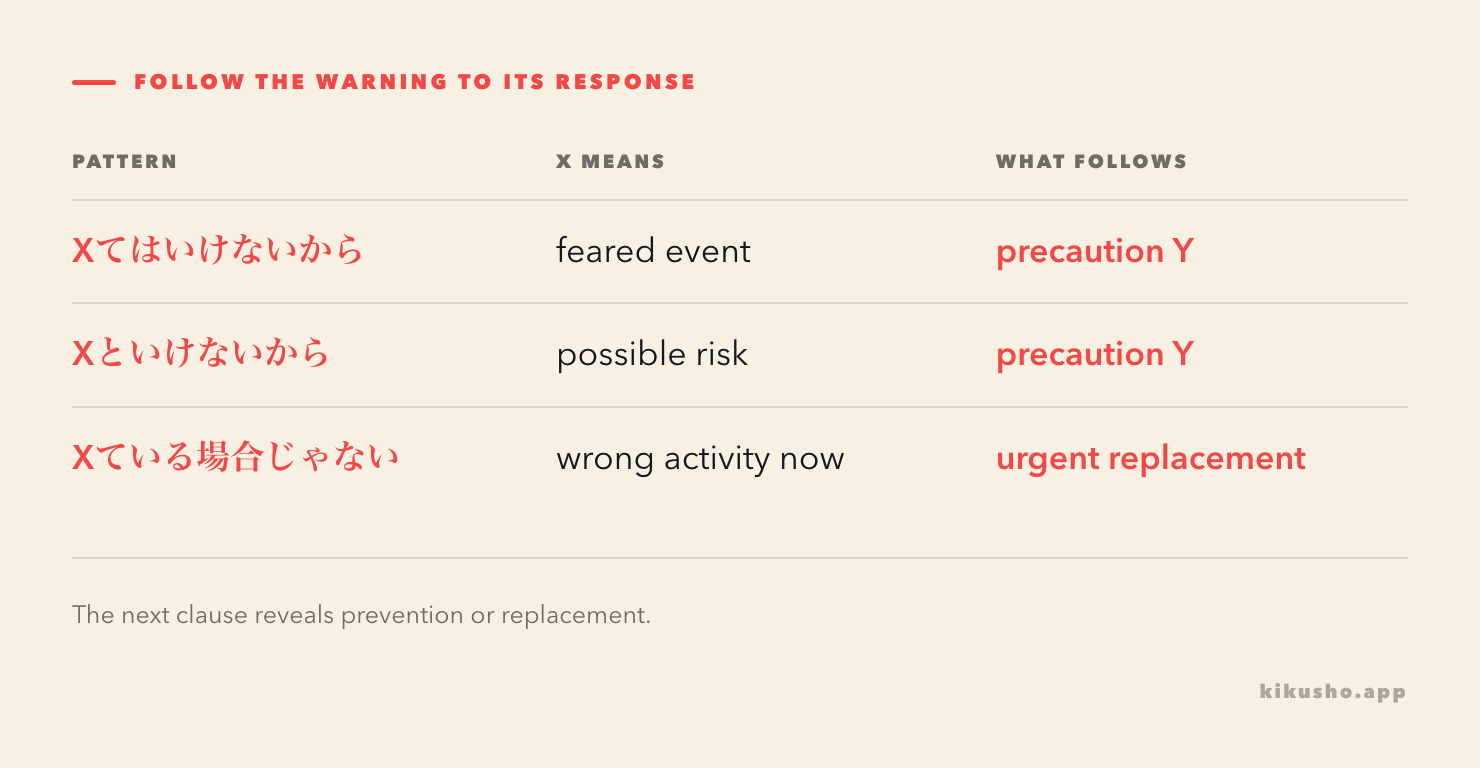
With てはいけないから, the following material normally supplies a precaution:
資料をなくしてはいけないから、コピーを取っておこう。
しりょうを なくしては いけないから、コピーを とっておこう。
Let's make a copy so we do not lose the document.
With ている場合じゃない, the context supplies a competing priority:
資料が見つからない。責任を押しつけ合っている場合じゃない。まず全員で探そう。
しりょうが みつからない。せきにんを おしつけあっている ばあいじゃない。まず ぜんいんで さがそう。
The document is missing. This is no time to blame one another. First, let's all look for it.
That test prevents two common errors. First, ている場合じゃない does not mean that the activity is permanently forbidden; resting may be sensible after the deadline. Second, てはいけないから does not necessarily rebuke the person named before it; the subject may be a child, weather event, machine, or result that the speaker simply hopes to avoid.
Clause boundaries can change the reading
Do not treat every nearby てはいけない and から as the preventive pattern. Compare:
危ないから、この機械に触ってはいけない。
あぶないから、この きかいに さわっては いけない。
Because it is dangerous, you must not touch this machine.
Here 危ないから is the reason, and 触ってはいけない is the main prohibition. The order is reason → rule.
機械が止まってはいけないから、予備の電源を用意した。
きかいが とまっては いけないから、よびの でんげんを よういした。
I prepared a backup power supply so the machine would not stop.
Here 機械が止まってはいけないから is the reason, and 用意した is the precaution. The order is feared event → response. Particles, subjects, and the main verb reveal the boundary more reliably than an English keyword.
Preserve the response when you save an example
If you capture only 忘れてはいけないから, the card loses the preventive action and may look like an unfinished prohibition. Keep 予定をメモした with it. For ている場合じゃない, retain the pressure that changes the priority, such as 締め切りは一時間後だ. Those surrounding clauses make the contrast retrievable during review.
Kikusho lets you edit the word, reading, meaning, register note, and example before the card enters its review schedule. A note such as “feared event → precaution” or “current activity → urgent replacement” is more useful here than translating both patterns with a vague “shouldn't.”
Practice: identify the direction of the warning
Answer all six questions before reading the explanations.
Question 1 — grammar choice. You saved a map so you would not get lost. Which sentence expresses that precaution?
- A. 道に迷っている場合じゃないから、地図を保存した。
- B. 道に迷ってはいけないから、地図を保存した。
- C. 道に迷ってもいいから、地図を保存した。
- D. 道に迷わない場合じゃないから、地図を保存した。
Question 2 — text grammar. The deadline is in thirty minutes, but Ken is playing a game. Complete the warning: 締め切りまであと三十分だ。ゲームをして__。
- A. はいけないから
- B. いる場合じゃない
- C. もいいから
- D. いる場合だ
Question 3 — interpretation. In 子どもが起きてはいけないから、ドアを静かに閉めた, who performs the preventive action, and what event is being avoided?
Question 4 — sentence composition. Arrange the chunks to say “Let's take an umbrella in case it rains.”
- 傘を持って行こう
- 雨が
- 降るといけないから
Question 5 — grammar choice. Which sentence is a direct prohibition whose reason comes first, rather than the N3 preventive pattern?
- A. 危ないから、この機械に触ってはいけない。
- B. 機械が止まってはいけないから、予備の電源を用意した。
- C. 忘れてはいけないから、予定をメモした。
- D. 雨が降るといけないから、窓を閉めた。
Question 6 — passage completion. Fill the two gaps with one option.
発表はもうすぐ始まる。資料をなくして( )、今のうちに人数分コピーしよう。小さな字体について議論して( )。まず内容を確認しよう。
- A. はいけないから/いる場合じゃない
- B. いる場合じゃない/はいけないから
- C. もいいから/いる場合だ
- D. はいけない/いる場合だから
Keep your selections fixed before opening the answer block.
Answers and explanations
Answer 1. B, 道に迷ってはいけないから、地図を保存した. Getting lost is the feared event; saving the map is the precaution. A rebukes someone for currently being lost, which does not fit the stated purpose. C permits getting lost. D does not form either target pattern.
Answer 2. B, いる場合じゃない. The game is the present activity rejected because the deadline has priority. A would leave ゲームをしてはいけないから waiting for a following result and would frame playing as the reason for a precaution. C grants permission, and D affirms that this is the occasion to play.
Answer 3. The speaker closes the door, and the event being avoided is the child waking up. The subjects differ: 子どもが belongs to 起きる, while the omitted subject of 閉めた is understood from context. This is prevention, not an order addressed to a sleeping child.
Answer 4. 雨が降るといけないから、傘を持って行こう。 (あめが ふると いけないから、かさを もっていこう). 降るといけないから presents rain as the unwanted possibility; the volitional 持って行こう proposes the precaution.
Answer 5. A. 危ないから gives the reason, and the main clause 触ってはいけない forbids touching. In B, C, and D, the unwanted event plus いけないから forms the reason for a preventive response.
Answer 6. A, はいけないから/いる場合じゃない. Losing the materials is a future risk that motivates copying them. Debating the small typeface is the current activity rejected in favour of checking the content. Reversing the forms would reverse those two discourse roles.
A warning can protect without commanding
The subject split in 子どもが起きてはいけないから、ドアを閉めた exposes something an English “shouldn't” translation hides. Japanese can mark an event as unacceptable without issuing an instruction to its subject. The grammar becomes clearer when you follow responsibility across the comma: who might undergo X, who performs Y, and which action can still change the outcome.
OpenAI Codex performed this lesson's AI editorial check, comparing attachment, clause boundaries, readings, translations, the risk-versus-priority contrast, and all six exercises with the sources above. This review is not human or native-speaker certification.
Common questions
What does てはいけないから mean?
In this N3 pattern, Xてはいけないから presents X as a feared or undesirable event and gives it as the reason for a precaution: 忘れてはいけないから、メモした means “I wrote it down so I would not forget.”
What does ている場合じゃない mean?
Vている場合じゃない says the present activity is inappropriate because something else is more urgent. のんびりしている場合じゃない means “This is no time to be taking it easy.”
Is 場合じゃない different from 場合ではない?
The core meaning is the same. じゃない is the ordinary spoken contraction of ではない; the uncontracted form suits more measured or formal speech.
Are these the same as a simple prohibition?
No. Vてはいけない by itself forbids V. In Vてはいけないから、Y, the feared event motivates precaution Y. Vている場合じゃない instead tells someone to stop or reconsider an activity because another demand takes priority.